Monday, 30 January 2017

Stumped

About five years ago a rather large tree of Common Lime, Tilia x europaea, growing on Byfield's playing fields, was cut down for, as far as I could see, no obvious reason. It left a stump about one metre high.
It would inevitably be attacked by fungi; it was just a matter of time and on a visit today it could be seen that the attack was well under way. The species involved was Trametes versicolor, aka Coriolus versicolor. The fruit body is often distinctly marked with concentric rings in brown, cream and buff , giving it the common name of Turkey Tail, but it is very variable.

Trametes versicolor attacks a tree stump. Bufield,
Northants. 30 January, 2017

In the specimens in question the fruiting bodies were fundamentally grey but with a distinct edging of white. It is extremely common and could be regarded as the most widespread of all Britain's macro-fungi clearly playing a major role in the decomposition of many woodland trees.
Its common name of Turkey-tail is often appropriate but
not in this case.


But chemicals contained within this fungus are also under investigation for the prevention of cancer recurrence.
On a completely different issue I noticed that the berries of Stinking Gladdon, Iris foetidissima, growing nearby, appeared to be untouched. Although we have only had one snowfall this January there have been some very sharp frosts.
Stinking Gladdon, aka roast Beef Plant. Byfield, Northants.
30 January, 2017
The berries of this iris are, with their bright orange-red colour, clearly designed to attract birds and this dispersal strategy seems very effective, with plants widely scattered both in Byfield and in Daventry. Nevertheless it seems clear that these berries, frosts or no frosts, are only taken after more palatable options have been exhausted. In Northamptonshire the plant is best regarded as a neophyte, in other words a plant which, though originally alien, has arrived and taken on a wild state since 1500 CE. Though a neophyte in our county it is presumed native in Southern Britain where it occurs on well-drained calcareous soils usually near the sea.

Tuesday, 24 January 2017

Alders

Warning: unless you enjoy  mind-numbing tedium, please leave this blog immediately!
Britain's native alder is the rather sticky-leaved Alnus glutinosa. It is widespread in our county, growing beside rivers and streams and is also frequent in wet woodlands, where it produces its catkins from February through to early April. Its seeds are interesting because they contain air-tight cavities and these, together with an oil protecting them from wet, allow them to float unharmed throughout the winter to germinate on mud or damp soil in the spring.
The Italian Alder, Alnus cordata, is widely planted both as a street tree and in gardens and in urban areas it is perhaps the commonest alder. Its flowering times are similar to those of our native alder but the species is rarely self-sown. Perhaps our climate is too far removed from its home in southern Italy and Corsica.
The third species likely to be encountered is the exceptionally hardy Grey Alder, Alnus incana. I have certainly seen it growing beside streams in, for example, Byfield, but its habit of suckering makes it a potential nuisance in gardens. However, it flowers early with its catkins appearing in January or even December, so when I saw an alder in Daventry today I immediately suspected, as it bore hundreds of catkins, that it was this species. But... 
Alder catkins. Daventry, 24 January, 2017
What was I looking at? Perhaps it wasn't  A. incana at all; the trunk just wasn't right; the word 'incana' means hoary or grey, and the trunk I photographed seemed at best only slightly grey-ish. Furthermore this specimen showed no signs of suckers - and yet the male catkins were present and obvious.
Did the female catkins offer a clue? Only last year's 'cones' were to be found and they were of no obvious help but when I gave them a tap a few seeds fell out; they were flat and wrinkled, rather than the smooth and plump propagules I might expect. From this I concluded that the trees - and there were several in the area - were probably hybrids, perhaps A. glutinosa x A. incana, otherwise referred to as A. x pubescens.
Last year's female 'cones, now dry and hard. Daventry, 24 January, 2017
Does all this matter? Probably not (but at least it kept me from grinding my teeth over the latest choleric outpourings of the Daily Mail and surely that has to be 'a good thing').
One interesting point is perhaps worth making: Italian Alder is host to an aphid, Crypturaphis grassii. It is a distinctively coloured insect found on the foliage of this species and nowhere else, and since its first recording in 1998 is rapidly spreading across Britain. If it turns up on this tree, that will be conclusive. So aldermen/women, watch this space.


Sunday, 22 January 2017

Boddington Reservoir

It has been some months since I visited Boddington Reservoir but yesterday, finding myself in nearby Byfield with an hour or so to kill, I paid the area a visit. The reservoir itself was about two-thirds frozen over with a couple of dozen Canada Geese, Branta canadensis, cruising around the ice-free area. I decided to give the reservoir itself a miss and instead strolled along the west bank of the main feeder stream which comes in from the north. Unsurprisingly it too was frozen over and offered little of obvious interest.
A small rivulet feeds Boddington Reservoir. 22 January, 2017

On the banks grew teasels, Dipsacus fullonum, the prickly seed-heads by now stripped of seeds, probably by Goldfinches or a congeneric species.
Teasels found a home on the banks. 22 January, 2017
A couple of metres away grew Lesser Burdock, Arctium minus. The two plants may appear superficially similar but differ in important ways. The seeds of the teasel, as suggested, are distributed largely by birds whereas the seed-heads of burdock cling to the coats of wild animals and, as most children soon learn, by us, and may be carried for several kilometres before becoming dislodged. In fact the two plants belong to separate families, the teasels in the Dipsacaceae (in old books, Dipsaceae) and the burdock in the Daisy Family, Asteraceae (old books, Compositae). Both are valuable to insects for the nectar yielded by their flowers.
Burdocks too found it a congenial home. 22 January, 2017
I pressed on, passing a rather fine oak and, a little beyond, a wind turbine, its blades gently swishing. Except for the occasional car on the nearby road, all was silent. For me the structure is an impressive feature and whilst accepting that, in the wrong place, these turbines can be an eyesore, I feel that this site could have accommodated one or maybe two more.
Would an extra turbine have done any harm? Near Boddington, Northants.
22 January, 2017
A little further on, and for no apparent reason, the ice on the feeder stream disappeared. A kingfisher, Alcedo atthis, had been taking advantage of this open water but flashed away in a blur of startling blue as I approached. In severe weather these birds can face real hardship and, although a few years ago newspapers carried a photograph of a kingfisher diving through a hole in the ice, these frozen conditions often lead to high mortality rates. Hopefully this severe spell will come to an end before a complete freeze-up occurs. Tradition has it that halcyon days are the days when the kingfisher mates and I had assumed that the word halcyon was derived from the word Alcedo; etymology supports this idea but only in a rather oblique way.
This had me puzzled. Near Boddington, Northants. 22 January, 2017

Another hundred yards or so brought me to a simple bridge. I had been aware for some years that a nature reserve existed in the area but, had it not been for the sign attached to the bridge, I would have been unaware of its location. I am still not much clearer as this 'nature reserve' appears on no maps nor could I find any mention of it on the web pages of Natural England (which is the successor to English Nature).

Owl box in oak tree. Near Boddington, Northants. 22 January, 2017
An owl nesting box in an oak tree was the only obvious sign of conservation work. As for wildlife, most creatures were sensibly hidden away with only the empty shell of a Brown-lipped Snail, Cepaea nemoralis, remaining to hint at the area's possibilities.
There was no one at home. Shell of Brown-lipped Snail. 22 January, 2017
Time to turn and retrace my steps but not before carefully examining a small (1cm diameter) fungus protruding from the trunk of a dead oak. I am quite prepared to believe that it is a common species but I have been through my books and trawled the internet, all to no avail. Anyone out there...?
??? Near Boddington, 22 January, 2017


Tony White. e-mail: diaea@yahoo.co.uk
 

Tuesday, 17 January 2017

All for a visit to the bank.

In 1934-5 the Red Army of the Communist Party of China undertook the Long March. It has since been estimated to have totalled more than 9000 kilometres over 370 days, all to avoid the clutches of the Chinese Nationalist Party, the Kuomintang. The soldiers must have found it pretty gruelling, but then they never had to walk from Stefen Hill into Daventry's town centre on a wet January morning in order to visit Lloyds Bank. Of course I didn't have to do it: I could have jumped into my Ford Coprolith and driven there but the shame would have been more than I could bear.


No, I was 'keeping fit'. It would be good for me. 'But you can do it on the telephone!' Chris pointed out, but no, I strode forth with shoulders thrown back, an imaginary band performing stirring martial music to set the blood pounding...for the first one hundred yards. After a while a more thoughtful, sober mood set in and after another hundred yards I concluded that my actions were probably certifiable.  But I looked down at my hands, reminding myself that my bent fingers were the consequence of Dupuytren's Contracture, a genetic fault said to denote Viking ancestry. Another hundred yards on and I concluded that the Vikings probably didn't bank with Lloyds either.
Thankfully the rain began to ease off and I was able to throw back my coat hood and raise my eyes. Now Daventry has many good points but dramatic landscapes aren't among them but I remembered a remark made by my friend Bernard Tisley, who pointed out then when you regularly write a blog you tend to be on the lookout for material.
Mid-January and a Eucalyptus was flowering at the roadside and from its flowers, its attractive cream and brown bark - and the fact that it is hardy - confirmed it was Eucalyptus gunnii. This is often called the Cider Gum, not that it is associated with real cider but from it a sweet sap can be tapped in a similar way to maple syrup.
Eucalyptus gunnii flowers, Daventry, 17 January, 2017
This tree has been awarded the Award of Garden Merit by the Royal Horticultural Society.
Speaking of maples, I passed several specimens on my walk - mostly Field Maples, Acer campestre. Twelve months ago I would have stated that it was in the Aceraceae but recent genetic work has placed it in the Sapinadaceae. The Horse Chestnut, Aesculus hippocastanum (which I also passed) has met a similar fate. Once in its own family, the Hippocastanaceae, this too has been put in the Soapberry family, the Sapindaceae. So the sycamore and the conker now share the same family as the lychee, Litchi chinensis. Changes over recent years have been almost bewildering but the link between Horse Chestnuts and other members of the soapberries is interesting. Many of the Soapberries contain saponins in their make-up, as does the foliage of Horse Chestnuts, and I remember as a child reading that conkers and their leaves could be used to make soap. Seventy years later and it all starts to make sense. 

Stamp collecting

'Science is either physics or stamp collecting.' This famous remark by the physicist Ernest Rutherford is largely true, but I must defend the 'stamp collecters', a fraternity to which I undoubtedly belong. Perhaps zoology or botany can become too laboratory-based, for in recent years concern has been expressed over the extent to which students reading for a degree in a field such as 'Plant Sciences' can leave university and not be able to identify more than a handful of common wild flowers. They have hardly visited a 'field' at all.
Does this matter? I think it does, and an obvious example from entomology makes the point: for how long would the dearth of bumble bees have gone unnoticed had 'stamp collectors' not picked up on this and drawn attention to a potentially catastrophic situation? Butterflies such as the Small Tortoiseshell, Aglais urticae, and the Duke of Burgundy, Hamearis lucina, make interesting case studies. The former remains a familiar insect but although its larval food plant, the Stinging Nettle, remains abundant the butterfly has nevertheless shown a significant decline. Why? The latter, once known as 'Mr Vernon's Small Fritillary' was never as familiar as the Small Tortoiseshell but its habitat of woodland clearings is now less common and in Wiltshire, for example, although it was known from 126 sites in the 1980's, a recent survey only found it in 23 locations. Laboratory work would never have revealed this problem.
So what brought on these profound ruminations? Have I had a devastating eureka moment? Not a bit of it. But these thoughts passed through what I refer to as my mind when I was looking at some common lichens and mosses on trees alongside Christchurch Drive, a stone's throw from our house. As far as I am aware all the organisms I noted are ubiquitous species. There was, for example, the lichen, Ramalina fastigiata, on twigs.

The lichen Ramalina fastigiata found adjacent to Christchurch Road,
Daventry, 17 January, 2017

Also present was a jelly fungus, Tremella mesenterica, again on a twig. This is also very widespread but often overlooked as it is inconspicuous when dry. Was it worth recording and reporting? The answer is surely yes.
The jelly fungus Tremella mesenterica can be eye-catching when wet.
Christchurch Road, Daventry, 17 January, 2017
Suppose an insidious pathogen were to attack and drive the lichen or fungus towards extinction, with serious knock-on effects. Or perhaps an atmospheric pollutant caused a dramatic reduction in its range.  The nature of the problem would probably be determined by laboratory work but it would be recording by the amateur naturalist, aka the 'stamp collector', that would flag up the problem.
The truth is of course that the philatelists and physicists are mutually dependent and perhaps we should regard their relationship as symbiotic which, under the circumstances, is surely an appropriate term.

Sunday, 8 January 2017

Peaflowers and Pigeons


Our Coronilla valentina shrub is just coming into flower and, although particularly cold weather is forecast, it should bear its pretty, bright, lemon-yellow flowers over the next few weeks. Despite being a native of southern Portugal and Mediterranean regions it is reasonably hardy and is apparently naturalised in a few places, notably south Devon. But to be on the safe side I have positioned it facing south-east and close to the house. This is a dry part of the garden but, given its home on dry hillsides, this shouldn't be a problem. It belongs to the Fabaceae, a family which includes peas, lupins and laburnum.
Coronilla valentina in our garden at Stefen Hill, Daventry.
11 January, 2017


It was introduced to Britain as long ago as 1596 and it has been deservedly popular ever since. Its rather gorse-like flowers are pleasantly scented, apparently reminding some people of ripe peaches and its neat, evergreen, slightly glaucous foliage is a bonus. Apparently its common names include 'Shrubby Scorpion-vetch' and 'Bastard Senna'. I'm not sure about the last name but Bloody Cranesbill, Geranium sanguineum, grows nearby and I am plagued by a clump of sodding Stinging Nettle, Urtica dioica, also not far away.
When I ventured out this morning to photograph the plant I saw a dead Woodpigeon, Columba palumbus, at the roadside. It's passing won't be lamented; I doubt any local farmers will be wearing black.
The specific name simply comes from the Latin palumbus - a dove. An old Scottish name for it is Cushie-doo, a rather affectionate-sounding name that belies its status as a pest with a current UK population of around eleven millions.  So common and reviled is it that specimens taken in mist-nets rarely seem to get ringed and certainly the specimen I examined today was ringless - unless you count the ring-like patch of white feathers on the neck which give it the alternative name of Ring Dove. I left it there, where a fox or crow may get to work on the corpse.

Thursday, 5 January 2017

Kentle Wood: a new year

It has been some months since I last visited Kentle Wood; many weeks since I last scaled the absurdly complicated entrance stile. There is probably a government leaflet somewhere proffering advice about this: https://consult.defra.gov.uk/irritating.stiles./2g7au/is. But be careful: one tiny typo and you'll get guidance on sustainable scallop dredging, which is all very well if you live on the coast but... Incidentally I recently heard Julia Bradbury on BBC TV trot out the absurd yet-oft-repeated statement that  'nowhere in Britain are you more than 75 miles from the coast.' Try walking from Daventry to the sea, gal. I reckon that our nearest bit of coast is near Holbeach in Lincolnshire and is about 86 miles away.
Now, having got that off my chest, where was I? Ah. Clambering over the stile.
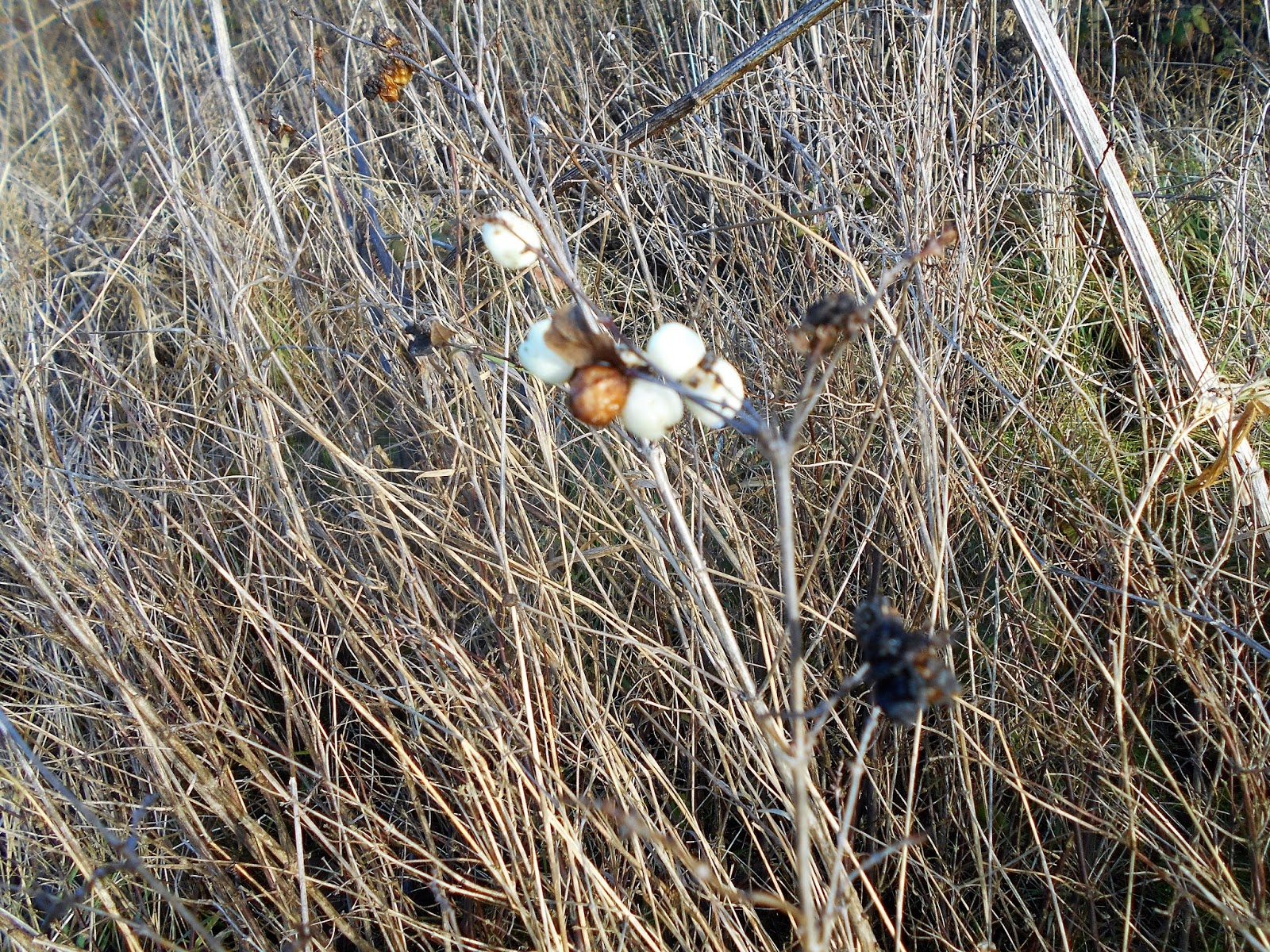
Just before reaching the gate stands a small clump of Snowberry, Symphoricarpos albus. I wrote a little about this very familiar North American shrub recently ('Ashby Fields' 24 November) but omitted to mention a curious fact: although the plump white berries contain seeds with apparently well-developed embryos, these seeds rarely germinate and little success has been had with this method of propagation even by professionals. And yet on the continent the species is spreading steadily by seed. It may be that the seeds need to pass through the gut of a bird and in Germany Greenfinches, Carduelis chloris consume the berries avidly. Only rarely are seedlings found in Britain.
The weather was lovely and, although I had no expectations of finding anything out of the ordinary, there was a spring in my limp. As expected, the trees were largely bare but Beech, Fagus sylvatica, was still carrying its russet foliage - one of the factors making it such a good windbreak when used as a hedge.

Quite unsurprisingly the coppiced hazels carried great numbers of catkins and the brownish, rather withered condition of some suggested that they had been out for the best part of a month. 
A clamorous noise made me look up to the sky where a Buzzard, Buteo subbuteo, was being harried by four crows. The buzzard neither swerved nor deviated in any way, serenely following its chosen path. Once it is beyond their territory I am guessing that the crows will lose interest.
Logs carefully lifted to one side revealed two species of Carabid beetle, known to coleopterists as Ground Beetles. As children in Northampton my friends and I always referred to them as 'rain beetles' and I note that in Lancashire, according to Peter Marren's excellent 'Bugs Britannica', they were known as 'rain clocks', apparently because if one was trodden on there would surely be rain the next day. One of those found today was the very common Leistus spinibarbis with a lovely blue iridescent sheen, whilst the other was the slightly larger and probably even commoner Nebria brevicollis.
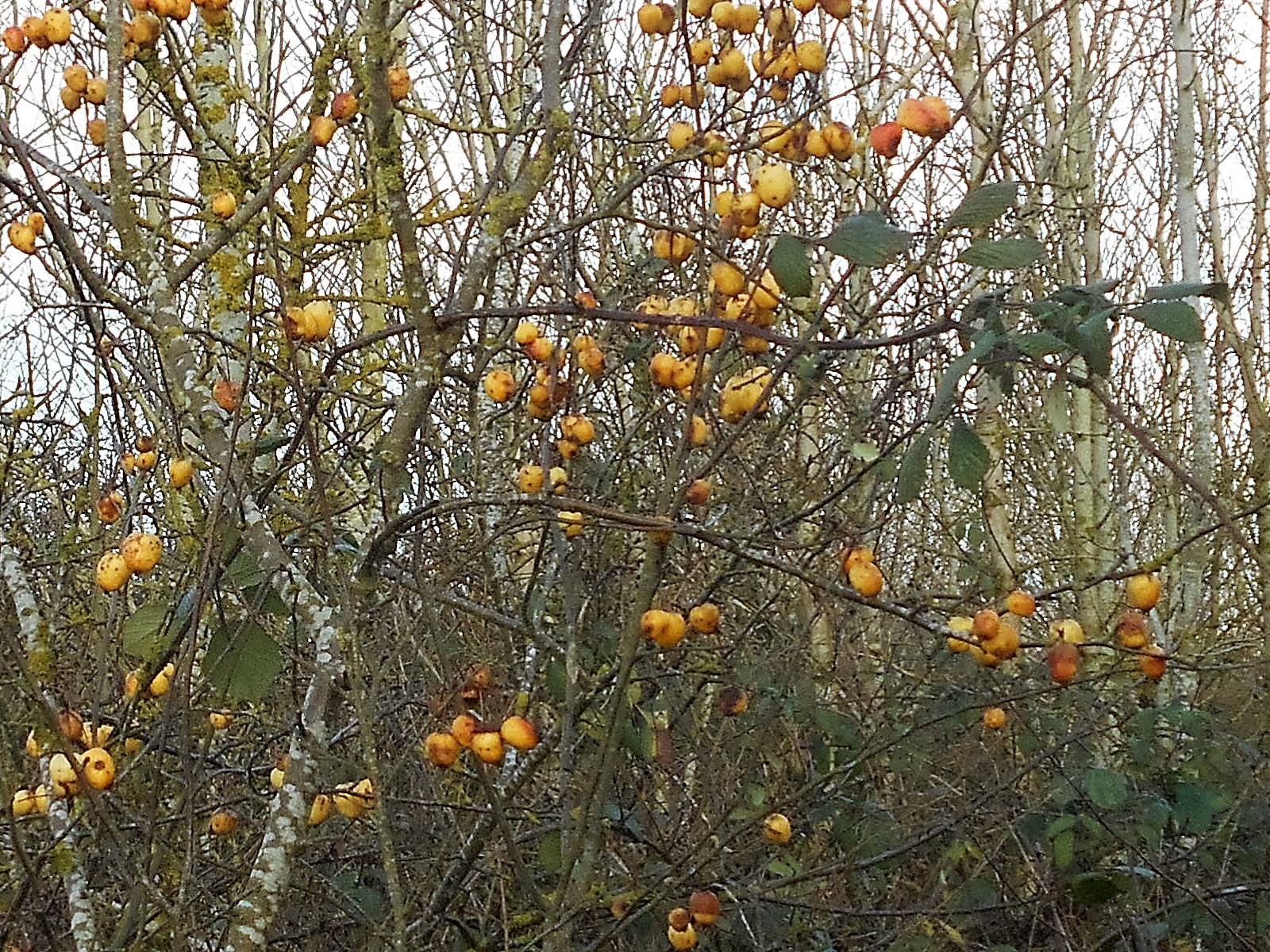
A number of apples trees have been planted and they still carried large quantities if fruit. In my experience they are only readily consumed after they have fallen to the ground. I should be able to establish the taxon to which these apples belong when their foliage has fully developed.
A new industrial complex has been established to the east of Kentle Wood and it is separated from the woodland by a steep bank. Literally hundreds of trees have been planted on the slope with the object, presumably, of stabilising the bank and screening the large buildings still being erected, but they will surely encourage more wildlife.
Ok, nothing to get the heart racing, but pleasant enough and it is, after all, a very new woodland. It was pleasing to note that more lichens are becoming established. On the trunk of just one cherry tree I noted five species of lichen and doubtless many more escaped my not-very eagle eye.


Tony White: diaea@yahoo.co.uk