Friday, 3 June 2016

Borough Hill - and still much to do

Today I made my third visit to Borough Hill in recent weeks, knowing that a vast amount of time would need to be spent at this site for reasonable coverage to be obtained. After my first visit I had only recorded 6 spider species, 11 diptera (two-winged flies) and 12 other invertebrates. It was, as I said at the time. a paltry figure. Following my second visit on 27 May the figures has advanced to 12 spiders, 17 diptera and 20 other invertebrates; I was still only scratching the surface.


I arrived on a dull, dismal and dreary day (It's always worth sticking in a bit of alliteration when you haven't much to say). It slowly warmed up but the sun was reluctant to put in an appearance.
Just inside the entrance a group of Wych Elms, Ulmus glabra, stood. The word 'glabra' implies lack of hair, but the foliage is in fact hairy when young although the leaves are glabrous later.
Withering fruits on Wych Elm. Borough Hill, Daventry.
3 June, 2016

It had flowered some weeks ago. Now even the fruit wings were withering. Although the huge elms of my childhood are largely a memory, the Wych Elm seems unaffected by Dutch Elm Disease and can still make a hefty tree.


White Campion on Borough Hill, Daventry.
3 June, 2016
A few plants of White Campion, Silene latifolia (= Silene alba), were present and, a couple of yards away, Red Campion, Silene dioica was in flower.
Red Campion, Borough Hill, Daventry.
3 June, 2016
The two species readily cross-pollinate so it was no surprise to find the pink hybrids, Silene x hampeana, also present.
The wishy-washy Pink-Red Campion hybrid.
Borough Hill, Daventry. 3 June, 2016
The inclement weather meant that few insects were on the wing and not a butterfly was seen.
Sloe Bug on White Dead -nettle. Borough Hill, Daventry.
3 June, 2016
But a Sloe Bug, Dolycoris baccarum, put in an appearance. Just as Hawthorn Shieldbugs are not confined to hawthorn, so the Sloe Bug is not restricted to sloes (blackthorn fruits); in fact the insect appears to have no connection with sloes whatsoever, so the name seems to have arisen through a misconception.
Rather annoyingly, the weather had just decided to mend when the time came for me to go home but I had quite a few spiders in my pot of alcohol so I was reasonably content.

Wednesday, 1 June 2016

Rain, rain, go away

Late afternoon on the last day of May. In the garden yellow roses toss their heads in the gusting wind. Raindrops make little rivulets down the window panes. A crow perches on a nearby television aerial and ruffles its wings to shed the rain from its feathers. I am reminded of words of the 17th century poet Henry Vaughan:


                                                   Waters above! Eternal springs!
                                                   The dew that silver's the dove's wings!


A lone bumble bee makes its way home. It isn't cold and the rain per se will not bother it, but the nectar in flowers will have been diluted to a point where it isn't worth collecting. Perhaps this is the reason why some flowers, such as bluebells, have nodding, campanulate flowers wherein the nectar is protected.


The following morning, the first day of 'flaming June', and the skies are still grey. In Byfield the ever-reliable White Dead-nettles, Lamium album, are in flower and receiving a few visits from bumble bees. These insects, snug in their furry jackets, are able to continue work in inclement conditions.
The flowers of these Dead-nettles are not bell-shaped but the upper lobe forms a hood, giving some measure of protection to the nectaries, so the nectar remains undiluted. The hood is also furnished with hairs which form a barrier against rain.


White Dead-nettle. Byfield, Northants.
1 June, 2016


The identical structure can be seen in the Yellow Archangel, Lamiastrum galeobdolon. Indeed, this species was once included, as Lamium galeobdolon, with the Dead-nettles. The word galeob means 'to cover with a helmet', presumably a reference to the characteristic hood, but there is doubt about the full meaning of the specific name.


Yellow Archangel. Byfield, Northants.
17 May, 2016

The odd shape of these Dead-nettles, and indeed all members of the Family (the Lamiaceae) is due to the bilateral symmetry of the flowers. Botanically this shape is termed zygomorphic and is found in plants belonging to other families, i.e. the Snapdragon (Scrophulariaceae), the Fumitories (Fumariaceae) the orchids (Orchidaceae) and so on.


Migratory insectivorous birds such as swallows will soon be wondering why they bothered making the long trip north. Now let's hope tomorrow brings some sun


Sunday, 29 May 2016

Norton Churchyard

The clock on the church tower said 2.30 so there was time for  quick look around before kick-off in the England v Wales rugby, being shown at the village pub, The White Horse.


Kick-off in half an hour! All Saints Church,
Norton, Northants. 29 May, 2016
The Church of All Saints is very old, with the porch dating from the 13th century, but a legend claims that St Patrick hails from the village, so Christianity hereabouts goes back much further. (It seems that religious fervour is still intense here: twice I heard someone shout 'God help us' when watching the rugby.)

Solid and unfussy. All Saints Church, Norton.
29 May, 2016
The church is an unfussy building and is fairly typical of the area using, as is often the case, the local Jurassic marlstone for the masonry. Most of the churchyard is carefully manicured and of limited wildlife value but around 250 square metres at the back of the church has been left to revert to nature and would have repaid further attention.
Woody Nightshade, its relationship to the potato all
too obvious. Norton, Northants. 29 May, 2016

Brambles and nettles were dominant but Woody Nightshade aka Bittersweet, Solanum dulcamara (dulcis sweet; amara - bitter), was present, as was hawthorn:


                                  And scrambling up the hawthorn's prickly bower,
                                  For ramping woodbines and blue Bitter Sweet.
                                                                                             John Clare's Village Minstrel, 1821


Nearly kick off time. Just time to photograph the headstone of the unfortunate Emily who, once married, became Emily Emery - try saying that after a couple of pints!


England triumphed but I'll gloss over the details in case any Cambrians read this blog.

Friday, 27 May 2016

Borough Hill - again

On 15th May I went with friends to Borough Hill (see blog) but came away vaguely dissatisfied. I recorded 6 spider species, 11 diptera (two-winged flies) and 12 other invertebrates but I knew that this represented a paltry haul given the nature of the habitat.


Today I returned, resolving to do a little better. The weather was fine and I felt very optimistic as I set out. The hawthorn bushes in the hedgerow were heavy with blossom and the hillsides were studded with sky-blue patches of Common Field Speedwell, Veronica persica. (As children we always called it simply Birdseye.) G.Claridge Druce, in his 1930 flora of the county describes it as 'ericetal', i.e. growing on acid soil where Erica (Heather) might occur. Certainly the soil on Borough Hill is a bit on the acid side.


The Birdseye Speedwell, Veronica persica, on Borough Hill, Daventry
27 May, 2016


They seemed to like the sandy soil of ant mounds and many of these hillocks seemed to be wearing a blue cap. There are over twenty species of Veronica found in Britain, including some introductions, but with care they are not difficult to separate. Incidentally, these ant mounds were significant for I took a specimen of the hoverfly Xanthogramma citrofasciatum, whose grubs feed upon root aphids 'farmed' by the ants.


It wasn't long before I was encountering interesting species.

Agapanthia villosoviridescens is one of the Longhorn Beetles and its grubs feed in the stems of thistles. With a body length of up to 22 millimetres (my specimen was a mere 17 mm) the long specific name seems apposite but for once the 'common' name is even longer - The Golden-bloomed Grey Longhorn Beetle. On the photograph the golden hair on the elytra (wing cases) can just about be made out. This species seems to be confined to central and eastern England. 
Agapanthia villosoviridescens is an impressive beetle.
Borough Hill, Daventry. 27 May, 2016
Spiders were not particularly conspicuous. As usual, Nursery Web Spiders, Pisaura mirabilis, were prominent on leaves but seemed to be having little success in seizing prey. However this crab spider, Xysticus cristatus had got her lunch in the form of a sawfly of some sort.
Xysticus cristatus with prey. Borough Hill, Daventry.
27 May, 2016
They have powerful jaws and the male must exercise caution when mating. He will walk around the selected female trailing web and thus pinning her legs to the ground. She is helpless while he has his wicked way with her but she will eventually extricate herself - by which time the male has scarpered.
Most people will be familiar with black millipedes and they may also know the Striped Millipede, Ommatoiulus sabulosus. In his monograph on British millipedes J. Gordon Blower writes: '...it is associated with sandy soils...and heathland' (sabulose means 'of sandy places') so it is to be expected at Borough Hill. I found several specimens.

The Striped Millipede, Ommatoiulus sabulosus at
Borough Hill.27 May, 2016


I finally called it a day and returned home with a pot of money spiders. Their average length is about 2 millimetres so I have a lot of microscope work facing me.


Thursday, 26 May 2016

Canons Ashby

I went to Canons Ashby on Wednesday evening. The occasion was a visit by The Boddington and District Garden Association and, although we have recently had several days of lovely warm and sunny weather, this was an evening for wrapping up well. I had collected Ann and John Pimm on the way and in all about twenty of us turned up to brave the elements.
Spindle was in flower near the car park. Its flowers are hardly colourful but its berries, in a sealing-wax pink, are a delight. It is native to the county, where it is more often found on limy soils.


Spindle was growing beside the car park at Canons Ashby.
25 May, 2016
I was pessimistic with regard to the chance of finding interesting insects and, sure enough, there was little of note but an exception was caterpillars of the Mullein Moth, Cuculia verbasci, on - you've guessed it - Mullein.
Mullein Moth caterpillar at Canons Ashby.
25 May, 2016
These larvae were still quite small and my photograph exaggerates their size, for they were only about ten millimetres long. I am always pleased to find them; gardeners are generally not so keen!


Some aspects of the gardens are rather formal and, although they offer fine views, I was more interested in the herbaceous borders, where some unusual plants were to be seen.


Looking out across an attractive  landscape.
Canons Ashby, Northants. 25 May, 2016

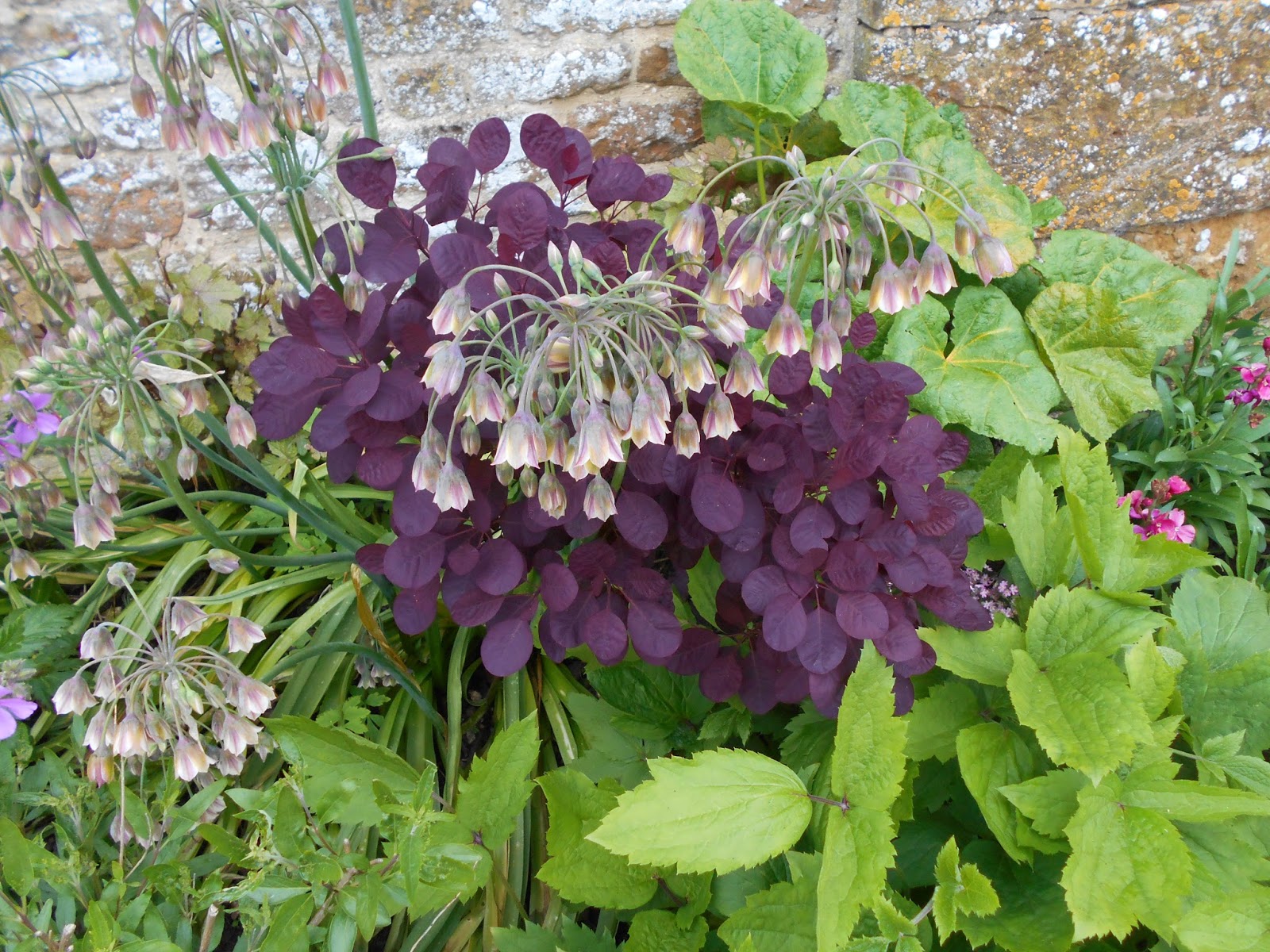
The pale green-pink flowers of Nectaroscordum siculum were backed by the purple leaves of Cotinus coggygria to provide an interesting contrast, but by and large I'm not a person to bother about 'colour clashes'.  The Nectaroscordum has an onion-like smell and indeed was once included in the onion genus as Allium siculum.

Honey Garlic, Nectaroscordum siculum backed by a
purple Cotinus coggygria. Canons Ashby. 25 May, 2016


A little further on grew an attractive member of the Cistus family.  It may have been Cistus clusii or C. monspeliensis. There are several similar species but Chris, who was showing us around, was not at hand to ask.  Whatever it was, I rather coveted it! 
This Cistus shrub was an attractive border feature.
Canons Ashby, 25 May, 2016
Next to capture my interest was the striking spurge, Euphorbia griffithii. The form usually grown goes under the name of 'Fireglow' and I am assuming that this is what it was. It hails from Tibet and Bhutan and the name commemorates the largely forgotten William Griffith, who travelled and collected widely in the region.
Euphorbia griffithii is a lovely feature in a border.
Canons Ashby. 25 May, 2016


In a shady border numerous ferns were growing and Claytonia sibirica was also growing profusely. This plant has flowers of a strong pink coloration but in the gathering gloom my camera failed to pick this up. In my youth it was placed in the Portulacaceae Family along with the purslanes, but I find that some botanists have recently placed in a 'new' family, the Montiaceae.
Claytonia sibirica, aka Montia sibirica 
Canons Ashby, Northants. 25 May, 2016
It is an annual but may sometimes behaves as a short-lived perennial. Here is has attained the status of a weed, tolerated because it is very pretty, but I suspect that the staff need to be quite ruthless with it.

Trillium discolor in a shady border at Canons Ashby.
25 May, 2016
I could ramble on but will content myself with one final plant. In the same border as the Claytonia were some specimens of Trillium. Here the genus was represented by Trillium discolor; even more stunning - in my opinion - is Trillium foetidissimum. As the name would suggest it has an unpleasant smell. But the finest species must surely be T. sessile; it too has a foul smell but no worse than, for example, Crown Imperial, Fritillaria imperialis. If I could give them the conditions they demand, a loamy soil with dappled shade,  I would surely give any of them a home.


The cold was now really making itself felt so, after coffee and cake, it was time to leave. I have promised the staff that I will return and do a survey of the invertebrates at Canons Ashby, so I'll be back.


Sunday, 22 May 2016

A good day for beetles

Chris was going out for lunch with our daughter Jacqui so I resolved to visit Kentle Wood.


Prior to departing I had a quick look at out giant Cardoon, Cynara cardunculus, plant. Its magnificent thistle-like flowers attract hordes of insects in the summer but occasionally insects are to be found on the leaves.


Today it was a Tortoise Beetle, i.e. a species of Cassida. In the U.K. here are twelve species found and a little care must be taken with identification. This specimen turned out to be Cassida vibex, widespread in southern Britain but less common further north.


The beetle, Cassida vibex. Stefen Hill, Daventry.
22 May,2016


So, not a rarity at all, but a pleasing start to the day.


The sun was now gaining strength so I packed my gear and set off for Kentle Wood.

I immediately spotted a beetle basking on a dog rose leaf and recognised it as Cantharis nigricans.  As with the Tortoise Beetle we have a dozen or so species of Cantharis in the U.K but keys to identify the species are readily available.

One of the Soldier Beetles, Cantharis nigricans, on dog rose foliage.
Kentle Wood, Daventry. 22 May, 2016
Pyrochroa serraticornis is a common Cardinal Beetle.
Kentle Wood, Daventry. 22 May, 2016
If disturbed these 'Soldier Beetles' are quick to drop to the ground, where they can be difficult to find. This is true also of the Cardinal Beetles - my next find. The species in this case was Pyrochroa serraticornis. and it can be recognised by the scarlet - not black - head and the distinctive serrated antennae. The bright red coloration warns would-be predators that it is toxic to eat, but as a precaution it not only drops to the ground when disturbed but, in my experience, falls with the underside uppermost.  This ventral side is black, making the beetle well-nigh impossible to locate. There it lies for, perhaps, several minutes before moving. The feigning of death - 'playing 'possum' - is a widespread strategy within many animal groups. Known technically as thanatosis it is clearly successful and must have led to the survival of countless millions of creatures.


The edges of the rides have now developed a foaming mass of Cow Parsley, Anthriscus sylvestris, in many cases with a background of creamy - and very fragrant - hawthorn blossom.
Neither of these plants was attracting noteworthy insects but the understorey of White Dead-nettle, Lamium album, was receiving plenty of attention from various species of bee.
Buttercups too were getting visitors, largely from the fly, Cheilosia albitarsis. Fortunately the specimen I photographed was a male; the females are indistinguishable from those of Cheilosia ranunculi. Both species are found commonly on Creeping Buttercup and the former certainly lays its eggs at the base of the buttercup stem.


At this point I put my camera away as I planned to spend an hour or so investigating the spiders found in grass tussocks and vole runs.


Not situations likely to throw up photogenic material!


Saturday, 21 May 2016

Of this and that...

When out surveying an area for invertebrates my camera is always at the ready. It is not that I am a particularly competent or enthusiastic photographer but it is a way of recalling odd or memorable ...whatever.


For example: a casual glance at a Cherry Laurel shrub yesterday brought a couple of ladybirds to my attention.


Harlequin Ladybirds in copula. Daventry
19.v.2016

It might appear that two species of ladybird are mating, but of course it is nothing of the sort. The Harlequin Ladybird, is extremely variable and, although in this instance the male is fundamentally black with spots and the female has a ground colour of brick-red with apparently a dozen or more black markings, they are both Harmonia axyrida. It is an unwelcome but well-established alien - but that is another story.


A little further on and I casually passed my net through a birch tree and out came another pair of mating insects - spring had definitely arrived! Ladybirds are of course beetles and some shieldbugs can have vaguely beetle-like appearance (although there are numerous significant differences).
This was a pair of Parent Bugs, Elasmucha grisea.  Their common name derives from the fact that when danger threatens the tiny offspring will creep under their mother's body until the threat has passed. The mouthparts of bugs are modified to form a sort of drinking straw and Parent Shieldbugs imbibe the sugar-rich phloem from birch or alder trees. (Aphids are also bugs.)


Parent Bugs in cop. Daventry 19.v.2016


It seems  hadn't done with shieldbugs for fifty yards further on I passed a line of tall Lawson's Cypress. I had beaten these before in the hope of finding a Juniper Shieldbug, Cyphostethus tristiatus, but with no success. On this second occasion I was in luck.


Juniper Shieldbug netted from Lawson's Cypress.
Daventry. 19.v.2016

The nymphs of this species feed on the cypress cones.  The notorious 'Leylandii' cypress, being a hybrid, rarely bears cones and is therefore of no interest in this context but the widespread planting of Lawson's Cypress has allowed this shieldbug to spread rapidly in recent years.

Shieldbugs - and indeed most bugs - are good, and in some cases strong, fliers. The same obviously cannot be said of mites. These creatures, being arachnids and thus related to spiders, are wingless.
Eriophyes galls on Common Lime.
Byfield, Northants. 20.v.2016
It is therefore a bit of a puzzle how rapidly they disperse and colonise newly created habitats. These pustules on the hybrid Common Lime, Tilia x europaea, are the work of mites, in this case a species of Eriophyes. The identity of the mite in question cannot  be established on this hybrid other than by an experienced acarologist, which I am not. But whatever the species, how does it disperse from tree to tree?  I have not investigated this problem but suspect that phoresy may be the answer. Phoresy is the act of  'hitching a lift' by clinging on to another organism. In some cases it can be insects, but perhaps in here birds are the unwitting carriers.