Tuesday, 18 April 2017

Mooching around Daventry

The day didn't get off to the best of starts. I sat in bed idly looking at environmental issues on my tablet when I stumbled upon a 'wildlife quiz' - and found myself stumped by the very first question:
                     What is a lobster? Is it    a. an insect
                                                             b. a fish
                                                             c. a crustation
                                                             d. a mollusc
... and of course there was no correct answer since 'crustations' do not exist.


I have, over the years, often found references to a film called '101 Dalmations' but a 'crustation' was a new one for me. I try to be tolerant because my mathematical ability is almost risible but I'm amazed that a spell check hadn't picked it up.
Anyway, it was Chris's day for spending a couple of hours at the Daventry Air Ambulance shop. I had a few jobs to deal with in town but still ended up with lots of time on my hands so I went for a mooch around some of the less-visited areas adjacent to the town centre. (Mooch, by the way, apparently comes from the Old French mouchier, to hide, but I tried not to look too shifty.)
Where pavements were less trodden little 4-5 mm high 'palm trees' grew. These were the gemma-cups (asexual reproductive organs) of the liverwort, Marchantia polymorpha.
Marchantia polymorpha grew in paving crevices,
Daventry, 18 April, 2017
This is a common plant, particularly in plant nurseries and garden centres, where it can become a real nuisance, and here it flourished particularly around the bus station.
In a quiet spot just off the High Street stands a gnarled old specimen of Box Elder, Acer negundo. From whence comes its common name I know not.
Acer negundo, looking centuries old but perhaps not even a centenarian.
Daventry, 18 April, 2017
Certainly the leaves are vaguely elder-like, but I fail to see any resemblance to a box tree. All I learned from the internet was that there is a town in Colorado called Box Elder! The tree has an alternative name of Ashleaf Maple and perhaps this is the name we should use. The fruits of the tree already look brown and withered, but in fact are young and still ripening. The species, hailing from the eastern parts of central U.S.A., is commonly grown but, unlike this specimen, usually in the form with variegated foliage.
The odd-looking fruits of A. negundo
Although it was sunny it was rather chilly. Fortunately conditions away from the wind were very pleasant and on a leaf a female hoverfly, Syrphus ribes, was basking. This is one of the commonest of the wasp-mimicking hoverflies and frequently visits flowers, making it quite a useful pollinator.
The wasp-like Syrphus ribes enjoys the sun.
Daventry, 18 April, 2017
Bees are, of course, pollinators par excellence, and many were visiting shrubs of the gorse-like Spanish Broom, Genista hispanica. This is an excellent plant forming a mound covered with golden-yellow flowers and I was pleased to see it being grown in a municipal flower-bed.
Genista hispanica, found in Spain, France and Daventry.
18 April, 2017
The flowers have a delicious, spicy perfume and it was surely, this as much as the colour, which was attracting the bees, overwhelmingly Buff-tailed Bumblebees, Bombus terrestris.
A procession of bees was working at the flowers.
A handsome but very common Red-tailed Bumblebee, Bombus lapidarius, made off with her loot, not needing to travel far and quickly coming to ground among some dead leaves.
Bombus lapidarius is thankfully not one of our endangered species.
Daventry. 18 April, 2017
There will be an underground nest nearby containing up to 300 workers. The species seems to have a particular liking for yellow flowers. It is very widespread, unlike the very similar Bombus cullumanus, sadly now presumed extinct.

Friday, 14 April 2017

Fickle Spring


What has happened to spring? After a few lovely days we have been subjected to about four days of distinctly chilly weather. Even when the sun has broken through there has been little warmth to it and we have been troubled by a nagging north-west wind.
'April is the cruellest month' claimed T. S. Eliot in 'The Waste Land'. True, he wasn't referring to these sudden setbacks in the weather but the words seem appropriate.
What on earth am I talking about? Looking back over the years I can recall snow and bitter April winds; I can recall flood and devastation, and here I am, whingeing about a short cool snap. In fact I have risked planting out Morning Glory, Ipomoea purpurea, in our back garden, and so far no frosts have arrived to dash my optimism. No, the weather isn't that bad, but recently we have been spoiled.
Despite the cool conditions I strode forth today in the direction of Kentle Wood, passing on the way some large specimens of Cherry Laurel (mentioned in my blog on 2 April).
Cherry Laurel in full bloom. The Grange, Daventry.
14 April, 2017
It is a fine sight at this time of the year with its racemes of creamy-white flowers -  if you have plenty of space, Bone hardy it is, but in a smaller garden there are, I suggest, some choicer options.
The racemes of Cherry Laurel flowers attract a good range of insects.
Normally there would be numerous flies paying these flowers a visit, but not today and I pressed on. A little further on and a sparsely-grassed bank was being mined by Andrena bees. Their appearance, with distinctive and conspicuous grey-white hairs, showed them to be Ashy Mining Bees, Andrena cineraria.
Although this insect tends to have a western and southern distribution in England, finding it in this situation is in no way a surprise and there is evidence to suggest an increasing presence in central England.
With only a quarter of a mile to go I reached Browns Road where yellow roses tumbled down a bank.
I cannot be certain what they are but I'm reasonably confident that the species is Rosa xanthina 'Canary Bird'. 
A lovely rose makes a floral waterfall at the roadside.
Browns Road, Daventry. 14 April, 2017

The lovely yellow flowers are single and much visited by insects, making it an excellent choice for the wildlife garden.
The single flowers are unscented but attractive to wildlife.


On other shrubs at the roadside shieldbugs were to be seen. Only a couple of very common species were noted but nonetheless I was pleased to see them. Palomena prasina is, despite its green dorsum giving it camouflage on green foliage, reasonable easy to spot. No other British bug has quite the same size and coloration but, to be certain of the identification the under (ventral) side is of a pink or yellow shade.
Palomena prasina is one of Britain's largest shieldbugs. Browns Road,
Daventry. 14 April, 2017

Much more boldly marked is the Hawthorn Shieldbug, Acanthosoma haemorrhoidale. Surely this would be much easier to see with its distinct green and wine-red markings, but these blend in very well with the green leaves and red berries of hawthorn, making the insect easily overlooked.
The Hawthorn Shieldbug is a narrower insect. Browns Road, Daventry.
14 April, 2017

Compared with the observations made en route, Kentle Wood held few surprises. An open area of grassland in the central area had been colonised by hundreds of Coltsfoot, Tussilago farfara, plants.
Masses of Coltsfoot had gone to seed. Kentle Wood, Daventry.
14 April, 2017
These had gone to seed and from a distance they resembled a patch of cotton grass on a Scottish moor. (Rather surprisingly Common Cottongrass, .Eriophorum angustifolium, is found a few miles away at Bugbrooke Meadow.) I did however take a large number of beetles and spiders and perhaps microscopic examination of these over the next two or three days will reveal something out of the ordinary. So far I have recorded 44 species of flowering plants and 398 arthropods (insects, spiders, centipedes, etc.) from Kentle Wood and hopefully this year the figures will swell significantly. (Sure enough, a tiny spider called Ero furcata has just joined the list. This is one of the Pirate Spiders, a group of spiders specialising in entering the webs of other spiders and then killing them as prey. )


Wednesday, 12 April 2017

The Pocket Park and Primulas

As mentioned on 4 March, Pom Boddington has gathered together a small team to do maintenance work in Byfield's pocket park and a short visit earlier today confirmed that the efforts are bearing fruit.
One enters from the cricket pitch to the north via a metalled track where apple blossom is bright among the elder and scrambling ivy. The origin of these apple trees is doubtful.
Apple blossom greets the visitor entering from the north.
Byfield Pocket Park. 12 April, 2017
Remains of a small orchard, dating back to the times when Byfield railway station stood here, can be discerned but the plant photographed may, like many 'Crab Apples', simply be the consequence of an apple core casually cast aside by a passer-by. Be that as it may, the pink blossom is a delight to humans and insects.
Flowers are now appearing in abundance. Most are commonplace but even the humble dandelion should not be ignored. Certainly they are not ignored by hoverflies and the one photographed is delving deep into a capitulum in search of nectar. Of course we can eat the flowers too: according to Adele Nozedar they 'make a good addition to salads, pancakes and even jellies and trifles'. (Adele Nozedar, 'The Hedgerow Handbook', Square Peg Books, 2012) Strictly speaking these pollinating insects are not required for pollination since dandelions - Taraxacum species - are apomictic: they produce seed wholly female in origin without fertilization, with the consequence that an enormous number of 'microspecies' has evolved, with at least 235 of these currently recognised in the British Isles alone.
 A hoverfly gets stuck in to a dandelion head.
Byfield Pocket Park. 12 April, 2017
Their diuretic properties are well known and in French they are called pissenlit - literally 'wet the bed' and my grandmother always referred to them such, as it was also the old Northamptonshire dialect term for them. Adele Nozedar states: 'This same diuretic action helps flush out toxins, including uric acid, alleviating rheumatism and gout'. I'll bear it in mind!
Primroses, Primula vulgaris, and Cowslips, Primula veris, are both native in the area of course, but not in Byfield Pocket Park. Both species have nevertheless been introduced although, like the apples referred to earlier, their provenance is questionable. We have three other species of Primula native to Britain. They are: Oxlip (Primula elatior), Bird's-eye Primrose (Primula farinosa) and the Scottish Primrose (Primula scotica), none of which is native to our county but are all very attractive garden plants.
Primula vulgaris flowers in Byfield Pocket Park.
12 April, 2017
The primroses look perfectly authentic but the 'cowslips' may be hybrids with primroses. The colourful  Polyanthus, Primula x polyanthus, plants of gardens are such hybrids and sometimes the precise taxon to which a particular plant belongs can be unclear. (Is this why the oxlip-primrose hybrid is sometimes called the Bedlam Cowslip?) But it must be admitted that the general appearance of the plants here is that of a cowslip. The plant is common in pastures and their name is derived from the Old English cu cow and slype slime, ie cow-dung. Tellingly, one old Northamptonshire dialect word for the plant is 'cowslop'. John Clare acknowledged this association with pastures when he wrote:
                                             The shepherd on his pasture walks 
                                             The first fair Cowslip finds,
                                             Whose tufted flowers on slender stalks,
                                             Keep nodding to the winds.  
Cowslips? Probably 95% anyway. Byfield Pocket Park.
12 April, 2017
The pocket park needs to be kept in a tidy state and the footpaths accessible but I am pleased to note that fallen trees are being left to decay. The Elder photographed will hopefully support a number of fungi in the course of this process, adding to the interest and natural health of the habitat.
A fallen Elder, Sambucus nigra, begins the slow road to decay.
12April, 2017
The soil disturbed in its falling will create opportunities for rapid colonisation by plants such as these Forget-me-nots, Myosotis species, whose flowers, small though they are, create a mist of sky-blue in open areas.


Monday, 10 April 2017

Flore gardens

Flore is a very interesting  village immediately to the east of Weedon. It has something in common with Kilsby in that people in their cars tend to hurry through on the main road and are unaware  of the fascinating range of houses, old and new, lining the narrow little streets of the village. The name is interesting: it was Flora in the Domesday Book, suggesting a connection with flowers, but remains of a tessellated Roman pavement or floor have been unearthed nearby. If this was known in Anglo-Saxon times the true origins of the name may be a reference to this feature.
Charles Whynne-Hammond, in his book 'Northamptonshire Place Names', written in 1994, remarks: 'The area has long been famous for...the botanical wealth of the local gardens'.Yesterday Chris and I, together with friends, went for a look around the gardens, and this 'botanical wealth' was still evident from the very first one we visited.


To my mind Fritillaria persica is a superb plant but my attempts to grow it have ended in failure. Seeing it flourishing in a lovely garden in Spring Lane has fired me with enthusiasm and I'll give it another go, perhaps growing them from bulbs in a pot, where conditions can be controlled.
Fritillaria persica was here growing in an urn. Flore.
9 April, 2017
Kerria japonica is a member of the Rose family and is a fine plant too. Unfortunately the form grown is almost invariably, 'Pleniflora', and this was common throughout the village. To my mind it is a most unattractive plant and, being double, has a fundamental flaw in that it is of no interest to pollinating insects. However, I was fortunate, for in one of the gardens visited the original single flowered type was present.
Kerria japonica 'Pleniflora' is familiar to everyone. Flore, 9 April, 2017
With simple, buttercup-like flowers (botanists have often remarked on the similarities between the Buttercup family and the Rose family) it is, I consider, a far more garden-worthy plant.
The single-flowered form of Kerria japonica is far less common.
 Flore, 9 April,2017

In another garden the rather sinister stems of a Voodoo Lily caught the eye. It was unlabelled and I couldn't find the owner but the species was almost certainly Typhonium venosum. T. guttatum is similar but on the balance of probabilities I'll go for the former.
 Typhonium venosum is rather too tender to risk outdoors.
 Flore, 9 April, 2017
These strange members of the Arum family, formerly referred to as Sauromatum species, are native to upland regions in Africa and Asia but will survive in a conservatory or even, as in this case, in a sheltered area outside. It grows from a corm and remarkably will flower if simply placed in a saucer of water but, easy though it is, I may give it a miss. The busts of five empresses near by in this remarkable garden will be holding their noses when the flowers are produced because they (the flowers) are spectacular but unfortunately smell of rotting flesh or a dirty, wet dog.
More acceptable if a little more mundane, was a Chocolate Vine, Akebia quinata. Its flowers are rather small but are an unusual maroon or brown colour and smell of chocolate.
The curious flowers of Akebia quinata. Flore, Northants. 9 April, 2017
This vigorous climber, a native of Japan and Korea, is reasonably hardy and makes a talking point for visitors to the garden. In very warm summers it produces sausage-shaped fruits but I have not seen them produced in Britain. I understand that they are edible but not very palatable.
Given the right conditions Akebia quinata climbs rapidly.
Flore, 9 April, 2017
Near to the Voodoo Lilies a pan of Pleiones was flowering. They were unlabelled but were almost certainly Pleione formosana, a native of China, and its common name of Windowsill Orchid gives a clue as to how it could be grown. It will however be scorched by hot sun and benefits from being misted occasionally. Relative to the overall size of the plant the flowers are huge and this is a species I am tempted to grow. Many plants bear the specific epithet formosa, meaning 'beautiful', but in the case of this orchid formosana means 'from the island of Formosa'.
Stunning! Pleione formosana encourages the sin of covetousness!
Flore, Northants. 9 April, 2017
Several of the gardens were growing Crown Imperials, Fritillaria imperialis. Like F. persica, I have attempted to grow this species but have failed miserably. Rather gallingly someone has thrown out some bulbs in The Twistle, Byfield, and there beneath a hawthorn hedge they bloom happily! I'll try again despite the fact that the flowers have a rather rank, foxy smell.
Fritillaria imperialis is available in this yellow form or an orange alternative.
Flore. 9 April, 2017
I could ramble on about the flowers seen but will restrict myself to one more. Not many trees are grown for their lovely bark although the Paperbark Maple, Acer griseum  is one.
Acer griseum in the churchyard of Holy Cross church, Byfield.
5 April, 2017
Another, seen in a Flore garden, is the Tibetan Cherry, Prunus serrula. To my mind the Acer has the more attractive bark but of course with the cherry there is a bonus in the form of flowers (Acers have flowers too of course but rarely excite comment). It is perfectly hardy, but I notice that a well-grown tree will cost in the region of four hundred pounds! (Beware, there is a Japanese Cherry called Prunus serratula, so if you plan to order a few, better get the name right!)
Prunus serrula. Peeling the bark is an almost irresistible
temptation. Florte. 9 April, 2017
Tony White. E-mail: diaea@yahoo.cco.uk


Friday, 7 April 2017

Badby Wood - almost

A very pleasant walk leads from Bunkers Hill, Badby, meandering south to Badby Woods and yesterday I resolved to follow the track to record invertebrates in the aforementioned woods. I never made it. Being weak-willed I allowed myself to be so diverted by flowers, insects and the like that I simply ran out of time.
At various points along the track Dark-edged Bee-flies, Bombylius major, were seen visiting flowers, particularly clumps of Primroses, Primula vulgaris. Often plants in the vicinity of houses are of doubtful provenance but there was little doubt that this was the genuine wild plant.
Primroses flower in a hedgerow near Badby Wood. 7 April, 2017
The bee-fly is indeed very bee-like with its body covered in golden brown fur and that people often mistake them for a genuine bee is perfectly understandable, particularly when it is obviously imbibing nectar.
Bombylius major showing its very long proboscis. Taken from primroses
near Badby Woods. 7 April, 2017
As my photograph shows, the bee-fly only has two wings compared with the four of a genuine bee, but this is hardly obvious when the insect is hovering with the wings simply a blur. It tends to hover in the manner of a humming bird but its body is only a centimetre or so in length.
With the golden brown of the bee flies and the pale yellow of the primroses it was a day for yellowish hues.
Once regarded as a species of Dead-nettle (as Lamium galeobdolon)  Yellow
Archangel was abundant as I began my walk. 7 April, 2017 
Yellow Archangel, Lamiastrum galeobdolon, grew in masses on damp banks. It is often found as a garden escape but the fact that the antiquarian and historian George Baker (1781-1851) recorded it from Badby in 1822 suggests it is genuinely native here. Celandines, Ficaria verna, were too abundant to photograph and the picture shown is that of a group seen a few days earlier.
Celandines grew in patches throughout.
I was not done with yellows for where the soils consisted of damp clay, plants of Coltsfoot, Tussilago farfara, were in bloom. Its leaves were once much used by herbalists as a demulcent, i.e. employed to soothe irritable coughs, and as an expectorant. The leaves are hoof-shaped, giving the plant its common name, but these do not appear until the plant has almost finished flowering.

Coltsfoot grew in damp clay. Near Badby Woods. 7 April, 2017
My sweep net had failed to secure anything to cause excitement. Silpha atrata, one of the burying beetles and known as the Black Carrion Beetle, had ended up in my net, but this is a widespread insect. Nevertheless it is an interesting one. It has a very small head in relation to the rest of its body and this enables it to get deep into the shell of snails in order to devour them.
Silpha atrata taken from beside a footpath near Badby Woods.
7 April, 2017
It was now well into the afternoon and I had yet to walk home to Daventry. It isn't very far as the crow, Corvus corone, flies, but I'm not a crow, and wasn't looking forward to that hill leading out of Badby. Anyway I set off at brisk trudge and eventually made it, having passed thousands of dandelions - bright yellow of course.

Wednesday, 5 April 2017

Holy Cross churchyard, Byfield

A little spare time earlier today gave me the chance for a stroll around the churchyard of this fine, Grade 1 listed building. The area has considerable potential as a wildlife habitat but the possibilities are not utilised.
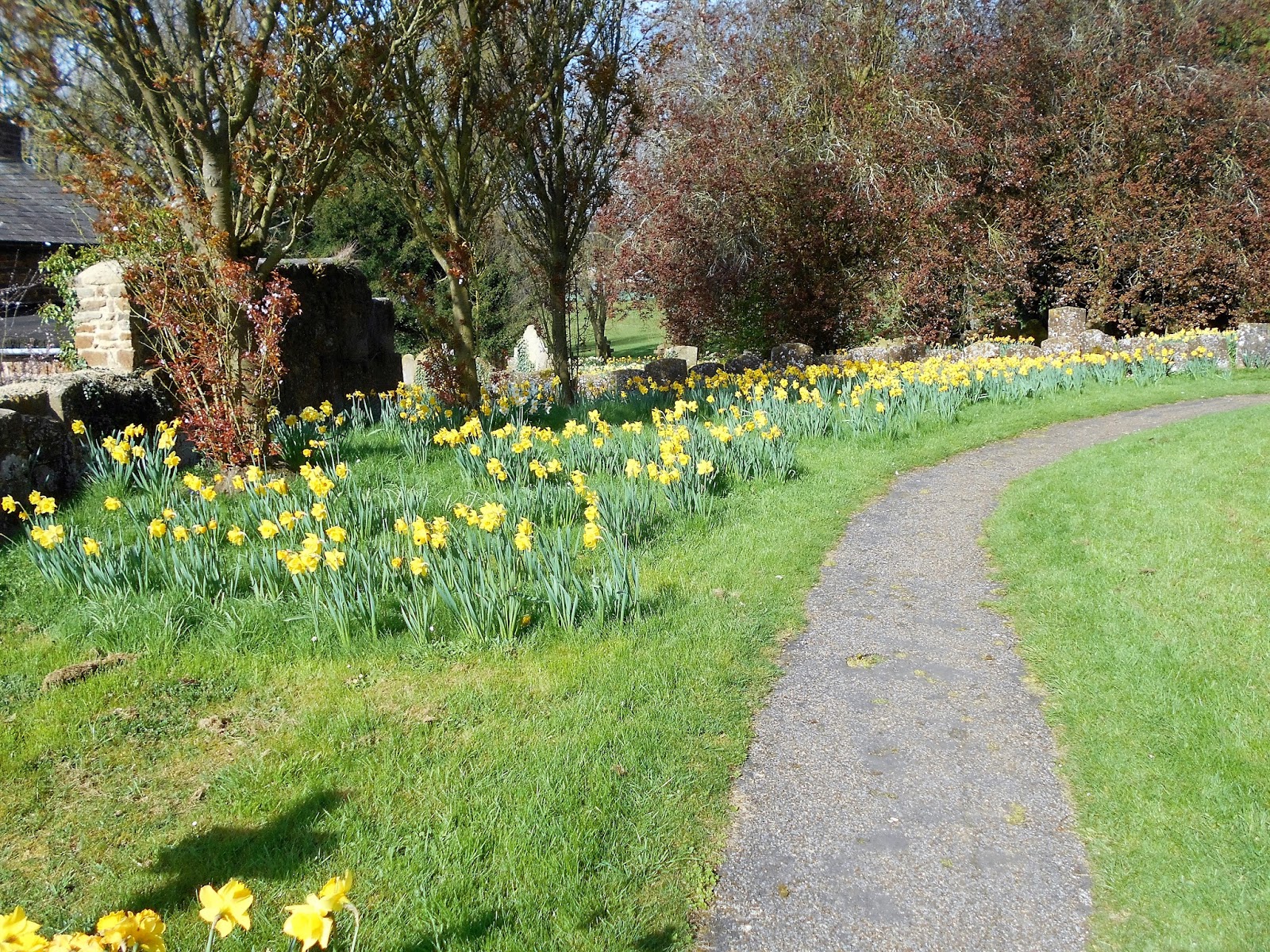
At this time of the year the visitor is greeted by swathes of daffodils. They look rather fine but very little wildlife makes use of them.

There are hundreds of daffodils present. Holy Cross Church, Byfield.
5 April, 2017
One exception is the handsome hoverfly, Merodon equestris. Known as the Large Narcissus Fly it can be a horticultural pest, its larvae damaging the bulbs. It is a bumblebee mimic and is also found in bluebell woods, where it again attacks the bulbs but appears to do little damage. Today the only hoverfly I saw was the very common Eupeodes luniger, sunning itself on a nettle leaf. I had rather expected to also see the Juniper Shieldbug, Cyphostethus tristriatus. It is certainly present in the churchyard as I have noted it there several times over the years.
Add caption
It is often on or near to the developing cones of Lawson's Cypress, of which there are several specimens along the west of the area but I was to be disappointed. In a few weeks time the females will lay their eggs on these cones
Lawson's Cypress with hundreds of male cones. Holy Cross Church, Byfield
5 April, 2017
I had to be content with admiring the lovely little Acer griseum. Known as the Paperbark Maple, this species, from central China, is quite small and slow-growing, making it suitable for even a modest-sized garden. I am surprised it isn't more often seen.
Acer griseum is quite a small tree. Holy Cross Church,
Byfield. 5 April, 2017
It has a neat habit but is grown for its beautiful, coppery-brown bark with a distinctive peeling nature and its spectacular autumn foliage The specific name of griseum - 'grey' seems inappropriate. The species was introduced to Europe in 1901 by Ernest 'Chinese' Wilson. He is associated with Chipping Campden, and a while back Chris and I visited the interesting garden in the village, created in his memory. In Wilson's day the Acers were placed in their own family, the Aceraceae but are now placed in the large Sapindaceae family along with Horse Chestnuts.
It is not yet in leaf but the bark is beautiful. Holy Cross Church,
Byfield, 5 April, 2017
Several hundred square metres of grass surround the Acer, composed almost entirely of perennial rye grass and this seems a wonderful opportunity for the imaginative use of bulbs such as Snake's Head Fritillary, Fritillaria meleagris, dwarf irises Iris reticulata and Dog's Tooth Violets , Erythronium dens-canis, with the mowing regime adjusted appropriately. They  would certainly be far less trouble than the daffodils. As it is only a few plants of Ground Ivy, Glechoma hederacea, provide a spot of colour in the sea of green.
The flowers of Ground Ivy are a deeper blue than my photograph shows.
Holy Cross Church, Byfield. 5 April, 2017
Tony White: diaea@yahoo.co.uk

Sunday, 2 April 2017

Cherries all

The cherries in Kentle Wood are coming into bloom.
A stroll to the wood through The Grange area takes me past a couple of other cherries. At first glance the do not appear cherry-like at all, yet this is what they are.
At the start of my walk I pass a bank of Cherry Laurel, Prunus laurocerasus. With its large, leathery leaves this very familiar shrub vaguely resembles an unspotted Spotted Laurel, Aucuba japonica,  but the two species are quite unrelated.

The leathery leaves of Cherry Laurel. Northampton General Hospital.
31 March, 2017
The leaves and habit may be similar but the flowers are not.
The curious purple-brown flowers of Aucuba japonica. Flore, 9 April, 2017
So, an examination of its flowers shows that with P. laurocerasus we are looking at a true cherry (although Max Roemer placed in a separate genus as Laurocerasus officinalis). At one time the fresh leaves were used for flavouring such things as custard and 'sweetmeats' - whatever that means - but this was a distinctly risky practice as they contain significant amounts of prussic acid! It may be the presence of this poison which make the leaves unpalatable to insects and I only find an occasional leaf nibbled. The nectar is perfectly safe of course and is much sought after by bees. Introduced from Europe about 400 years ago, it is valued in shrubberies for its tough, evergreen nature but when used as hedging some meticulous gardeners clip off the unwanted branches with secateurs rather than making an unsightly cut across a leaf with shears.  Birds such as thrushes (and bullfinches - see below) much enjoy its succulent black fruits.

A honey bee enjoys the nectar
I am old-fashioned enough to often use the chopped-up leaves as a means of subduing insects, for when cut up finely they release a vapour containing hydrogen cyanide. The kernels of all cherries together with their relatives, plum, peach and almond also contain this compound but generally not enough to cause harm. (In almonds cultivated for edible nuts the cyanide is virtually non-existent, but in the nuts of ornamental almonds the prussic acid levels can be quite dangerous.) The Cherry Laurel has a close relative in Portuguese Laurel, Prunus lusitanica, also much grown again for its evergreen foliage, and I pass a hedge of this species as Kentle Wood is approached. The rather pendulous leaves are marginally less leathery and have distinctive red veins and petioles.
Portuguese Laurel. Browns Road, Daventry. 1 April, 2017
A more conventional little cherry tree stands at the top end of our allotment. This will limit the vegetables we are able to grow there, but I will forgive it. We intend to place chairs in its shade in order to relax in the heat of summer.
Chris cuts back some errant brambles beneath the cherry
Tree on our allotment plot, Daventry. 2 April, 2017
Most cherries have a distinctive annulated bark (which can be peeled off in strips) allowing them to be recognised even in the depths of winter.
The distinctive bark of Prunus avium is recognisable
even in winter. Our allotment, 2 April, 2017
 'Our' tree also has beautiful flowers which, being single, are again much appreciated by bees. It appears to be our native wild cherry, Prunus avium. Sometimes called the Gean, Housman's 'loveliest of trees' is native to this area of Northamptonshire and so is particularly welcome. John Morton, in his monumental 'Natural History of Northamptonshire' (1712), called it the Black Cherry Tree - Cerasus sylvestris fructo nigro - although I have only witnessed it bearing red fruits. Sadly the flowers are rather fleeting and within a couple of weeks its petals will begin to drop, creating a snowfall on our little plot. I believe this species is completely self-sterile, so our tree may yield no fruit although there are a couple of other specimens less than a hundred metres away.

Our allotment tree is bearing beautiful blossom.
2 April, 2017
We found a scattering of the buds on the allotment and I suspect that Bullfinches, Pyrrhula pyrrhula, have been at work. They are beautiful birds but bullfinches and cherries do not mix - at least not if you are a fruit grower!