This being a lovely day Chris and I took a stroll around both Upper and Lower Wardington. Overall it is a most attractive village, with Upper Wardington being quite lovely. The manor house is very fine and growing from the wall were several plants of Polypody Polypodium vulgare, which I was able to photograph by standing on tiptoe. This is a moderately common fern in this part of Britain, with old walls being a favoured habitat.
Its common name is based on Late Latin and means "many feet" but, although the rhizome and branches are said to resemble little feet, I just can't see it. The backs of the leaves are covered with brown spots; these are the reproductive structures (sori) which produce spores. I recall (more years ago than I care to remember) an edition of "Gardeners' Question Time", when an anxious member of the audience complained about a 'disease' causing spots on the leaves of his ferns. The panel members soon put his mind at rest.
Saturday, 8 December 2012
Caper Spurge and Gorse
To Daventry earlier today (7th December). Passing through Charwelton I noticed rooks fussing around their nests but they will not start breeding yet as the first clutches of eggs aren't normally laid until March. A nearby field harboured a number of Fieldfares - maybe 40-50 - but their close relatives, Redwings, did not appear to be present. Both these species of thrush arrive in considerable numbers from northern Europe and will stay with us until March/April.
On the Daventry bypass there are several gorse bushes. It may be approaching mid-December but their yellow flowers were in evidence:
Alternatively:
When gorse is out of blossom,
On the Daventry bypass there are several gorse bushes. It may be approaching mid-December but their yellow flowers were in evidence:
Kissing's in season when the gorse is in bloom.
Alternatively:
Kissing's out of fashion.
There are several variations on this, all recognising the fact that gorse is always in bloom. Oddly, although John Clare makes several references to it in his poems, he fails to mention this ever-flowering habit.
Near to Daventry library the unmistakeable Caper Spurge, Euphorbia lathyrus, was present in a flower border.
With its oddly stiff habit it somehow looks alien - and indeed it may not be a native to Britain - but it is widespread and familiar to gardeners (indeed, my excuse for including it here is that it is present in my Byfield garden). Its fruits look vaguely like culinary capers but all spurges are poisonous, some dangerously so. If it has a use it is only as a mole repellant, but evidence that it is at all effective is hard to find.
* The spelling 'lathyris' is sometimes used.
Wednesday, 5 December 2012
Spindle and Hawthorn
There are a couple of Spindle (Euonymus europaeus) bushes in the Pocket Park. It is a shrub native to Northamptonshire but in the south-west of the county it is far from common and our specimens have been planted. Druce's 'Flora of Northamptonshire', published in 1930, includes a record of it from Charwelton and I recall seeing it between there and Woodford Halse earlier this year. Its distinctive fruits are generally described in books as 'sealing-wax pink' and I couldn't argue with that.
One of the two shrubs has been stripped of its fruits by birds but, as my second photograph shows, the other specimen still has plenty on offer.
As I approached the Pocket Park a number of Fieldfares flew off with a peevish 'chak-chak'. These winter visitors from Scandinavia and eastern Europe were feeding on hawthorn but the resident Blackbirds will account for most of the fruit. There is a decent drop of haws but they have not been as plentiful as last year, when the bushes were heavily laden. My third picture, from 2011, shows Common Hawthorn, Crataegus monogyna, but the Pocket Park has one specimen of Midland Hawthorn, Crataegus laevigata.
Tuesday, 4 December 2012
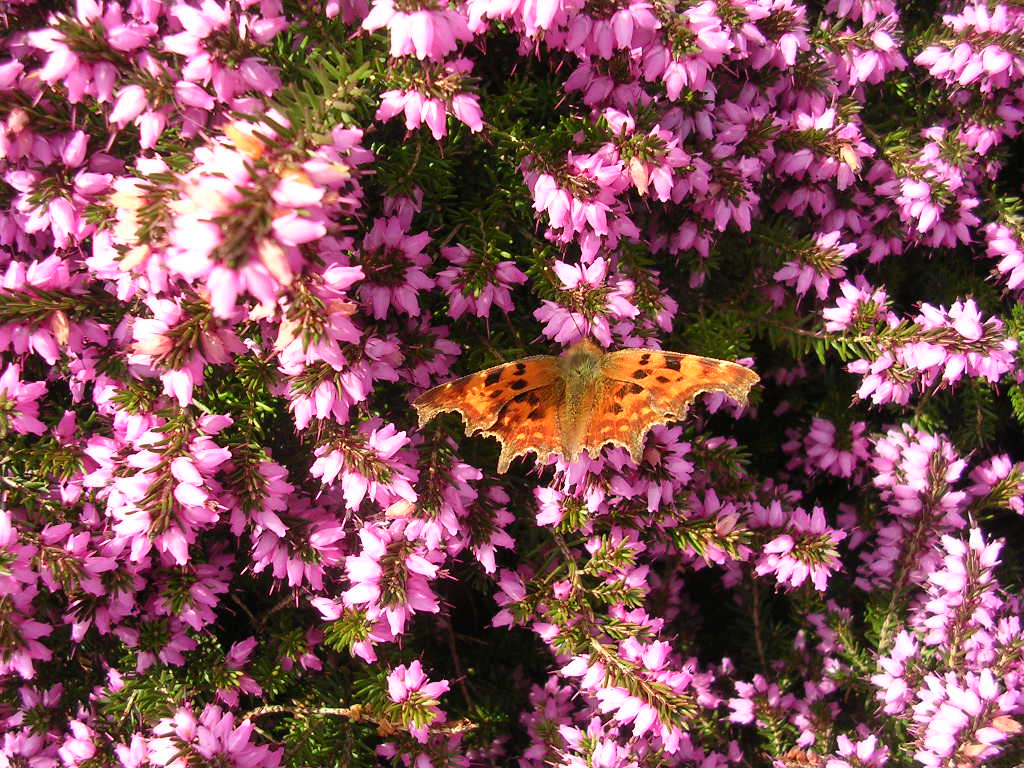
Winter-flowering Heather
My friend, Tony Pearson, has a patch of winter-flowering heather brightening up his front garden. Years ago (when I were nowt but a lad) this plant was known as Erica carnea - a perfectly sensible name for a something with flesh-pink flowers (Latin carnis - flesh). Then some bright spark pointed out that the first name given to this plant was Erica herbacea, and that by internationally accepted rules this must be its legitimate name. This decision caused an outcry, not only because 'herbacea' is inappropriate (the plant is not herbaceous, it is woody) but because gardeners and nurserymen had been using the name Erica carnea for generations.
My top photograph was taken yesterday (4th December) but the plants will remain in flower until we are well into spring, by which time it will be attracting numerous insects. Tony's plants include several cultivars: this pink specimen attracted a Comma butterfly earlier in the year and bumble bees such as Bombus hortorum also appreciate the early supply of nectar made available.
As wild plants, members of the Erica genus are extremely rare in Northamptonshire, simply because the acid soil they require is so uncommon within the county. The closely related genus Calluna is represented by Ling, Calluna vulgaris. This is also rare but I noticed a patch in a disused railway cutting near Charwelton some four or five years ago; I must check to see if it is still there.
As so often, I'll leave the last words to John Clare:
Still keeps the Ling its darksome green
Thick set with little flowers.
Shepherd's Calendar, 1827
Monday, 3 December 2012
Teasels
With a little human encouragement we now have quite a few teasel plants in our pocket park. Flocks of goldfinches frequently pass through and with their delicate bills they are adept at tweaking the seeds from the teasel seedheads. This year however they have missed some seeds and in the wet conditions a number of them have germinated before becoming detached from the plants, forming what botanists refer to as proliferous seedlings. My photograph, taken earlier today, shows one such seedhead, but a number were similarly affected.
Some plants such as the Alpine Meadow-grass Poa alpina depend almost entirely on this ploy to produce new plants; in other species it is a less frequent occurrence. In theory some of these teasel seedlings will drop to the ground and root but the odds are surely stacked against this happening. What a contrast this autumn has been to the baking conditions described by John Clare in his poem Noon, written in 1820:
By the hot relentless sun
E'en the dew is parched up
From the teasel's jointed cup.
Oh poor birds where must ye fly,
Now your water pots are dry?
He refers here to the paired leaves of the teasel which form a water-holding structure but I have never seen birds making use of these tiny reservoirs. The jointed leaves are apparent on the plant in the foreground of the picture below - a photograph taken earlier in the year.
The teasel, Dipsacus fullonum, gets its name from past use by fullers, who would make a brush from the prickly seed heads and so tease the surface of cloth to produce a nap. It was once regularly used to raise a nap on snooker tables. In most situations teasel heads have been replaced by other devices but for very fine cloth - including, I believe, the uniforms of the Household Cavalry - it is still used.
Spurge Laurel
This native evergreen shrub is frequent around Byfield, occupying waste ground and neglected corners of gardens. Despite its name it is neither a spurge nor a laurel but a Daphne, Daphne laureola. I write about it now because its flower buds are becoming quite plump and may burst into bloom within the next few weeks. If John Clare is correct -and he was an excellent observer of all countryside things - it may even bloom in autumn:
While Dark Spurge Laurel on the banks below
In stubborn bloom the Autumn blight defies.
Clare's Shepherd's Calender, 1827
In our village it begins to in flower in January and I photographed it early this year in Lovett Road. To our limited olfactory systems its fragrance is light; to that of a bee it may be far stronger. Certainly flowering in mid-winter it needs all the fragrance it can muster if it is to attract any insects for the flowers are quite inconspicuous. Somehow pollination is achieved because the shrub usually bears plenty of oval black berries later in the year.
Spurge Laurel is one of two laurel species once found in Northamptonshire. The other is - or was - Daphne mezereum, known commonly as Mezereon. It is thinly scattered in light woodland on limestone throughout southern England, but the last specimen known from our county was dug up from a wood at Evenley, near Brackley, in 1909. There is a good case to be made for planting a specimen or two in our village pocket park although there is reason to believe that the specimens known from Evenley Wood were garden escapes.
While Dark Spurge Laurel on the banks below
In stubborn bloom the Autumn blight defies.
Clare's Shepherd's Calender, 1827
In our village it begins to in flower in January and I photographed it early this year in Lovett Road. To our limited olfactory systems its fragrance is light; to that of a bee it may be far stronger. Certainly flowering in mid-winter it needs all the fragrance it can muster if it is to attract any insects for the flowers are quite inconspicuous. Somehow pollination is achieved because the shrub usually bears plenty of oval black berries later in the year.
Spurge Laurel is one of two laurel species once found in Northamptonshire. The other is - or was - Daphne mezereum, known commonly as Mezereon. It is thinly scattered in light woodland on limestone throughout southern England, but the last specimen known from our county was dug up from a wood at Evenley, near Brackley, in 1909. There is a good case to be made for planting a specimen or two in our village pocket park although there is reason to believe that the specimens known from Evenley Wood were garden escapes.
Sunday, 2 December 2012
Fossils and the Church Fete
On Saturday Chris and I called in at the Church Fete. It gave me an opportunity to study some fossils. I refer not to the senior citizens thronging the church aisles - or I would have to include myself - but to those visible in the church masonry. Byfield's Holy Cross Church, which is a fine Grade 1 Listed building, is built entirely from Jurassic stone, much of which came from quarries at Helmdon. Where the stone is rich in iron few fossils are to be seen but, where the lime content is higher, they are frequent.
On the left of the picture a belemnite can be clearly seen; a less obvious one is present in the top right hand corner. Belemnites - squid-like marine creatures - must have been extremely common in Jurassic seas. Certainly they are common in stone of this type but the two shown are not particularly good examples. Here and there around the village ammonites are also to be seen but the provenance of the stone is not always known.
Many lichens are present on the masonry but I doubt I'll ever get around to dealing with them all. The obvious white crusts are patches of Diploicia canescens, an extremely common lichen in this kind of situation.
Subscribe to:
Posts (Atom)