Monday, 8 January 2018

Photinia

When Chris and I lived in Byfield we had, at the back of our property, a specimen of Photinia 'Red Robin'. It had attained distinctly tree-like proportions and was an important feature of the garden. Unless my memory is at fault, it was a relatively uncommon plant a few decades back and in fact Photinias didn't really exist when I was a child.
Photinia davidiana make a neat and rather unusual hedge.
Stefen Hill, Daventry. 30 October, 2017
Of course that is nonsense, they did exist but masqueraded under a different name and in older books they are referred to as Stranvaesia species. Thus Photinia davidiana, The best-known species, was Stranvaesia davidiana. If the word 'stranvaesia' sounds odd, then blame the Latin language; the genus was named after William Fox-Strangeways, 4th Earl of Ilchester. Strictly speaking there is no 'w' in Latin and so Strangeways became Stranvaesia. Fortunately not all taxonomists have been quite so pedantic, for we have Lewisia, Wolffia, Weigela and so on.
Photinias, as members of the Rose Family, Rosaceae, are closely related to Cotoneaster and Pyracantha (but fortunately without the thorns of the latter) and share similar flowers and berries, Unfortunately, to encourage the bright red new growth, the shrub is often pruned quite hard so the flowers and fruit are lost. The removal of the berries may partly explain why the species is only occasionally naturalised.
As for the specific name, it commemorates the French missionary and explorer Armand David, remembered not only in this species, but also in the lovely tree Davidia involucrata and Pere David's Deer, Elaphurus davidianus, a herd of which may be seen at Woburn Abbey. [Note 1]
Now, in the depths of winter the cheerful bright red of the younger leaves is welcome but it does seem sad that secateurs and hand saws are so often taken to this potentially lovely tree.
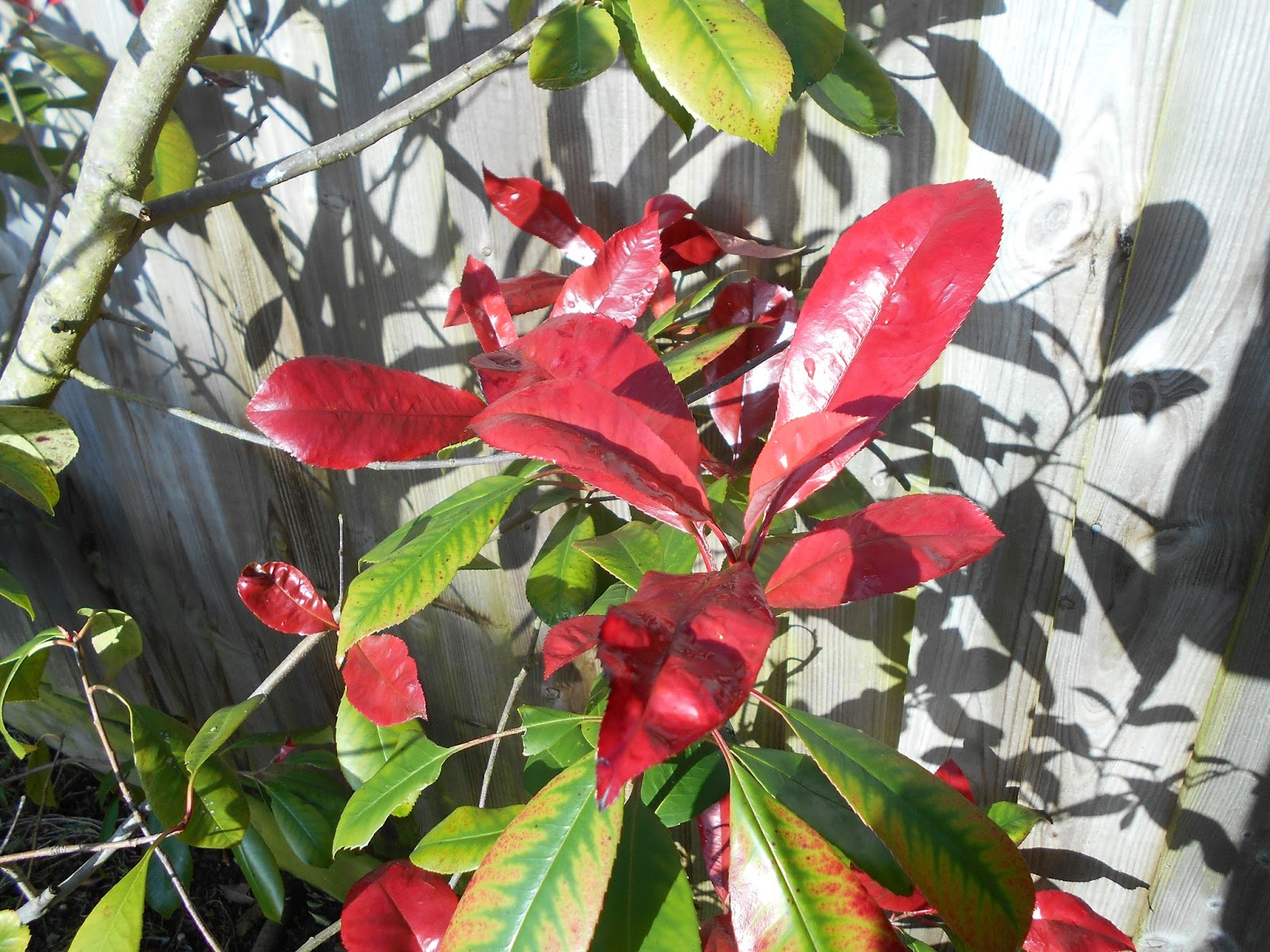
Photinia still providing colour. Stefen Hill, Daventry.
10 January, 2017


Notes


1.  The history of Pere David's Deer is a curious one. Armand David sent a carcass of the animal back to Europe where it was recognised as a new species. A few live specimens were then sent (illegally) back to Britain where a herd was established at Woburn. Shortly afterwards the species was declared extinct in the wild but fortunately those at Woburn were flourishing and subsequently (1985) some were returned to China and have been established in a wildlife reserve.


Sunday, 7 January 2018

Daventry Country Park on a c...c...c ...cold day

As explained in a previous blog, my trousers appear to have shrunk over the Christmas period. In an endeavour to rectify the situation I (together with my wife Chris and my daughter Jacqui, who face a similar problem) walked around Daventry Country Park. The bright blue sky was deceiving; the wind blew from the north-east and was bitterly cold. Puddles were frozen and I was a little surprised that edges of the reservoir, around which the park has been created, were not also frozen.
Gorse, Ulex europaeus, was in flower of course. On the acid, generally free-draining soil around Daventry it is common but it may surprise the non-botanist to find that we have three species of gorse in Britain.
Kissing was clearly in season. Gorse in flower at Daventry Country Park.
7 January, 2018


Western Gorse, Ulex gallii, is, as the name suggests, generally only found it the western parts of the country and has never been found in Northamptonshire. Dwarf Gorse, Ulex minor, does occur in this county but is extremely rare. It was recorded from Badby Woods back in 1843 but is now known only from Harlestone Heath. There it was also thought to be extinct but reappeared when presumably dormant seeds germinated following scrub clearance some years ago.
Around the reservoir bright colours were in short supply, with russets, browns and dull green shades dominating. A dead branch sported a growth of Yellow Brain Fungus, Tremella mesenterica, but any other colours were confined to bright anoraks or the  Christmas-present bicycles being pedalled furiously by children. Flowers were there none.
Yellow Brain Fungus makes a bright splash of colour on a dear branch.
Daventry Country Park, 7 January, 2018
 
Wet ground beside the water was dominated by willows and where they were joined by alders a carr-like woodland had developed. Many willows had collapsed into the water but there they will probably flourish.
Many willows had collapsed into the water. Daventry Country Park.
7 January, 2018
The usual waterbirds were present: coot, moorhens, mute swans and mallard plus the ever-hungry gulls. In a backwater a pair of Teal, Anas crecca, discreetly slipped away as we approached. This lovely bird, Britain's smallest duck, tends to stick to the edges of lakes and rivers and I rarely see it far from the bank or shore.  Away from the water birds were few but the ivy berries are ripening steadily and will be food for many thrushes and their like. Squirrels will batten on them too.
Ivy berries are turning from purple to black. Daventry Country Park.
7 January, 2018
The walk takes in some fine beeches, oaks and cherries, the latter often oozing sticky gum. This condition, known as gummosis, is a symptom rather than a cause of a problem. Gummosis can be caused by mechanical damage, the boring of insects or by bacterial infection. It may simply have been caused by the recent cold weather but identification of the cause is a job for the expert.
Gummosis on a cherry tree. Daventry Country Park. 7 January, 2018

Our walk concluded at the little café, where a brisk business in hot coffee was being conducted. Bing, Jacqui's little dog, is young and would have been game for another circuit but we had had enough. Time for home and lunch.


Friday, 5 January 2018

Thwarted!

First it was snow and ice, then it was a heavy cold, finally Storm Eleanor. In consequence I have been straining at the leash, champing at the bit - or whatever. Thwarted!
Nevertheless I have at last managed to get out of the house, even if my travels have only taken me as for as Daventry. 
There the gnarled and picturesque Caucasian Wing-nut, Pterocarya fraxinifolia, in Foundry Court, is yet to show any signs of life, but beneath the bark its cells are ticking over, awaiting signs of spring. Insoluble starches are being converted to soluble sugars for distribution to growth points and the swelling buds will demonstrate that all is well - we hope.

A Caucasian Wing-nut stands in Foundry Court, Daventry.
5 January, 2018
We take trees for granted; after all, a tree is just a big plant with a stick up the middle, yet every one is an individual.
A hundred metres from our house stands a Sycamore, Acer pseudoplatanus. It is not a tree to grab one's attention yet it has its points of interest. It has not been intentionally pollarded or coppiced but its three trunks diverge at an intermediate point; presumably some thirty or forty years ago the leading shoot was damaged and this 'poppice' or 'collard' is the result.
Coppice or pollard? Neither really. A sycamore at
Stefen Hill, Daventry. 5 January, 2018
With all but the most stubborn of leaves now whipped away from our deciduous trees by winter gales this is the ideal time to seek Mistletoe, Viscum album, for now it is at its most conspicuous. But my own searches have been in vain; mistletoe is a very scarce species in Northamptonshire, yet it has not always been so. Miseltoe (sic in older books) was apparently once far more plentiful in our county and John Morton, writing in 1712, tells us that (it is) common enough all over Rockingham Forest, but admits to its scarcity elsewhere in Northamptonshire. John Clare was clearly familiar with it too, writing:

                           And on old thorns the long-leaved Miseltoe
                           Regains fresh beauty as its parent dies!
                                                            
                                                                        Clare's Shepherd's Calendar, 1827

Now it is rarely seen although, as I have mentioned in a previous blog, it is abundant on lime trees in Kingsthorpe Recreation Ground, in Northampton.
Now, the hours of daylight are lengthening

                          Shine out, fair sun, with all your heat,
                          Show all your thousand-coloured light!

                                                                             Anon. 16th Century

This winter has lasted long enough.


Monday, 1 January 2018

2018: here we go

I, like millions in the Western World, have eaten far too much unsuitable food over recent days. In consequence my trousers have shrunk, barely meeting at the waist, so now I must pay the price. Unfortunately with the festivities has come a very bad cold so today I have put my plans for a long walk on hold.
Nevertheless Chris and I did make it as far as our allotment to drop off the components of a compost bin I am constructing. As we went though Draycott we were delighted to see drifts of daffodils in flower.
Daffodils brightened up a grassy verge in the Draycott area of
Daventry. 1 January, 2018

They were on a grassy south-facing verge, clearly a warm spot for elsewhere 'daffs' may not be in bloom for some weeks. For example, on our allotment we planted fifty or so bulbs but they are only just poking their noses through the cold, wet soil.
Incidentally we were pleased with the state of the allotment plot. We are aiming to preserve soil structure by avoiding digging except where it is essential. One consequence could have been a forest of weeds since, chickweed, groundsel and winter cress will germinate and grow even in winter. So we were delighted when we were able to find very few of these annuals.
As for my walk, tomorrow's weather forecast is promising so I'll give it another bash.


Sunday, 31 December 2017

And, to end the year...

Today we saw the last of the ice and snow swept away in this area as we enjoyed a balmy, spring-like day. It won't last of course but let's enjoy it while we can. Gorse is in bloom but there is nothing noteworthy in that. It is rarely out of flower.
Gorse, almost perpetually in flower.  Daventry, 30 December, 2017
I confess that I pay insufficient attention to gorse (or furze, as it was more generally known in 19th century Northamptonshire). During 2018 I'll be surveying Matt Moser's land for invertebrates and the gorse on his land - and there are some large clumps - will be well worth examining, not least for the very interesting ladybird, Stethorus punctillum. It is a predator on the Gorse Mite, Tetranychus lintearius, for which I'll also be looking.
On a completely different issue, I visited Byfield earlier today to visit an old friend, Angela. She was out, but I took the opportunity to take a quick look at the fungus growing on a birch stump in her garden.
Lenzites betulina on a birch stump. Byfield. 30 December, 2017
Fungi are definitely not one of my strengths but I have little doubt that the species in question was Lenzites betulina, aka Trametes betulina, known as the Birch Mazegill. Whilst not confined to birches it is certainly most commonly found on these trees.

In our own garden the shoots of Iris reticulata are pushing through. This delightful and deservedly popular species is native to Russia and the Caucasus where it faces far colder conditions than ours.
Iris reticulata grows beside the succulent and glaucous stems of Euphorbia
myrsinites. These prostrate stems have been attractive all winter.
Stefen Hill, Daventry. 31 December, 2017
Poor drainage is its greatest enemy but ours seem to do well and we can look forward to flowers sometime in January.
Oh, and a Happy New Year everyone, including the 207 Russian(s) who, according to my stats, have viewed this blog!


Friday, 29 December 2017

A double whammy

I have long passed the age when I found snowfalls at all exciting. I thought of taking a few photographs and there was a choice of snow, icy puddles, icicles, frozen slush and frost. On top of those miserable options I've had a stinking cold. A double whammy. Roll on 2018!
We have kept the bird feeder topped up but there have been very few visitors. A mavis sits, sentinel-like, on the garden fence but is completely uninterested in the bird feeder. Mavis is, of course, the old country name for a Song Thrush and comes from the old French mauvis. The Song Thrush is not a particularly common species hereabouts so I was pleased to see it. I was also reminded of the old song, Ca' the yowes, surely one of the loveliest of Britain's folk songs:


                                    Hark the mavis' e'ening sang,
                                    Sounding Clauden's woods amang;
                                    Then a-faulding let us gang,
                                    My bonie dearie.


It was of course collected, and probably tweaked a little, by Robbie Burns. It has more than once been set to music, most notably by Vaughan Williams. Can folk songs be composed or written? I suppose all are written or at least taken down at some point although it would be nice to feel that they are somehow autochthonous and simply evolve in a particular region. Romantic nonsense of course and yet, listening to some of the extremely primitive tunes collected by Bela Bartok, one wonders, because they appear to date from a time when most people were illiterate and also had had no way of writing down musical notation.
Anyway, I seem to have drifted off the point - whatever that was, but in short there was little to write about in terms of wildlife, zoological or botanical and I am left with a thought. The Latin name for the Song Thrush is Turdus philomelos and there must be many a woman in Britain or North America who thanks the gods that she was called Mavis and not Turdus.

Friday, 22 December 2017

Just a stroll down The Twistle

People walking south-west from Byfield towards Banbury along the A361 face an unpleasant quarter of a mile or so; traffic is generally heavy, fast and noisy, the roadside is featureless and it suffers badly from litter. It is a relief when a right hand turn can be made on to The Twistle and so into Byfield by the back door so to speak. Litter remains all too common and a considerable number of vehicles use this road but the noise of the A361 steadily recedes and relative peace prevails.
I was pleased to see that a long section of the hedgerow - perhaps three hundred yards or so - had been properly laid. Too often a heavy sort of flail is used to cut down hedges and, although the resultant scars heal, the immediate consequence is an ugly mess.
The Twistle, looking north towards Westhorpe. 22 December, 2017
Of course, laying a hedge by traditional methods means a temporary setback for wildlife (in this case a couple of fairly large ash trees had been removed) but the sunlight can get to the base of the hedge, promoting rapid development of the herb layer.  Aesthetically  too the result is far more pleasing. Nevertheless, at this time of the year there is little to get excited about.
Just before entering Byfield The Twistle crosses a cutting through which the Stratford-upon-Avon and Midland Junction Railway once ran. Access to this cutting has always been technically possible though made rather tricky by thick vegetation. But recently some shrubs seem to have been cleared allowing the cautious walker a way down.
Looking towards Byfield. The station would have been about 3/4 of a
mile away. 22 December, 2017
I have always had more than my fair share of reckless stupidity so I scrambled down the steep and slippery bank for a closer look.  To be honest it was barely worth the effort and yet I was pleased to have made it. With a degree of foresight this could have been developed as an attractive walk to Aston-le-Walls and beyond; now it is far too late.
Facing in the other direction was the bridge I had just left. The cutting beyond this point has been filled in (with household waste?) and is now farmland.
Looking west-south west towards Aston-le-Walls.
Puffing and blowing I regained the road and crossed the bridge. The parapets of this structure are showing their age with significant cracks developing and these will surely require attention before long.
Interestingly patches of calcite stand out starkly against the brickwork, showing where lime in the mortar has leached out as a solution in water only to precipitate and form these deposits (the same process as in the formation of stalagmites and stalactites). It may be that the rather acidic rainwater of recent decades has accelerated this process.
I pressed on and soon found myself entering Byfield via Westhorpe. Once a separate hamlet, the expansion of Byfield has led to the merging of these two settlements and it now forms one of the most attractive parts of the village. Mid-winter or not, flowers studded the carpets of Aubretia tumbling down south-facing walls.
Another plant, often overlooked, was a form of snowberry. The commonest Snowberry, Symphoricarpos albus, generally bears white berries, reminding me in colour and size of the mothballs of my childhood. This plant however differed in having smaller, pink berries; it is Symphoricarpos x chenaultii and may in fact be a form of S. orbicularis.
Symphoricarpos x chenaultii, Westhorpe Lane, Byfield.
22 December, 2017
As far as I am aware, all members of this genus are from North America. To be honest I regard these shrubs as rather lacking in interest but they have one redeeming feature: bees love the rather inconspicuous flowers for their copious nectar.
Winter Heliotrope, Petasites fragrans, was snaking through a wall at the corner of Westhorpe Lane. Like snowberry species, it is highly undistinguished (does that count as an oxymoron?) but, like true heliotrope (to which it is unrelated) it has a heavy fragrance, unfortunately not often obvious in cold and windy conditions. It is an invasive thug and is probably best avoided by gardeners.
Winter Heliotrope protrudes from a wall at the corner of
Westhorpe Lane, Byfield. 22 December, 2017
And that was about it. In midwinter botany may not throw up surprises but the fact that something is commonplace does not mean that it is lacking in interest.


Tony White. E-mail: diaea@yahoo.co.uk