Thursday, 30 May 2019

Minefulness

We are more or less at the end of May. Insects have now been galling plants and creating leaf mines to the point where they are more obvious and the creatures responsible can be identified with some degree of confidence.


I went for a constitutional around Stefen Hill Pocket Park earlier today and the first thing to catch my eye was indeed a mine.
The larvae of Aulagromyza hendeliana mine honeysuckle leaves
and are very common. Stefen Hill Pocket Park, 30 May, 2019


It was on honeysuckle and the insect responsible was a fly, Aulagromyza hendeliana. Its mine, which generally hugs the leaf margin, is distinctive with grains of frass (poo) in the form of evenly distributed grains. Not a lot of people know that - nor, I am sure, do they particularly want to.


In fact, despite the title of today's blog, I failed to find many mines, but plant galls were more evident. Cecidology, the study of plant galls, takes in many disciplines. Some botanical knowledge is essential and the galls themselves can involve many groups of creatures: wasps and flies (entomology) and mites (acarology) are often responsible. Then there are fungi, particularly rusts, so theoretically mycology is involved too, although I admit that at the level at which I record galls it is not really necessary.


Oaks are galled by a particularly large number of creatures and the picture shows the work of a gall (Cynipid) wasp, Andricus curvator. Its galls can confusingly take several forms depending upon which part of the plant has been selected.
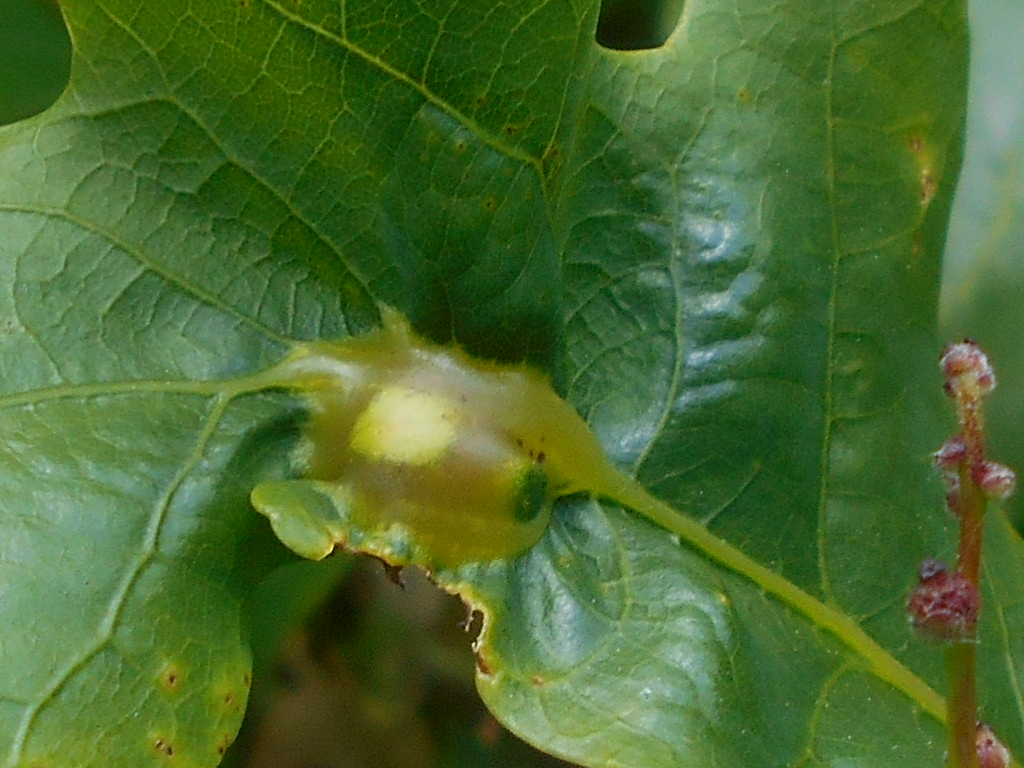

The cynipid wasp, Andricus curvator, is a common creator of galls
on oaks. Stefen Hill Pocket Park, 30 May, 2019
There was also the tatty but unmistakeable remains of a gall from last year. It was a Ramshorn gall, Andricus aries, caused by another cynipid wasp. I had to stand on tiptoe to photograph it, so apologies for the quality.


Andricus aries forms the distinctive Ramshorn Gall. This is a specimen
lingering on from last year. Stefen Hill Pocket Park, 30 May, 2019
Speaking of oaks, I had hitherto only found one specimen but today a spotted a second. It was not at all typical and I hesitate to put a name to it. It is rather like a White Oak, Quercus alba, a North American species sometimes planted for ornament, with leaves turning red in the autumn. And yet...


Quercus alba? I'm not convinced but if acorns form they may provide an
answer. Stefen Hill Pocket Park, 30 may, 2019
Anyway, I'll keep an eye on it for acorns.

Ash trees are galled, but the example I photographed is the work of a psyllid bug, Psyllopsis fraxini. It causes the leaflet edge to develop a reddish coloured roll.

Few ash trees escape the bug, Psyllopsis fraxini. Stefen Hill
Pocket park, 30 May, 2019.
And that was about it. There were smallish galls on Field Maple which I won't bother the reader with, and the only other thing to trouble my camera was a tight ball of spiderlings.

A feast for birds! Spiderlings on a goosegrass stem.
Stefen Hill Pocket Park, 30 May, 2019
They were on the tip of a goosegrass stem and almost certainly were Araneus diadematus offspring. They will soon start to disperse and statistically only a couple should survive to replace their parents. This profligacy troubled Alfred, Lord Tennyson:


                             Are God and Nature then at strife,
                             That Nature lends such evil dreams?
                             So careful of the type she seems,
                             So careless of the single life.


Who would be a spider?


Wednesday, 29 May 2019

A Pocket Park Potpourri

I was in Byfield today and, with time to spare, had one of my irregular mooches around the pocket park. For late May the weather was disappointingly cool and insects were as rare as Philip Green apologies.


First up was a pair of tortoise beetles on a burdock leaf. We have eleven of these beetles in the U.K. The species I saw today was the Thistle Tortoise beetle, Cassida rubiginosa. The specific name 'rubiginosa' refers to the red liquid which can 'bleed' from around the head region when the beetle is alarmed.


Thistle Tortoise beetles on burdock. Byfield Pocket Park, 29 May, 2019

Despite being on burdock it is generally found on thistles, especially Creeping Thistle. This is common everywhere, but the pocket park also contains Spear Thistle and I photographed one of its beautifully architectural flowers in the pocket park only a few days ago.
Spear Thistle, Cirsium vulgare. Byfield Pocket Park, 26 May, 2019

Another tortoise beetle, Cassida vibex occurs in the pocket park and was recorded only about five days ago. It too feeds on thistles.

Yet another beetle was noted today, although to the non-enthusiast it was not obviously a beetle at all. Like butterflies, beetles also go through a 'caterpillar' stage and this curious creature is the larva of a Viburnum Leaf Beetle, Pyrrhalta viburni.

Viburnum Leaf  Beetle in its larval stage. Byfield Pocket Park,
29 May, 2019

It was on one of the Guelder Rose, Viburnum opulus, shrubs in the pocket park. The beetles are a serious pest across Britain, making a real mess of the foliage.

It is not welcome in gardens! Byfield Pocket Park, 29 May, 2019
Almost directly beneath this shrub was a mallow plant. It too was in a bit of a mess but this time no insect was involved. Instead it is a fungus - Hollyhock Rust, Puccinia malvacearum. As will be guessed, it is also a pest on garden hollyhocks.

Common Mallow afflicted by Hollyhock Rust. Byfield Pocket Park.
29 May, 2019

A hedge of Beech separates the pocket park from the village burial ground. Some of the beech leaves had curiously rolled edges and in this case the culprit is a mite, Acalitus stenaspis. It is very common but easily overlooked.
The rolled edges of these beech leaves betray the presence of the mite,
Acalitus stenaspis. It seems to do little harm. Byfield Pocket Park,
29 May, 2019


I was about to go when I took a casual swish with my net through the foliage of a birch tree and found I had taken a Birch Shieldbug, Elasmostethus interstinctus. This was hardly a surprise as it is common enough, but confirmation of its presence was pleasing.

A sweep of my net revealed the presence of Elasmostethus interstinctus
in a birch tree. Byfield Pocket Park, 29 May, 2019
So, cool conditions meant that few insects were on the wing, but my visit was far from boring. Even so, a spot of warm sunshine would be welcome.


Friday, 24 May 2019

Allotmenty things

Our allotment plot received a visit today: I put in a short row of a dozen spuds. Things seem to be progressing nicely but there is plenty that could yet go wrong.


Last year I grew a patch of Phacelia, Phacelia tanacetifolia, intending to dig it in as a green manure. In fact I allowed it to flower, not having had the heart to rob bumble bees of this bounteous source of nectar.


Inevitably a few plants self-seeded. I left them to develop and they have begun blooming over the past few days. The flowers of this North American annual form a raceme which curls over like the neck of a violin, giving it the name of Fiddleneck, although it is often simply called Lacy Phacelia or even Blue Tansy. Although 'tanacetifolia' means 'with leaves like Tansy', the two plants are unrelated.
Fiddleneck, Phacelia tanacetifolia, has self-seeded on our allotment, where
it is very welcome. Drayton, Daventry. 18 May, 2019


I was expecting it to attract bumblebees and indeed it has, with this Buff-tailed Bumblebee, Bombus terrestris, so furry that it looks way out of focus. This is the relatively small female worker; the queens are considerably bigger.


The Phacelia was attracting bees - as I had hoped.
Drayton Allotments, Daventry. 18 May, 2019...
A Red-tailed Bumblebee, Bombus lapidarius, was equally busy on the following day.


Red-tailed Bumblebees can have a yellow, rather than a red, tail.


I was not expecting to find shieldbugs visiting, but this Hairy Shieldbug, Dolycoris baccarum, was also present. Was it planning to take nectar? I'm not sure. It tends to feed on unripe fruits of various plants and I have never positively seen one nectaring.

...but had also attracted this Hairy Shieldbug (aka Sloe Bug).
Drayton Allotments, Daventry. 18 May, 2019
With many of the crops, such as lettuces, potatoes, and rhubarb flowering is unnecessary and in the case of the later any flowers should be removed as they divert energy away from the production of the leaves with their long, edible petioles.
No bees? Not a problem for the lettuce grower. Ours are doing nicely.
20 May, 2019

Broad beans, Vicia faba, are now coming into flower and I am hoping that the bees visiting the Phacelia will divert to the bean flowers. Last year we had a good crop so I am optimistic.


The broad bean was once known as Faba bona and as such gives its name to the whole of the huge Pea Family, Fabaceae. Oddly enough the Broad Bean is unknown as a wild plant and may somehow have evolved as an agricultural accident. It is not known from early Neolithic sites but is present in later Iron Age deposits. It seems to resemble maize, also unknown in the wild, in its evolution via agriculture although this American plant is found from more ancient archaeological sites in Mexico over 9000 years old.


Diversity

At Foxhill Farm Matt Moser is employing a variety of techniques to increase the diversity of wildlife on his land. The changes won't come overnight but already some of his efforts are bearing fruit.


Hedgerows over much of this region are basically hawthorn. It is cheap, grows easily, is subject to few diseases and with just a little effort can be made stockproof. But Matt is looking to enrich these hedges, a good example being the one on the western edge of the farm which forms the boundary between his land and the A361. Yesterday Chris dropped me off en-route to Byfield where she was meeting friends and I took a closer look.


Hawthorn is still the basis of the hedge and is, of course, excellent for wildlife. Spot the shield bug? It is centre-right on the photograph, a specimen of the Green Shieldbug, Palomena prasina.

A green shieldbug is halfway down on the right hand side.
Foxhill Farm, 23 May, 2019

Native shrubs have been included in the hedge, which was re-laid a few months ago. The treatment looks harsh but recovery is rapid. The Guelder-rose, Viburnum opulus, is flowering well and is very eye-catching.

I am always pleased to see Guelder-rose. Foxhill Farm, Badby, Northants.
23 May, 2019
Less obvious are the flowers of Spindle, Euonymus europaeus. Its season of glory will be the autumn, when the lovely, sealing-wax pink fruits will be attracting birds. At least three galls are known to occur on spindle. None is obvious without careful examination but I'll try to keep an eye open for them.

The simple flowers of Spindle are not obvious to us but small insects
 manage to find them. Foxhill Farm, 23 May, 2019

Scrambling through herbs around the base of the hedge grows Black Bryony, Tamus communis, our only native member of the Yam Family, Dioscoreaceae. (Black Bryony's alternative but little-used name is Dioscorea communis.)


The flowers of Black Bryony are even less obtrusive.
Foxhill farm, 23 May, 2019
 Like spindle its flowers are hardly spectacular and it too is most valued for its autumn fruits which take the form of scarlet berries.


Ox-eye Daisies. Always welcome along the roadsides.
Edge of Daventry, 23 May, 2019
All this is very encouraging. I was also pleased as I walked home to see how well Ox-eye Daisies, Chrysanthemum leucanthemum, are flourishing at the side of the A361. As kids we always referred to them as moon daisies. I hope the authorities can resist spraying them for they not only look attractive but attract plenty of insect life too. Once roadsides are left unsprayed they are one of the first flowering plants to re-colonise these areas. They are one of the parents of the much-grown Shasta Daisies, Leucanthemum x superbum, of gardens.


Wednesday, 22 May 2019

Kentle Wood: doing nicely

I visited Kentle Wood earlier today and came away feeling just a little more optimistic about the future. It isn't perfect but since its planting as a millennium project it has been maturing nicely. Another thousand Kentle Woods and we'll be getting somewhere.


Insects abounded and this gathering of Dock Bugs, Coreus marginatus, was very unusual - at least, in my experience. I counted twelve, including five mating pairs. There must be something in the water.


Dock Bugs on - what else - dock (actually Broad-leaved Dock'
Rumex obtusifolius). Kentle Wood, 21 May, 2019


Several specimens of the red and black froghopper, Cercopis vulnerata, were seen on my walk. This species seems to be having a good year. The nymphs live underground where they feed on roots, but they aren't numerous enough to do much damage.


Red and Black Froghoppers were frequent. Kentle Wood.
21 May, 2019
I generally steer clear of sawflies. They form an interesting group but a comprehensive guide to their identification is unavailable. Having said that, certain species are quite unmistakeable, like this Tenthredo mesomela. Although it feeds on pollen and nectar it will often make small insects part of its diet.


One of the more distinctive sawflies, Tenthredo mesomela.
21 May, 2019
Craneflies such as Tipula species are conspicuous with their strong but bumbling flight. Relatively overlooked are the closely related limoniids. The photograph shows Limonia phragmitidis, easily recognised by the three spots on each wing and the stripe down the middle of the pale yellow thorax. It is very common in spring.

Limonia phragmitidis was abundant at Kentle Wood today.
21 May, 2019
With a few notable exceptions spiders tend to be unphotogenic and I only took one picture. It shows a common crab spider (they often shuffle along sideways), a female Xysticus cristatus. This specimen has a rather large abdomen and may be distended by eggs.
Britain has close on twenty species of crab spiders but Xysticus cristatus is
 perhaps the commonest. Kentle Wood, 21 May, 2019


Many beetles of the genus Cantharis have quite a bright red coloration or frequently they  are of the dull yellow-red colour referred to by coleopterists as testaceous. To us as kids they were all bloodsuckers. The fact that do not suck blood was irrelevant. However they are mostly predators and hunt among grasses and herbaceous plants. Cantharis rustica always has a dark blotch on the pronotum (the top of the thorax) but the form of the blotch is variable.


Cantharis rustica is variable but generally easily recognised - and very
common. Kentle Wood, 21 May, 2019
Kentle Wood has been in existence for under twenty years and the insect life, despite a limited range of flora, has proliferated amazingly. I have recorded 480 species and yet have barely scratched the surface, with few moths, no aphids, no snails, no ants and only a handful of bees, wasps and sawflies on the species list. We cannot (yet) bring back species from extinction but with public goodwill (which is developing fast) and government backing (sadly limited by interest groups such as those which control grouse moors) the ghastly destruction of the world's biosphere can be stopped and then reversed. The Knepp Estate re-wilding project shows how it could be done. 

But it must start soon.


Postscript


An examination of a green-eyed tephritid fly taken on Goat's-beard, Tragopogon pratensis, showed that it is the rather scarce Orellia falcata. A very pleasing record.


Monday, 20 May 2019

Fasciation

How often, as we queue at a Tesco checkout, have our minds turned to the matter of fasciation. Indeed, in Daventry we speak of little else. Well, perhaps I exaggerate a little, but it is a curiosity familiar to most gardeners. Fasciation is described in botanical works as  'a malformation of plant stems commonly manifested as enlargement and flattening as if several stems were fused.' Little is offered in the way of explanation for these odd distortions.

A Gaillardia with the flower head displaying fasciation.
Daventry market. 4 July, 2017
On Daventry market a while back a Gaillardia showed a distorted flower head, the normally round disk florets having taken up an oval shape. This was the result of the stem immediately below the flower being flattened.

More recently a walk in Daventry Country Park produced another example, this time involving Black Bryony, Tamus communis. The stems of this climbing plant (which, incidentally is the only British representative of the Yam Family, Dioscoriaceae) were distinctly flattened, although the plant itself appeared healthy.


Black Bryony with the stem displaying fasciation. Daventry Country Park.
19 September, 2017

In Stefen Hill Pocket Park today a dandelion was also displaying fasciation and again it was the stems affected. They were greatly flattened, looking very broad from one direction...

The stem of this dandelion is very flattened. Stefen Hill Pocket Park.
20 May, 2019
...but extremely thin from another angle. The flower head was also distorted , though less obviously.


From this angle the degree of flattening is obvious.


Fasciation is always a malformation affecting the stem. No other organs are directly affected but, as in the case of the inflorescence of the Gaillardia there may be some consequent distortion.


Thursday, 16 May 2019

More Foxhall Farming

Recently I have been paying a lot of attention to sites such as Byfield Pool and Stefen Hill Pocket Park and the consequence has been a neglect of Foxhill Farm. Today I balanced things up a bit, but my return to the farm brought no spectacular results. For all Matt's hard work the flora and fauna are still limited but he has made a good start and future generations will reap the benefits. 


There are a few orchids at Foxhill Farm but I saw none today and it is still a little early for them. The plants I saw were predictable and perhaps a little mundane - but welcome. Pink campions welcomed me as I stepped through the gate and in damper parts of the meadow cuckooflowers were plentiful.


Pink campions were around gates and along hedgerows. Foxhill Farm,
near Badby, Northants. 16 May, 2019
Rather less commonly seen is Pignut, Conopodium majus, but there were plenty of these around, with their filigree leaves. Like the cuckooflowers this is a species which has declined with the drainage of many old meadows and has probably suffered rather more. Its tuber can be eaten but tends to be six inches or more beneath the surface at the end of a thin, easily-broken root. It was probably the 'fairy potato' dug up by Caliban in 'The Tempest'.


Pignut is still locally common but has suffered a drastic decline.
Foxhill Farm. 16 May, 2019
Yellow Rattle is another plant of old meadows but here the situation is rather different for I am 90% certain that this has been introduced by Matt to his land, the seeds being readily available from specialist dealers. As a hemi-parasite it weakens rank, dominant grasses and gives smaller species a sporting chance. In the Welsh border country it is known as rochlis, the death rattle. (John Lewis-Stempel, 'Meadowland - the Private Life of an English Field'.)

Yellow Rattle seems indispensable in the ecology of good meadowland.
Foxhill Farm. 16 May, 2019
The only other plant I photographed was Germander Speedwell, Veronica chamaedrys. Like other speedwells they were sometimes carried by travellers to provide good luck when setting out on a journey. This species, perhaps the commonest speedwell in meadows, can be recognised by lines of white hairs on opposite sides of the stem.
Germander Speedwell. A brilliant patch of azure in meadows.
Foxhill Farm. 16 May, 2019

I only took my camera to a couple of insects. One was very easily recognisable. Known as the Red-and-Black Froghopper, Cercopis vulnerata looks lather like a large but misshapen ladybird, but as soon as it jumps - which it does very readily to the frustration of a photographer - it becomes clear that it is quite different. It is a type of bug and soon becomes familiar to anyone visiting grasslands in the summer.

Red-and-Black Froghopper - or is it Black-and-Red Froghopper?
Foxhill Farm. 16 May, 2019

The other insect photographed was a caterpillar. Insects have six legs, and yet the the caterpillar appears to have more. Its six 'true' legs are at the front of the body; towards the rear end are four pair of so-called prolegs then finally a pair of claspers.
Brown-line Bright-eye (I think) Foxhill Farm. 16 May, 2019


This caterpillar was on grass and I'm reasonably confidant that it is a Brown-line Bright-eye, Mythimna conigera. Hardly exciting as it must be one of Britain's commonest moths. Its chestnut-coloured cocoon is often dug up by gardeners when weeding.