Saturday, 5 January 2013

Witch-hazels

As I sat down to write this blog I realised that I didn't have the foggiest idea of how Witch-hazels got their name. I suspected that it had nothing to do with witches, and in this I was right: it appears that "witch" as used here comes from the Old English wican - to go away. This still left me puzzled but perhaps it refers to a preparation made from the bark: it makes bruises go away. There is an alternative possibility: the word "wice" in Old English means pliant or bendable and, like our own native hazel, Witch-hazels could be used to weave "wicker" baskets. So, as I sat down to write this blog I realised that I didn't know how Witch-hazels got their name...and I still don't know!


Hamamelis mollis


I grow the Chinese Hamamelis mollis and it seems happy, having grown steadily since being planted four years ago. I have also added the rusty-flowered hybrid Hamamelis x intermedia "Aphrodite", the parents of which are H. mollis and a Japanese species, Hamamelis japonica. Witch-hazels are not found in Europe and are not at all related to our own native hazel (photographed in Byfield Pocket Park last spring) but their foliage and habit are broadly similar.


Hamamelis x intermedia

Both my Witch-hazels are in flower now and have a spicy fragrance, presumably to attract insects but I have yet to note any visitors. In fact it seems that, even in the wild, insect pollination is not commonly observed. The rarely-grown North American species, Hamamelis virginiana, flowers in late autumn and it has been reasonably postulated that all Witch-hazels flower in these chillier months to avoid competition for pollinating insects. I have to admit that if Hamamelis species grew in mid-summer I wouldn't bother with them but as I look out of my window now their appearance pleases me. My specimens also have glorious autumn foliage of crimson-orange - although they were a disappointment this last season. 


Hazel, Corylus avellana in Byfield Pocket Park
 

Friday, 4 January 2013

To Parson's Spinney

Another fine day persuaded me to stretch my legs along the disused railway track bed which runs west from Byfield. This was the Stratford-upon-Avon and Midland Junction Railway - the SMJ - otherwise known as the Slow, Miserable and Jolty Railway.


The Track Bed

As my photograph shows, the track bed is still easily walkable over some stretches and provides easy access to Parson's Spinney.

I found that I was following some deer tracks, the size and shape of the "slots" (50 pence coin for scale) showing that they were Fallow Deer. Like me, they were also making for Parson's Spinney. This is a rather attractive patch of wet woodland in which I have taken many Dolichopodid flies - known as "dollies" for short. The drier patches support several fine cherry trees, recognisable by the horizontal stripes on the bark. This species is Prunus avium, sometimes known as the Gean, and is a wonderful sight in late spring when, as A.E Housman wrote:


                                                            Loveliest of trees, the cherry now
                                                                                    Is hung with bloom along the bough.


I will doubtless be visiting this site several times over the coming months in search of insects. However, today only one fly was taken, Sylvicola fenestralis, known as the Window fly from the place where it is often seen - but here quite a long way from the nearest window.
Wild Cherry  Prunus avium

Wednesday, 2 January 2013

Of Zeller's Midget and other things


In these short winter days the naturalist tends to note things which might otherwise be overlooked.

Byfield's pocket park is home to a couple of Holm Oaks, Quercus ilex, and I noticed today that several of the leaves have been mined by a very small moth with a very long name, Phyllonorycter messaniella, otherwise known as Zeller's Midget. The species is widespread across the south and midlands of Britain but becomes very rare further north. This is probably the first record for Northamptonshire. It is named after Philipp Christoph Zeller, who first described the species.                                                
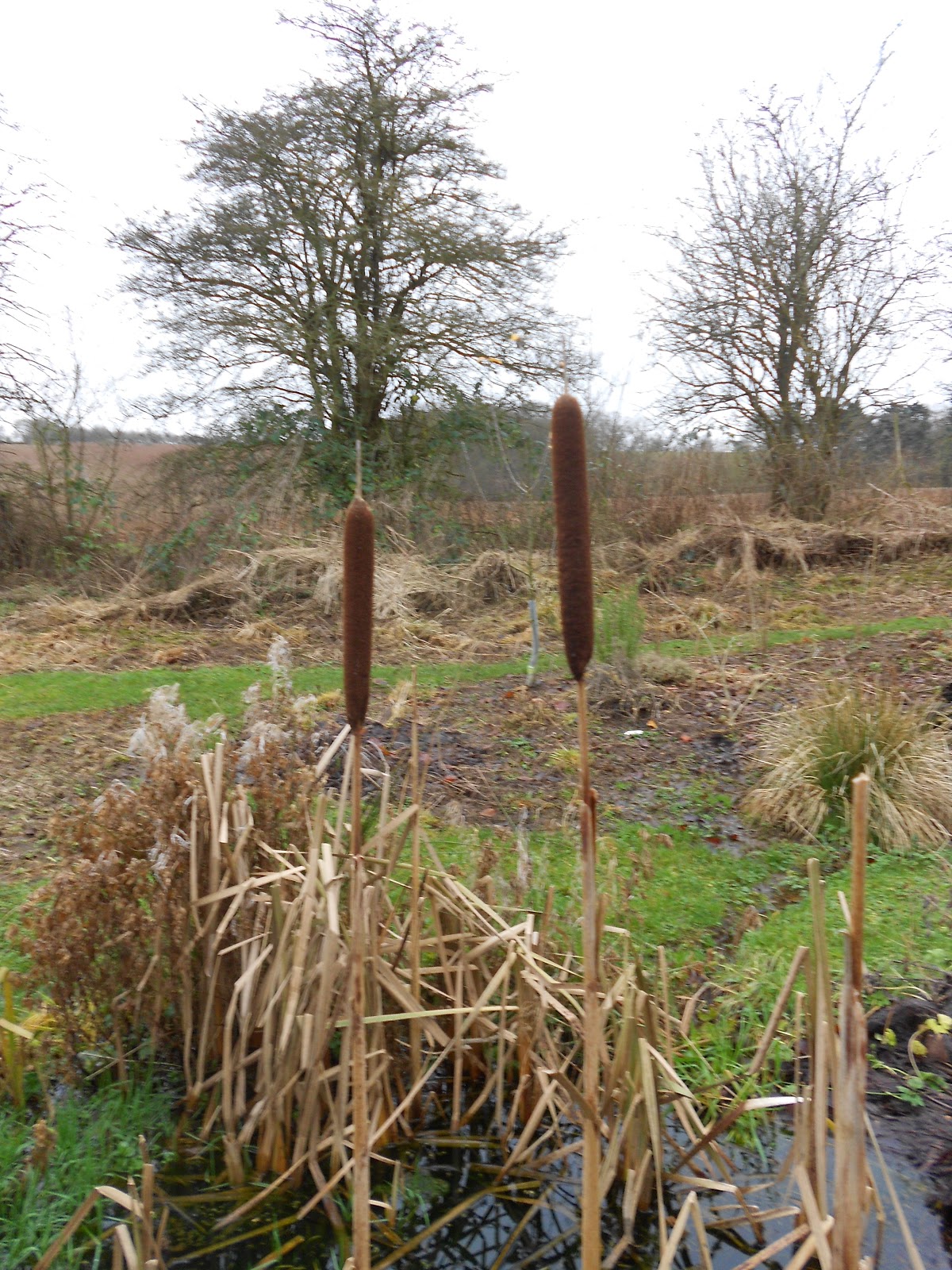
                                                                  At the edge of the pocket park is a small pond which has been colonised by Common Reed-mace, Typha latifolia, often called Greater Bulrush. This is one of several plants I intend to monitor over the next few months with the hope of recording the Bulrush Wainscot, a moth yet to be recorded in the park.

Reed-mace or Bulrush? This is a long running argument. Reed-mace is regarded as the older name but apparently a Victorian painter produced a picture of "Moses in the Bulrushes" and illustrated it with Reed-mace (instead of the "true" Bulrush, Scirpus lacustris). This is said to be the source of the confusion but the argument persists. Indeed, in Northamptonshire pubs the talk is of little else. The problem is avoided in North America where these plants are called Cat-tails.  


Greater Reed-mace Typha latifolia in Byfield Pocket Park

e-mail: diaea@yahoo.co.uk 


Tuesday, 1 January 2013

King Alfred's Cakes and Marble Galls


Daldinia concentrica
 New Year's Day. Waking up to brilliant sunshine I needed no persuading to go for a walk in Byfield's Pocket Park. Just inside the park an Ash tree was sporting a good number of King Alfred's Cakes. The growths are actually a fungus, Daldinia concentrica, and the name presumably refers to the fact that these hard structures look like burnt cakes. Their other name is Cramp Balls, stemming from a belief that, if carried in the pocket, they could prevent cramp. 

Oak Marble Galls

A little further on an oak bore several Marble Galls. These are quite different from Cramp Balls (which technically are not galls at all) and are caused by a gall wasp, Andricus kollari. The insect lays its eggs in a soft twig and, when an egg hatches, the grub begins to tunnel into the tissues; these respond by forming a gall in which the grub completes the first part of its life cycle. The insect, now bearing wings, tunnels out of the gall, leaving a hole. A couple of these are visible in my photograph. In fact the life cycle of gall wasps is usually very complicted and I do not intend to go into detail here. The study of plant galls, knows as cecidology, can greatly enhance a simple country walk.

Monday, 31 December 2012

House Spiders

It was the late Gordon Osborn, a genial retired butcher from Olney, who first - inadvertently - guided me towards the study of spiders. His own interests were snails and fleas, and we noted that certain invertebrate groups were very neglected. I felt that spiders were much maligned and therefore given little attention, not realising that in the Northamptonshire village of Wadenhoe lived Eric Duffey, one of Europe's most distinguished arachnologists. He had, in 1956, discovered one of Britain's largest and rarest spiders, Dolomedes plantarius, at Redgrave Fen; but for Eric's efforts the spider would probably have become extinct there. When Eric retired to France I took over as Spider Recorder for Northants. However, I digress...

I do limited work on spiders nowadays but generally check out any which, for one reason or another, come to my attention. In our house in Byfield I have noted about a dozen species, of which four are "regulars". I mused on these matters when contemplating the imminent removal of the Christmas decorations for there, tucked away in the corner of our living room, was a large, untidy web of the Daddy Long-legs Spider Pholcus phalangioides. This species is rarely, if ever, found outside buildings in Britain, suggesting that it is not a native to this country but is a relatively recent arrival. People who dislike spiders may be pleased to learn that other spiders form a large part of the diet of Pholcus so arachnophobes have a dilemma: leave it to keep down the population of spiders in the house, or get rid of it. It does not need to be described in detail for no other house spider has this combination of long legs and a large tangled web. Incidentally phalangioides means "like a harvestman (Daddy Long-legs)".

The Mouse Spider Scotophaeus blackwalli is also more or less confined to houses, and turns up here from time to time. I'm afraid it is quickly dispatched as it has been known to ruin insect collections by chewing the specimens; I'm not going to expose my collection to this danger. It also has a rather nasty bite which can take a week or more to clear up. This species is 8-10 mm long with the females being generally larger than the males; it has a mouse-grey colour, giving this spider its common name, and is more or less nocturnal in habit.

From time to time, often on a late summer evening, a large, long-legged spider will emerge from behind an item of furniture and dash across the floor. This is the House Spider Eratigena atrica (=Tegenaria gigantea). Though most often found in buildings it does occur in hollow tree trunks, beneath overhanging banks, and so on. The females reach a body length of about 16 mm, justifying the specific epithet of 'gigantea' - and they will bite, although only under unusual circumstances. I once had a large female in a specimen tube and had mislaid the stopper, so I put my thumb over the tube while I rummaged around. Big mistake! However, the well-deserved bite was no worse than a wasp sting and the pain lasted less than 48 hours. The males are smaller than the females and it is males which are most often seen as they go out, reeking of Old Spice and carrying flowers (Now Tony, don't be silly!) in search of females.

The fourth, and most common spider in our house is Amaurobius similis, but you will be relieved to know that I'm leaving comments on this species until a later blog.


Saturday, 29 December 2012

Sand Dunes and Christmas Trees.

The sand dunes at Winterton on Sea (see previous blog) seemed in a pretty good condition, with the Marram Grass doing its vital job of stabilisation, but elsewhere along the coast I noticed worrying signs of erosion. In many places such as Formby and along the Essex coast Christmas trees are being strategically placed to augment the work of the Marram Grass and help in the job of re-establishing dunes. Most communities seem to arrange a post-Christmas collection (our local authority certainly does) and I'll be dragging our tree out and adding it to the heap shortly. 

The tree most commonly used for decoration purposes at Christmas is of course the Norway Spruce Picea abies. It is not native to Britain but where plantations have been established self-sown seedlings are common. This is not surprising as it certainly has been native to our islands during more recent interglacials, with the pollen sometimes being found in considerable quantities. So, although "alien" species are often unwelcome, we should perhaps not be too alarmed if the tree becomes a minor feature of suitable terrain. Furthermore it does support a number of interesting insects such as the Spruce-cone Bug Gastrodes abietum, the Great Spruce Bark Beetle Dendroctonus micans and a tortrix moth Cydia illutana - although it has to be said that some of these insects are not welcomed in plantations! A couple of fairly mature Norway Spruce are present in Byfield Pocket Park and I'll be monitoring them in the coming year.

Friday, 28 December 2012

A Winter's Day at Winterton

Chris and I decided, almost on the spur of the moment, to slip away and spend Christmas in the Norfolk Broads. The weather was remarkably good and the highlight was actually on Christmas Day, when we visited Winterton on Sea.

We had no idea of what to expect and were astonished to find a wonderful area of dunes and dune slacks. Most unusually the soil conditions were acid, with ling, gorse and birch being prominent. Predictably, the gorse was in flower (see blog for 8 December).

Some of the birches were really picturesque, with contorted trunks as shown in the second picture. This can possibly be explained by rabbits - of which there is a large population - nibbling away at seedlings to produce natural coppicing. Away from the trees there were large patches of Polypody (a fern mentioned in a previous blog) together with areas covered with a grey lichen. It was a species of Cladonia and could be Reindeer Moss (Cladonia rangiferina) but I am far from certain. Not surprisingly, the area is a National Nature Reserve.

The walk back along the beach was far less interesting but we were intrigued by a group of a dozen or so Common Sandpipers at the water's edge performing tiny hopping movements, perhaps to disturb small invertebrates. For this homeward walk we were blessed with bright sunlight, our bodies casting grotesquely long shadows across the sand. A Christmas Day to be remembered.