 Anyway, it is a very common fungus which I have only ever found on Elder, although it apparently occurs on other trees. Its Latin name of Auricularia auricula-judaea is a direct translation of its common name. I spotted these specimens yesterday when out on a walk with my friend John Pimm near Charwelton. According to the usual books it is edible. I consulted Google and found a recipe for cooking Jew's Ears with sorrel and ginger. Call me conservative but I can't claim I'm tempted.
Saturday, 22 December 2012
Jew's Ear Fungus
The common name of this fungus is seen as politically incorrect in the USA where the name Jelly Ear is being used as an alternative. Why I don't know: Dicentra cucullaria is known as Dutchman's Breeches and we also have Hottentot Fig (Carpobrotus edulis), so where's the problem? Jew's Ear apparently gets its name from a belief that Judas Iscariot hanged himself from an Elder Tree. Depending on which legend you read he also hanged himself from a Judas Tree (Cercis siliquastrum) and a Hawthorn. He was obviously very thorough.
 Anyway, it is a very common fungus which I have only ever found on Elder, although it apparently occurs on other trees. Its Latin name of Auricularia auricula-judaea is a direct translation of its common name. I spotted these specimens yesterday when out on a walk with my friend John Pimm near Charwelton. According to the usual books it is edible. I consulted Google and found a recipe for cooking Jew's Ears with sorrel and ginger. Call me conservative but I can't claim I'm tempted.
Anyway, it is a very common fungus which I have only ever found on Elder, although it apparently occurs on other trees. Its Latin name of Auricularia auricula-judaea is a direct translation of its common name. I spotted these specimens yesterday when out on a walk with my friend John Pimm near Charwelton. According to the usual books it is edible. I consulted Google and found a recipe for cooking Jew's Ears with sorrel and ginger. Call me conservative but I can't claim I'm tempted.
Friday, 21 December 2012
Earth Stars

As the fruiting bodies of Earth Stars mature the outer wall splits into the pointed rays which give these fungi their common name; my photograph shows six rays but these are not diagnostic as this species can have from 4 to 8 of these structures. We have several species of Earth Star native to Britain. Most are rare; none is excessively common but Geastrum triplex seems to be the most frequently encountered.
Moral: don't jump to conclusions, particularly with a group of organisms in which you have little expertise.
Cotoneasters

Birds enjoy the fruit and this alone is a good reason for the wildlife gardener to include a specimen - or there are hundreds of smaller alternatives available from this genus if space is at a premium. However, this is not the only reason for including one of these in the garden; their creamy flowers attract very large numbers of insects, particularly Honey Bees. Your local bee-keepers will be ever in your debt!
Cotoneaster is a large genus of around 80 to 150 species (depending on the criteria used). Something like forty species are now naturalised in Britain, and are found on railway embankments, waste ground and so on. However one member of the genus is native to Britain. This is Cotoneaster integerrimus, a rare plant found only on Great Orme's Head, near Llandudno.
Tuesday, 18 December 2012
Two Notable Trees
Chris and I visited Helmdon, near Brackley, earlier today. The pupils at the village school were attending a nativity service in the local church so, as our daughter Jacqui is the Head Teacher, we thought we'd show family support.


There was time for a stroll around the churchyard and there I came upon quite an impressive Ash Tree. At some time the tree had been cut off at the base, i.e. it had been coppiced, and eight strong branches now grow from the stool. (My photograph appears to show only seven, but I counted eight.) It would be very sad if Ash Dieback led to its demise.
However, this tree was as nothing when compared with a Yew close to the church itself. I roughly measured its girth at head height and made it about ten metres. According to a notice in the church, following numerous calculations the conclusion had been reached that it was 1,700 years old. I have to say I'm very sceptical about such a date as it would mean that the tree predates the church; a medieval date would seem more likely. One interesting feature was that the tips of many hundreds of branches bore "Pineapple Galls". These are caused by a gall midge, Taxomyia taxa. It is not uncommon but I have never before seen a tree so infested. Strangely, several other Yews nearby showed no sign of galling. The lower photograph shows - not very clearly - a couple of affected shoots.
 Trees of this age are often hosts to unusual invertebrates including spiders and false scorpions so I may try to return there next summer for a closer look.
Monday, 17 December 2012
Wall Plants

With the sun again shining brightly I set off for a brisk walk, confining myself to the village. There are dozens of old walls hereabouts, with at least one being a Grade 2 Listed Building, and I was struck by the number of plants finding a congenial home there. One of the commonest is Reflexed Stonecrop (Sedum rupestre), sometimes accompanied by its relative, Biting Stonecrop (Sedum acre). The former (top left) is an introduction from the southern part of Europe; the latter (second picture) is a native plant. If you have ever wondered how Biting Stonecrop gets its name, try nibbling one of its leaves, It has a distinct peppery taste, hence the specific name 'acre' (cf acrid - burning). Both these plants will have starry yellow flowers in the summer.
 Aubretia - always called this despite its 'proper' name of Aubrieta - is common all around the village and several plants bore a few flowers, as in the example below, photographed today beside the main road. Common it may be but a tumbling purple or blue waterfall of this plant is a glorious sight - and is much appreciated by bees and butterflies. It is a native of south-east Europe but is more or less naturalised in places.
Sunday, 16 December 2012
A muddy miscellany

I headed for The Twistle (the road has a sharp twist towards its western end and this may account for the odd name) and crossed into Muddy Lane.


The sun was shining brightly but, as it is so low in the sky at this time of the year, it gave out little warmth. A few Winter Gnats danced in safety around some rose briars. I had badly torn my sweep net in a similar situation a few days previously so I made no attempt to catch any. I did make a desultory sweep over some dead grass heads but all I came up with was an immature Larinioides cornutus - a common orb-weaving spider and nothing to set the heart racing. A Robin watched my efforts; it will need more success than I enjoyed if it is not to go hungry. A Heron passed overhead from the direction of Boddington Reservoir where it had doubtless been for an early morning fishing session.
Not all walks produce noteworthy observations but, what did it matter...The Saints had won!
Saturday, 15 December 2012
Defying the odds
The very cold conditions of recent days have been brought to an end by heavy rain, so heavy in fact that several roads in this area were impassable by late evening yesterday.

 My walk took me back via the Pocket Park
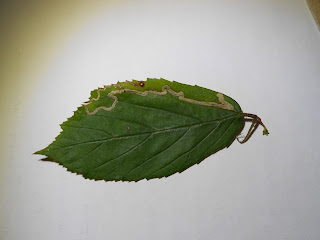
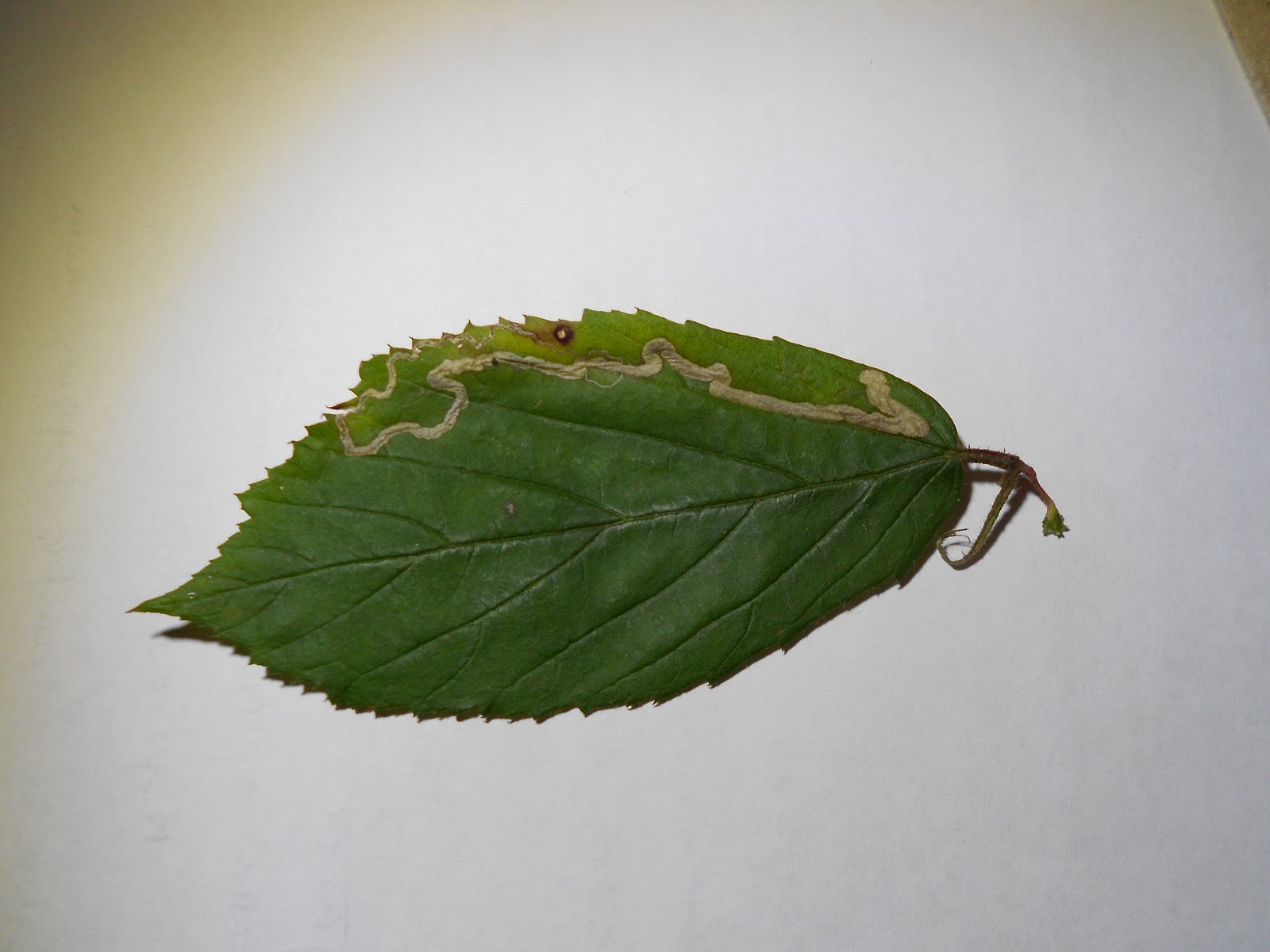
where, even in miserable conditions, there is usually something of interest to be noted. Today my attention was caught by a leaf mine on a bramble. It was formed by the larva of a Glossy Bramble Pygmy Moth, a tiny moth with the inordinately long name of Stigmella splendidissimella. The windy conditions made photography awkward so I re-photographed the leaf at home.

I took a stroll over to Byfield allotments earlier today, but not before observing a group of about a dozen Long-tailed Tits working their way through a Hawthorn tree in our back garden. They at least have passed the first icy ordeal of winter. Many of the allotment plots, as shown in my photograph, were badly flooded. This is a frequent occurence on this low-lying land and, not for the first time, I was glad that I'd given up my own plot a couple of months ago.
On the roadside adjacent to the allotments a  clump of Perennial Cornflower was in flower, defying the elements. This is not native to Britain but is widely naturalised on rough ground, having been thrown out from gardens, where it can become invasive. To me it is the cottage garden flower par excellence.
 clump of Perennial Cornflower was in flower, defying the elements. This is not native to Britain but is widely naturalised on rough ground, having been thrown out from gardens, where it can become invasive. To me it is the cottage garden flower par excellence.
 My walk took me back via the Pocket Park
where, even in miserable conditions, there is usually something of interest to be noted. Today my attention was caught by a leaf mine on a bramble. It was formed by the larva of a Glossy Bramble Pygmy Moth, a tiny moth with the inordinately long name of Stigmella splendidissimella. The windy conditions made photography awkward so I re-photographed the leaf at home.
Identification of these leaf miners can be tricky but the food plant, the shape and position of the mine and the distribution of the frass are all helpful.("Frass" is the name used by lepidopterists for the excrement of insects.) The insect egg has hatched towards the left of the leaf. The larva has then eaten its way towards the right - with the mine getting steadily wider as the larva grows - and has emerged at the leaf edge on the right-hand end of the leaf.
Subscribe to:
Posts (Atom)