Saturday, 6 December 2014

Splendid spurges

Euphorbia is a remarkable genus of plants containing over 2000 species (2420 according to Encyclopedia Britannica). We have about a dozen or so native to Britain, with several other species more or less naturalised. 

The genus contains plants enormously varied in form, with some succulent species resembling cacti and others fairly described as trees. Despite this variation the flowers are generally instantly recognisable, with a female and several male flowers being clustered into a small group known as a cyathium. All species also bleed a poisonous milky juice when damaged. In the shopping concourse of central Milton Keynes some of the very large cactus-like Euphorbias can be identified if a pin is surreptitiously used to pierce the tissues; milky juice quickly oozes out. It will come as no surprise to learn that the Rubber Tree is a member of the Euphorbia family but belongs, as Hevea brasiliensis, to a different genus. A slightly less obvious member of the family is Castor Oil, Ricinus communis.

Here in Northamptonshire a number of Euphorbias, generally known as spurges, are native, with several species being common. The Wood Spurge, Euphorbia amygdaloides, is quite easily found in woodlands on limestone in the north-east of the county and was familiar to me when I was based at RAF Wittering. It is rather common too around Byfield, but here it is probably a garden escape.


Turkish Spurge in a Byfield garden, with the bright red
leaves of  Photinia davidiana in the top left-hand corner.
18 March, 2014


An attractive subspecies, E. amygdaloides ssp robbiae, often called Turkish Spurge, is commonly grown in gardens and may occasionally escape. It was early to flower in Byfield, making a vivid splash of lime-green in borders. 


Musca autumnalis on Turkish Spurge.
Byfield, 8 April, 2014


Like most (all?) spurges, E. amygdaloides 
receives numerous insect visits. Here a male Lesser House Fly, Musca autumnalis, is imbibing nectar.


When living in Byfield I grew the Cypress Spurge, Euphorbia cyparissias. It is probably a British native but is certainly not so in Northamptonshire. With its feathery foliage it is a pretty plant for the rock garden but introduce it at your peril; it has long creeping rhizomes and can become very invasive, sometimes escaping on to rough ground. I won't be growing it here in Daventry.


Cypress Spurge. Byfield, 8 April, 2014


The wise gardener will confine Cypress Spurge to a sink garden or a similar container. In the accompanying photograph the gardener has taken the risk, planting it in a border with a pretty Pulmonaria.


Another spurge in my Byfield garden was Myrtle Spurge, Euphorbia myrsinites. It is a splendid plant and has been awarded the A.G.M. We bought a plant on a visit to Beth Chatto's lovely garden near Colchester but left it behind in Byfield.


Myrtle Spurge, Euphorbia myrsinites, in my garden.
Byfield, 23 March, 2014


From south-east Europe and Asia Minor, it is a sprawling, slightly succulent plant for a sunny spot. It is an easy-going species providing it gets plenty of sunshine and is in well-drained spot. I grew it in gravelly soil where it thrived.


A closer view shows the flowers in the form of a cyathium, typical of the genus.


Caper Spurge by a track in Byfield.
9 May, 2014
The Caper Spurge, Euphorbia lathyrus, is a curiosity with its stiff, opposite leaves in four vertical rows giving it an artificial look - a tall (up to 4 feet) plant made from a kit! It cropped up from time to time in my Byfield garden from an unknown source but the seeds are suspected of remaining viable for many years so may have pre-dated our move there. A hairless biennial, it may be native in some parts of England but is usually encountered as a plant on waste ground. The fruit look like capers and there is some evidence that they have been used as caper substitutes in the past. However, they are very bitter and all spurges are poisonous, with some fatalities known. Like many spurges, the seeds are initially dispersed by an exploding fruit capsule. Spurges are myrmechororous plants: following the bursting of the fruit their seeds are further dispersed by ants. Each seed has an oily structure attached to it known as an eliaosome. The oily material is attractive to ants who will carry the seeds away, helping to disperse them and perhaps even burying them.

With lots of spurges found in Britain I will mention just one more. The Sun Spurge, Euphorbia helioscopa, is a weed - but I consider it rather attractive. I have cultivated three allotments over the years, and Sun Spurge has occurred in all of them. Although generally regarded as a native to Britain it is probably an archaeophyte - a plant likely to have been introduced over 1500 years ago. In this case,  as with many other archaeophytes it may have arrived on these shores as a crop impurity, perhaps as far back as Neolithic times.

Perhaps we shouldn't forget those which are of importance to the florist.


Euphorbia milii is regularly seen in florists' windows, as was the case with these I photographed in Daventry. This species develops extremely prickly stems and is sometimes sold as 'Crown of Thorns'. However it can hardly have been Christ's crown of thorns as this species hails from Madagascar.


Now, with the approach of Christmas, one of the most familiar of all Euphorbias forces its way into our consciousness - except that most people probably aren't aware that it is a spurge. I refer to Poinsettia, Euphorbia pulcherrima. The word 'pulcherrima' is the superlative of pulchra - beautiful, and clearly people do find it very attractive. Strangely, the origins of this plant are not clear, although Wikipedia suggests Mexico and Central America. Visitors to the Mediterranean region will find it growing on waste ground (if, like me, they like to like to poke around in such areas) where it often forms quite a large shrub.


Altogether the genus Euphorbia is of great interest and identification of the many species provides a challenge to the holidaymaker when visiting southern Europe.


Friday, 5 December 2014

An hour to kill

Chris and I paid a visit to Woodford Halse for a much-needed trip to the hairdressers. I was first to be dealt with, just having a 'Number 4' but Chris was having the full works so I had well over an hour to kill.

With my shorn locks leaving me feeling chilly I turned up my collar and set off for the church of St Mary the Virgin, Woodford Halse. There, I've said it! Local belief is that "Woodford Halse" and "virgin" never appear in the same sentence. How justified that is, I've no idea.
The church of St Mary the Virgin, Woodford Halse.
5 December, 2014


The rather simple church is typical of the region, being built using a local Jurassic sandstone, perhaps from the quarry at nearby West Farndon. The historian John Bridges, in his book on the "History and antiquities of the County of Northampton" (1791) refers to Farndon producing 'a rock of serviceable stone for building or pavements'. There was also a quarry at Byfield, barely two miles away, but this produced a distinctive, darker sandstone.


Grassy tussocks are a feature of the churchyard to
the rear. 5 December, 2014


The churchyard is interesting. The area around the main entrance is kept neat and tidy but for a very large expanse to the rear the condition is in state of benign neglect, with headstones leaning in a variety of angles. This rather wild area is splendid for wildlife although it has to be said that on a chilly December day it was not glaringly obvious.


The lichen Caloplaca virescens is one of the
 crustose species present on the headstones.
Woodford Halse, 5 Decemberf, 2014


In these cold, dark days the gravestone lichens often provide an element of interest but there was little variation in the stone being used and consequently there was only a limited range of lichens to be seen. (but an expert would have detected far more). Examples of the yellow Caloplaca species were present, with Caloplaca flavescens being particularly common. Indeed it is very common across most of England but becomes relatively scarce from the middle of Scotland northwards.


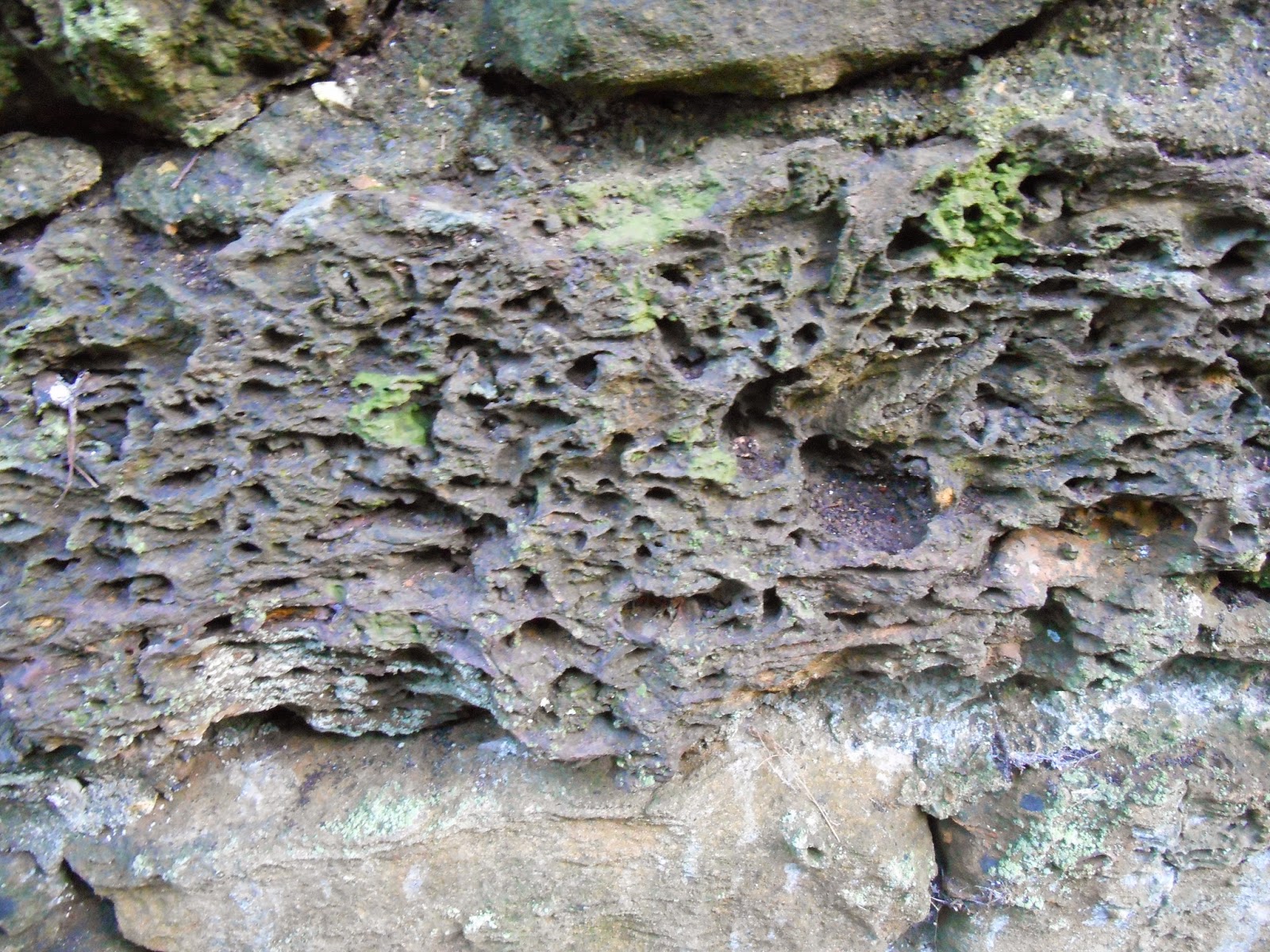
Perhaps most of us take these building stones for granted but elsewhere in the village I found examples of badly chosen material. The chemical erosion of this sand-stone block is very pronounced and, were it in the wall of my house I would be a tad worried, if not for me, certainly for my grandchildren.


Very few fossils were noted and, in short, the building materials were of very limited interest. A bench-mark had been carved into stone adjacent to the church and I assumed that a check of the local Ordnance Survey map would give me a spot height for this. I was wrong (although a large-scale map would probably provide a figure).


I kept glancing at my watch. The cold was getting through to me and there was little to get excited about. And then I chanced upon this little patch of...what?


It was situated on the exposed top of a wall, and that was the odd thing. Had it been on the underside of a plant leaf I would have accepted it as a cluster of insect eggs of, probably, a butterfly or moth. But here, on a bare wall? The eggs - for that is what they undoubtedly were - measured only about 0.5 mm across. A close-up is of interest but still leaves me puzzled. Between the eggs are slight traces of leaf venation so it is probably a fragment of plant material that has simply fluttered down and come to rest on the wall.


A little further along the same wall I once again came across a 'slime-mould' (see blog for 19 November). But I'm starting to have my doubts; is it some other organism? IF it is a slime-mould, my money is on Nostoc communeWhatever it is, it always seems to be on, or near to, a patch of moss. I have found other pictures of this by trawling the internet, but those posting the images have carefully avoided offering a name. The jelly-lichen, Collema auriforme is another possibility, and yet, and yet...


In a sheltered border a clump of Serbian Bellflower, Campanula poscharskyana was coping well with the cold, but I wasn't, so I began to retrace my steps.


It was good to get into the car, bang on the heater, and begin to thaw out.


Wednesday, 3 December 2014

December flowers

Garden plants in flower at this time of the year are to be expected. Plant hunters have scoured the globe seeking out suitable species and any decent garden book will suggest dozens of worthy plants.
Viburnum tinus in Balliol Road, Daventry.
3 December


Viburnum tinus (pictured), Mahonia species (featured in an earlier blog) and heathers such as Erica carnea come into this category are all currently in bloom hereabouts.


Then there are those plants which, though not naturally flowering in winter, have been selected by plant breeders to give colour in the darkest days of the year.


Pansies were in flower in Daventry
3 December, 2014

Pansies come into this category. We see them in abundance in bedding displays without giving them a thought. (Now that is an interesting Freudian slip; the word 'Pansy' is derived from the French pensee - a thought). These winter flowering pansies are in fact hybrids, Viola x wittrockiana, whose parents are probably Viola tricolor and Viola arvensis. (All pansies are, of course, large-flowered violets.) Selected forms of our native primrose, in a wide range of colours are likewise common in our gardens of course and will flower throughout the winter. The reds, purples, etc are usually the result of various crossings with Primula juliae, from the eastern Caucasus.


Then there is the 'awkward squad', plants which are in flower but probably only within the cosseted environment of an urban garden, where the extra 2-3  degrees makes just the difference. 
Greater Periwinkle, Vinca major, flowering in Daventry.
3 December, 2014

Perhaps Periwinkle, Vinca major, fits into this category. This highly toxic plant is a member of the largely tropical family, the Apocynaceae, and is thus related to Oleander and Frangipani - all equally poisonous. I would not allow Periwinkle into my garden, not because of its toxicity, but it can be very invasive and difficult to eradicate when established. It was in flower today (3 December) in Daventry.


Rather oddly, just a short  distance away, was another clump - or so I thought. But even a very brief examination showed that it was a quite unrelated plant, being a Geranium, perhaps a form of Druce's Cranesbill, Geranium x oxonianum. This hybrid is, rather obviously, named after George Claridge Druce, who wrote the first Flora of Northamptonshire back in 1930.


Then there are roses. This one, again photographed earlier today looks healthy enough but, at this time of the year, most of these flowers will open no further, being 'balled'. Cold, wet weather causes the outer petals to fuse, thus preventing the flower from opening any further. They remain in a ball-like shape. Having said that, this particular specimen looks in fairly good condition. We'll see.


What prompted this blog about winter flowering plants was the fact that, as I set out to walk into Daventry earlier today I could hardly fail to notice that several of our native wild plants are still in bloom.


Yarrow, aka Milfoil, Achillea millefolium, in Daventry.
3 December, 2014

The first species to catch my attention was Yarrow, Achillea millefolium. This should have ceased flowering some weeks ago but, those extra 2-3 degrees...

This plant, a member of the Daisy Family, is the species reputedly applied to the wounded heel of Achilles at the Battle of Troy. Whatever the plant was, it failed, as we all know, to effect a relief. 


My 1923 edition of 'Potter's Cyclopaedia of Botanical Drugs and Preparations' recommends Yarrow as a tonic and as a diaphoretic. This latter word means 'promoting sweating' Presumably therefore, the protracted wait for the announcement of winners in "Strictly..." is also diaphoretic - and grossly irritating!


Predictably Dandelion, Taraxacum officinale was in flower, as was White Dead-nettle, Lamium album and Groundsel, Senecio vulgaris. Many species of Senecio have a greyish appearance, often due to the presence of grey hairs and the name is derived from the Latin senex - an old man. 'Senile' comes from the same root (now, concentrate Tony, you can do this).


In a sheltered spot at the edge of a car park the flowers of Herb Robert produced a small but bright spot of colour. Although the smell of the leaves and stem is foul, the flower is undeniably pretty. Like Druce's Cranesbill this is another Geranium, Geranium robertianum. Various explanations have been offered for the name, often trying to trace 'Robert'. This may be a false trail to follow for it could simply come from the Latin ruber, meaning 'red'. Often the leaves, and if fact the whole plant, take on a brilliant red coloration.

Anthriscus sylvestris in a Daventry park.
3 December, 2015
I will end by mentioning Keck, Anthriscus sylvestris. More generally known as Cow Parsley it is perhaps the most profusely flowering of all our spring plants with its masses of white flowers like billows of foam along country lanes and hedgerows. Yet here it is, blooming in a public park in Daventry. Someone needs to have a word with it. I'd have spoken up but perhaps it would come better from Prince Charles. "Now look here, old chap; about your timing..."


Monday, 1 December 2014

The First of December

I always feel that December 1st should be the first day of winter. It isn't of course, that distinction goes to the 21st of December. Certainly, although it was grey and damp as I set out earlier today it was by no means wintry.
Leaves of Field Maple, Acer campestre, form a carpet.
Christchurch Drive, Daventry. 1 December, 2014


A thick, damp carpet of leaves lay beneath the trees as I visited a small plantation, largely of maples, off Christchurch Drive here in Daventry. Most of the soil in this area, and certainly my own garden, is a heavy clay. Given a couple of centuries of work by earthworms and there should be a good loam here, but for my garden I'm just working in gritty sand and compost in places where plants are to be placed.


Blackthorn, Prunus spinosa, bushes in a nearby hedgerow were bearing fruits. At least, I am assuming that they are blackthorns. The fruits were perhaps a little larger and rounder than usual and they could have been specimens of Bullace (Prunus domestica, ssp institia). I will need to re-examine the plants in spring.


Sloe or Bullace? Probably the former. The skins split
as the fruits begin to blet. Christchurch Drive, Daventry.
1 December, 2014
Whatever they were, the fruits were ripening nicely. The fruits of blackthorn, i.e. sloes, are impossibly astringent at first but as the weeks slip by they soften and become sweeter. This softening is known as bletting and as it proceeds the fruits begin to split and become acceptable to birds. Of course the birds spread the seeds far and wide - a cunning plan.


Adjacent to the blackthorn were several hazel bushes. A few lemon-yellow leaves clung on and between them hung the yet- undeveloped catkins, waiting for spring, when the lengthening days will prompt them into further growth.  


I include the obligatory leaf mine, in this case on a bramble leaf. It is probably the work of Stigmella aurella, the Golden Pigmy. This is among the commonest of our micro-moths and it is an bramble indeed if doesn't bear any of these mines. The structure of the mine seems to have impeded growth at the leaf tip, causing it to die off.


Not an exciting day. But after a lot of wet and generally unpleasant weather it was just good to be out.

Comments?  E-mail diaea@yahoo.co.uk


Friday, 28 November 2014

Cacti - spiny curiosities

When in my early teens I had a small collection of cacti and for me they have always had a fascination, not least because of their flamboyant flowers. My theory is that cacti tend to grow in hostile environments where pollinating insects such as bees are uncommon, and to attract the chance visitor the flowers must be unmissable.

I already have a handful of specimens. Unless cacti are purchased from a specialist they tend to be unnamed and I haven't yet got around to positively identifying mine (and unless they flower it may be impossible).


This bowl sat precariously on a window ledge for a decent photograph to be obtained but was then quickly returned to a safer spot. I crushed some brick and used it as a dressing and am quite pleased with the effect.


I have tentaatively identified two ofthe plants. The specimen on the left appears to be Mammillaria huitipochtli and the central one may be Myrtillocactus geometrizans. As for the columnar species on the right, it would be a challenge for Alan Turing.


This specimen will need re-potting in the spring, but being root-bound suits many species and may encourage flowering.


Any road, wishing to increase my stock I sent for some seeds via Amazon. The last packet was slow to arrive and I was surprised, on receiving them, to find that they had been sent from China.

The instructions were interesting:

                 Latin name: Cactaceae

                 Descriptions:

                 Succulents. the lower portion of the stem nearly woodiness, obovate
                 or ellipse with intensive thron. Dry resistance and dislike waterlogging,
                 likes enough sunshine with relaxed for soil.

I smiled of course, but have to admit that my Chinese - Mandarin or otherwise - isn't too hot. The seeds can't be sown yet, that will have to wait until the New Year. Apparently they germinate quite easily so I'm looking forward to having a go.

Tuesday, 25 November 2014

Of this and that...

In the high summer it is easy to assemble enough material to write a blog. Something on flowers? No problem; there are plenty about. Hoverflies? It wouldn't take long to get a few interesting species on camera. But late November...

Last night was the first real frost of the year and the car roofs wore a white crust. On the other hand there was barely a cloud in the sky and under the increasing warmth of the climbing sun the frost was fleeing.

I had to go into Daventry and the sunshine prompted me to walk. Where fence panels were facing the sun a thin cloud of steam was rising and on dry areas flies were gathering to dispel the torpidity brought on by the cold night.


Male Calliphora on a fence in Daventry.
 24 November, 2014
There were at least a dozen concentrated in a particularly favourable spot. All were Calliphora species, i.e. blow flies. I took a close look but didn't attempt to capture one. My best guess is Calliphora vicina; all but one were males. The photograph shows one of these males and it can be seen that the large red-brown compound eyes are almost touching.This is known as the holoptic situation.

   
A female, probably of the same species.
Same fence; same date


The second picture shows the only female I saw. Here it can be seen that there is a significant gap between the eyes. This is the dichoptic state. Given a spell of warm sunshine it is not unusual for these flies to be seen in the depths of winter. Not all flies have this form of sexual dimorphism but it is common among the 'higher' flies.


I was rather  surprised to see Viburnum rhytidophyllum in flower in a garden (and annoyed not to have taken more care with my photograph). Viburnum tinus is in flower everywhere but to find the so-called Wrinkled Viburnum to be in bloom was a surprise.


Its common name is well justified, for the leaves are very wrinkled, making identification easy. Despite its Chinese origins it finds the British climate to its liking and is sometimes found established in the wild.


Web of Amaurobius similis in a hedge. Daventry.
24 November, 2014
Nearby a neatly clipped hedge of 'Leylandii' (yes, it is a good hedging plant if kept under control) was covered in spider webs. Their grey appearance and the apparently haphazard construction showed that they were the work of Amaurobius similis. This very common spider has an almost identical sibling species called Amaurobius fenestralis. Now 'fenestralis' ought to be the one found around our window frames but perversely it is nearly always A.similis whereas A. fenestralis is usually found under loose bark in woodlands. Why can't nomenclature be appropriate! In both cases the spider's retreat is a tunnel-like structure near the middle of the web and it is clearly shown in the photograph.


Ivy in flower, Badby Road West, Daventry
24 November, 2014


Ivy, as is often the case, was in flower and in fruit on the same plant and, as the sun gathered it's strength, a few flies were imbibing the copious nectar.


Ivy (Hedera helix) does not describe a
helix as it climbs a tree. Byfield churchyard.
28 November, 2014


Regarding inappropriate names, Ivy is another case in point. Its Latin name is Hedera helix, and the specific name suggests that the plant describes a helix as it ascends a tree. I have never seen Ivy climbing in this way.


Harlequin Ladybird on ivy fruit. Badby Road West,
Daventry, 24 November, 2014


Anyway, back to ivy and its fruit. The berries were quite plump but some way short of being ripe. They will ripen through January and February, doing much to sustain birds through the winter. 


The ladybird, in this case a Harlequin  Ladybird,  Harmonia axyridis, was one of dozens out enjoying the sun and, worryingly, it was the only species I saw.


So, as I stated, a bit of this and that.


Wednesday, 19 November 2014

The Church of the Holy Sepulchre, Northampton

The Church of the Holy Sepulchre is one of Northampton's loveliest and most famous churches. My parents were married there. It is - or was - often called St Sepulchre's Church and from time to time a heated debate would break out in the 'Letters' page of the local paper regarding the usage of the word saint; could 'Saint Sepulchre's' possibly be right? Of course it can, since the words 'saint' and 'holy' are more or less synonymous.

Anyway, finding myself in Northampton with an hour to kill, and not withing to visit one more shop where a talentless singer was yelling or wailing a third-rate song (my word, you are grumpy today!) I decided to seek sanctuary in the church. It was locked! Instead I wandered around the churchyard, but was soon wondering, as I eyed dozens of discarded syringes, whether Marks & Spencer's might be a better bet after all.


Clematis vitalba scrambles across a wall near
Northampton town centre. 18 November, 2014
Approaching the church I had been agreeably surprised to find Traveller's Joy, Clematis vitalba, scrambling across a wall. 


The mine of the fly Phytomyza vitalbae on
 Clematis vitalba. 


Not only was it in flower but several leaves bore the mines of Phytomyza vitalbae. It is common but had probably not been recorded from the area before.


I therefore began to feel more optimistic as I began to stroll through the churchyard. In my childhood the grassy areas were kept under control by a flock of sheep. From time to time we would encounter the flock as it was being driven to or from the churchyard. Then only a little difficulty was created for the traffic, but nowadays...


Adjacent to a side entrance stood a lovely pine, with elegant branches spreading sideways to display the leaves, which were borne in groups of five.


The long, cylindrical cones confirmed that it was a Bhutan Pine, Pinus wallichiana. This tree, a native of the Himalayas, must be one of the most elegant of the genus.


I groaned as I realised that almost the whole of the churchyard was ringed by lime trees. Small bugs flitted from leaf to leaf.
Alnetoidea alneti on a lime leaf. St Sepulchre's
Churchyard, Northampton. 18 November, 2014


At 3 millimetres they were a challenge for my little camera but I managed to get a decent picture of one of the all-yellow insects. Under the microscope back home they proved to be Alnetoidea alneti, a very common member of a family called the Cicadellidae.


The gall of Taxomyia taxi. St Sepulchre's
churchyard, Northampton. 18 November, 2014

Another insect had been at work although I failed to find the culprit. Instead I found its gall on a yew tree. This distortion at the end of a branch is caused by Taxomyia taxi, one of the Cecidomyid flies.
These glands on the leaf petiole help to identify the tree as
a species of cherry


A few cherry trees were present. Many cherry species may be recognised by the thin and glossy outer bark, which peels off in strips round the trunk. In this case the bark was different but, as not all the leaves had fallen (and these were in the process of being shed), I could see that two glands were present where the leaf blade joined the petiole (leaf stem). This is diagnostic for cherries.


The pines, limes, yews and cherries made a good selection of trees, and a fastigiate ash was also present but parked cars (in the churchyard!) thwarted my attempts at a decent photo.
Grimmia pulvinata on a sandstone wall. St Sepulchre's
church. Northaampton. 18 November, 2014  


I turned my attention to the mosses on the church wall. The stone was a local Jurassic sandstone aand predictable species were present, most obviously the pretty but generally ignored Grimmia pulvinata. Known as the Grey-cushioned Grimmia it is generally abundant on walls, gravestones and so on.


I was just about to turn away when I noticed, just above head-height, something glistening.


It was a slime-mould and my first thought was Nostoc commune, but something wasn't quite right so I  am stumped. It is odd that in my previous blog, 'A dearth of fungi' I showed what I believe to be the fruiting stage of another slime-mould, Lycogala epidendrum. I should stress that the study of these organisms is a highly specialised pursuit and my identifications are speculative.


I could put off Christmas shopping no longer so it was back to the town where, to the strains of that festive favourite "Jingle tills", I made my way into the Grosvenor Centre.

Tony White:  diaea@yahoo.co.uk