Friday, 20 September 2019

Around Byfield Pool

Now and again - maybe twice a year - I like to visit Byfield Pool. I say 'like' but perhaps I should choose a different word.


The first time I ever went there must have been about twelve years ago and I came away impressed with what seemed a fascinating reserve. After today's visit I left wondering whether I should ever bother again. To be fair, conditions were not at their best: the west of Northamptonshire, together with much of the English Midlands, has endured a long summer with very hot and dry conditions; wildlife has not benefited. The plants were looking dusty and and droopy; it seemed that everything was on hold, with no rain to stimulate any fresh growth. The water level in the pool itself had dropped by at least two feet.
Water level were lower than this photograph suggests. Byfoels Pool,
near Byfield, Northants. 20 September, 2019


Inevitably there were features of interest. Swags of Black Bryony, Tamus communis, clambered from branch to branch with clockwise turns, covered with scarlet but poisonous berries. Needle-sharp crystals of calcium oxalate seem to be responsible for the illness caused by consuming them but cases are apparently rare nowadays.


The scarlet berries of White Bryony are eye-catching.
Byfield Pool, 20 September, 2019

White Bryony, Bryonia dioica, is - if distribution maps are to be believed - almost equally common and I frequently encountered this member of the Cucumber Family in my childhood, but I have not seen it for a long time. It too has poisonous scarlet berries but the two species are not even distantly related. It was surely White Bryony to which John Clare alluded when he wrote:


                     The Bryony in the hedge that now adorns
                     The tree to which it clings and now the thorns
                     Owns five-starred pointed leaves* of dingy white.


                                                                      Clare's Rural Muse, 37


 Mammals seem to largely avoid both plants but presumably birds eat the fruit.

The ground flora around Byfield Pool is depressingly limited, consisting of about 60% Wood Avens, Geum urbanum with most of the remaining plants consisting of nettles. I found a few ferns, one plant of St John's Wort and one of Lesser Burdock, Arctium minus. Of course, there were many other plants present but they were scarce. Sinuous mines on the Burdock were the work of Phytomyza lappae. 
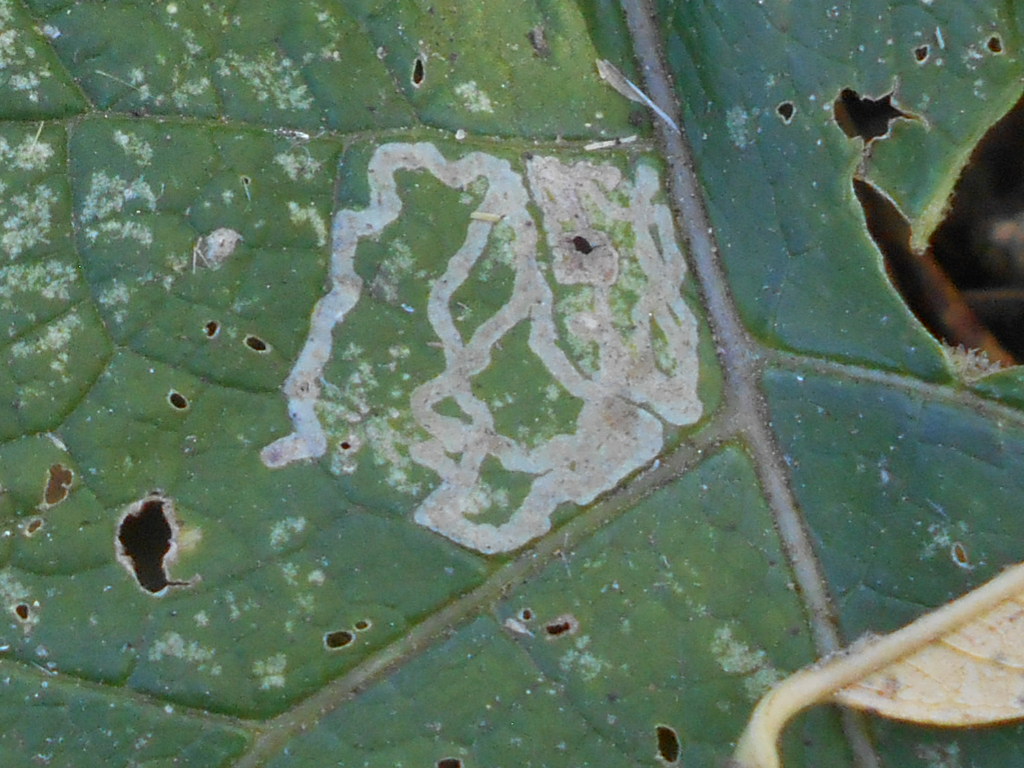
Lesser Burdock leaf mined by Phytomyza lappae. Byfield Pool.
20 September, 2019

A few plants of Meadowsweet occurred near the entrance. They too had been mined, or more correctly galled, by Dasineura pustulans. Both the Dasineura and the Phytomyza were new records for the site.
Dasineura pustulans has produced these galls on Meadowsweet.
Byfield Pool, 20 September, 2019


It was while I stooped to photograph the meadowsweet that another species was recorded. I had put down my sweep-net in order to reach for my camera but within a few seconds a dragonfly had landed on it.


A Ruddy Darter investigates my sweep net. Byfield Pool,
20 September, 2019

It was a Ruddy Darter, Sympetrum sanguineum. The Common Darter, S. striolatum is more frequently met but the specimen on my net had a deeper, almost blood-red (hence 'sanguineum') abdomen and completely black legs.

It wasn't the rarest insect I encountered today but, perhaps because dragonflies are not something I often spend time over, it was the most pleasing.

* Sic - but White Bryony has five petals of a dingy greenish-white.


Thursday, 19 September 2019

Autumn is nigh (but the rugby season is with us)

A gentle stroll around Stefen Hill Pocket Park today provided further evidence - if any be needed - that autumn is just around the corner. The Midland Hawthorn, Crataegus laevigata, was heavy with fruit.


Midland Hawthorn was in fruit in Stefen Hill Pocket Park.
19 September, 2019
All other hawthorns in the immediate area are of Common Hawthorn, C. monogyna, so it seems quite likely that the seeds will produce a number of hybrids.

Also bearing fruit were brambles, Rubus fruticosus. In this case the principal foraging animal seems to be Homo sapiens, but wasps were not far behind, especially where the fruit was over-ripe.

The brambles are heavy with fruit. 19 September, 2019
As I have mentioned before, there are many forms of R. fruticosus and the study of these micro-species is known as batology. The word is derived from the Ancient Greek baton, a blackberry. This is something all people need to know!

Rose hips were in evidence but their hips were not being consumed. However the leaves were providing food for several creatures such as the Rose Sawfly, Arge ochropus. Gardeners squeal with delight when they find the larvae on their cherished ramblers, stripping the leaves down to the midrib (and often consuming that too). I found it on our 'Golden Showers' last year and was less than impressed.

Rose Sawfly in Stefen Hill Pocket Park. 19 September, 2019
Another insect larva feeding on rose leaves - and less likely to induce apoplexy in the gardener - was the Grey Dagger Moth, Acronicta psi. It is a common moth but is not easy to distinguish from the Dark Dagger - at least, not as an imago. However, the caterpillar is a different matter, with that of the Grey Dagger being very distinctive.

The Grey Dagger Moth has a striking larva. Here on rose in Stefen Hill
 Pocket Park. 19 September, 2019
It has a broad and bold yellow stripe down the back and a spike of black hair just behind the head. The 'dagger' refers not to the spike of black hair but arrow-shaped markings on the adult wings. 
Grey Dagger larva showing the carefully gelled spike of hair
 a little behind the head.


Although in the pocket park it was feeding on rose it is equally happy on a range of other  deciduous shrubs and trees, i.e. it is polyphagous. Such adaptable insects avoid the danger faced by monophagous insects such as the Bleached Pug, which feeds only on Golden-rod. Should that become unavailable...end of.


.

Saturday, 14 September 2019

Segueing into autumn

Leaves are still green and our gardens are still full of flowers and yet...


There is an autumnal feel about the fields and hedgerows. Perhaps it is the ripening fruit that gives the game away. Apples were hanging heavily from the trees on Matt Moser's land when I visited yesterday. They are not intended for human consumption but they will be allowed to fall and act as food for thrushes and other birds. Insects too will batten on the rotting fruit and small mammals such as field mice will also tuck in. And larger creatures such as badgers won't want to miss out.
Apples are ripening at Foxhill Farm. 13 September, 2019

That some of the fruit is blemished is irrelevant. Animals will be putting on fat for winter survival and a bit of scab will be ignored.


Apple Scab will not be a deterrent to animals fattening up for winter.
Foxhill Farm, Badby, Northants. 13 September, 2019
Spindle, Euonymus europaeus, is widespread in the eastern parts of our county, where the soils tend to me calcareous. Foxhill Farm consists of rather acid grassland and the fact that spindle is common in its hedgerows is down to the extensive plantings made by Matt and his staff.

Spindle bushes currently carry large quantities of fruit. Foxhill Farm,
13 September, 2019
The fruit is steadily ripening and, although it is highly poisonous to humans, the birds will soon be dining on the berries - always described in books as sealing-wax red. In mediaeval times the hard, straight young branches were used for 'skewers, toothpicks, pegs and knitting needles' (Ref 1). Clearly the wood was not regarded as poisonous. Strange that it should be called the spindle bush because, although it may indeed have been employed for spindles, that was by no means its main use. 

The leaves are being consumed by hungry insects but I've not yet identified the culprit(s) and perhaps never will.

Hands up! Who did it? Spindle leaves nibbled beyond recognition.
Foxhill Farm, 13 September, 2019
Spindle was first recorded in our county from Abington, Northampton in 1822 by George Baker. Perhaps it still lingers in the hedge beside Abington Meadows but I doubt it.

Nothing startling was noted yesterday and the fact that I even bothered to photograph the mines on this buttercup leaf tells its own tale. It is the work of Phytomyza ranunculivora, a fact that can be established by carefully examining the pattern of the frass (poo) within  the mine.

The larvae of Phytomyza ranunculivora are responsible for these mines on
buttercup leaves. Foxhill Farm, 13 September, 2019

Back home the signs of autumn are everywhere but Pasque Flowers continue to ignore the calendar to produce a flower or two. Last week it was rich, almost maroon blooms. The white down, clearly visible on the 'petals', helps to distinguish the Pulsatilla genus from anemones.
Plum? Maroon? Deep Cherry Red? Whatever, it is lovely. Pasque Flowers
in our front garden at Stefen Hill, Daventry. 12 September, 2019


Today a lovely, pure white bloom, again with the downy hair clearly showing ('densely sericeous' according to Clive Stace, Ref 2) has made an appearance. Bees have been visiting so the flower may even produce fruit, although I have so many seedlings popping up that they will be redundant.

The white variation is stunning! Again in our garden, 14 September, 2019

 
I'll just mention one other harbinger of autumn in our garden. Hylotelephiun spectabile (formerly Sedum spectabile) is producing its flowers in abundance. They are of a rather mucky pink colour but I will forgive them this shortcoming as they are attracting honey bees, hoverflies and butterflies in abundance.


The visitors today included this Comma, Polygonia c-album. It was once a rather scarce butterfly and only commonly found in hop-fields. The decline of the hop industry and the widespread use of insecticides could have spelt doom for the species but instead it transferred its allegiance to nettles (a relative of hops) and has since flourished.

As Peter Marren has pointed out (Ref 3) several butterflies and moths have names related to punctuation marks or letters, generally referring to their wing markings. There is the White Colon moth, Sideritis turbida and the Essex Gem, Cornitiplusia circumflexa. The Scarce Silver Y moth has a Y-shaped mark on the wing, but this can be also be interpreted as a question mark and the insect carries the name of Syngrapha interrogationis.


Whoa! I am starting to ramble. Time to put a stop to this blog (and, more urgently, time for lunch). Finis.


References


1.  Mabey, R. (1997) Flora Britannica  Chatto & Windus


2.  Stace, Clive (1991) New Flora of the British Isles  Cambridge University Press


3.  Marren, Peter(2019) Emperors, Admirals and Chimney Sweeps  Little Toller Books


Sunday, 8 September 2019

Tired at the end of summer

No. no, not I. Earlier today I visited Kentle Wood and couldn't help but notice how, after the end of a hot, dry summer, things were looking a bit weary.


To begin at the beginning, the entrance to the wood is now controlled by a new gate. Installed at great expense, a gap has cunningly been left to allow motor bikes to sneak though, allowing them to churn up the tracks into a sea of mud. I am being facetious; I'm sure  (hope) the gap will be closed shortly.


The new gate to Kentle Wood surely requires completion.
8 September, 2019
The foliage of the trees is looking decidedly weary. Cherry and ash were the most bedraggled but oak seemed to be faring better.

Cherry trees were wilting, their roots in parched soil. Kentle Wood,
Daventry. 8 September, 2019
The red berries on the rowan were wrinkled, suggesting that either the local birds prefer other pabulums or, perhaps more likely, there aren't enough birds around to take advantage of this resource.

Rowan berries hang wrinkled and uneaten. Kentle Wood, Daventry.
8 September, 2019
The berries on the buckthorn, Rhamnus cathartica, were similarly untouched but may need a little while to fully ripen. Humans are best avoiding them for they act as a violent purgative. This is a shrub which refers limy soils but seems happy on the neutral clay of Kentle Wood.

Berries of Rhamnus cathartica, the Purging Buckthorn.
Kentle Wood, 8 September, 2019
By the late summer insects have had ample time to nibble foliage, create leaf mines or form galls, so there is much of interest - for some.

Here and there the buds of ash had been transformed into brown, cauliflower-like growths. The culprit is a mite, Aceria fraxinovora. Readers will be amazed to know that it is called the Cauliflower Gall Mite. Maps show that it has a restricted and patchy distribution in the U.K. but it is probably the recorders who are restricted and patchy.


No thanks, not even with a cheese sauce. Cauliflower gall on ash.
Kentle Wood, 8 September, 2019


Stigmella floslactella was found mining hazel leaves. It is one of those micro-moths which has been given an English name - the Coarse Hazel Pigmy - but is invariably referred only by its Latin name.
The meandering mine of Stigmella floslactella. This was on a hazel leaf.
Kentle Wood, 8 September, 2019

It was a new record for Kentle Wood, bringing the site total to 537 species. I have a number of mines to yet identify and any interest in this blog will rapidly wane if I go on about them.

Right. To the microscope!


Thursday, 5 September 2019

The wow factor

There are insects which, for anyone other than the enthusiast, can only be described as dull. Take this leaf mine for instance. It is formed by the larva of Aulagromyza hendeliana, an agromyzid fly of no interest at all except perhaps for a concerned gardener whose honeysuckle plants are suffering an infestation (in fact it does no significant harm).


The mine of Aulagromyza hendelianum often runs parallel to the leaf edge.
Stefen Hill Pocket Park, 5 September, 2019
It was on the commonest of our wild honeysuckles, Lonicera periclymenum*, and was the first thing I noticed today when entering Stefen Hill Pocket Park. Even I stifled a mild yawn when seeing it.  And to exacerbate things I found when arriving home that I had recorded it from the park before.


Sloes, the fruit of blackthorn, are ripening nicely although at least a couple of months need to elapse before they are even mildly palatable. I was about to take a photograph - don't ask me why - when something unexpected caught my eye. Although I make no claim to be dragonfly expert there is no doubt that this is a female Southern Hawker, Aeshna cyanea.

The Southern Hawker is one of the commonest of our hawker dragonflies.
Stefen Hill Pocket Park, 5 September, 2019


It is widely distributed in Northamptonshire and is a confirmed breeder in our county. To find it well away from water is not unusual and it crops up in parks, light woodland and even gardens.


In fact it was not too far away from water, for the small pond in the pocket park was only 100 metres away - but it has virtually dried up. The Purple Loosestrife growing at the margins is looking a bit wilted and the Large Elephant Hawkmoth** caterpillar, which I had photographed a week or so ago, was still present but seems to have made little growth.
This Elephant Hawkmoth caterpillar has made little growth over the last
week - or is it a different specimen? Stefen Hill Pocket Park,
5 September, 2019

Bugs were plentiful today, but nothing out of the ordinary was found.

The Green Shieldbug, Palomena prasina (the word prasina means 'leek-green' and comes from the Greek word for one of the onion species) was on many leaves and not difficult to see despite its colouring.
Green Shieldbug on the foliage of Field Maple. Stefen Hill Pocket Park.
5 September, 2019

The Hawthorn Shieldbug, Acanthosoma haemorrhoidale, is more strikingly marked but it too is difficult to spot in some circumstances. Apart from hawthorn it can be found on other members of the rose family including rowan, whitebeam, firethorn and cotoneaster.
Hawthorn Shieldbug, strongly marked but often difficult to see.
Stefen Hill Pocket park, 5 September, 2019

The photograph shows clearly the sharply pointed 'shoulders' which give the insect its generic name: acantho = spine, soma = body.

A third shieldbug was present, the Parent Bug, Elasmucha grisea, and was on alder foliage. The adults are often paler than the specimen seen today and I have a suspicion that it is beginning to darken in preparation for hibernation.

Parent Bug, clearly content to be exposed in bright sunlight.
Stefen Hill Pocket Park, 5 September, 2019
Alder is one of the Parent Bug's favourite trees but I only found one. I attempted a photograph even though the insect was in an awkward spot: a ladder would have come in handy!

So what qualifies as a wow factor? The dragonfly was a surprise and for me was the pick of the day's insects. But beauty is in the eye...

*   Our only other 'wild' honeysuckle is the Fly Honeysuckle, Lonicera xylosteum. Recent investigations suggest that it is in fact a long-established alien.


** There is a Small Elephant Hawkmoth, but is less common than its larger relative.


Wednesday, 4 September 2019

Byfield trivia

Wednesday, Byfield Pocket Park. I paid a visit today armed with nothing other than a camera - not deliberately, but I left home in a rush.


Lots of flowers were still in bloom, most obviously Rosebay Willowherb, Chamerion* angustifolium. It was once known as Epilobium angustifolium (and still is, in some books) but whereas Epilobium species have actinomorphic (radially symmetrical) flowers, those of Chamerion species are zygomorphic (bilaterally symmetrical) flowers.
Rosebay Willowherb is often abundant on waste ground. Byfield
Pocket Park, 4 September, 2019

 
The picture shows that whereas four of the petals are broad, the fifth (lowest) one is narrow, giving the zygomorphic form. This is one of the food plants for the caterpillar of the Elephant Hawkmoth, but I searched for them in vain today.


Perhaps more important for insects are the broad, saucer-sized umbels of Hogweed, Heracleum sphondylium. With nectar accessible to even short-tongued insects the flowers attract a wide range of species, and that was the case today.


Tachina ferox on hogweed. Byfield Pocket Park.
4 September


The yellow and black tachinid fly, Tachina ferox, is a common and distinctive insect. So many were about today that in some cases an umbel was hosting two or more specimens. The caterpillars of larger moths need to beware as these flies will leave their larvae in a suitable spot; they will then parasitise a passing victim.


Two, and sometimes more, specimens of Tachina fera were present on
hogweed umbels. 4 September, 2019
Ivy flowers are beginning to open and by far the most interesting insect today was a hoverfly feeding at ivy blossom. The photograph is poor as the insect only gave me a second or two to compose my shot before flying off. Fortunately it settled again and I was able to briefly capture and examine it.

It was specimen of the Golden-tailed Hoverfly, Xylota sylvarum. It is a reasonable common but elusive species and must rank as one of our most handsome flies. It is by no means the first record for Northamptonshire but is certainly new to Byfield Pocket Park.

The best I could manage: Xylota sylvarum on ivy blossom.
4 September, 2019

And here is a slightly better (!) picture from the internet.


Xylota sylvarum. (wildlifeinsight.com)
Finally, Dock Bugs, Coreus marginatus. It is always plentiful on dock plants and occasionally on its relatives, rhubarb and sorrel but I have never seen it is such abundance as it is this year.
Dock Bugs in abundance. Byfield Pocket Park, 4 September, 2019

It has to be said that it is not the most colourful of insects but if it drops to the ground when alarmed it is extremely difficult to spot.


* The alternative name Chamaenerion is wrong and regarded as a nom. illegit. (nomen illegitimum as Jacob Rees-Mogg would say.)


Tuesday, 3 September 2019

Out of season

I'm sure that many people will have noticed, over the last week or so, plants blooming when they have no business to. Certainly the phenomenon can't be confined to our garden.


Most obviously out of synch is the Pasque Flower, Pulsatilla vulgaris, in our front garden. I say obviously because the word pasque is thought to derive from 'paschal' - of Easter, and indicates when it ought to be flowering.. We have two of the eye-catching blooms currently flaunting themselves, but the aficionados among you will recognise that the lower one is not our native plant, being reddish in hue. The top picture shows the more typical colour and is the form found wild in eastern Northamptonshire - or at least in the Soke of Peterborough, once Northants but now part of Cambridgeshire.


This rich purple Pasque Flower is the British native form. Our garden
 on Stefen Hill, Daventry. 3 September, 2019
In fact we have at least four different colour forms in our front garden including red and white.
This reddish form is more like the Swiss-Austrian strain.
3 September, 2019

Also blooming is a cyclamen. To be more precise it is Cyclamen hederifolium, the specific name referring to the leaves which are reminiscent of Ivy, Hedera helix. In truth the cyclamen isn't too far out of season, perhaps just a month or so early. The leaves are not yet showing.
Sowbread, Cyclamen hederifolium, in our garden. 3 September, 2019

More of a surprise is the Elder, Sambucus nigra, growing in a neighbour's garden. In fact it is not the typical wild form of the plant but is a variety called 'Black Lace'. Nevertheless it flowered about three months ago and this is most definitely a second , abnormal flush of bloom.

The elder shrub now in flower in a neighbour's garden, is now as high
as the house itself. 3 September, 2019
In contrast, flowering at the correct time, is our Zauchsneria californica. It is a dwarf form known as 'pumilio' and is sometimes simply referred to as Zauschneria pumilio, the specific name meaning 'dwarf'. As the name suggests, it is a native of California, named after Johann Zauchsner, a professor at Prague.


This dwarf Zauchsneria is ideal for the rock garden. Stefen Hill,
3 September, 2019
The plant is, according to the literature, only half-hardy, but it faces south-east and is in well-drained, gritty soil. It should be fine and will probably eventually get larger but should be easy to trim back.

Although Hibiscus syriacus hails from E. Asia it has been known in Britain since the late 16th century. It will make a small tree in favourable circumstances but ours is confined to a tub. The lovely flowers are not unlike those of a hollyhock; not surprising since both plants are in the same family, the Malvaceae.

Hibiscus syriacus comes in a range of colours. Our back garden,
3 September, 2019
It is getting late in the year but the garden is still full of flowers and bumblebees remain busy on the lavender which, although it is getting straggly, I haven't the heart to cut back.