Thursday, 20 June 2019

Micro moths and liverworts

If it's Wednesday it must be Byfield. Chris and I meet up with old friends at the coffee club, but I usually snatch a quarter of an hour to check out the pocket park. It was a drizzly sort of morning, the damp, windless air heavy with the scent of Elder.


Elder, Sambucus niger, is currently filling the air with fragrance.
Byfield Pocket Park, 19 June, 2019

It is a bit of a Marmite plant: Chris finds the fragrance unpleasantly cloying but I find it delightful.

Very optimistically I gathered a few catkins from a Silver Birch tree in the hope of revealing some Semudobia galls on the fruits. In this I was unsuccessful as it is too early in the season, but a consolation came in the form of a micro-moth on a nettle plant near the foot of the tree. It was a specimen of Epinotia trigonella, rather unimaginatively called the Birch Epinotia Moth. It is very common but was a 'first' for the pocket park.


Epitonia trigonella is strongly associated with birches.
Byfield Pocket Park, 19 June, 2019

Another moth was, or had been, present. I didn't see the insect but I did see the distinctive patches left by its larvae on Creeping Thistle leaves. It was the Pale Thistle Case-bearer, Coleophora peribenanderi, and was another first for the pocket park.


These translucent patches on Creeping Thistle are the work of the larvae of
the Pale Thistle Case Bearer. Byfield Pocket Park, 19 June, 2019

Red Campions were blooming well, and although the flowers were of a pale pink I'm sure they were the genuine article and not the hybrid with the White Campion. Incidentally, under ultra-violet light the flowers of the Red Campion are an amazing bright blue, and this is what attracts many insects.

Only pale pink but nevertheless the flowers are of the Red Campion.
Byfield Pocket Park, 19 June, 2019
A hoverfly was busy either taking nectar or feeding on the pollen grains. A closer look showed that it was Episyrphus balteatus. It is one of the few hoverflies to have acquired a common name, being known as the Marmalade Fly. It is unusual in having double bands on each abdominal segment and 'balteatus', meaning 'belted'' perhaps refers to this feature.


A Marmalade Fly, Episyrphus balteatus, taking pollen or nectar. The  insect
migratory, visiting the UK in large numbers each year. Byfield Pocket Park,
19 June, 2019
Having confirmed that the pocket park hadn't been stolen I sauntered back to the coffee club. (I'm not one to boast but I have to put it on record that I am one of Britain's outstanding exponents of sauntering. I once sauntered all the way across the Albert Bridge in London sustained only by an ice cream. Passers-by could only look on with astonishment.) My route took me past the village tennis courts and I was pleased to see some nice patches of liverwort flourishing on damp, shaded gravel. True, the species involved, Marchantia polymorpha, is very common but none the less photogenic.

The female organs are like umbrellas or tiny palm trees, depending on your imagination.

Female reproductive organs of Marchantia polymorpha. Byfield
village tennis courts. 19 June, 2019
Beside them grew patches displaying the distinctive male organs.
Marchantia polymorpha showing the male organs.
The plant is also able to reproduce vegetatively by the forming of structures called gemmae. These are held in distinctive round cups. These gemmae are apparently splashed out by raindrops during a storm


Gemma-cups of Marchantia polymorpha.


Tuesday, 18 June 2019

Success and problems

Chris and I visited our allotment today and met with a few problems but were generally pleased. The recent heavy rains have made the soil very workable and weeds, of which there were many, were easy to remove.


An undoubted success has been our lettuces, strong and healthy. They are free of problems, but the same cannot be said of our peas.


Our lettuces are doing well. Drayton Allotments, Daventry.
18 June, 2019 
Despite being carefully netted wood pigeons have managed to nip off so many shoots that the plants are stunted. Some of the leaves have been mined by the larvae of the agromyzid fly Chromatomyia horticola but the damage is minimal and of no consequence. The picture shows clearly how the mine starts off as a very narrow structure but gradually widens as the larva fattens. It finally ends when the fly pupates and then flies off.


The peas are being attacked by Chromatomyia horticola, but only in a
minor way. Drayton Allotments, Daventry. 18 June, 2019
On the potato foliage a micro-moth was 'resting'. What it was really doing is difficult to establish but it may have been actively releasing a pheromone in order to attract a mate.

It was a Light Brown Apple Moth Epiphyas postvittana. Despite is dull name it is rather an interesting insect, being an Australian moth first recorded in Cornwall in 1936. Since then it has spread steadily although populations are cut back during a hard winter. Part of its success lies in the fact that it is highly polyphagous, its larvae being able to feed on a wide range of plants.

The Light Brown Apple Moth, despite its name, is not confined to apples.
Drayton Allotments, Daventry. 18 June, 2019
Finally I ought to mention that I found a couple of oak seedlings while weeding. How they got there is anyone's guess for I am not aware of any oak trees nearby. Were the acorns buried by a squirrel? Were they dropped by a bird such as a jay? I intend to carefully lift and replant them once I have located a suitable site.


This oak seedling can't stay where it is. Drayton Allotments, Daventry.
18 June, 2019

Monday, 17 June 2019

Wow, some sunshine!

Just over a month ago - 10th of May to be precise - I was poring over my ark-building manual following heavy rain. I re-examined the document yesterday following several days of heavy showers but today the sun finally made its presence felt and I ventured forth, admittedly only as far as the local (Stefen Hill) pocket park.


Quite a lot of twigs and small branches littered the ground but although a blustery wind still tugged away at trees and bushes there were a number of insects around. Several species of micro-moths were dancing about, including the Yellow-barred Longhorn, Nemophora degeerella*. The males have extremely long antennae but I only managed to photograph a female.


Several moths bear a pale bar across their wings but the Yellow-barred
 Longhorn is quite distinctive. Stefen Hill Pocket Park, 17 June, 2019

Far more numerous, but 'dancing' so furiously that a decent photograph proved impossible, were dozens of the tortricid moth, Pseoudargyrotoza conwagana. Known as the Yellow-spot Tortrix it is extremely common hereabouts, perhaps because its main food-plant, the ash tree is also abundant (it is occasionally found on privet)). In some parts of the U.K. this moth is relatively scarce.

Even more common is the Nettle-tap, Anthophila fabriciana*, although I only saw one specimen today. As the name indicates, it is associated with its food-plant, the common nettle.

The Nettle-tap soon becomes familiar to anyone gathering material
for nettle soup. Stefen Hill Pocket Park, 17 June, 2019
This year I seem to have seen an unusually large number of Red-legged Shieldbugs, Pentatoma rufipes. Common they may be but nevertheless I was surprised to find one investigating, and apparently eating, a bird dropping. This species is known to have a wide diet, including dead insects. It moved away as I stealthily approached.

This nymph of the Red-legged Shieldbug appeared to be sampling a
bird dropping. Stefen Hill Pocket Park, 17 June, 2019
Before the heavy rains of recent days we had a long dry spell and the pond, awkwardly situated at the top of a hill, lost all its water. Tadpoles, of which there were large numbers, died en masse. Their corpses will not be wasted and even now there will surely be various creatures consuming their remains. The pond now holds considerable quantities of water and the Yellow Flags are blooming. This plant must rank among the loveliest of our wild plants.

The Yellow Flag, Iris pseudacorus, was blooming freely today.
Stefen Hill Pocket park, 17 June, 2019
One old name for this plant is 'segg'. and refers to the sword-like leaves, segg being an Anglo-Saxon name for a short sword.


---------------------------------------------

* The names of these two moths commemorate very famous biologists. Charles de Geer (1720-1778) was a Swedish biologist whilst Johan Christian Fabricius (1745-1808) was Danish, specialising in insects. Perhaps because of Linnaeus, Scandinavian biologists played a very important role in the development of modern taxonomy.


Saturday, 15 June 2019

Major Morrison's Land

A good percentage of people in and around Byfield are keen walkers and all will know or be aware of 'Major Morrison's land'. He* owned a considerable acreage of land to the south of Byfield but died, I believe, about twenty years ago. His widow lives on, now in her nineties. A public footpath runs roughly north south across the land and is popular with walkers, not least because the land is sympathetically managed for wildlife. With a spare half hour to kill earlier today Chris and I blew away a few cobwebs with a walk across the land, climbing a gentle hill, reaching 184 metres, for the fine views it offers, views to which my little camera would not do justice.


Very broad verges surround the fields of crops and the flowers which occupy these areas, though largely 'agricultural weeds'. add colour to the landscape.
The broad borders to the fields support ox-eye daisies, poppies and
hogweed. 15 June, 2019

The flowers, such as Ox-eye Daisy, Chrysanthemum leucanthemum, Common Poppy, Papaver rhoeas, and Hogweed, Heracleum sphondylium, were being visited by a wide range of insects, particularly bumblebees. Also present were clumps of Common Mallow, Malva sylvestris.


Common Mallow, a relative of cotton and okra, is worth a close examination.
15 June, 2019
Mallow supports several interesting species of weevil and I must make a return visit to check which species are present.

Red Campion is flourishing very well it seems across much of Britain. White Campion is rather less common, particularly around Byfield where the soils are on the acid side, and I was therefore pleased to find both species in numbers beside our track.

White Campion is very fragrant after nightfall. 15 June, 2019
White Campion, Silene alba, produces a heady fragrance as evening approaches, aiming to attract night-flying insects, but I have never noticed this with Red Campion, Silene dioica.  Both species have five petalled flowers but the petals are deeply divided and at a glance there sometimes appears to be ten petals.


Red Campion is much the commoner plant hereabouts. Its five petals
can be so deeply divided as to appear to be ten. Farmland south of Byfield.
15 June, 2019
Although the two species are closely related, sometimes producing hybrids when they are in proximity, there are some important differences and botanists often place the two in separate genera. White Campion is an annual whereas its congener is a perennial. Both campions bear male and female flowers on separate plants, as indicated in the case of the Red Campion by the epithet 'dioica'.

It was rather surprising to find specimens of what appear to the Field Rose, Rosa arvensis, beside the track. I make no claim to be a rose expert but the Field Rose normally grows on calcareous soils, as distinct from the rather acid land around Byfield. I should have taken a sample for examination later.

Rosa arvensis? Probably, but I have a nagging suspicion...
Farmland south of Byfield. 15 June, 2019
The attention given to wildlife conservation was very impressive and I was also pleased to note that a number of thickets of trees have been established on spare ground. It would be churlish to complain that some of the trees were North American because overall they have surely been of benefit to our fauna.


* I confess to a mild irritation with ex-military officers who insist on using their rank after retirement. We do not hear of Fire Chief Wilson, Head Teacher Barnes or Detective Chief Inspector Brown clinging to their rank or status when they have hung up their truncheons or whatever.

Sunday, 9 June 2019

High Wood and Meadow - with postscript


High Wood and Meadow represents one of Northamptonshire's finest reserves and yet, although it is only about ten miles away from Daventry I haven't been there for over a year - maybe two. Today it was the venue for a meeting of the N.D.S.G. - the Northamptonshire Dipterists' Study Group. It is an informal group consisting of a few friends and although ostensibly it exists for the study of diptera I generally spend at least 50% of my time looking for other invertebrates, particularly spiders and beetles. Graham Warnes was present as were Chris and Kate Colles from Boddington.

The four of us set off, passing a large field of Oilseed Rape. I suspect the farmer uses very little in the way of pesticides for many of the leaves were infested with aphids, and  poppies formed a scarlet edging to the crop. Poppies are self-sterile and insect visitors are essential for pollination, but there is no nectar to tempt them. Instead beetles and others visit in order to collect the pollen.

Common Poppies, Papaver rhoeas, are quick to make a comeback when an
 opportunity presents itself. Near Preston Capes, Northants. 9 June, 2019
I don't know why I so love to see Goats Beard, Tragopogon pratensis, otherwise known as Jack-go-to-bed-at-Noon. It is a relative of scorzonera and salsify, two occasionally-grown vegetables. Something to do with its spiky, geometrical flowers? Perhaps, but it is also a weed in our front garden and I haven't the heart to eradicate it.


Only ten in the morning, so Jack-go-to-bed at-noon was still open for
business. Near High Wood, Preston Capes, Northants. 9 June, 2019


A moth fluttered up from where my feet had disturbed it in long grass. It settled in a nearby hawthorn bush, allowing me a photograph. It was a Silver-ground Carpet, Xanthorhoe montanata. The species is very common throughout most of Britain but is undeniably pretty.


The Silver-ground Carpet is very photogenic. Near High Wood,
Preston Capes, Northants. 9 June, 2019
Rather similar in form if not in colour was this Yellow Shell, Camptogramma bilineata. If possible it is even more common than the Silver-ground Carpet, being ubiquitous. I don't care: I was pleased to see them both.
The Yellow Shell soon becomes familiar to walkers in our countryside.
High Wood and Meadow, near Preston Capes, Northants. 9 June, 2019


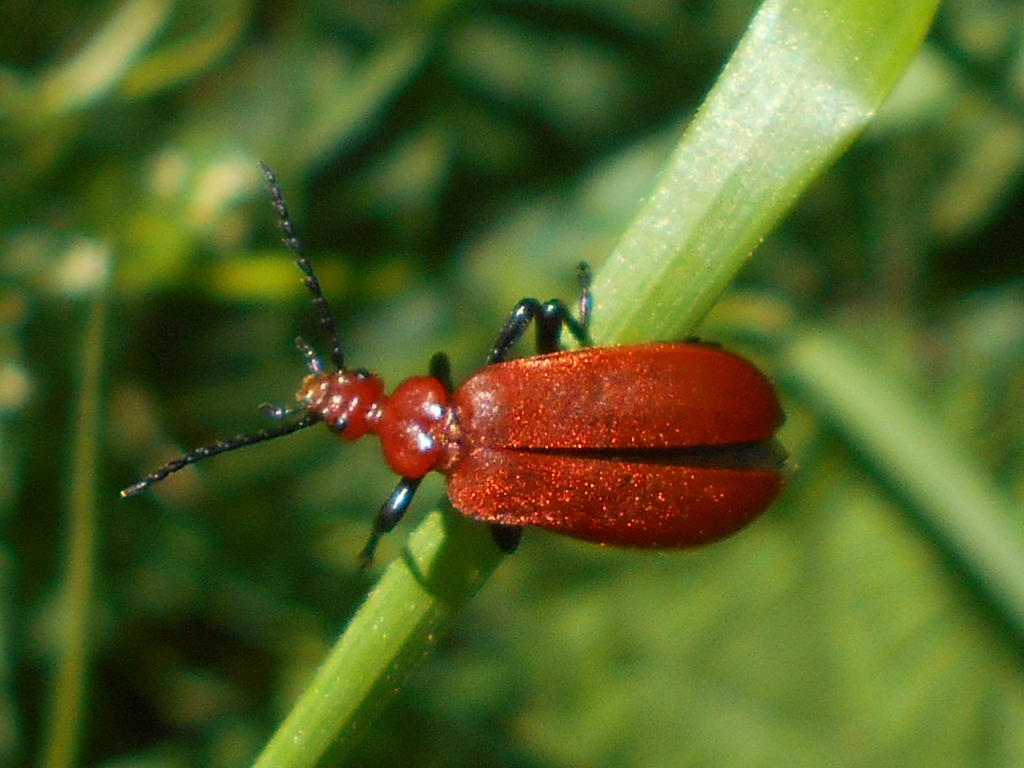
By now I had reached the meadow, where a Cardinal Beetle came to my attention. Several beetles come under this general name; this one is probably the commonest and is sometimes called the Red-headed Cardinal Beetle, other species having black heads. For those hungering for the Latin name it is Pyrochroa serraticornis.


The Red-headed Cardinal Beetle is the commonest of our three
Pyrochroa species. High Wood and Meadow. 9 June, 2019
All these are very commonplace insects and I can only hope that sorting through my specimens later will reveal something  little more out of the ordinary.


My hopes were later realised, for among the flies gathered was a specimen of the False Woodlouse-fly, Eggisops pecchiolii. It took me some time to identify it, for I had not encountered it before. Come to that, neither have many people because if I am right it is only the 21st record from Britain! I'll get confirmation from an expert but I am reasonably confident about it.
Oedemera nobilis on buttercup. Near High Wood, Preston Capes,
Northants. 9 June, 2019

Tony White. E-mail: diaea@yahoo.co.uk

Thursday, 6 June 2019

A fine, fat bumblebee - not

Byfield Pocket Park yesterday threw up a few surprises, most of which are of no interest except to nerdy dipterists and their ilk. One insect that was not a surprise was this specimen of Volucella bombylans. It is a common insect but for anyone new to entomology it can cause a bit of head scratching.


The first instinct could be to reach for a book or website dealing with bumblebees, but a closer look reveals a surprise. Bumblebees have four wings and yet this creature has only two.
Volucella bombylans, found in Byfield Pocket Park.
5 June, 2019

It is in fact a hoverfly. Many hoverflies mimic bees or wasps to some extent and this species is a superb bumblebee mimic.


When watching these creatures going about their daily business it should be clear that it is not a bumblebee. Birders often refer to the 'jizz' of a bird - something tricky to describe and yet characteristic: the posture that a bird adopts when sitting on a fence; the way in which it moves on the ground with a bouncy hop or not. The way it flicks its tail.


Hoverflies have a different jizz from a bee or a wasp but in the case of this specimen any such observations were not possible, for it was in a moribund condition when I found it and was dead by the time I had brought it home - hence the less than satisfactory photographs. But these insects are common in the garden and with practice they can soon be distinguished one from another.
The wing venation is all wrong for a bee.

Pity they don't get it right on Gardeners World, where hoverflies are often mistaken for bees.


Tony White. E-mail: diaea@yahoo.co.uk


Monday, 3 June 2019

Picture-winged Flies and other insects

A fine but blustery day found me in Byfield, where time allowed me a visit to the local pocket park. Situated on land once occupied by Byfield railway station and yard, the pocket park is being sympathetically managed by a team of volunteers led by Pom Boddington. Wildlife seems to be responding.


I had only advanced a few yards into the park when I noticed that the goosegrass beside the main track was galled by Cecidophyes rouhollahi. This mite causes a twisting and general distortion of the leaves at the tip of the stem. It is both widespread and apparently harmless.


The mite, Cecidophyes rouhollahi, causes goosegrass to wring its
hands in despair.  Byfield Pocket Park, 3 June, 2019
A butterfly, the obligatory Speckled Wood, settled a few feet away, enticing me into a photograph. I obliged, notwithstanding the fact that I have featured this species, Pararge aegeria, dozens of times before.

Please take my picture. This Speckled Wood decided to rest just in front
of my camera. I couldn't resist. Byfield Pocket Park, 3 June, 2019
Equally common was the Sloe Bug, Dolycoris baccarum, now more often referred to as the Hairy Shieldbug. This second name is fully justified even though the hairs are not particularly obvious. It is a pretty bug and there seems some evidence that this species has become more common in recent years (Ref 1). Certainly I see it very regularly.


The zebra-crossing antennae of the Hairy Shieldbug are very
distinctive. Byfield Pocket Park, 3 June, 2019


At this time of the year tiger craneflies are very common. The word 'tiger' refers not to carnivorous habits, for they do not bite and may have no functioning mouthparts. Rather it refers to the pattern of black and yellow stripes on the thorax and abdomen. The commonest species at this time of the year is Nephrotoma appendiculata, with a relatively broad dark stripe down the centre of the abdomen and an dark inverted 'U' shape below the wings. Even allowing for a certain amount of variation this is fairly straightforward to identify.
This cranefly, Nephrotoma appendiculate, seems unbothered by the
uncomfortable position of its wings. Byfield Pocket Park, 3 June, 2019


Less colourful but rather more pleasing to find was this hoverfly, Rhingia campestris. Not that it is rare, for at this time of the year it is a frequently-seen species, but this may be the first record from Byfield Pocket Park. The larvae are said to breed in cow dung, but perhaps they can make do with sheep dung, for cattle are relatively uncommon in the area.

Rhingia campestris. Its long 'snout' is clearly seen here. Byfield Pocket
Park, 3 June, 2019
Most pleasing, but a challenge for my little camera, was this Picture-winged Fly. Its distinctive wing patterning and the fact that it was on Black Knapweed, Centaurea nigra, help to establish that it is Urophora quadrifasciata, sometimes clumsily called the Four-barred Knapweed Gall Fly. (Latin names are often so much easier.) It is not rare but is by no means the commonest member of its family, the Tephritidae. 


Urophora quadrifasciata on Black Knapweed (Hardheads). Nice to see but
easy to miss. Byfield Pocket Park, 3 June 2019.
Some years ago I built up a long(ish) list of the insects and spiders of Byfield Pocket Park. Somewhere along the line this was lost and I am slowly re-compiling it, hopefully for future generations to examine and assess what has been lost and, hopefully, what has been gained. It is going to take quite a few more visits.


Reference


Hawkins, R.D.(2003) Shieldbugs of Surrey.  Surrey Wildlife Trust