Tuesday, 16 October 2018

Dung Beetles

For the general public I have no doubt that the idea of investigating dung for its insect life is rather repellent. The 'Cow-dung Community' (Ref.1) is in fact endlessly fascinating and, of course, is of vital importance for agriculture and the general well-being of our countryside. In Australia the introduction of sheep and cattle created a problem, for no dung community existed there and significant areas of land gradually became less productive as a result of ungraded dung, because of course vital soil nutrients were locked up in this material. Great efforts have been made over the last few decades to establish a bucoprophilous fauna to deal with the  situation.
The dung of carnivorous animals is often unpleasant both in terms of odour and its potential for spreading disease via insects. With herbivorous animals these problems are not entirely absent and sensible hygiene precautions need to be taken but Eau de Sheep Poo is usually very faint and the insect visitors are, in general, very unlikely to go on to visit our picnic table. Of course, when I say the odour is very faint, that is not the case for insects such as dung beetles. Often the dung has barely hit the ground before the beetles arrive and, once there, they virtually 'swim' into this rich food source. Significantly several dung beetles belong to the mainly aquatic Hydrophilidae 'water-loving' family.
Many dung beetles are quite small, tiny even, but the rather handsome Aphodius fimetarius females can reach 8 mm in length.


Aphodius fimetarius, taken in flight. Foxhill Farm, Badby.
31 May, 2018
The most interesting of the dung beetles taken so far this year has been Onthophagus  coenobita. I retrieved it, more dead than alive, from a water trough on Foxhill Farm. Its elytra (forewings) have the same red-brown coloration (dung coloured?) as Aphodius fimetarius, but is far less common and this may be the first recording of it from Northants.

My pinned specimen (9 mm) of Onthophagus coenobita from Foxhill Farm, Badby. 9 September, 2018
It may now be approaching mid-October but there are still plenty of dung beetles around. Aphodius contaminatus is particularly common and I have even found one or two on window ledges around the house, but we are only three hundred yards from the nearest sheep pasture.


Thought. In mediaeval times dung was often incorporated into daub for the construction of walls. I wonder whether dung beetles have been found entombed in this mixture? I will investigate.


Reference


Skidmore, Peter (1991) Insects of the Cow-dung Community. Field Studies Council.
This book should be in every home. It is the perfect antidote to 'Strictly Come Dancing'.


There's always the garden

I've taken a break from blogging for a few days, partly 'cos I've been busy but also because the foul weather has largely kept me indoors - too wimpy to go out. But I shouldn't grumble as local farmland is still displaying cracks in the soil an inch or more wide.


The rain has topped up my half-barrel and it's current level suggests we've have a shade over an inch of rain over the last couple of days.


A couple of Water Lettuce plants, Pistia stratiotes, drift around in the barrel. They are odd plants, their roots spreading, finger-like, searching for dissolved mineral salts in the water. They won't find much as I've kept deliberately kept nutrient levels low. The species is not at all hardy and I'll doubtless lose my plants over the winter. As for the flowers, they are tiny and difficult to find deep in the rosette of leaves.


Water Lettuce in our half-barrel. Stefen Hill, Daventry.
15 October, 2018
Pistia is a genus in the Arum Family, Araceae. The family is huge, with some 3,750 known species but in Britain we are not well off, having just two species plus another two or three which are naturalised. Our two native species are Arum maculatum, known as Lords and Ladies, Cuckoo Pint, Wake Robin and a host of other names plus the Italian Lords and Ladies, Arum italicum, native to the south of England and South Wales. The thick root (actually a rhizome) of the Italian Lords and Ladies is rich in starch and this was extracted and used for stiffening Elizabethan ruffs and other items.


Lords and Ladies, Arum maculatum. Daventry. 16 August, 2018
Perversely, many plants are at their best, with flowers being produced in abundance. Our two Yuccas I have already mentioned but a foxglove is also in bloom.

This is a variety of Digitalis x valinii, a hybrid produced by crossing Digitalis purpurea with a species from the Canary Islands. The Canary Island plants were formerly classed as Isoplexis species but are now generally regarded as true Digitalis species. The hybrids are reasonably hardy and, in our sheltered back garden, seem happy. Unsurprisingly these are be sterile and, not producing seeds, stay in flower longer than a fertile species.


Our hybrid Digitalis is flowering strongly.
15 October, 2018
These crosses are sometimes marketed as 'Digiplexis' hybrids but the name is of doubtful validity. A friendly thrush has pulled out the label from my specimen and I can't yet recall the name under which I purchased it. But I like it.


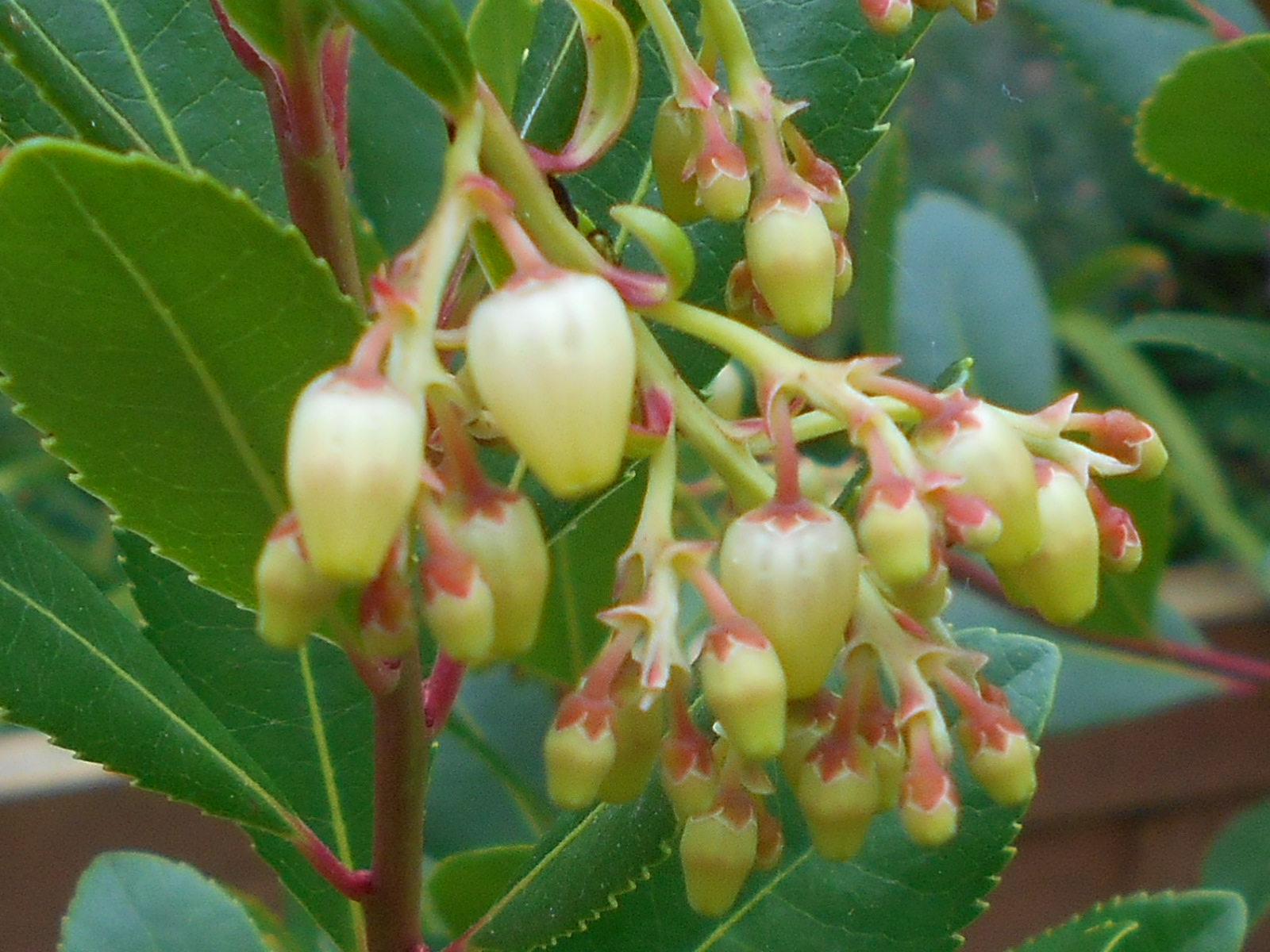
As for the Strawberry Tree, Arbutus unedo, it is flowering beautifully. This is the best display it has put on since we bought it.

Our Strawberry Tree is performing admirably. 15 October, 2018
Unfortunately the conditions are so wet that it isn't likely to receive any insect visitors for the time being. The flowers are beaded with droplets of rain but in the pendulous, flask-shaped flowers the pollen is safe and dry.

Unfortunately the flowers won't receive any visitors while these conditions prevail.


Thursday, 11 October 2018

Oaks around Byfield

We have two native oaks in Britain, Quercus robur and Q. petraea, plus two species which are well naturalised - too well naturalised in some areas. The common oak of lowland Britain is the Pedunculate oak, Q. robur, and there are several specimens around Byfield. The acorns in their cups are on the end of a stalk - the peduncle - an inch or so long. The leaves have rounded lobes at the base.


A leaf of Quercus robur, showing lobes at the base. Byfield, Northants.
10 October, 2018


There are specimens of Q. petraea within a few miles of Byfield but I have not found one within the village.


Easily mistaken for either of these common oaks is the Turkey Oak, Q. cerris, of which two specimens stand beside the village hall car park. It is one of our two naturalised species.  I will not weary any readers with details of the Turkey Oak's features as I have written of this species before. Just a reminder that the leaf tends to have a greater number of lobes and these are slightly pointed. The acorn cup is covered in rather long curvy scales, looking like whiskers.
The leaf lobes of Q. cerris come almost to a point. Byfield.
10 October, 2018


Three examples of the Holm Oak, Quercus ilex, otherwise simply known as the Ilex, stand in the village pocket park. Actually I should say stood, for in the last few days two of them have been unaccountably felled.
Many oaks have evergreen leaves but Q. ilex is the only species commonly found in the U.K.
Byfield Pocket Park. 10 October, 2018

The glossy leaves look, to our eyes, very un-oak-like, but interestingly leaves produced on young stems at the base of the tree are prickly and rather like holly. It is worth remembering that the Latin name for holly is Ilex aquifolium. The Holm Oak does produce small acorns but not reliably and I have been unable to find any this year.

The Holm Oak is native to countries around the Mediterranean and is the second of our naturalised species, but we have a North American species in Byfield too. For some time I have been unsure about its identity but this year I found a number of its odd little acorns scattered beneath the tree.


They are curious flat structures and enabled me to determine that it is Quercus palustris. The Americans call it a Sallow (we use the word sallow for a species of willow). It is also known as Pin Oak.

Leaf and cones of Q. palustris. Byfield, 10 October, 2018
The acorns seem not always to develop properly and the specimens I found were certainly oddly flattened, but they do match the structures described in some of my books. It may be that the species is self-sterile and for proper acorn development needs to be pollinated from another specimen.

The acorns seem to be under-developed.
On thing is sure: the tree takes on lovely autumnal colours and certainly justifies a place in Byfield, where it stands adjacent to the tennis courts.


The Byfield specimen of Quercus palustris is currently a fine sight. 10 October, 2018
In having only two species native to Britain we have missed out, for oak trees, in their various forms consist of between 300 and 600 species depending on the criteria employed by the individual taxonomist, but 450 would seem a reasonable figure. I have frequently found leaves of North American oaks in country lanes with the parent tree(s) not apparent. Autumn leaves clearly get carried over considerable distances.


Friday, 5 October 2018

Of Thorn Apples and other things

Just as silly headlines appear in newspapers about False Widow Spiders (several schools in London's East End have been closed recently for fumigation) so it is with the Thorn Apple, Datura stramonium.


  'Poison arrow plant found in English garden' (Independent, 7 August, 2010)


  'Deadly tropical plant grows in Suffolk Garden' (Telegraph, 6 August, 2009)


  'The deadly household plant that teens are using to get high - and kills hundreds each year' Daily Mail, (apparently encouraging young people to experiment!) 10 May, 2013


_____________

I wrote a blog on the subject recently (22 August, 2018) and I am tempted to add a little but, interesting though the plant is, there is only so much that can be said before readers nod off. Suffice it to say that it is still today (5 October, 2018) flourishing in the grounds of Northampton's General Hospital.

Despite alarmist headlines I suspect no one will be chomping on the plants and, even though they are on the edge of a busy car park, the odds are that no one has noticed them.

Thorn Apple showing the spiky fruit from which the plant gets its
common name. Northampton General Hospital. 5 October, 2018
Oddly enough the were growing cheek by jowl with another extremely poisonous plant, Hemlock, Conium maculatum. This looks vaguely like parsley but I don't think they'll be a part of anyone's fish dish tonight. The third member of the original triumvirate of toxic plants, Deadly Nightshade, has disappeared - or at least, I couldn't find any.


A dastardly duo. On the left, Thorn Apple with, on the left, Hemlock.
Over almost every border in the hospital grounds, sprawls Traveller's Joy, Clematis vitalba. The garden staff seem to have adopted a policy of benign neglect for, although it was surely never planted, it is an attractive species. Its clusters of stamens are arguably more of a feature than the petals (which in fact are really sepals, but who among the public cares?) The flowers will be replaced by feathery fruits, described vividly by Gilbert White: 'The downy seeds of traveller's joy fill the air, & driving before a gale appear like insects on the wing.'

Traveller's Joy, aka Old Man's Beard, with its starburst of stamens.
The day was sunless and, initially, on the cool side so few insects were around. A lone bug, Elasmucha grisea, was on a birch leaf. Known as the Parent Bug as a result of the way it protects its offspring, it is very common but pleasing to see.

The Parent Bug wears sombre colours. Very sensible too.
Northampton General Hospital. 5 October, 2018
Although Chris was visiting the hospital today her treatment is complete and hopefully it will be a long time before we need to return.


Wednesday, 3 October 2018

October in the back garden

It may be October but our back garden still holds much of interest and there are as many plants in bloom as at any time of the year.


Most obvious is the yucca. Our plant, like most around Daventry, is Yucca gloriosa 'Variegata'. It is native to the warm east coast regions of the U.S.A. between Virginia and Florida but appears to be perfectly hardy.


Yucca gloriosa is currently a fine sight. Our garden at Stefen Hill,
Daventry. 3 October, 2018
From time to time over the years I have needed to move a specimen. It is a hazardous business. It is not called 'Spanish Dagger' for nothing and carelessness can lead to the loss of an eye. I suspect it is reasonably safe from grazing animals!

Earlier this year, on Friday 13th of July, we visited the late Beth Chatto's beautiful garden near Colchester and Chris bought a plant of Tulbaghia violacea. It was in flower at the time and is in flower still and shows no sign of stopping. I'm afraid my photograph shows the flowers as a wishy-washy off-white but in fact it is of a delicate violet colour.

Tulbaghia violacea may be a South African plant but seems very happy
with us. 3 October, 2018
This species, native to southern Africa, is sometimes called Society Garlic and when crushed the leaves and stems do have an onion-like smell. A couple of decades back it was regarded as a risky plant to grow in Britain but with climate warming it is a far safer bet.

Holotelephium spectabile is also a good, safe choice for all but the shadiest or wettest of gardens. I have photographed it at least partly to remind me that its former name of Sedum spectabile ought not to be used. The old name is not wrong but genetic research suggests that it is sufficiently different from other Sedums (Seda?) to merit being placed in a different genus. It is ultimately a matter of opinion.

Holotelephium spectabile is full of flower but lacks butterflies. Stefen Hill,
Daventry. 3 October, 2018

It is generally regarded as an excellent butterfly plant but sadly this year I have seen none on it.

Speaking of butterflies, an excellent plant for insects generally is the widely-popular Verbena bonariensis (bonariensis - of Buenos Aires). Theoretically it is extremely easy to grow but for some reason ours struggled a bit at first. However it is now doing well and has produced a few seedlings.

Verbena bonariensis. This time a South American but happy enough.
Stefen Hill. 3 October, 2018


Chris and I grow few roses. Partly it is down to a lack of space but the concept of a 'rose garden' does not appeal. We use them as we would use any other shrub but insist on fragrant varieties.
'The Pilgrim'. David Austin roses have a reputation for hanging their heads
but can be lovely. 3 October, 2018
 
The Pilgrim, a David Austin rose, is one of only four varieties we grow. It is very fragrant and is tall enough to train against a fence.

Finally a plant I am particularly fond of although it is admittedly not a dramatic feature. The Strawberry Tree, Arbutus unedo, has featured in a previous blog so I will not dwell on it. It causes surprise among many to learn that it is a member of the Heather family, Ericaceae.

The flowers of the Strawberry Tree are not fuzzy although my photograph
would suggest otherwise. 3 October, 2018
Ours is a young plant and this is the first year in which it has put on a show of flowers. There are no signs of the fruit yet but earlier today I photographed a specimen in Byfield bearing several of the scarlet, rather warty fruits.

A specimen in Church Street, Byfield, is bearing fruit.
3 October, 2018
Given visits from pollinators and we too should have some fruit a year hence.


Monday, 1 October 2018

A Diaea for diaea

It was back to Matt Moser's farm today but my precise destination was a little different. Last time we had met I had asked Matt whether a little patch of land in the north-east corner was actually part of Foxhill Farm. He assured me that it was, so a small group of trees I had hitherto ignored suddenly took on considerable interest.


I parked up about half a mile away on the edge of Daventry and set off walking. A flock of Jacob's sheep met me as I climbed the stile and entered the first field. I say 'met' but in fact they strolled off, unhurried but determined.


Jacob's sheep turn their bums to me and strode off.
Foxhill Farm. 1 October, 2018

Trying not to let my hurt show over this rejection I made for an area which would be bathed in sunshine yet sheltered. I wasn't the only one with similar ideas for on a sunny tree trunk was a Noon Fly, Mesembrina meridiana. The Noon Fly belongs to the same family, the Muscidae, as our common house fly and it has to be said that  the majority of its members are dull little creatures. Not so with this species.

A Noon Fly basks on the trunk of a tree stump. 1 October, 2018
With its brilliant orange wing-bases this insect is very eye-catching. Its larvae, which live in cattle dung, are coprosaprophagous, feeding on the faeces but also decaying vegetable matter. Apparently they may also live on carrion.

Also enjoying the sunshine was a Comma butterfly, Polygona c-album. As it sat on a fence with its wings spread, the c-album bit wasn't visible as the marking is on the underside of the wing.

The clue to the comma's common name is not to be seem on the dorsal
wing surface. 1 October, 2018
I offered it a Kit-Kat to co-operate and it obligingly opened its wings but I then sneaked off and ate it myself. Yes, I know...there's a nasty side to my nature.

The comma mark is very clear on the ventral surface of the rear wing.
1 October, 2018
I continued on my way and eventually reached my target - a clump of Norway Spruce, beneath which were several rotting logs. A number of interesting spiders were taken from the crevices and under loose bark but, just before departing, I had a swish with my net through the needle-like spruce foliage and...

One of Britain's prettiest spiders is Diaea dorsata. The male is striking, with emerald-green legs and carapace and was painted by Mike Roberts for the cover of his monumental 'Spiders of Great Britain and Ireland'. The female is of a similar shape and size but is of muted browns.

Diaea dorsata features on the cover of Volume 1 of Mike Roberts' great 
3 volume work.
I also chose it for my e-mail address: diaea@yahoo.co.uk, so when I looked into my net and saw it there I was delighted. The species seems to like evergreens and I usually find it on yew. This was not the easiest place for a photograph so it is a poor picture but I hardly felt like complaining.


From a Norway spruce came this prize. Foxhill Farm.
I October, 2018


A good start to October.


Over Fox Hill

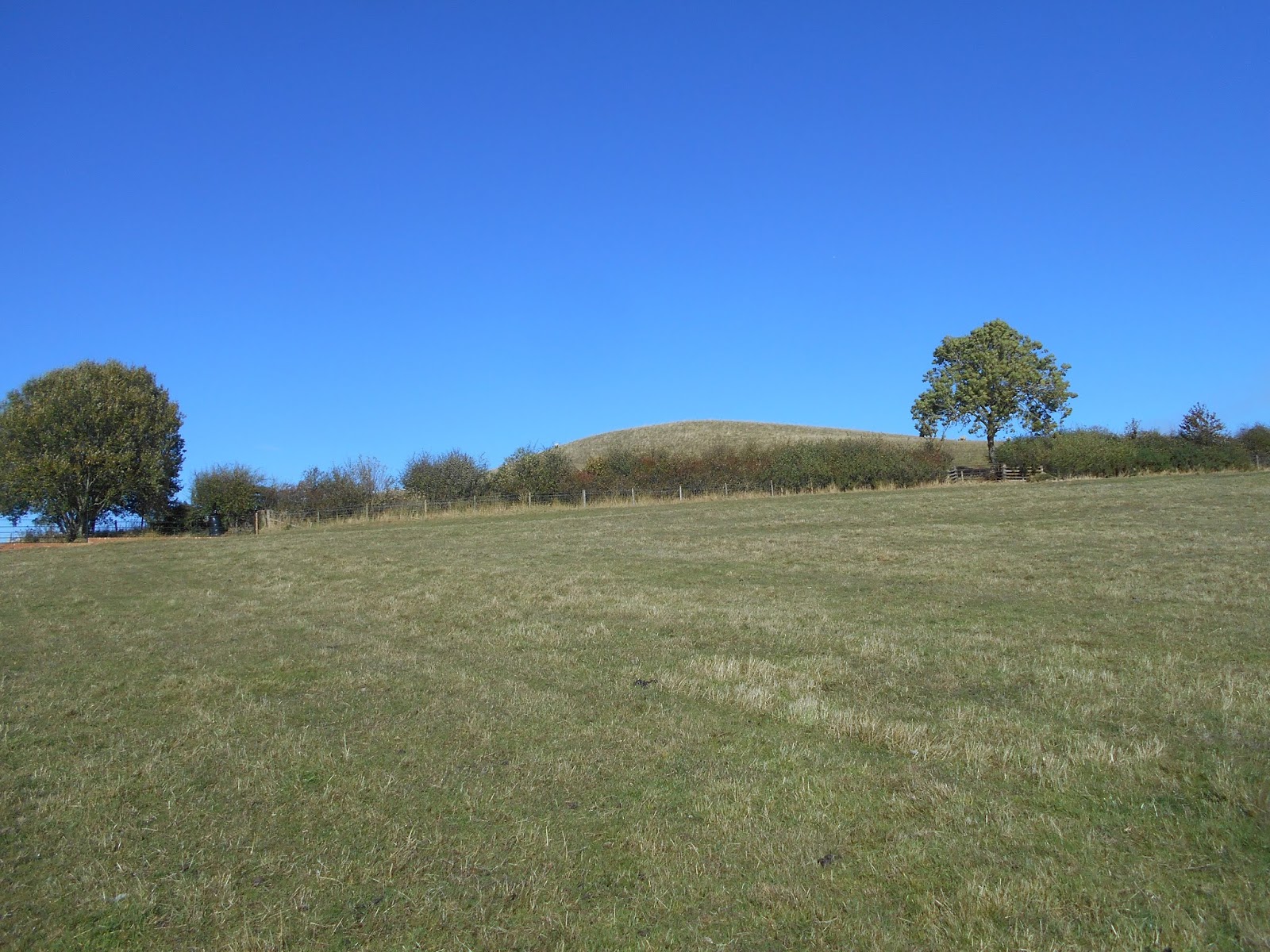
It is remarkable that, having visited Foxhill Farm about thirty to forty times, I had not, until today, scaled the hill itself. In truth, at c. 300 metres, it is hardly remarkable: in Shropshire it would barely merit a glance and in mid-Wales it would be regarded as flat land.


I would like to report that the approach is impressive but it really isn't - just a low hummock with the vegetation no different at the top from that lower down. No tree line, no windswept alpine crags. Just grass. And sheep.


Fox Hill from the south. 24 September, 2018
Even so, the hill does afford some interesting views from the top. Looking to the north there is a good view of Daventry but 'the Athens of the north' is not a description to be applied to a town which counts the Tesco store among its finest architectural achievements.

From the summit of Fox Hill looking north over Daventry.
24 September, 2018
To the west the view is of more interest. The hill in the background is officially and almost laughably called Big Hill - all 215 metres of it. In the foreground Foxhill Farm with its various outbuildings is clear, and a closer view shows, in the middle ground, a white building with a rather interesting history.

From the summit of Fox Hill looking west. 24 September, 2018

This is Badby Park, now home to Elysium Neurological. It stands in a 50-acre estate and the house itself, originally built in 1826 for Charles William Watkins, functioned as a nunnery/monastery until 2005 when a severe shortage of nuns (notably poor breeders) together with the failure of some commercial enterprises, led to its closure.


A closer look at the view to the west, with Badby Park in the
middle ground. 24 September, 2018
The walk was interesting and revealing but yielded other than the handsome bug, Pantilus tunicatus, a September/October insect - and one which I foolishly failed to photograph.