Monday, 1 October 2018

Over Fox Hill

It is remarkable that, having visited Foxhill Farm about thirty to forty times, I had not, until today, scaled the hill itself. In truth, at c. 300 metres, it is hardly remarkable: in Shropshire it would barely merit a glance and in mid-Wales it would be regarded as flat land.


I would like to report that the approach is impressive but it really isn't - just a low hummock with the vegetation no different at the top from that lower down. No tree line, no windswept alpine crags. Just grass. And sheep.
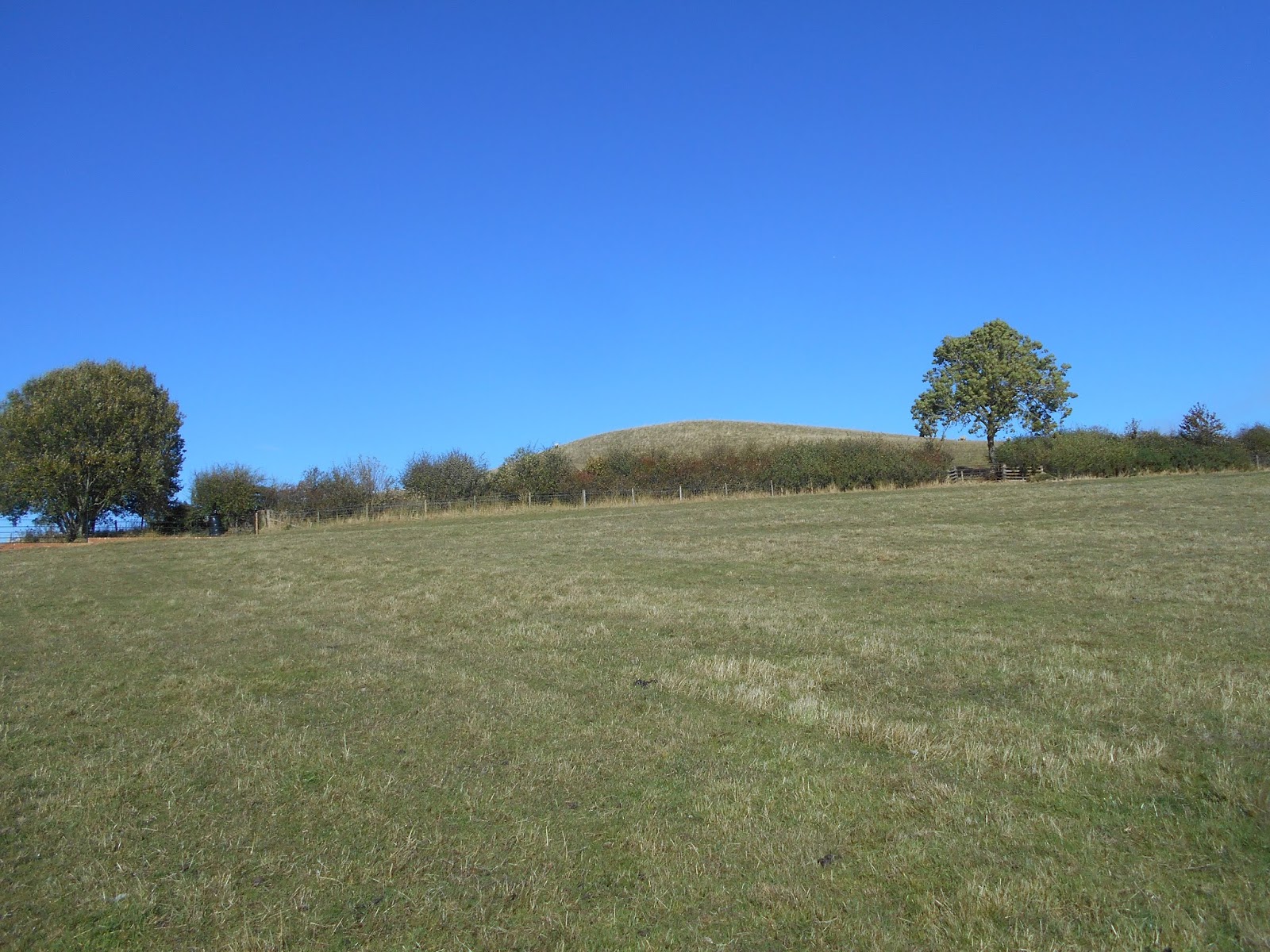

Fox Hill from the south. 24 September, 2018
Even so, the hill does afford some interesting views from the top. Looking to the north there is a good view of Daventry but 'the Athens of the north' is not a description to be applied to a town which counts the Tesco store among its finest architectural achievements.

From the summit of Fox Hill looking north over Daventry.
24 September, 2018
To the west the view is of more interest. The hill in the background is officially and almost laughably called Big Hill - all 215 metres of it. In the foreground Foxhill Farm with its various outbuildings is clear, and a closer view shows, in the middle ground, a white building with a rather interesting history.

From the summit of Fox Hill looking west. 24 September, 2018

This is Badby Park, now home to Elysium Neurological. It stands in a 50-acre estate and the house itself, originally built in 1826 for Charles William Watkins, functioned as a nunnery/monastery until 2005 when a severe shortage of nuns (notably poor breeders) together with the failure of some commercial enterprises, led to its closure.


A closer look at the view to the west, with Badby Park in the
middle ground. 24 September, 2018
The walk was interesting and revealing but yielded other than the handsome bug, Pantilus tunicatus, a September/October insect - and one which I foolishly failed to photograph.


Friday, 28 September 2018

Cranesbills and Storksbills

We are all familiar with Cranesbills. They are true species of Geranium, as distinct from the largely South African Pelargonium plants. Gardeners persist in referring to the latter as 'geraniums', much to the frustration of botanists.


Geraniums get their name from geranos, the classical Greek word for a crane and the reference is to the long pointed 'beak' of the carpels. Probably most gardeners grow some geraniums although currently I only grow one - the small but delightful Geranium cinereum 'Ballerina'. (Probably not true G. cinereum but a hybrid.)


Geranium cinereum 'Ballerina' in our front garden at Stefen Hill, Daventry.
28 September, 2018

It has typical geranium leaves with the usual palmate shape, 'palmate' because the lobes of the leaves spread out like fingers from the palm of a hand. Small geranium species are common on roadside verges and in lawns and the leaves of Dove's-foot Geranium, G. molle are very familiar.

Geranium molle showing the palmate leaves. 
Church Street, Byfield. 3 October, 2018


Storksbills are members of the Erodium genus and are very closely related to cranesbills. The best-known species is probably Common Storksbill, Erodium cicutarium, a plant which enjoys dry, rather sandy ground and in Northamptonshire, with its clay soils, it is not 'common' but is only occasionally found. However,  given the right habitat it can be abundant. I was both pleased and surprised to find a considerable patch on the grassy roadside verge outside my daughter's house earlier today.

Common Storksbill on the roadside at Timken, Daventry.
28 September, 2018
This plant also gets its name from the Greek, in this case from erodios, a heron, and Storksbill also has long pointed fruiting head. A crucial difference between Geranium and Erodium lies in the shape of the leaves for in the case of the latter genus they are not palmate but pinnate, and where the leaves were spreading across a kerbstone their appearance was clear. (An exception to the rule is Erodium pelargonifolium, with palmate leaves.)

A pinnate leaf is a compound structure consisting of leaflets spread along the rachis (leaf stem) and, as most will be aware, comes from the Latin pinna, a feather. Several storksbills are included in plant lists for rock gardens, but are only occasionally used.


Storksbills usually have pinnately compound leaves.
Timken, Daventry. 28 September, 2018
In the wild, given its liking for sandy conditions the Common Storksbill is more frequent on or near to the coast. I suspect that the occasional taste of salt when roads are gritted does not come amiss.

Wednesday, 26 September 2018

Yet another Daventry walk

Bright, warm sunshine today encouraged me to walk into Daventry. There are always jobs to be done. My walk took me past Danetre Hospital (Danetre, along with Daventrei and Daivintre, is an old name for the town) and a largish Lawson's Cypress occupies a position near the entrance. Unsurprisingly a Juniper Shieldbug, Cyphostethus tristriatus, superbly camouflaged, was on the foliage. Unsurprising for 2018 perhaps, but this would have been a real puzzle fifty years ago when this bug was a rare insect found only on juniper in Surrey and perhaps one or two adjacent counties.


Juniper Shieldbug on Lawson's Cypress. Danetre Hospital, Daventry.
25.ix.2018
I was indeed surprised when I found a paler specimen on a beech tree a couple of hundred yards further on. There were more Lawson's Cypresses nearby and I think it had simply suffered a satnav error.
A specimen on beech was clearly confused. I recommended 'The Hamlyn
Guide to the Trees of Britain & Europe' but it treated my suggestion
 with disdain.


I have recently mentioned the knopper gall in my blogs. Caused by the wasp, Andricus quercuscalicis, it is generally found on the acorn cup. On an oak in Daventry today I found an example where five of these galls were present on the same cup and had coalesced to form a very odd structure.

A quintet of knopper galls had coalesced on this oak in Daventry.
25 September, 2018
To the rear of our local Tesco supermarket stands a Cedar of Lebanon, Cedrus libani. Currently it is a particularly fine sight for the sweeping lower branches are adorned with hundreds of cones.

Even when young a Cedar of Lebanon is a fine sight.
Daventry. 25 September, 2018
They are the male cones and a closer examination shows that their pale yellow pollen is currently exposed, eventually to be carried away in the wind. Once the pollen has been dispersed these cones will fall to the ground, their task complete.

Pollen was clinging to the male cones. A dry day and a brisk wind
and they will be swept away.
Many people are puzzled by the strange larval forms of ladybirds. With practice they can be identified but one specimen made me pause for thought although I should not have been surprised. It was a Harlequin Ladybird, Harmonia axyridis. The adult (imago) is extremely variable and this larva simply had yellow patches on the abdomen rather than the brick-red with which I am more familiar.


The larva of a Harlequin Ladybird. The transformation into the adult form is
something we often take for granted but it really is astonishing.
Daventry. 25 September, 2018
As usual the walk was of far more interest than the shops, despite all their blandishments.


Tuesday, 25 September 2018

At last, a pond.

Some months ago Matt Moser had mentioned that a pond existed towards the western end of Foxhill Farm, but prior to today I had not seen it. In fact I was not looking for it at all but sort of blundered on it today whilst having a general walk. It is, of course, completely artificial and, unlike the farm's other 'pond', it contained water.


The lake at the western end of Foxhill Farm had shrunk greatly during the
long, hot summer, but at least there was water. 24 September, 2018

The two ends were quite different: the western end held a stand of Lesser Reedmace, Typha angustifolia, but the eastern end was dominated by Common Reed, Phragmites australis. I must pay more attention to these patches for numerous insects are associated with the two species.

Lesser Reedmace was present at the western end of a small lake on
Foxhill Farm. 24 September, 2018
Water there may have been, but the banks were largely unvegetated and, other than a few lycosid spiders dashing around, there was little to be seen in the way of invertebrate life. I suspect the pond has been re-dredged recently.

A stand of Common Reed dominated the eastern end. 24 September, 2018
A hefty tree-trunk had been left to decay at one point and I enthusiastically embarked upon an investigation of the rotting wood. Disappointingly I found nothing other than a few woodlice and was about to give up when a chunk of soft material broke off to expose a couple of very large beetle larvae.

A stag beetle? Probably, but likely to be the Lesser stag beetle rather than
its impressively large cousin. Foxhill Farm, 24.ix.2018
Foolishly I photographed one specimen without placing something nearby for scale but each was about the size of a pound coin. This is not my area of expertise but the words 'stag beetle' came to mind. I must keep an eye on this area next summer. Realistically they are most likely to be the larvae of the Lesser Stag Beetle, Dorcas parallelipipedus.


On my way to the pond I noted several shieldbugs. (The famous scientist E.O.Wilson once wrote 'Every kid has a bug period. I never grew out of mine' I can sympathise with that.)Anyway, these particular insects rely on 'stink glands' to deter predators but, ideally, their camouflage will prevent them being detected in the first place. A Green Shieldbug, Palomena prasina, had made a reasonably sensible choice of an ash tree leaflet on which to rest.

A Green Shieldbug is reasonably well camouflaged on an ash leaflet.
Foxhill Farm, 24.ix.2018

Unfortunately another shieldbug nearby had made a rather less prudent decision and was relying on a purple dogwood leaf as background. Whoops!

Not so good!
One of our commonest shieldbugs is the Hawthorn Shieldbug, Acanthosoma haemorrhoidale. A specimen dropped into my sweep net and I photographed it for no particular reason but was astonished to find, on returning home, that it had not been previously recorded at Foxhill Farm.
A Hawthorn Shieldbug was surprisingly a new record for Foxhill Farm.
24.ix.2018


Monday, 24 September 2018

An abandoned track

A couple of days ago, quite by chance, I stumbled upon a long-disused track towards the southern edge of Foxhill Farm. It had been metalled but was now overgrown, with weeds splitting open the surface. (I was inspired once home, to put on a c.d. of Janacek's delightful piano suite 'on an Overgrown Path.) The sides of the track were lined with bushes of hawthorn, elder, snowberry, gorse, viburnum, blackthorn, privet and spindle. Most had been planted, with the last two not naturally found on the mildly acid soils of the farm but more normally found on limy soils, whilst snowberry is not a British native, being a North American introduction. Swathes of the willowherb known as Great Willowherb or less prosaically, Codlins and Cream, Epilobium hirsutum, also bordered the track.


The track once metalled, has fallen into disuse. Foxhill Farm,
Badby, Northants.
The Spindle, Euonymus europaeus, was fruiting in abundance, turning an otherwise unremarkable-looking shrub into a very eye-catching feature. Indeed, the word euonymus means 'of good name' for, although it is rarely planted it was highly regarded for various features (despite the fruit being distinctly poisonous to humans, though clearly not for birds, which are happy to consume the berries). The wood is strong and hard so it was much used for making spindles, hence the common name.


Pink rather than red, the four-lobed berries of Spindle adorn hedges
usually on chalky soil.. Foxhill Farm, Badby. 24 September, 2018
In my childhood almost every suburban garden seems to have its privet hedge, with the chosen species invariably being Ligustrum ovalifolium, a native of Japan. It was dull, useless for wildlife and needed constant clipping but it was apparently a 'must have'. I suppose its evergreen nature was a plus. The clipping regime greatly reduced its capacity to flower and fruit, doubtless much to the relief of beekeepers because, I gather, the resultant honey is nauseous.

Privets belong to the Olive Family, Oleaceae, and there are about fifty species in the genus. Our native privet is Ligustrum vulgare, and this is the species occurring at Foxhill Farm. The species attracts a number of insects including our largest resident moth the Privet Hawkmoth, Sphinx ligustri, scarce in Northamptonshire and thinning out rapidly further north. I should perhaps not be too dismissive of Garden Privet for the insects which feed on Wild Privet are generally happy to accept the garden alternative. (Also content with privet, as many schoolchildren know, are stick insects.)
Privet is in the Olive Family and the fruits have a superficial resemblance
to olives. Foxhill Farm, 24 September, 2018


Late summer into early autumn is the prime time to be looking out for galls or for leaf mines. Insects have done their worst and left the scene; the naturalist must be prepared, like a detective, to examine the evidence and come up with a culprit. So I was intrigued to find that this acorn on a Pedunculate Oak, Quercus robur, had become distorted, losing its normal symmetry.


In this case the culprit was a wasp, Andricus quercuscalicis. The gall it had caused, the very common knopper gall, had developed and grown into the acorn, with the odd result shown in the photograph. On the same tree was a silk-button gall, yet again caused by a wasp, in this case Neuroterus numismalis.
The Silk-button Gall is an extremely common feature of oak leaves in
late summer. Foxhill Farm, 24.ix.2018


 This and other species took the Foxhall Farm total to 404.


Monday, 17 September 2018

Surprises

On my last visit to Foxhill Farm I met up with Matt Moser and he accompanied me for a few minutes, intrigued by the various methods employed for catching creepy-crawlies. On the way he pointed out to me, hidden beside a rather tall hedge, a field (7077) I had previously overlooked. Last year, 2017, he had sown it with a range of flowering plants to attract bees and, later on, birds to the seed heads. This year he sowed it with barley but it was an indifferent crop, largely because a huge number of these wild plants re-appeared. I decided there and then that this field must be the target for my next visit.


So that is where I found myself today.


At first there was little to show other than a pair of Dock Bugs, Coreus marginatus, sharing a leaf but clearly not on speaking terms. As I have said before, this species is invariably lumped together with shieldbugs although technically belonging to a separate though related group.


Dock Bugs on -  what else? - dock. Foxhill Farm, 17 September, 2018
Despite the name of Dock Bug this insect can also be found on sorrel and, occasionally, rhubarb.


In truth there was not a great variety of plants to be seen but the situation was interesting. A dense growth of sub-tropical grasses had appeared and beneath them there was a carpet of borage. This plant, Borago officinalis, gives its name to the family Boraginaceae; it is, as John Hutchinson once pointed out, 'The Borage of the Borages'. Borage oil is sometimes used in skin conditioners and in order to boost its appeal in cosmetics it is sometimes given the name of 'Star Flower Oil'.


Thousands of borage plants carpeted the ground beneath the tall grasses.
Foxhill Farm, 17 September, 2018
The flowers were attracting huge numbers of honey bees together with a smaller number of bumblebees. For birds however the grasses are of greater importance because the species present produce large quantities of sizeable seeds. These are already ripening and being shed.

In the brisk breeze a satisfactory photograph proved tricky so I brought home specimens of the most significant species.

On the left is Cockspur Grass, Echinochloa crus-galli. This is a luscious, robust annual from the warm temperate parts of the Old World but is frequent in Britain from bird seed mixtures.
Cockspur Grass and Glaucous Bristle-grass sown to support wildlife.
Foxhill Farm, 17 September, 2018
Yellow Bristle-grass, Setaria pumila, is on the right. It too turns up in wild bird mixtures but is perhaps rather less common. Like Cockspur Grass it is a native of the warmer parts of the Old World.

Common Hawthorn has jaggedly pointed leaves but at the foot of this field a species with
rounded leaves was present. This is Midland Hawthorn, Crataegus laevigata, frequent in this area but always pleasing to see.

Midland Hawthorn has rather rounded lobes to the leaves.
Foxhill Farm, 17 September, 2018
I made my way home with a mixed bag of spiders, flies, beetles and true bugs. The total for the farm should soon reach the 400 mark.


Friday, 14 September 2018

More pocket park maintenance

Once again a select band of locals gathered in Byfield Pocket Park for the first of three scheduled autumn meetings. Despite a very dry summer, with remarkably dry soil as a consequence, plants had flourished mightily. Much of the pocket park is situated on land  on which Byfield Railway Station once stood. This land, and the adjacent ground, has been levelled off at some time with rubble and being very free-draining this has exacerbated the dry conditions.


Typical plants of waste ground occur including Mugwort, Artemisia vulgaris. Most people are familiar with it, not only because of its appearance with deep-cut leaves, greyish beneath and dark glossy green above, but also because of its smell. This is not as pungent as its close relative Wormwood, A. absinthium, but is easily recognised. Indeed its aromatic nature has led to it being used in the past, probably through much of southern England, as a substitute for tobacco. It has a rich folklore associated with it and for millennia it has been employed medicinally for things as diverse as relieving indigestion and easing childbirth. Today my interest in it was limited to an interesting leaf miner, Calycomyza artemisiae.


The leaves of Mugwort had been mined by a fly, Calycomyza artemisiae.
Byfield Pocket Park, 14 September, 2018
This insect is a member of the Agromyzidae Family and is not rare but has not previously been recorded in the pocket park. It was not the only addition to the pocket park list. A tiny fly on a leaf turned out to be Fannia armata. In fact although this is quite a common insect it is the first time I have ever recorded it, perhaps because it is such a small fly.


Mahonia branches burned particularly well.

Pom Boddington has ordered a number of plants including Spindle, Euonymus europaeus, and presumably our next session will concentrate on getting them in before the winter.
Chris broke from her work for a snatch of conversation
As long as Pom provides delicious cake she will be able to depend on a loyal band of volunteers.