Monday, 19 February 2018

An eye-opener

My last visit to Matt Moser's farm ('Below the Windmill') concluded with a comment regarding the potential of the land. This was emphasised today when I ventured into the most interesting piece of woodland yet.
My arrival involved the now-familiar sight of a flock of sheep hurrying towards me. I called out 'cheese' and they all responded with sheepish grins. I felt embarrassed at having nothing to offer them but they didn't seem too disappointed.
A crowd gathered. Newnham Hill, nr Daventry.
19 February, 2018
I zig-zagged my way down the steep scarp slope, pausing only to note the pile of recently-dug earth excavated from a badger sett. There seems to be quite a number of 'brocks' in the area but, being rather crepuscular creatures, they have not exposed themselves to me yet. (Ed: Perhaps you need to re-word that sentence.)
Only February, but badgers have been at work. Near Newnham
windmill. 19 February, 2018
My target was a piece of woodland I'd seen on my previous visit. It was accessible only by a rather wobbly stile but I scaled it without swearing once. It turned out to be worth the effort, a real eye-opener. This steep slope has probably never been cultivated and the woodland is therefore likely to be largely natural with oak and some fine cherries being the dominant species. However there was some pine, sycamore, beech and birch present. These are (with the possible exception of the birch) not indigenous to Northamptonshire and have clearly been planted. Not all the trees had survived and some lay on the ground, decomposing nicely, some as soft as balsa under the onslaught of fungi, bacteria and other agents.

A young birch tree lies prone, now a food source for a host of fungi and
invertebrates. Below Newnham windmill. 19 February, 2018
The cherries came as a surprise, not because they are uncommon - I know of some fine specimens a mile or so west of Byfield - but because the large specimens I found today had been so well hidden. Once they are covered in blossom their presence will be more obvious.
This species, Prunus avium, is often known as the Gean and is the parent of our familiar orchard cherries. Its bark is very distinctive, being glossy with horizontal rows of lenticels (breathing pores), peeling in strips of a rather papery texture. This remains obvious even on a fallen specimen.
My suspicion that this woodland was of some age was further strengthened when I found the leaves of bluebell, Hyacinthoides non-scripta, pushing through the carpet of dead leaves.
Gean trunks have very characteristic bark, Woodland below Newnham
windmill. 19 February, 2018
When the cherry blossom and bluebells are in flower this woodland should be quite a sight. I recorded a few species including two new millipedes, raising the site total to fifty, but this is one for the warmer months. Bring it on!
Bluebells are pushing through. Woods below Newnham windmill.
19 February, 2017


Sunday, 18 February 2018

It's snowdrop time at Thenford

In truth snowdrops, Galanthus nivalis, have been in bloom since the end of January but early to mid-February sees them at their peak. But to imply that only G. nivalis is involved would be to over-simplify the situation for botanical recorders have confirmed that five species and three hybrids are present in Britain - and probably none is a native.

Snowdrops in Bell Lane, Byfield, Northants.
8 February, 2018

Galanthus nivalis is overwhelmingly the most common species and can be regarded as a denizen (see my blog for 8th February). Mention should be made of Queen Olga's Snowdrop, Galanthus reginae-olgae, as it blooms in early December and is probably responsible for many reports in the press of 'early-blooming snowdrops'. It is a native of the Peloponesse in southern Greece and although Chris and I were in that area about four years ago we were far too late - or early - to see it.
Snowdrops have been with us since the late 16th Century and suspicions that it is native are perfectly understandable given how it flourishes in our woodlands. But for at least three weeks snowdrops locally have been flowering in vain. The chance of a visit from early bees has been vanishingly small and this almost absurdly early flowering is another reason for doubting its native status and most early flowerers prove to be aliens: crocuses, mezereon, winter heliotrope, lungworts, periwinkles and so on.  
The snowdrop has a multitude of common names but the old Swedish name was snodroppe so what we appear to have is an anglicised form of that. To the French it was pierce-neige: even I, by no means Francophonic, can work out that the term means 'snow piercer'. 
Anyway, what is this leading up to?
Today, Chris and I went with our friend Lynda to visit Michael Heseltine's house and rather grand gardens at Thenford. Ostensibly it was a 'Snowdrop Day' but I was on the look out for other plants.
There were eye-catching specimens of Helloborus x hybridus drawing the admiration of visitors. Helleborus argutifolius, H. lividus and H. niger may all be involved in the genetic make-up of these plants with other species such as H. thibetanus occasionally involved. I am told that the plants sometimes receive insect visitors but I have not witnesses this.
Purple-maroon flowers of hellebores are real crowd pleasers.
Thenford, Northants. 18 February, 2018
Several south-facing walls are available at Thenford and I was pleased to see a couple of loquats being grown. The Loquat, Eriobotrya japonica is native to the hills of China but apparently, despite its Latin name, not Japan.
Loquat plants appreciated the shelter of a warm wall.
Thenford, Northants. 18 February, 2018
It is widely cultivated in warmer regions and I have sampled its fruits in Mediterranean countries but have found them to be rather unexciting. The plants rarely fruit in Britain anyway. The plant has handsome foliage and its flowers remind me of large hawthorn blossoms - unsurprising perhaps as both are members of the same family, the Rosaceae.
One attractive feature of the Loquat is the foliage.
Thenford. 18 February, 2018
In mid-February I wasn't expecting to see much in flower and it was other features which caught the attention. A magnificent tree exposed its moss-covered roots and was creating much comment. The tree was unnamed but it was almost certainly an ash. Not our native Fraxinus excelsior but the shape and form of its buds convinced me that it was one of its many relatives. My best guess is Fraxinus americana.
Fraxinus americana? Certainly a lovely tree.
Thenford. 28 February, 2018
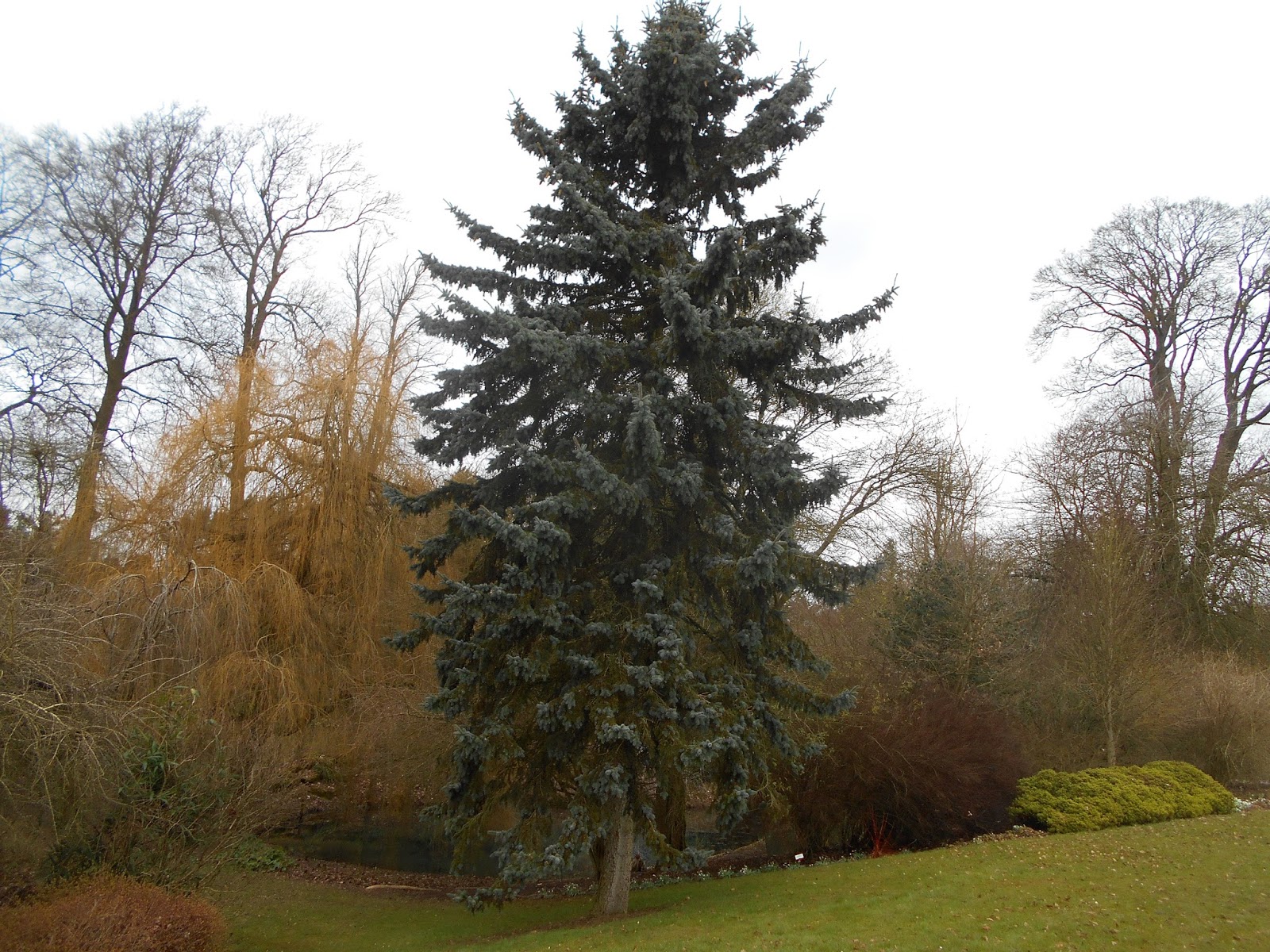
I have often felt that here in Britain we make insufficient use of conifers. There were several handsome species to be seen at Thenford and I was particularly impressed by a beautiful specimen of the Colorado Spruce, Picea pungens, native to Colorado and adjacent states in the Rockies.
It has lovely glaucous foliage and the form being grown, 'Hoopsii', is particularly fine. It is sometimes used as a 'Christmas Tree' but why don't we see it more often as a garden specimen? Incidentally the specific name 'pungens' does not refer to a pungent smell but in this sense means 'sharply pointed' and describes the leaves.
There are several lovely forms of Picea pungens. This is 'Hoopsii'.
Thenford. 18 February, 2018
A majestic tree had fallen just beyond the gardens. Too often these giants are taken off to a sawmill for timber but the aesthetic appeal of this specimen had been recognised and, following a little judicious trimming, was left in clear view for us to enjoy.


This fallen giant has been trimmed to make a rather impressive feature.
Thenford, Northants. 18 February, 2018
We briefly visited the nearby church of St Mary the Virgin, a very plain church with no ostentatious features that could have raised the ire of Oliver Cromwell. I was surprised to later find that it had Grade I status, listed for features of its architecture that meant little to me. For me the interest was in the churchyard, where leaves of celandines had been mined by Phytomyza ranunculi, a very widespread but tiny fly.
Leaf of celandine mined by Phytomyza ranunculi.
Thenford, 28 February, 2018
There was enjoyment elsewhere within the gardens: sculptures, lichen-encrusted trunks, lakes and other water features, an aviary and a wonderfully fragrant shrub of Daphne bholua 'Jacqueline Postill'. What a pity I couldn't catch the delicious perfume with a camera!
Oh, and there were rather nice cakes too.

Not a bad day.


Thursday, 15 February 2018

Below the windmill

At last! A sunny and reasonably mild (7 degrees) day allowed me to resume work on Matt Moser's land. As on other occasions a flock of sheep, mostly Jacobs, rushed towards me, clearly anxious to be photographed. I resisted their blandishments and any hope of them appearing in a film were dashed. A Flockwork Orange? No chance.
Newnham Windmill stands on the crest of a rather steep scarp slope affording wonderful views to the west. Patches of woodland cling to the slopes and may have a role in stabilising the soil. A pair of ravens soared overhead as I scrambled down the slope, their harsh, guttural calls seeming to mock my laborious progress.

Patches of woodland cling to the steep slopes adjacent to
Newnham windmill. 15 February, 2018
Viewed from below it can be seen what an appropriate situation the windmill occupies. It stands only about 150 yards from the Daventry-Newnham road so access during its working life would have been reasonably easy.
Newham windmill from the south-west. 15 February, 2018
Despite being quite a fine day mid-February is not known for teeming insect life so my haul of invertebrates was quite paltry. One of the flat-backed millipedes, in this case Polydesmus coriaceus, was new for the site, despite being a reasonably common species. The genitalia needs microscopic examination but my copy of Blower's book (Ref.1) made the job straightforward.

Polydesmus coriaceus dropped on to my collecting sheet from a
tussock of grass. 15 February, 2018
Dead leaves at a field margin concealed the caterpillar of a Square-spot Rustic, Xestia xanthographa, a very common moth but also new for the site.
The larva of a Square-spot Rustic was beneath leaves.
Foxhill Farm. 15.ii.2018

The more I familiarise myself with this area, the greater the potential for wildlife becomes apparent. Woodlands, clumps of gorse, decaying logs and a pond I've not even looked at yet offer a host of possibilities.
Today's 'paltry' haul added another six species to the total, now standing at 46 species.

Clumps of gorse around trees look very promising. 15 February, 2018


Tony White: diaea@yahoo.co.uk


Reference


Blower, J. Gordon (1985) Millipedes  Linnaean Society of London


Wednesday, 14 February 2018

More about birches

I often mention birches in my blog. They have to be among my favourite trees and I'm sure this is a sentiment I share with many others. Around sixty species of birch exist across the northern hemisphere but their fossil remains date back to Upper Cretaceous times, when dinosaurs still existed. 
Yesterday, strolling through the grounds of Northampton General Hospital, I was pleased to see some rather nice specimens of the Paper-bark Birch, Betula papyrifera. It is native to North America and the indigenous people there put it to good use for canoes, roofing (it is waterproof) and so on. The specimens I saw yesterday were in a rather inaccessible place and as a consequence the bark was peeling off in sheets of significant size. Normally, I suspect, people can't resist the temptation to tug at this loose material so sizeable pieces never survive.
Paper-bark Birches in the grounds of Northampton General Hospital.
12 February, 2018

Similar birch species occur in Asia and Hindu manuscripts, dating from around 1800 B.C., were written on birch bark. 'Birches are good biochemists' states Colin Tudge (Ref.1) and few would argue with that. Although birches are not in the same family as willows (the former are in the Betulacae whereas willows are placed in the Salicaceae) both contain aspirin-like compounds. In the case of birches the active compound is methyl salicylate which is present in oil wintergreen, also obtained from birches.They can be used to make syrups and in times of famine the starch and oils also present have possibly meant the difference between death and survival.
The fissured bark of silver birch. Beckett's Close, Byfield.
14 February, 2018
It is generally agreed that our two native oaks, Quercus robur and Q. petraea, support more insects than any other British trees. But the silver birch also does extremely well in this respect. From moths such as the Birch Mocha, Cyclophora albipunctata, to bugs like the Birch Shieldbug, Elasmostethus interstinctus it is host to a great array of organisms. Micro-moths in particular seem to occur on birches prolifically and at least nine species of aphids (Ref 2) may be found on their leaves and twigs.
A second birch species occurs in Northamptonshire, particularly on badly-drained soils. This is the Downy Birch, Betula pubescens, but this will have to be dealt with on another occasion.
Finally, the sap of birches, particularly that of Sweet Birch, Betula lenta, can be employed to make birch beer.
I like birches!

References
1. Tudge, Colin (2005) The Secret Life of Trees  Penguin Books


2. Dixon, T and Thieme, (2007) Aphids on Deciduous Trees  Richmond Publishing

Monday, 12 February 2018

Hospital hotch-potch

Today was the occasion of another visit by Chris and me to Northampton General Hospital. After her check-up she went to have a chat over coffee with one of her ex-colleagues, giving me the opportunity to have a look at some of the plants in the hospital grounds. Not surprisingly there was little to cause a raised eyebrow but here and there were things of marginal interest.
A shady border was home for a patch of Pachysandra terminalis. It is known as Japanese spurge or Carpet box but the latter is a more appropriate name as it is generally placed by botanists in the Buxaceae, the Box family.
Pachysandra terminalis was growing in an out-of-the-way bed.
Northampton General Hospital. 12 February, 2018
From China, Korea and, of course, Japan, it is a rather undistinguished plant and I wouldn't bother growing it but will survive in conditions too dry for many plants and is very hardy. The plants were in bud and I expect them to produce their rather undistinguished flowers in about three to four weeks.
I have wandered around the grounds many time and yet on one stony bank, passed by me on numerous occasions, were the unmistakeable rosettes of Weld, Reseda luteola. Had I seen it there on a previous occasion? I couldn't be sure.
The distinctive basal rosettes of Dyer's Rocket.
 Northampton General Hospital. 12 February, 2018

These basal leaves are shiny and very crinkled and from them will rise a tall spike of yellowish flowers. The plant is often called Dyer's Rocket and was once used to produce a bright yellow dye from a flavonoid, luteolin, found in its tissues.
A third species also saw my camera brought into action. It was Butcher's Broom, Ruscus aculeatus, a curious plant rather local in Britain up to the north midlands but apparently not native to Northamptonshire (It is found naturalised in about twenty places). For a long time it tended to be placed in the Lily family, Liliaceae, but is now generally regarded as a member of the Asparagaceae.
The prickly cladodes of Butcher's Broom. Northaampton General Hospital.
ebruary, 2018
It has no leaves and what appear to be leaves are sections of flattened stem known as cladodes. My photograph shows the flower buds in the middle of these 'leaves'. These cladodes have sharply prickly (aculeate) tips and bunches of the twigs were apparently once used by butchers for cleaning the blood and gore from their slabs. Its use was once suggested by herbalists for 'female obstructions'. Make of that what you will.
Perhaps I would normally overlook the three plant species mentioned, but in the late winter I'm happy to give them blog space.
And Chris was pronounced healthy.


Tony White. E-mail: diaea@yahoo.co.uk

Thursday, 8 February 2018

Despite the cold


We have endured several days of bitter weather. It's not over yet and it could be another week or so before we see temperatures reach even ten degrees. I attempted a spot of gardening today, aiming to move some foxgloves into a more pleasing position but I gave up as the ground was frozen.
Despite all this there are things to gladden the eye. In my own garden Iris reticulata brighten up the scene. From the mountains of south-east Europe they have the genes to withstand the cold. They hate poorly-drained soil but the gritty loam I've given them seems suitable.
Iris reticulata in our front garden at Stefen Hill, Daventry
7 February, 2018
A visit to Byfield yesterday found a number of species in flower. Winter Aconites, Eranthis hyemalis, were putting on a good show but pride of place went to a lovely clump of crocuses in Beckett's Close. They weren't labelled but I'm confident the species is Crocus tommasinianus.
Crocus tommasinianus was putting on a lovely show in Byfield.
7 February, 2018
Walls along Church Street - and throughout the village - were topped with Silky Wall Feather-moss, Homalothecium sericeum. In the bright sunshine it really did have a silky sheen to it and its common name is very appropriate.
Silky Wall Feather-moss crowned walls in Church Street, Byfield.
7 February, 2018
One plant which always draws my attention is Caper Spurge, Euphorbia lathyris. Even at this bleak time of the year its architectural form is eye-catching, looking rather like a plant assembled by a child from a kit. Is it native to Britain? Probably not, and it is often regarded as a denizen. I found a plant outside Tim and Pom Boddington's house in Bell Lane, Byfield.
Caper Spurge in Bell Lane, Byfield. 7 February, 2018
For a botanist a denizen is a plant that behaves more or less like a native but is suspect either because of the habitat it occupies - e.g. man-made - or because of its natural distribution outside Britain. Caper Spurge is poisonous, as are all spurges, containing a violently purgative oil. An alternative name is Mole Weed; it is said to deter moles but I know of no hard evidence to back this claim.
True capers are the fruits of Capparis spinosa, an attractive perennial plant which I became familiar with when serving with the R.A.F. in Aden, where it was used as a bedding plant on traffic islands and the like. It is marginally hardy in Britain (but so, until recently, were olive plants). The fruits of Caper Spurge and the true caper are very similar in appearance.


Monday, 5 February 2018

Jacob's

For my visit to Foxhill Farm today I approached by a different route and found myself approached by a flock of inquisitive Jacobs.

Whoops! Sorry about that. I meant the sheep.


This breed, originally imported from Spain, has a sort of piebald coat, and I once thought that their name referred to Jacob's multi-coloured coat but I was wrong.
                      
                  Jacob separated the lambs, and made the flocks face towards the striped
                  and all the black in the flock of Laban; and he put his own herd apart
                  and did not put them with Laban's flock.
                                                                               Genesis Ch 30, verse 40


Well, that's all cleared up...or not.


Jacob's sheep are rather photogenic. Near to Newnham windmill, Northants.
5 February, 2018
They ran up to me but stopped about three metres away and quickly backed off when I tried to approach them. The greeting was on their terms, not mine. Each wore a thick fleece and they surely needed it for the conditions were bleak - three degrees according to my car's dash. We were on high ground and the wind, though not strong, had a real bite to it. In my childhood no one ever seemed to refer to the 'wind chill' but today this was a very relevant factor.
In the conditions I almost turned back but told myself not to be a wimp and decided to pay a visit to a small patch of woodland clinging to a west-facing slope. Trees were largely oak but beech and pine - neither native to Northamptonshire - were also present, plus a little holly. So steep was the slope that I could only make progress by going from tree to tree, clinging on to convenient branches. It was hard going and my hands were already beginning to go numb.
A small woodland fell away steeply to the west. 5 February, 2019
Was it worthwhile? I did take a few spiders in leaf litter but insects were  conspicuously absent, and after half an hour I decided to absent myself too. Nevertheless, as is so often the case, I decided that I must re-visit tis little woodland in a couple of months time as it clearly has lots of potential. Some nearby clumps of gorse, on the mildly acid soils, were tempting but they too must wait for a later visit.


In fact I added one spider, Stemonyphantes lineatus and a rove beetle, Quedius nigriceps, to the list. It now totals 40 species.