Sunday, 19 March 2017

Round and round the garden...

March still has over a week to run yet things are now really moving. A week or so ago our Mezereon, Daphne mezereum, had a decent showing of blossom but now the branches are wreathed with the lilac, heavily fragrant flowers. It will bear a crop of scarlet berries later in the year and I should be able to rear some progeny from these.
Mezereon is blooming particularly well, Our garden, Stefen Hill, Daventry.
19 March, 2017
In one of the alpine beds Saxifraga 'Peach Melba' is flowering very well. It is a hybrid and it is often quite helpful to know the parentage of a plant in order to judge its requirements - sun/shade, acid/alkaline, moist/dry - but this plant appears to have been an accidental hybrid of unknown parentage. It seems very happy anyway.
Our Saxifraga 'Peach Melba' enjoys a gritty, well-drained compost.
19 March, 2017
The Myrtle Spurge, Euphorbia myrsinites, was only planted recently but it is an undemanding species and seems to have settled in nicely in a rather gritty loam. Its name derives from the Greek word 'myrsine' meaning a Myrtle but, although I grow a true myrtle shrub, Myrtus communis, I am at a loss to see any resemblance.
Euphorbia myrsinites has settled in well. Stefen Hill, Daventry.
19 March, 2017
The flowers of Euphorbia species are structurally very interesting. They are known as cyathia and are well worth examining closely. Although their superficial appearance may vary greatly from species to species (take the spectacular Poinsettia, Euphorbia pulcherrima) in detail they are essentially the same. A huge range of Euphorbias is available and to my mind they have only one drawback: they bleed a white latex which is poisonous and very irritating to sensitive skin.

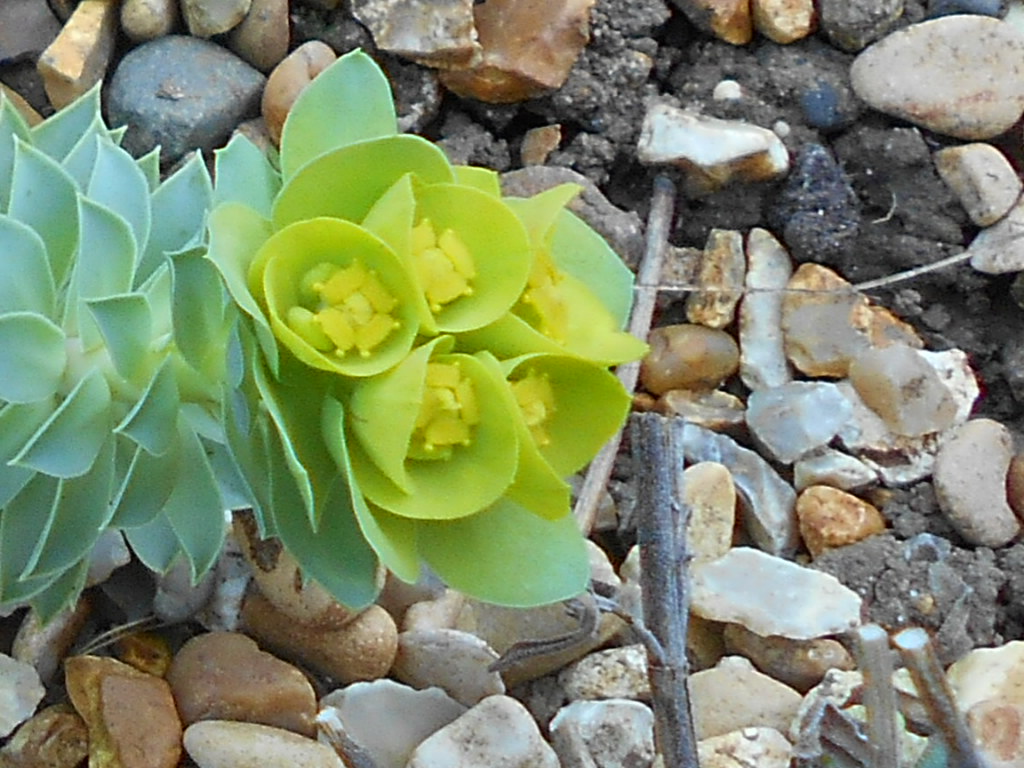
Cyathia of the Myrtle Spurge.
Despite lacking bright colours or any obvious perfume Euphorbia flowers can be very attractive to bees.
Also poisonous are Pasque Flowers. The Red Pasque Flower, currently in bloom in our front garden, is sometimes referred to as Pulsatilla rubra but in reality it is just a form of our native Pulsatilla vulgaris, found wild in the east of Northamptonshire.
Pulsatilla vulgaris, var rubra. Stefen Hill, Daventry. 19 March, 2017
Like Euphorbia flowers, its blooms also merit a closer look for they too have a curious structure. The 'petals' are seen to be silky and in fact they are not true petals, being better described as petaloid sepals. Within them a cluster of golden stamens surrounds a group of darker styles. These are the tips of the carpels and, later on in the season, will lengthen and become feathery (showing the plant's relationship with Traveller's Joy, Clematis vitalba) helping the wind to carry away the ripened fruits.
A Pulsatilla flower in close-up.
The word 'Pulsatilla' appears to come from the Latin pulsata, to shake, and may refer to the way in which these flowers shake in the wind. The genus Pulsatilla was once included in with the anemones, whose name is also derived from the Greek, for anemos means 'the wind'. Curious!


Tony White. e-mail: diaea@yahoo.co.uk


Thursday, 16 March 2017

The Blue Lagoon (2)

Two days after my first visit chance took me back to the Blue Lagoon: sounds like a film - 'Return to the Blue Lagoon'. My first visit had not been particularly productive, perhaps because of a rather keen wind. There had been no rarities but the Celery Leaf Beetle, the Hawthorn Leaf Beetle and the European Chinch Bug all turned up.
Compared with my first visit there were fewer pedestrians about and, notwithstanding the noise of heavy traffic at the nearby Barnes Meadow roundabout, a Grey Heron stood serenely in the shallows.
A Grey Heron kept a careful eye on me. Blue Lagoon, Northampton.
15 March, 2017
Coot, Mallard, Moorhens and Mute Swans were also present and, rather surprisingly, a pair of Teal, Anas crecca, were busying themselves beside a reed bed.
In general fewer butterflies were seen but Small Tortoiseshells were very common, perhaps attracted by the beds of nettles (the food-plant for their caterpillars) on the bank side.
Several Small Tortoiseshells were enjoying the sunny conditions.
Blue Lagoon, Northampton. 15 March, 2017
A singleton, colours a little faded, was soaking up the sun but a more active pair was engaged in a spot of courtship. Their colours were far brighter, suggesting that they had only recently emerged from their pupae.
With procreation in mind... Blue Lagoon, Northampton.
15 March, 2017
Along the bank fluffy balls were being blown around by the breeze. The seed heads of the Common Reedmace or Bulrush, Typha latifolia, had burst open and these were the seeds being borne on the wind with the aid of downy strands. We have two species of reedmace in Britain, the other being the considerably less widespread Lesser Reedmace, Typha angustifolia,
I returned to my car, parked a few yards away, and was just preparing to drive off when there was a little 'clunk' on the bonnet. It was a Lesser Water Boatman; to be more precise it was Hesperocorixa sahlbergi, a very common species found throughout Northants. It is a true bug and therefore related, if only rather distantly, to bedbugs and aphids.The steely grey-black of the car, glinting in the sun, had clearly been mistaken for a lake or even a river (the insect may have been misled by the word 'Ford' on the front of the car). Anyway, it got a nasty surprise.


Monday, 13 March 2017

The Blue Lagoon (1)

As one leaves Northampton via the Rushmere Road there is, at the base of the slope on the left, a rather obvious lake. It is officially just a flood relief lake on the floodplain of the River Nene. Unofficially, but invariably, it is known locally as The Blue Lagoon - about as justified as 'The Blue Danube'. Enjoying brilliant sunshine on 13 March, I had an opportunity to stroll along its northern bank and record a few insects.
The Blue Lagoon, Northampton, Looking east. 13 March, 2017
Celandines, Ficaria verna, (Ranunculus ficaria in all but the most recent books) were in flower as was Cherry Plum, aka Myrobalan Plum, Prunus cerasifera, but rather surprisingly neither was attracting any insects as far as I could see. The Cherry Plum was very fragrant and presented a lovely sight; it is introduced, widely naturalised and the earliest Prunus to fruit. Most insects were taken from young stinging nettles and various umbellifers such as hemlock near to the water's edge
Cherry Plum beside the Blue Lagoon, Northampton. 13 March, 2017
Other than these two species, the only other flowers I found were those of Common Field Speedwell, Veronica persica. Although it is abundant in the wild, behaving as though it were native, it is an introduced plant, having arrived in Britain under two hundred years ago and it is really a native of the Middle East including Persia (Iran) hence persica. In Britain galls have been recorded from no fewer than eleven Veronica species, but records suggest that the Common Field Speedwell is not one of the targets.
Common Speedwell beside the Blue Lagoon, Northampton.
13 March, 2017
Butterflies were on the wing including Small Tortoiseshell, Peacock and Brimstone. Members of the general public often assume that anyone wielding a sweep-net is attempting to catch butterflies but, although several passers-by asked what I was seeking, none mentioned butterflies and when I said that I was recording 'ordinary' flies, they were interested rather than surprised. I strolled along to the far end of the lake and then retraced my footsteps. On the return journey the sunshine had gained in strength and very large numbers of insects were about including flies, beetles and true bugs; it is likely to be two or three days before all are identified. This has been the best recording day of 2017 so far.
The Blue Lagoon, Abington, Northampton, looking west. 13 March, 2017

Tuesday, 7 March 2017

Much ado in the garden


A welcome sign of advancing spring is the flowering of Mezereon, Daphne mezereum. Although for a century or more botanists have tended to regard this shrub as a British native, opinion now has shifted and it falls in the same category as the Common Snowdrop, Galanthus nivalis, with the suspicion being that it was brought to this country, perhaps as much as a thousand years ago, by travelling monks.
Mezereon in flower in our back garden, Stefen Hill,
Daventry. 9 March, 2017
The fact that, like all Daphnes, it is highly poisonous gave it potential importance as a medicinal plant. Indeed, only a century ago it was still being recommended, because apparently it 'acts favourably in syphilis, scrofula and rheumatism' (Potter's Cyclopaedia of Botanical Drugs and Preparations, Potter & Clarke, Ltd, 1923). Well, if I'm struck down by any of these ailments I'll know where to turn. I have little use for rouge either so its nineteenth century use for producing rosy cheeks leaves me unmoved. In fact, when a paste of mezereon was applied to the cheeks it caused the blood vessels to dilate but when the danger and implication of this was understood it rapidly fell out of use.
Of course, if fickle fashion demanded pale cheeks, then a different plant might offer a solution and John Clare's advice could be heeded:
                                          A Fumitory too - a name
                                          That superstition holds to fame -
                                          Whose rare and purple mottled flowers
                                          Are cropped by maids in weeding hours,
                                          To boil in water, milk and whey,
                                          For washes on a holiday,
                                          To make their beauty fair and sleek
                                          And scare a tan from summer's cheek.
                                                                                            Clare's Shepherd's Calendar, 1827
Alpines and rock garden plants are doing nicely. The Hacquetia we brought with us from Byfield took a while to establish but this member of the carrot family, with its curious green 'flowers' (the 'petals' are really bracts) has now settled down.
Hacquetia epipactis in our front garden, Stefen Hill, Daventry.
9 March, 2017
Hacquetia epipactis, to give it its full name, is said to be fairly common in central Europe, enjoying dappled shade beneath trees but, although I have kept an eye open for it in northern Italy, the Tyrol and the like, I have never found it. But for this plant Balthasar Hacquet, the Austrian writer after whom it is named, would probably be forgotten.
When, a few days ago 28 February) I photographed Saxifraga oppositifolia in our sink garden, I felt that it couldn't flower any more. In fact it is now impossible to see any leaves. This species is native to Britain of course and is said to be locally common in north Wales, the north of England and Scotland. All forms are lovely but I am growing a selected strain of the plant.

Saxifraga oppositifolia is flowering quite remarkably in our sink garden.
Stefen Hill, Daventry. 9 March, 2017

Another saxifrage, Saxifraga x irvinii 'Jenkinsiae' is also doing well, forming a neat dome of white flowers, each with a pinkish heart. Its parentage is unknown but apparently, unusually for a hybrid, it can be propagated from seed. 
Saxifraga x irvingii 'Jenkinsiae' has yet to reach its peak in our back garden.
Stefen Hill, Daventry. 9 March, 2017

Several more alpines have yet to flower but I don't want them to be all over before summer. I need some thing to look forward to.


Tony White  E-mail: diaea@yahoo.co.uk


Monday, 6 March 2017

Spring arrives with a rush

So, has spring arrived yet? In one sense no, for astronomical spring begins on 20 March. However, meteorological spring has already begun, having started on March 1st. Whatever, March has so far been anything but spring-like, with rain lashing down and precious little sun - until today when,
although not particularly warm, the wind has been light and as I walked into Daventry and back I was bathed in sunshine all the way.
Flowers have been quick to respond, turning their faces to the sun and flirting with insects. The blue anemone, Anemone blanda, was flowering, but as usual my camera has failed to do justice to its brilliant blue tepals*. This native of south-east Europe and Turkey is very popular and occasionally becomes more or less naturalised. I say 'more or less' because colonies apparently do not usually persist.
Anemone blanda beside a war memorial in Daventry's town centre.
6 March, 2017
A very similar species, Anemone apennina, is less commonly cultivated yet appears to be been more frequently naturalised.
Daventry is well endowed with open spaces and in many of these areas crocuses have been liberally planted.
Hundreds of crocuses on open ground along The Inlands, Daventry.
6 March, 2017
One such area is alongside 'The Inlands' where drifts of Crocus, I suspect Crocus albiflorus, make a fine sight. Honey bees were busy at the flowers today, gathering both pollen and nectar. It is not unusual for the casual gardener to confuse honey bees with hoverflies, and even the BBC frequently gets it wrong. It is an easy mistake to make as some hoverflies are mimics of honey bees (and bumble bees too), and although there are major differences - hoverflies have two wings but all bees have four - if an insect is moving quickly then inexperience can lead a person into error.
A honey bee delves into a crocus flower. The Inlands, Daventry.
6 March, 2017
There were indeed hoverflies on the wing today, visiting the blossom of  Cherry Plum, Prunus cerasifera, hedging.
Hoverflies were frequent on Prunus hedging. Daventry, 6 March, 2017
The most frequent appeared to be Eristalis tenax, known as the Drone Fly. This is one of our largest Eristalis species and careful examination shows stripes across the compound eyes caused by lines of hairs. Both the hoverflies in the photographs are females; males would have the eyes meeting in the middle - an arrangement known as holoptic.
A female Eristalis tenax was quick to exploit the blossom. Daventry,
6 March, 2017
.

Other species were probably present and it is high time that I blew the dust off my collecting equipment and investigated a little further.


* Where sepals are coloured and have taken over some of the functions of petals, the term 'tepal' is frequently used. However, botanists often prefer to play safe, referring to them as 'perianth segments'.

The Dainty Lady

The Silver Birch, Betula pendula, often gets a mention in my ramblings and I offer no apology, for it is a beautiful tree. With its delicacy and grace it is probably one of the first trees that people generally learn to recognise. But, for all its grace it is, as I usually point out, as tough as they come. Its springtime growth is generally welcomed although perhaps there was a time when misbehaving children (and adults) were less than enthusiastic and in the 1607 play 'The Knight of the Burning Pestle 'by Francis Beaumont and John Fletcher, spring is celebrated with the lines:
                                        And now the birchen-tree doth bud; that makes the schoolboy cry.
I admit to having been birched at school, as were several of my school-mates, but we simply dared not shed a tear lest we be contemned.
Of course, despite the growth of birch trees, the arrival of spring was generally welcomed by boys, for the work goes on:
                                      The rumbling rivers now do warm, for little boys to paddle.
(Clearly, for Beaumont and Fletcher girls did not exist, at least not when the work was first performed.)
I seem to have gone off track a bit; where was I? Yes, birch trees.

In the Middle Ages the grace of the tree was surely appreciated, but it was valued for another reason, now almost forgotten. Our ancestors only had limited access to sweet substances and by spring any stores of honey would be almost exhausted. Where could they turn? From late March onwards birch trees offered a possibility, for their trunks could be tapped for its fragrant and rather sweet sap. There were two points to bear in mind: one, the sap rather rapidly went 'off' so it needed to be consumed quickly; the other thing to remember was that the cut made in the trunk needed to be sealed as soon as possible, using clay or something similar, or the tree would 'bleed' badly. Of course other trees could be tapped: Walnut, Juglans regia, Alder, Alnus glutinosa, Hornbeam, Carpinus betulus and, it seems, all Acers including Sycamore, Box Elder, Sugar Maple (obviously) and so on. Mind you, I have yet to meet anyone who has actually done this - and I certainly don't plan to. Willows may apparently be tapped but here a note of caution is required for the sap will contain significant amounts of salicylic acid, which in refined form is marketed as aspirin.
The deeply fissured bark of the Silver Birch. Daventry.
6 March, 2017
Sorry, I've veered off track again. Many birches are planted nowadays in parks and as street trees but probably the majority, despite having white bark, are not our native birches at all but are Himalayan Birches, Betula utilis var jacquemontii.
The smooth, much whiter bark of the Himalayan Birch.
Daventry, 6 March, 2017
Whereas our own birches generally develop a deeply fissured trunk these exotics have very white and much smoother bark (in some gardens the trunks are actually washed) which tends to peel off; for obvious reasons they are also referred to as silver birches.
The bark of Himalayan Birch tends to peel off.
Daventry, 7 March, 2017
Our native Silver Birch is also, as the specific name indicates, much more pendulous, giving it an overall much more pleasing shape. By and large the two species appear to attract similar insects but I have yet to see 'witches brooms' on a Himalayan Birch.

Saturday, 4 March 2017

Coppicing in Byfield Pocket Park

Recently my friend Pom Boddington assumed responsibility for the management of Byfield Pocket Park and when I spoke to her a few days ago she told me that a start had been made on coppicing the wooded areas. Today was fine and sunny - or at least, the morning was - so I strolled over to have a shufti*.
For many centuries coppicing was a widespread activity involving the cutting down of a tree near to the base of the trunk with the object of providing a crop of poles for hurdles and so on as re-growth took place from the stool. The practice began to die out, perhaps as labour became scarce in the countryside, but has been revived over recent decades when it became evident that so much of our woodland flora - primroses, bluebells and the like - was beginning to disappear. Coppicing allows sunlight to penetrate to the woodland floor and is regarded generally as good woodland management. It could be argued that in some woodlands it is done to an excess but in Byfield Pocket Park it is certainly needed and I assume some sort of rotational coppicing may be the aim (the cycle was generally a ten- or fifteen-year one, depending on the sort of poles required).

Hazel stool left by coppicing in Byfield Pocket Park.
4 March, 2017

One problem with coppicing is that the tender young growth so produced may be browsed, and sometimes rendered useless, by deer. The answer was pollarding, where the trunk was cut through perhaps eight or ten feet above the ground, producing young growth beyond the reach of deer. (I should hasten to add that hazel is not pollarded.) In theory most broad-leaved trees can be coppiced but pines and many other conifers do not respond and simply die. The usual target-species for this treatment is hazel but in Byfield's pocket park stand a few Spindle Trees, Euonymus europaeus, and I was concerned that these may have been coppiced. I need not have worried; they had been spared and were putting on plenty of spring growth.
A sweeping branch of Spindle shows off its new growth. Byfield
Pocket Park, 4 March, 2017
Not that it would have mattered in the long term; we would simply have been deprived of its flowers and fruits for a year.
A vitally important habitat. Dead wood beneath the trees in
Byfield Pocket Park. 4 March, 2017
I was delighted to see that the pruned growth had been gather up into a few suitable spots and left to decay. This will probably lead to a complaint or two but this decomposition process is of long-term benefit.
For many mini-beasts, especially woodlice and beetles, decaying timber is an important, even essential, habitat and I anticipate that these little piles of wood will soon be colonised. Logs are best for the encouragement of wildlife and in his excellent book, No Nettles Required (Eden Project Books, 2006) Ken Thompson tells of an experiment in which birch logs were stacked in twenty gardens. Two years later the stacks were examined and 'frogs, mites, harvestmen, spiders, centipedes, millipedes, woodlice, earthworms, flatworms, snails, slugs, springtails, ground beetles, rove beetles, bugs and flies' were revealed.
The pocket park contains a number of young Ash trees, Fraxinus excelsior, and I see that Pom and her co-workers have removed a number of these. Ash is such a common species hereabouts that their loss is of no importance and again their loss may be of long-term benefit. In effect these trees have been coppiced and there may be some growth from the stools; time will tell.
Stools of young ash trees. Byfield Pocket Park, 4 March, 2017
Anyway, the overall benefit of this management has been the opening-up of areas and perhaps, with a little human help, the establishment of Wood Anemones and Primroses - hopefully using seeds or plants from an unimpeachable British source. (Whoops! How racist does that sound!)
At the time of the pocket park's creation a number of 'Field Maples' were planted. The Field Maple, Acer campestre, is an important species (with impeccable British credentials!) but I have long held suspicions about the true taxon involved in this planting. There is something not quite right about them and I really ought to give them a closer examination. To be fair however, they do sustain a number of other species, especially galls, so perhaps their removal could not be justified. A splendid start has been made to the recovery/restoration of the area and I hope the work is appreciated.

* Shufti is an Arabic word for a quick look or glance, the sort of word that was once widespread during our imperial days. Many people who, like myself, saw service in the Yemen (in the then separate territory of Aden), picked up a host of similar words. It is probably now falling into disuse in the UK today. It dates me!