Sunday, 17 January 2016

Suddenly we have snow

We awoke to the first significant snow of the winter, a south-east wind having brought about an inch of the stuff. The growth of early Crocus, Narcissus and Irises has been brought to a shuddering halt. Birds have had it easy through December and early January but suddenly they are having to be extra diligent in their search for food. I must restock our bird feeders.


Our plans for tea and cakes in the back garden later have been put on hold.


 Even a 'leylandii' cypress has been rendered tolerably  attractive...


... and banks of Lawson's Cypress, Chamaecyparis lawsoniana, are positively picturesque. The prefix 'chamae' means 'low' and I always feel it is rather odd for a tree that is able to tower to 150 feet (45 metres) high.


Well, some may like the snow. Groups of excited children were lugging toboggans along the roadside, seeking in vain for a suitable slope. They have a long walk: I could just make out groups hurtling down the steep sides of Big Hill between Daventry and Newnham - too far for little legs to manage.

As for me - a few minutes out there sufficed and I trudged home to seek the sanctuary of central heating.

Now, about those bird feeders...


Friday, 15 January 2016

Daventry: the Marches

This morning we rose to the coldest morning of the winter so far. A light dusting of snow had followed a sharp frost, leaving the pavements white.


The coldest night of 2016 so far.
Daventry, 15 January, 2016


My grandmother always pronounced the word 'frost' as frorst and, following this rule, pronounced 'cross' as crorse. This means that the old nursery rhyme, 'Ride a cock horse', really did rhyme:

                          Ride a cock horse
                          To Banbury Crorse...

Anyway, it was distinctly chilly and I wrapped up well before setting out for a walk.
My last jaunt had taken me to Drayton; today I visited the less salubrious area around what I call The Marches: Long March, South March, Broad March and High March. I am assuming that, in this context, the word 'march' is derived from the Old English mearc meaning a border area between two regions. Anyway, this part of Daventry is an area of perfectly good houses but they have been squeezed together to create an almost claustrophobic situation.  Space for cars is at a premium and, as a consequence, many front gardens have been concreted over. Potentially bright gardens have been replaced by drabness.


Bergenias were in flower. Daventry. 15 January, 2016

I grow a few saxifrages in small containers and it is odd to consider that Bergenias are members of the same family. Here and there a few were flowering and, at this time of the year, they certainly introduce a splash of colour into a garden, but for the next eleven months...


Alder catkins tossed in a biting wind.
Daventry, 15 January, 2016


Hazel catkins have been open for a few weeks now and today I found the first alder catkins of the year. They appeared to be our native Alnus glutinosa; most of the trees at the roadside appeared to be Grey Alders, Alnus incana, but as they were devoid of leaves or flowers I couldn't be certain.


Wayside apple bushes were probably complex hybrids.
Daventry, 15 January, 2016


Apples hung on a small tree beside Long March; they were clearly not our native Crab Apples, Malus sylvestris, but doubtless came from a discarded apple core. The blossom will please the human eye and also be a magnet - hopefully - for various bees. 


I employ the word 'hopefully' because I have grave concerns about the government's attitude towards neonicotinoids, reinforced by a letter I received earlier today from my M.P. Chris Heaton-Harris. Previously I had expressed to him my misgivings about these powerful pesticides, particularly one marketed as Sulfoxaflor; this was assessed by the European Food Safety Authority as 'highly toxic to bees'. I learn via my M.P. that the government is going ahead with authorising its use - albeit in a limited manner - even though research has also shown that neonicotinoids persist in soil for at least six years. In the U.S.A. a federal court has struck down a permit for the use of Sulfoxaflor, again because of serious misgivings about its toxicity. Worrying!

Moving on. Groundsel, Sow Thistles and White Dead-nettles were all in flower. These ruderals can be relied upon to add a little interest to the winter scene but there was nothing out of the ordinary to get excited about; I had to again console myself with the thought that I'd at least had a brisk bit of exercise.  


Wednesday, 13 January 2016

Drayton

In the northwest corner of Daventry lies Drayton and, with a spare hour available earlier today I decided to have a quick look around. It was formerly a separate settlement and, although it has been subsumed by the more vigorously-growing Daventry, it retains some of its old features.


Eyre and Jeffery's map, dating from 1791, shows it as a hamlet detached from Daventry, and even in modern references it is still described as a hamlet, but the open land once separating the two settlements is now fully built over. Locally it seems to be regarded as one of the more 'select' areas of the town.


Buildings in School Street, Drayton, Daventry
13 January, 2016


Several old buildings remain from early Victorian times or before, invariably built utilising Jurassic sandstone, no doubt from local quarries.


A brilliant sapphire sky was deceptive - it was a cold day!
Drayton, Daventry. 13 January, 2016


Some are well-constructed buildings, clearly in a good state of repair and doubtless much sought after. Fossils abound in the stonework, notably belemnites and bivalves.


Most modern daffodils are complex hybrids.
Drayton, Daventry. 13 January, 2016


A welcoming sight was daffodils en masse at the corner of Holden Grove. These modern daffodils are hybrids of species within the 'Ajax' group, such as our native Narcissus pseudonarcissus. They will attract the occasional early bumble bee but have limited wildlife value. However, there is no denying their cheerful appearance.


More significant was a plant of our native Spurge Laurel, Daphne laureola. It was in a garden but had almost certainly not been planted, and further investigation would doubtless have revealed more specimens.


The flowers of Spurge Laurel would easily be overlooked
but for their fragrance. Drayton, Daventry. 13 January, 201

The flowers seem to depend upon their fragrance rather than bright coloration to attract pollinators. An article appeared in The Guardian newspaper earlier this week from a correspondent surprised at having seen a bumble bee on the wing, but I replied pointing out that these winter-flowering shrubs must rely on visits from these equally early insects for cross pollination to occur.  Certainly they always seem to bear a good crop of their black - and highly poisonous - berries.


Rosemary bore a few flowers.
Drayton, Daventry. 13 January, 2016

Also in flower was Rosemary, Rosmarinus officinalis. Their Latin generic name of Rosa marinus - 'Rose of the Sea' - may seem odd, but when I have seen this species growing on hillsides in southern Europe, it has never been far from the sea. Their zygomorphic (the botanical term for bilaterally symmetrical) flowers are designed for insect pollination but, at this time of the year, a bit of luck is required.


A brilliant red form of Japanese Quince.
Drayton, Daventry. 13 January, 2016


Yet a third shrub in bloom was Japanese Quince, Chaenomeles japonica. A few days ago a friend gave us a pot of quince jelly, which she admitted came from this species rather than a true quince. I may be giving the impression that Drayton was a kaleidoscope of flowers but the truth is that these needed to be hunted out among the drab browns and greys.


A bank was covered in Yellow Archangel.
Drayton, Daventry. 13 January, 2016

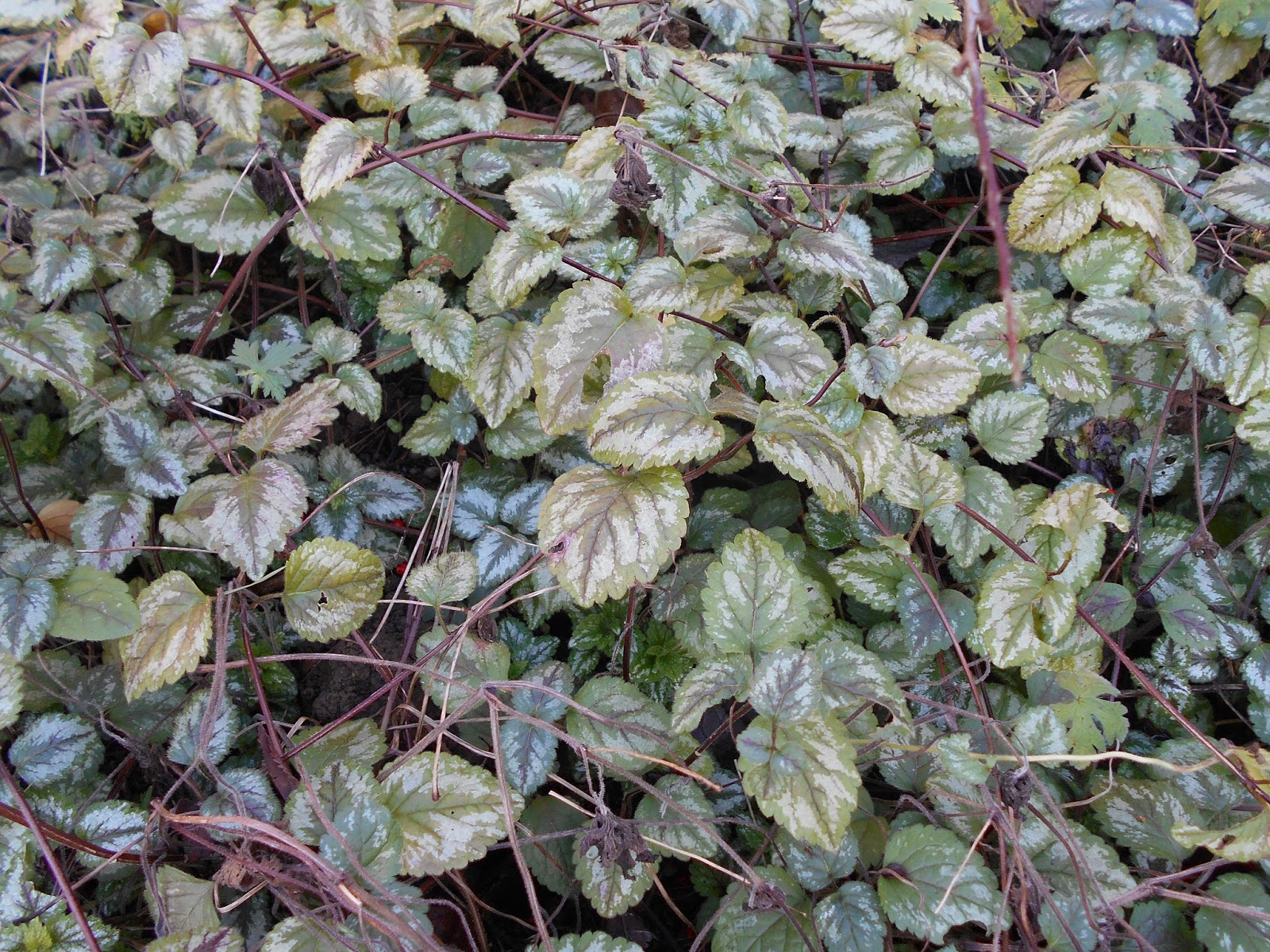
The variegated form of Yellow Archangel, Lamiastrum galeobdolon, var argentatum, was tumbling down a bank. It is a very distinctive plant which is sometimes regarded as a distinct species, Galeobdolom argentatum. Whatever its true status, it is another of those thugs, pretty enough, introduced into many a garden by the unwary and cursed ever after.


As usual recently, nothing dramatic, but for me Drayton turned out to be rather interesting and goes down as one of those (countless) places I should return to this summer.


Sunday, 10 January 2016

A wet Sunday in Daventry

Sunday afternoon in Daventry, Not a place to visit if excitement is what you are after, in fact my only reason for being there was a visit to the library. I wanted a copy of Laurie Lee's book, 'As I walked out one Midsummer Morning'. No luck, but to be fair, there was plenty of Mills & Boon material. (Tony, aren't you being just a little bit of a snob? Actually, for two years I really was a snob, this being an 18th century term for a shoemaker.) Anyway, moving on...

The shower that had dampened me a little earlier had cleared up. Time for a brisk stroll around the town to get the legs working. Would I see any wildlife? Answer: not a lot.

Normally busy streets were remarkably quiet. A blackbird scolded me as I passed a cotoneaster hedge. What was I a-playing at, disturbing respectable birds of a Sunday afternoon! A wren flitted quickly from on shrub to another, hoping not to be noticed.


Iris foetidissima has a host of common names
 such as Roast Beef Plant. 
Daventry, 10 January, 2016


Fruit on these bushes had been thinned out a little by birds, but the scarlet berries of Stinking Gladdon, Iris foetidissima, appeared to be untouched. Clearly they are the avian equivalent of brussels sprouts and only eaten under sufferance.


The popular but highly poisonous Stag's Horn Sumach.
Daventry, 10 January, 2016
Stag's Horn Sumach, Rhus typhina, was infesting a border, growing from the suckers of a plant in a nearby garden. It is quite a pretty tree but its suckering habit makes it a real nuisance and I would think twice before introducing one to my garden. It has a couple of other drawbacks too: it has no value whatever for wildlife, and all parts of the plant are extremely poisonous. This toxicity is not surprising as, being a member of the Anacardiaceae, it is related to the Poison Ivy of North America. 


Oddly enough, this family also includes cashew nuts and the mango. In this sense it resembles the Solanaceae, which includes dangerously toxic plants such as Deadly Nightshade, Tobacco and Henbane but also includes potatoes, tomatoes and aubergines.


Old Man's Beard wreathes its way through shrubs.
Daventry, 10 January, 2016

Old Man's Beard, Clematis vitalba, threaded its way through roadside shrubs. This relative of buttercups has, as in Northampton, found a congenial home on waste ground. As far as I as concerned it is very welcome.


A brick wall, probably the best part of a century old, looked promising. Surely, I thought, ferns will have colonised the partly-crumbling mortar. No such luck - but there were several plants clinging on there, such as Kenilworth Ivy, aka Ivy-leaved Toadflax.


Buddleia, Buddleja davidii, was predictable, a tiny sapling rooted among the mosses. It will need to be removed soon of the mortar is not to be badly damaged.


Yellow Corydalis enjoys the crevices in old brickwork.
Daventry, 10 January, 2016


Slightly less predictable was Rock Fumewort, Pseudocorydalis lutea. In the summer this area will be brightened up by its canary-yellow flowers. Some of its close relatives (Fumitory species) have grey, finely cut leaves which can have a vaguely smoke-like appearance, hence the odd common name. But in truth an even commoner name is simply Yellow Corydalis.  It is not a British native but is from the foothills of the Alps in southern Europe.


A few gulls swooped and screamed overhead. They could have been laughing at my largely fruitless efforts in tracking down wildlife - but I'd had a brisk walk. Job done!


Friday, 8 January 2016

Lambs' Tails and Lichens

A south-easterly wind greeted us this morning. In the summer this often gives very warm weather; today parked cars were white with frost. However the sky was blue and bright sunshine tempted me out.

Kentle Wood is very convenient so I made that my destination, donned wellies and sloshed my way along the rides, looking for signs of spring. The land is not low-lying but is rather flat; this, together with a high fraction of clay in the soil means that drainage is quite poor.

Hazel catkins tossed in the blustery wind, their appearance justifying their old country name of lambs' tails. Once again I had difficulty in finding any female flowers. If all the pollen is dispersed prior to the development of the females there may be a poor nut crop for 2016.


Partly formed hazel catkins were growing alongside fully open ones.
Kentle Wood, Daventry. 8 January, 2016


I was intrigued to note that, alongside the fully-open catkins were small, still-developing ones. Will these act as a back-up, opening later in spring if the first ones fail, or are they the catkins for 2017, already in place?


Some green hazel foliage still clung to twigs.
Kentle Wood, Daventry. 8 January. 2016


Quite a lot of foliage remained on the hazels and, in places, there were even new leaves beginning to unfurl.


Here and there a half-formed nut still clung to a twig. Hazel nuts have always been important in this region and, according to John Morton (1671-1726) in his 'Natural History of Northamptonshire', Rockingham Fair was known...'by ye vulgar (as) Nutcrack Fair from ye vast quantity of nuts brought in from ye circumjacent woods.'  People rarely seem to collect them now although blackberries are still gathered.


Bramble flowers were in bud here and there.
Kentle Wood, Daventry. 8 January, 2016


There were flower buds on brambles too, but these, I suspect, are hangers-on from the autumn, with this confusing winter leaving them half-developed. Perhaps they may yet flower.


Ash bark with a pink growth of lichens


The trunk of an ash tree was flushed with an odd buff colour. It was not the brighter orange of an alga (see blog for 18 December) and a closer look showed that a lichen was responsible.


The species appeared to be Physcia aipolia.
Kentle Wood, daventry. 8 January, 2015


I took a small sample home and under the microscope the species was found to be Physcia aipolia, with the jam tart-like ascocarps having a buff-coloured disc and a pale margin. Hardly an exciting discovery as this is a commonplace lichen.


The walk was taken for exercise rather than wildlife recording, which is just as well as little else was noted.


Blaniulus guttulatus was common under logs.
Kentle Wood, Daventry. 8 January, 2016


I turned over a couple of logs but, other than a few common woodlice I found only Spotted Snake Millipedes, Blaniulus guttulatus. This a widespread species even in gardens, where it can become a minor pest, nibbling or even burrowing into potatoes.


Turning and heading for home I found the wind in my face and, not for the first time this winter, was glad to get in my car.


Wednesday, 6 January 2016

A dismal pocket park

Chris and I arose to a rather foggy day, but some way short of a frost. We were to visit Byfield to meet old friends at the Coffee Club. I took the chance to stroll around the pocket park but conditions were predictably rather dismal, despite the fog having largely lifted.

Great Tits, Parus major, flitted through the bare trees, their distinctive see-saw call ringing out. Occasionally a bird would break into a single note, reminiscent of the pink-pink of a Chaffinch, but shriller and thinner; the Great Tit has a large repertoire of calls and can sometimes be a puzzle to the inexperienced birder. This is the largest of our tits with a very wide range, including North America, where it is known as the Great Chickadee. A robin sat on a nearby twig whilst a pair of the relatively gigantic ravens passed overhead a little later. Other than that few birds made themselves either audible or visible. 

Some years ago I had among my pupils an African-Caribbean pupil with the surname Pink; he was puzzled by this as it no way resembled his skin colour. I explained that Pink was an old country name for the chaffinch and he was a little relieved, it seemed. So many surnames are those of birds: Wren, Bunting, Nightingale, Mallard, Swann, Finch, Crowe, Eagle, Raven - and once I even came across the surname Sparrowhawk.

Now, where was I?


Rose-bay Willow-herb and teasels form a dense mass
at Byfield Pocket Park. 6 January, 2015

Rose-bay and teasels were oddly attractive in a stark way. They had little to offer for birds; their inflorescences had long been picked over by flocks of Goldfinches, a species particularly fond of the thistle-like heads of teasels.


Silver birch, Betula pendula. Byfield
Pocket Park. 6 January, 2015


At the edge of the nearby burial ground a birch, with its delicate tracery of pencil-thin branches - still occasionally used for making traditional brooms - stood out black against a steel-blue sky. As a native tree it was once quite uncommon on the heavy clays of Northamptonshire but has been so widely planted and naturalised that it is now a familiar site everywhere. It is certainly an asset for wildlife.


A Viburnum was in flower in the burial ground.
Byfield. 6 January, 2015


A short distance away a small tree was in flower. From a distance I took it to be a cherry or crab but closer examination showed it to be a viburnum, unlabelled but perhaps Viburnum x bodnantense. The blossoms were just past their best, but were welcome nevertheless.


Something - Muntjac deer? - had gnawed
the trunk of this Viburnum. Byfield.
 6 January, 2015


The burial ground is completely enclosed in a chain-link fence but the trunk of the tree had been heavily damaged by the gnawing of rabbits or deer; without protection it could be bark-ringed and die.


A large range of flowers adorned nearby graves, mostly varieties of 'Polythenus vulgaris'. It is unfortunate but, as the colours fade or are leached out of the plastic, they can look dreadful.


Solanum pseudocapsicum had so far survived the
conditions. 6 January, 2015

Rather less predictable was a plant of Solanum pseudocapsicum. Sometimes called the Jerusalem Cherry, this ornamental relative of the potato is distinctly tender. The optimism of whoever presented it had paid off, for it was still as yet undamaged. The fruits are highly poisonous and, looking like small tomatoes, must be very tempting to a child, yet they rarely seem to carry a warning label.


I saw not a soul during my walk. People must have decided they had better things to do and, after another ten minutes or so, I decided I could also use my time more constructively - and the Coffee Club was open.

Monday, 4 January 2016

2016: a sad start

The New Year. I pulled aside the bedroom curtains and peered out to find that cars parked nearby were white with frost. Well, sooner or later it had to come. Berries on Berberis and Cotoneaster bushes have been almost untouched by birds so far; I expect that to change soon.

I got back into bed!

That was four days ago - but I must explain that I have been out of bed since. It would be an exaggeration to speak of unremitting rain over these days but we seem to have had more than enough to top up reservoirs and I have found myself largely confined to the house. 

On 4 January Chris and I went to Banbury for the funeral of a friend, Earl Ferguson. I almost said an old friend but to be honest, although Chris had known him for some years, I only met Earl a year or so ago and that was to give him and his wife, Julie, a hand with the garden; the illness which was to claim his life was already beginning to affect him and render him less active.

We went to Banbury Crematorium for the service, seeing much flooded pasture on the way. The arrangements were very much as I would wish for my own: simple, non-religious and not at all mournful. As Earl was a proud Scot a piper was there to play a pibroch for the commencement and conclusion of the service; much as I love the bagpipes they would be inappropriate for me. Later the flowers from the coffin, etc, were arranged into small posies for the ladies to take home. I've not encountered that before and thought it was a very nice touch.


Chris has been rather ill for a month or so - we were even forced to cancel a short break in London - but she was determined to get to the funeral. She not only coped very well but even spent some time at the wake later. So despite the circumstances I came home feeling far more optimistic about the coming months.