Monday, 15 December 2014

Of mushrooms and mosses

I am often asked what is the difference between mushrooms and toadstools. The fact is, there is no simple answer. The word 'mushroom' is generally reserved for edible fungi and, as I have mentioned before, 'toadstool' may come from the German words tod - death, and stuhl stool. However, it is probably just a fanciful name - a stool for toads to sit upon. But interestingly, toads were always regarded as poisonous in the Middle Ages and a rather nasty, mildly toxic, fluid oozes from the warts on a toad's back if it is roughly handled.

Prithee, Tony, what led you down this train of thought?

Strolling through Stefen Leys Pocket Park earlier today I chanced upon a couple of common but interesting fungus specimens. Both were edible, but many people wouldn't apply the word 'mushroom' to them. 


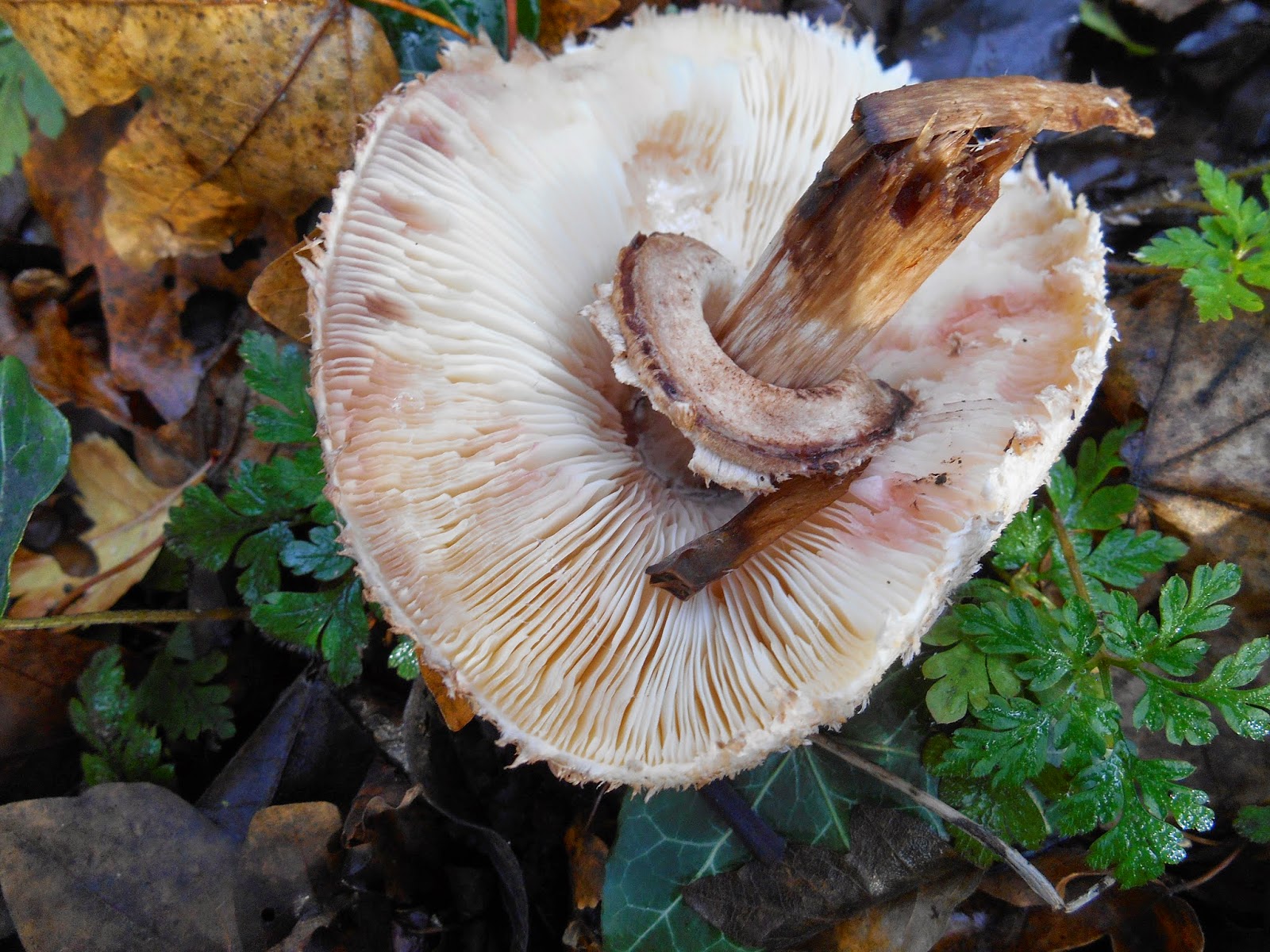
Shaggy Parasol, Macrolepiota rhacodes, var hortensis
Stefen Leys Pocket Park, Daventry. 15 December, 2014
The first was the Shaggy Parasol, Macrolepiota rhacodes. The variety photographed is var. hortensis. This is edible and tasty although some people have reported a mild gastric upset after a plate of them. Here it was, late in the year, beneath trees in the pocket park, surrounded by the bright green leaves of Herb Robert.


Although this species is easily identifiable from the patchy appearance of the cap, it is generally a good idea to look underneath to check the form and colour of the gills. These were as anticipated and the smell of the whole fungus was mild and mushroomy.
Pleurotus ostreatus, Oyster Mushroom. Stefen Leys
Pocket Park, Daventry  15 December, 2014


The Oyster Mushroom, Pleurotus ostreatus, is common and also edible. Yes, it is called a mushroom, but its cap does not have the disc shape of the Common Mushroom; as it generally grows from the trunk of a tree this is understandable. The group I found were in an ideal condition for gathering and eating but, as they were at the base of a tree adjacent to a footpath, I refrained. Something about dogs...


I was able to get a decent photograph of the gills.


This late in the season I might, in ancient or even reasonably mature woodland, have found other fungi, but beyond the two species photographed I noted only a few more specimens, shriveled or nibbled beyond recognition. However, that is not to say that evidence of their presence was lacking.


At the edge of the site, hard by a garden fence, stood a cherry tree. It was in a bad way, the condition of the lower trunk showing that its days were numbered. The damage demonstrated a classic case of attack by Honey Fungus, Armillaria mellea. It is sometimes called the Boot-lace Fungus and I know that, had I probed the ground nearby I would have found the hyphae (vaguely equivalent to roots in a real plant) like black bootlaces snaking through the soil.


Although the trees were now devoid of leaves a Jay, screaming in the tree-tops, defeated my search for it. This handsome member of the Crow Family is far more often heard than seen.

That left mosses. The bryophyte flora was very limited and, although a hands and knees posture with a Sherlock Holmes-type magnifying glass would probably have paid dividends, I held my enthusiasm in check and contented myself with very obvious species.
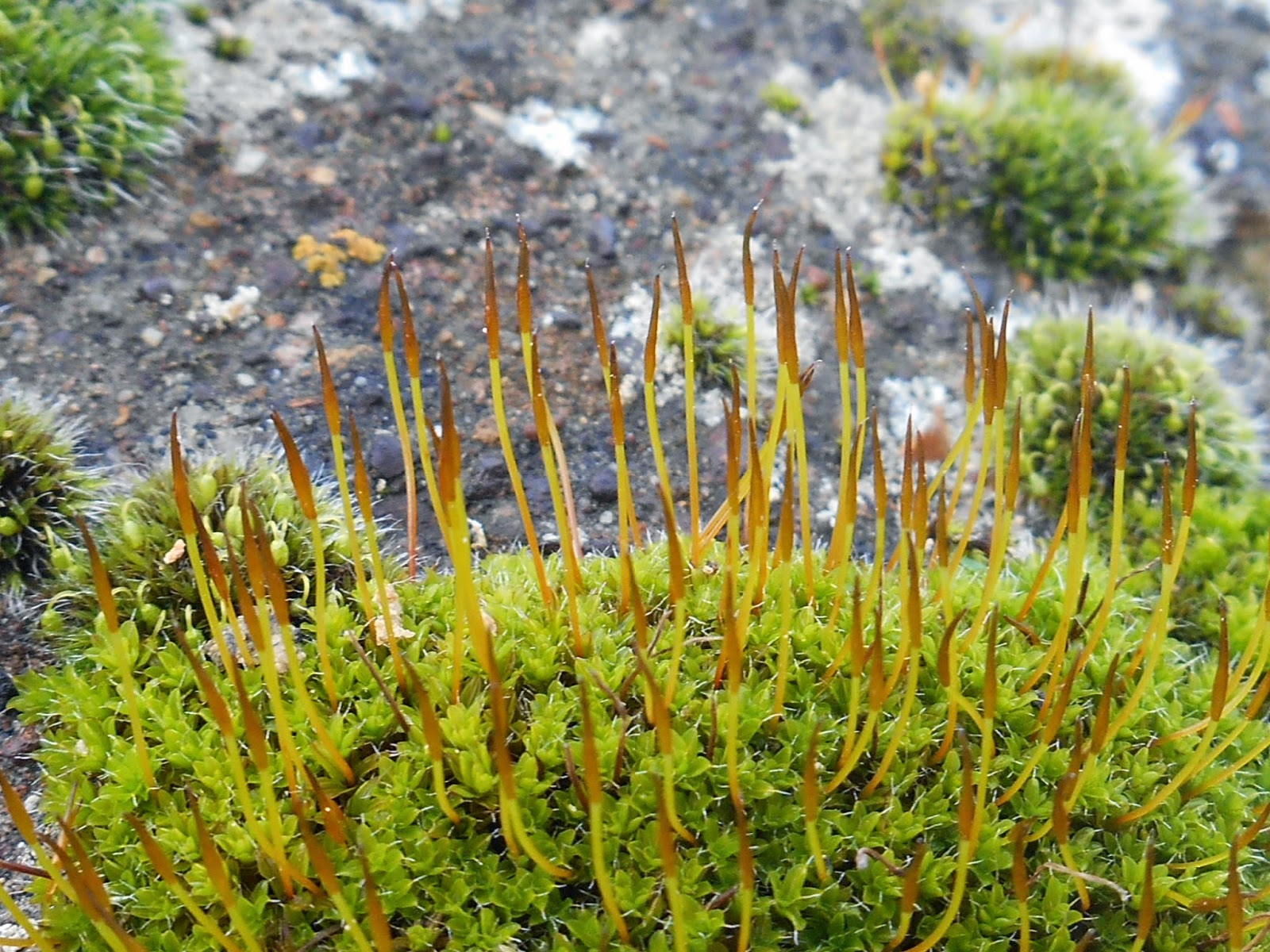


Tortula muralis at Stefen Leys Pocket Park,
Daventry. 15 December. 2014

The Wall Screw-moss, Tortula muralis, is abundant in rural areas on stonework, walls and neglected footpaths everywhere. I found it at the edge of a concrete path. Mundane, yes; unattractive, no. There are certainly more striking mosses but a careful examination of its features will reveal the delicate form of the leaves with a rather long hair-point at the tip. It beats watching 'Strictly...' [Everything beats watching 'Strictly...' Ed.]


This next moss is, I believe, Kindbergia praelonga.  Known as Common Feather-moss it is indeed extremely common but I was rather fortunate in finding a patch with abundant capsules, for these fruiting structures are not often seen.


Kindbergia praelonga from Stefen Leys Pocket Park,
Daventry. 15 December, 2014


I brought a sample home and was able to obtain a marginally better photograph which tends to confirm my original identification.


There were a few other mosses about but I know my limitations. Perhaps I'll have another look at them sometime. Anyway, it was a dull day in mid-December; not the most auspicious of times to be out in a patch of urban parkland, so I was content with my findings. As Del Boy would have said, "Multum in parvo my son" - and in a way it was


Saturday, 13 December 2014

Ivy: strictly for hederophiles

We take Ivy for granted. I don't need to point out that it is extremely common and it regularly gets an honourable mention on my blogs.

So is there anything more to be said?

Ivy is a member of the Araliaceae, a moderately large family of trees, shrubs and herbaceous plants, together with a number of lianas - those rope-like climbers so often featured in films about rain forests. Altogether the family contains about 254 species. I say about, because the situation is confused and modern techniques of DNA analysis seem certain to lead to a number of changes. Examples of the family are found in all the continents - obviously excluding Antarctica.

Ivy, Hedera helix, is found right across the British Isles and the European mainland, avoiding only high mountains and waterlogged or very acid soils. It takes on many forms in some parts of its range and it is this variability which prompted me to write this blog.


Ivy. Typical leaves on a non-flowering shoot.
Daventry. 13 December, 2014


The typical leaf-shape of ivy is very familiar to us all, being palmate with 3 to 5 lobes. The veins are pale and stand out distinctly against the dark green of the rest of the leaf. When these branches come into contact with a suitable surface they will produce roots allowing them to cling to walls, tree trunks and so on. However, these branches never produce flowers.


Ivy. Smooth, cordate leaves on a flowering
branch. Daventry. 13 December, 2014


The leaves on flowering branches are smooth and more or less ovate with a pointed tip although, as in the example shown, they can be cordate, i.e. heart-shaped. These flowering branches do not produce roots.


Contrary to popular belief ivy is not a parasite; it is a nuisance but will not harm a strong-growing tree. Nor will it harm a wall if it is structurally sound.


Hedera helix in the form dubbed 'Clotted Cream'
Daventry, Northants. 13 December, 2014


Some curious variations are to be found.  This form with crinkle-edged leaves was sprawling over the wall of a car park in Daventry. It appears to be Hedera helix 'Clotted Cream'.


Ivy on the church wall at Norton, Northants.
13 December, 2014

But even the common ivy can take one some attractive forms. Claret-hued leaves like those of this specimen on the churchyard wall at Norton are are very frequently encountered. The wine coloured variation is due (and I am taking an educated guess here) to the presence of a chemical, one of the anthocyanins, which imparts hardiness to plants in exposed places, such as this wall top.


All the illustrations so far are examples of common ivy.


"Hedera canariensis" probably just a large-leaved
form (keys shown for scale) of  the common ivy.
Daventry 13 December, 2014
The Canary Ivy, Hedera canariensis, is also very widely grown. It really does hail from the Canary Islands - islands named after dogs (canis) incidentally, not birds -  and is usually grown in the variegated form shown, again from a car park in Daventry. Recent research suggests that is merely a rather large-leaved form of the common ivy and does not merit specific status.
Ivy, bearing flower buds. Daventry.  13 December, 2014


I have, on several occasions, mentioned the fact that common ivy has a very long - September to December - period of flowering, with the fruits ripening early in the new year and providing very welcome fare to many birds. Even so I was astonished to find this ivy specimen with its flowers still in bud! 


Again it was in the same Daventry car park, surely now a mecca for hederophiles. (Incidentally I made that word up only to then Google it and find it really exists - "an ivy-lover". How odd.)

Do I grow any ivies? Not on your Nelly! They're fine confined to pots but when Chris and I lived in Byfield we waged a never-ending war with it, as did neighbours who were similarly overwhelmed with the stuff.

I'll leave the final words to John Clare:

                       Save grey-veined Ivy's common pride
                       Round old trees by the Common side,
                       The hedgers toil oft scare the doves that browse
                       The chocolate berries on the Ivy boughs.

                                         Clare's Shepherd's Calendar, 1827


Wednesday, 10 December 2014

Pole dancing

Now I've got your attention!

I had to invent a catchy title as nothing of great moment has come to my attention over the last 72 hours, but my readers - both of them - will be demanding a dose of my deathless prose.

A biting westerly greeted me as I got out of my car in Byfield. I had volunteered to deliver a batch of leaflets around the village. At least they gave me an excuse to visit a few gardens as I struggled to control the paperwork in the buffeting wind. 


Hebes were bravely flowering along Westhorpe Way. In the early years of the 20th century Hebes were all regarded as species of Veronica, but in 1929 the botanists Cockayne and Allen put the cat among the pigeons by arguing that the shrubby species, mostly hailing from New Zealand, should be placed in a separate genus as Hebe. Their arguments were generally accepted and they began to appear as Hebes in plant catalogues, etc. Unfortunately, a few years ago Prof. Garnock-Jones and colleagues at Victoria University used DNA and cladistic analysis to show that Hebes should probably be regarded as Veronicas after all. The problem still ferments and the return to Veronica is being resisted in many quarters.

Whatever we call them these shrubs are extremely valuable in the garden and with careful selection can provide colour for most months of the year.

If Hebe/Veronica shrubs are eye-catching then Pellitory-of-the-wall, Parietaria judaica, could hardly provide a greater contrast. 


Parietaria judaica at the base of a wall.
Byfield, Northants. 10 December, 2014
This herbaceous member of the Nettle Family (Urticaceae) is very appropriately named for it does indeed grow abundantly at the foot of walls almost everywhere except in the busiest of city centres. The generic name, Parietaria, actually means 'wall-dweller' and the name was bestowed upon the plant by Pliny. Its tiny flowers are open even at this time of the year. The fact that there are few insects around is of no consequence as the flowers are wind pollinated. One leaf (near bottom right) bears a dark blotch with a pale centre and is almost certainly the 'mine' of the fly Agromyza anthracina.  This is interesting as the mine, though recorded from the related stinging nettles, does not appear to have been previously recorded from Pellitory-of-the-wall.


Another wall-dweller, Kenilworth Ivy, aka Ivy-leaved Toadflax (Cymbalaria muralis) gallantly bore a few flower buds but conditions will need to change significantly if they are to open. The word 'muralis' means, 'of walls' and is therefore also quite appropriate.


Bittersweet, Solanum dulcamara.
Byfield, 10 December, 2014

Yet another appropriately-named plant was in fruit nearby. This is Woody Nightshade or Bittersweet. The Latin name is Solanum dulcamara, with 'dulcis amara' meaning sweet-bitter. The fruits are clearly intended to tempt birds but I've a feeling that they come some way down the thrush's list of "Berries I want for my Christmas Lunch". Although related to Deadly Nightshade it is only mildly poisonous - and obviously not toxic to birds.

It can pop up almost anywhere although the usual habitat is a hedgerow, as John Clare observed:

                                 And scrambling up the hawthorn's prickly bower,
                                 For ramping Woodbines and blue Bitter Sweet.

                                                                                     Village Minstrel, 1821

Also being ignored by birds - although a really cold snap will change things - were the fruits of Roast Beef Plant, Iris foetidissima. 


Iris foetidissima, The Twistle, Byfield.
10 December, 2014


Like the Bittersweet, this is almost certainly bird-sown. It is a native British plant but in Northamptonshire it is best regarded as a neophyte, i.e. a plant introduced and naturalised in the county since the year 1500. It occurs all around Byfield, so certainly the birds do eventually consume the berries, with the seeds of course passing undamaged through the gut.


Funaria hygrometrica on a wall-top.
The Twistle, Byfield, 10 December, 2014
And, as far as flowering plants were concerned, that was about it. I did pause to photograph a patch of the distinctive moss Funaria hygrometrica atop a wall. The spore-bearing capsules are a bit like a drooping pear and are unusually large for the size of the plant. They also tend to point in all directions. Very common, a patch of grit or gravel suits it and, oddly, it often seems to occupy the site of a former bonfire. It can also be a nuisance in garden centres where it often invades the pots of plants.


Leaflets safely delivered I set off home.


Saturday, 6 December 2014

Splendid spurges

Euphorbia is a remarkable genus of plants containing over 2000 species (2420 according to Encyclopedia Britannica). We have about a dozen or so native to Britain, with several other species more or less naturalised. 

The genus contains plants enormously varied in form, with some succulent species resembling cacti and others fairly described as trees. Despite this variation the flowers are generally instantly recognisable, with a female and several male flowers being clustered into a small group known as a cyathium. All species also bleed a poisonous milky juice when damaged. In the shopping concourse of central Milton Keynes some of the very large cactus-like Euphorbias can be identified if a pin is surreptitiously used to pierce the tissues; milky juice quickly oozes out. It will come as no surprise to learn that the Rubber Tree is a member of the Euphorbia family but belongs, as Hevea brasiliensis, to a different genus. A slightly less obvious member of the family is Castor Oil, Ricinus communis.

Here in Northamptonshire a number of Euphorbias, generally known as spurges, are native, with several species being common. The Wood Spurge, Euphorbia amygdaloides, is quite easily found in woodlands on limestone in the north-east of the county and was familiar to me when I was based at RAF Wittering. It is rather common too around Byfield, but here it is probably a garden escape.


Turkish Spurge in a Byfield garden, with the bright red
leaves of  Photinia davidiana in the top left-hand corner.
18 March, 2014


An attractive subspecies, E. amygdaloides ssp robbiae, often called Turkish Spurge, is commonly grown in gardens and may occasionally escape. It was early to flower in Byfield, making a vivid splash of lime-green in borders. 


Musca autumnalis on Turkish Spurge.
Byfield, 8 April, 2014


Like most (all?) spurges, E. amygdaloides 
receives numerous insect visits. Here a male Lesser House Fly, Musca autumnalis, is imbibing nectar.


When living in Byfield I grew the Cypress Spurge, Euphorbia cyparissias. It is probably a British native but is certainly not so in Northamptonshire. With its feathery foliage it is a pretty plant for the rock garden but introduce it at your peril; it has long creeping rhizomes and can become very invasive, sometimes escaping on to rough ground. I won't be growing it here in Daventry.


Cypress Spurge. Byfield, 8 April, 2014


The wise gardener will confine Cypress Spurge to a sink garden or a similar container. In the accompanying photograph the gardener has taken the risk, planting it in a border with a pretty Pulmonaria.


Another spurge in my Byfield garden was Myrtle Spurge, Euphorbia myrsinites. It is a splendid plant and has been awarded the A.G.M. We bought a plant on a visit to Beth Chatto's lovely garden near Colchester but left it behind in Byfield.


Myrtle Spurge, Euphorbia myrsinites, in my garden.
Byfield, 23 March, 2014


From south-east Europe and Asia Minor, it is a sprawling, slightly succulent plant for a sunny spot. It is an easy-going species providing it gets plenty of sunshine and is in well-drained spot. I grew it in gravelly soil where it thrived.


A closer view shows the flowers in the form of a cyathium, typical of the genus.


Caper Spurge by a track in Byfield.
9 May, 2014
The Caper Spurge, Euphorbia lathyrus, is a curiosity with its stiff, opposite leaves in four vertical rows giving it an artificial look - a tall (up to 4 feet) plant made from a kit! It cropped up from time to time in my Byfield garden from an unknown source but the seeds are suspected of remaining viable for many years so may have pre-dated our move there. A hairless biennial, it may be native in some parts of England but is usually encountered as a plant on waste ground. The fruit look like capers and there is some evidence that they have been used as caper substitutes in the past. However, they are very bitter and all spurges are poisonous, with some fatalities known. Like many spurges, the seeds are initially dispersed by an exploding fruit capsule. Spurges are myrmechororous plants: following the bursting of the fruit their seeds are further dispersed by ants. Each seed has an oily structure attached to it known as an eliaosome. The oily material is attractive to ants who will carry the seeds away, helping to disperse them and perhaps even burying them.

With lots of spurges found in Britain I will mention just one more. The Sun Spurge, Euphorbia helioscopa, is a weed - but I consider it rather attractive. I have cultivated three allotments over the years, and Sun Spurge has occurred in all of them. Although generally regarded as a native to Britain it is probably an archaeophyte - a plant likely to have been introduced over 1500 years ago. In this case,  as with many other archaeophytes it may have arrived on these shores as a crop impurity, perhaps as far back as Neolithic times.

Perhaps we shouldn't forget those which are of importance to the florist.


Euphorbia milii is regularly seen in florists' windows, as was the case with these I photographed in Daventry. This species develops extremely prickly stems and is sometimes sold as 'Crown of Thorns'. However it can hardly have been Christ's crown of thorns as this species hails from Madagascar.


Now, with the approach of Christmas, one of the most familiar of all Euphorbias forces its way into our consciousness - except that most people probably aren't aware that it is a spurge. I refer to Poinsettia, Euphorbia pulcherrima. The word 'pulcherrima' is the superlative of pulchra - beautiful, and clearly people do find it very attractive. Strangely, the origins of this plant are not clear, although Wikipedia suggests Mexico and Central America. Visitors to the Mediterranean region will find it growing on waste ground (if, like me, they like to like to poke around in such areas) where it often forms quite a large shrub.


Altogether the genus Euphorbia is of great interest and identification of the many species provides a challenge to the holidaymaker when visiting southern Europe.


Friday, 5 December 2014

An hour to kill

Chris and I paid a visit to Woodford Halse for a much-needed trip to the hairdressers. I was first to be dealt with, just having a 'Number 4' but Chris was having the full works so I had well over an hour to kill.

With my shorn locks leaving me feeling chilly I turned up my collar and set off for the church of St Mary the Virgin, Woodford Halse. There, I've said it! Local belief is that "Woodford Halse" and "virgin" never appear in the same sentence. How justified that is, I've no idea.
The church of St Mary the Virgin, Woodford Halse.
5 December, 2014


The rather simple church is typical of the region, being built using a local Jurassic sandstone, perhaps from the quarry at nearby West Farndon. The historian John Bridges, in his book on the "History and antiquities of the County of Northampton" (1791) refers to Farndon producing 'a rock of serviceable stone for building or pavements'. There was also a quarry at Byfield, barely two miles away, but this produced a distinctive, darker sandstone.


Grassy tussocks are a feature of the churchyard to
the rear. 5 December, 2014


The churchyard is interesting. The area around the main entrance is kept neat and tidy but for a very large expanse to the rear the condition is in state of benign neglect, with headstones leaning in a variety of angles. This rather wild area is splendid for wildlife although it has to be said that on a chilly December day it was not glaringly obvious.


The lichen Caloplaca virescens is one of the
 crustose species present on the headstones.
Woodford Halse, 5 Decemberf, 2014


In these cold, dark days the gravestone lichens often provide an element of interest but there was little variation in the stone being used and consequently there was only a limited range of lichens to be seen. (but an expert would have detected far more). Examples of the yellow Caloplaca species were present, with Caloplaca flavescens being particularly common. Indeed it is very common across most of England but becomes relatively scarce from the middle of Scotland northwards.


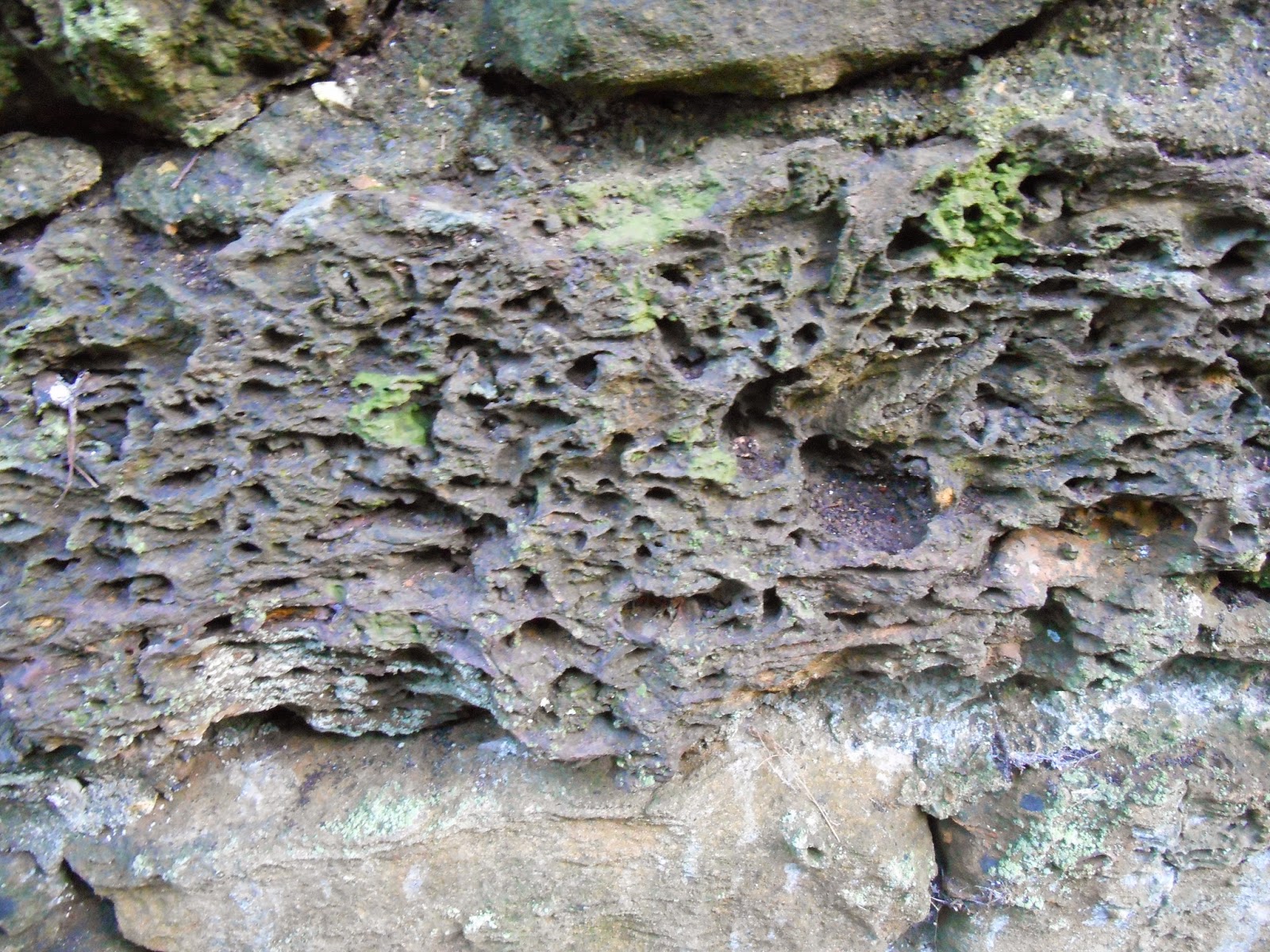
Perhaps most of us take these building stones for granted but elsewhere in the village I found examples of badly chosen material. The chemical erosion of this sand-stone block is very pronounced and, were it in the wall of my house I would be a tad worried, if not for me, certainly for my grandchildren.


Very few fossils were noted and, in short, the building materials were of very limited interest. A bench-mark had been carved into stone adjacent to the church and I assumed that a check of the local Ordnance Survey map would give me a spot height for this. I was wrong (although a large-scale map would probably provide a figure).


I kept glancing at my watch. The cold was getting through to me and there was little to get excited about. And then I chanced upon this little patch of...what?


It was situated on the exposed top of a wall, and that was the odd thing. Had it been on the underside of a plant leaf I would have accepted it as a cluster of insect eggs of, probably, a butterfly or moth. But here, on a bare wall? The eggs - for that is what they undoubtedly were - measured only about 0.5 mm across. A close-up is of interest but still leaves me puzzled. Between the eggs are slight traces of leaf venation so it is probably a fragment of plant material that has simply fluttered down and come to rest on the wall.


A little further along the same wall I once again came across a 'slime-mould' (see blog for 19 November). But I'm starting to have my doubts; is it some other organism? IF it is a slime-mould, my money is on Nostoc commune. Whatever it is, it always seems to be on, or near to, a patch of moss. I have found other pictures of this by trawling the internet, but those posting the images have carefully avoided offering a name. The jelly-lichen, Collema auriforme is another possibility, and yet, and yet...


In a sheltered border a clump of Serbian Bellflower, Campanula poscharskyana was coping well with the cold, but I wasn't, so I began to retrace my steps.


It was good to get into the car, bang on the heater, and begin to thaw out.


Wednesday, 3 December 2014

December flowers

Garden plants in flower at this time of the year are to be expected. Plant hunters have scoured the globe seeking out suitable species and any decent garden book will suggest dozens of worthy plants.
Viburnum tinus in Balliol Road, Daventry.
3 December


Viburnum tinus (pictured), Mahonia species (featured in an earlier blog) and heathers such as Erica carnea come into this category are all currently in bloom hereabouts.


Then there are those plants which, though not naturally flowering in winter, have been selected by plant breeders to give colour in the darkest days of the year.


Pansies were in flower in Daventry
3 December, 2014

Pansies come into this category. We see them in abundance in bedding displays without giving them a thought. (Now that is an interesting Freudian slip; the word 'Pansy' is derived from the French pensee - a thought). These winter flowering pansies are in fact hybrids, Viola x wittrockiana, whose parents are probably Viola tricolor and Viola arvensis. (All pansies are, of course, large-flowered violets.) Selected forms of our native primrose, in a wide range of colours are likewise common in our gardens of course and will flower throughout the winter. The reds, purples, etc are usually the result of various crossings with Primula juliae, from the eastern Caucasus.


Then there is the 'awkward squad', plants which are in flower but probably only within the cosseted environment of an urban garden, where the extra 2-3  degrees makes just the difference. 
Greater Periwinkle, Vinca major, flowering in Daventry.
3 December, 2014

Perhaps Periwinkle, Vinca major, fits into this category. This highly toxic plant is a member of the largely tropical family, the Apocynaceae, and is thus related to Oleander and Frangipani - all equally poisonous. I would not allow Periwinkle into my garden, not because of its toxicity, but it can be very invasive and difficult to eradicate when established. It was in flower today (3 December) in Daventry.


Rather oddly, just a short  distance away, was another clump - or so I thought. But even a very brief examination showed that it was a quite unrelated plant, being a Geranium, perhaps a form of Druce's Cranesbill, Geranium x oxonianum. This hybrid is, rather obviously, named after George Claridge Druce, who wrote the first Flora of Northamptonshire back in 1930.


Then there are roses. This one, again photographed earlier today looks healthy enough but, at this time of the year, most of these flowers will open no further, being 'balled'. Cold, wet weather causes the outer petals to fuse, thus preventing the flower from opening any further. They remain in a ball-like shape. Having said that, this particular specimen looks in fairly good condition. We'll see.


What prompted this blog about winter flowering plants was the fact that, as I set out to walk into Daventry earlier today I could hardly fail to notice that several of our native wild plants are still in bloom.


Yarrow, aka Milfoil, Achillea millefolium, in Daventry.
3 December, 2014

The first species to catch my attention was Yarrow, Achillea millefolium. This should have ceased flowering some weeks ago but, those extra 2-3 degrees...

This plant, a member of the Daisy Family, is the species reputedly applied to the wounded heel of Achilles at the Battle of Troy. Whatever the plant was, it failed, as we all know, to effect a relief. 


My 1923 edition of 'Potter's Cyclopaedia of Botanical Drugs and Preparations' recommends Yarrow as a tonic and as a diaphoretic. This latter word means 'promoting sweating' Presumably therefore, the protracted wait for the announcement of winners in "Strictly..." is also diaphoretic - and grossly irritating!


Predictably Dandelion, Taraxacum officinale was in flower, as was White Dead-nettle, Lamium album and Groundsel, Senecio vulgaris. Many species of Senecio have a greyish appearance, often due to the presence of grey hairs and the name is derived from the Latin senex - an old man. 'Senile' comes from the same root (now, concentrate Tony, you can do this).


In a sheltered spot at the edge of a car park the flowers of Herb Robert produced a small but bright spot of colour. Although the smell of the leaves and stem is foul, the flower is undeniably pretty. Like Druce's Cranesbill this is another Geranium, Geranium robertianum. Various explanations have been offered for the name, often trying to trace 'Robert'. This may be a false trail to follow for it could simply come from the Latin ruber, meaning 'red'. Often the leaves, and if fact the whole plant, take on a brilliant red coloration.

Anthriscus sylvestris in a Daventry park.
3 December, 2015
I will end by mentioning Keck, Anthriscus sylvestris. More generally known as Cow Parsley it is perhaps the most profusely flowering of all our spring plants with its masses of white flowers like billows of foam along country lanes and hedgerows. Yet here it is, blooming in a public park in Daventry. Someone needs to have a word with it. I'd have spoken up but perhaps it would come better from Prince Charles. "Now look here, old chap; about your timing..."


Monday, 1 December 2014

The First of December

I always feel that December 1st should be the first day of winter. It isn't of course, that distinction goes to the 21st of December. Certainly, although it was grey and damp as I set out earlier today it was by no means wintry.
Leaves of Field Maple, Acer campestre, form a carpet.
Christchurch Drive, Daventry. 1 December, 2014


A thick, damp carpet of leaves lay beneath the trees as I visited a small plantation, largely of maples, off Christchurch Drive here in Daventry. Most of the soil in this area, and certainly my own garden, is a heavy clay. Given a couple of centuries of work by earthworms and there should be a good loam here, but for my garden I'm just working in gritty sand and compost in places where plants are to be placed.


Blackthorn, Prunus spinosa, bushes in a nearby hedgerow were bearing fruits. At least, I am assuming that they are blackthorns. The fruits were perhaps a little larger and rounder than usual and they could have been specimens of Bullace (Prunus domestica, ssp institia). I will need to re-examine the plants in spring.


Sloe or Bullace? Probably the former. The skins split
as the fruits begin to blet. Christchurch Drive, Daventry.
1 December, 2014
Whatever they were, the fruits were ripening nicely. The fruits of blackthorn, i.e. sloes, are impossibly astringent at first but as the weeks slip by they soften and become sweeter. This softening is known as bletting and as it proceeds the fruits begin to split and become acceptable to birds. Of course the birds spread the seeds far and wide - a cunning plan.


Adjacent to the blackthorn were several hazel bushes. A few lemon-yellow leaves clung on and between them hung the yet- undeveloped catkins, waiting for spring, when the lengthening days will prompt them into further growth.  


I include the obligatory leaf mine, in this case on a bramble leaf. It is probably the work of Stigmella aurella, the Golden Pigmy. This is among the commonest of our micro-moths and it is an bramble indeed if doesn't bear any of these mines. The structure of the mine seems to have impeded growth at the leaf tip, causing it to die off.


Not an exciting day. But after a lot of wet and generally unpleasant weather it was just good to be out.

Comments?  E-mail diaea@yahoo.co.uk