Friday, 14 March 2014

A hotchpotch of a day.

A thick mist cut visibility down to little over 100 metres during the morning today, but the sun broke through in the afternoon and I sallied forth to investigate Wardenhill Covert, on the south flanks of Warden Hill. I had thought that a public right-of-way passed through it but I was wrong and had failed to study the O.S. map with sufficient care.

Being a stout-hearted and plucky Brit I was undaunted and resolved to strike south-west instead and take another look at Calves Close Spinney, entering it at SP506492. I had visited the site on three occasions last year but felt that another look could be productive. I was wrong!


Calves Close Spinney  looking south

The spinney always looks inviting from a distance, with a few fine oaks being obvious, but I had forgotten just how limited it is in terms of ground flora and variety of trees. I quickly changed my mind and retraced my steps. The return journey was quite useful. It seemed the kind of day when 'money spiders' would be ballooning and my net secured quite a few. In suitable conditions spiders will climb a grass stem and release a long strand of silk. The wind catches the silk and the spider is borne aloft and, with luck, will be carried for a considerable distance to a new site. Ballooning spiders have been caught at a height of several kilometres. I secured about twenty spiders; all but one were females and all were very common species. 
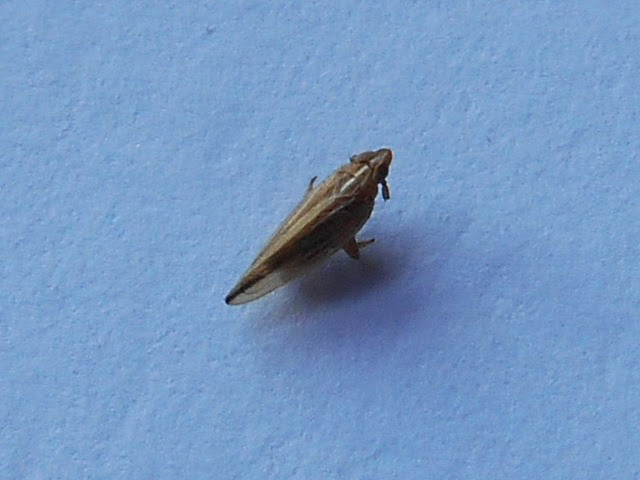


Also swept up was the very common planthopper, Stenocranus minutus.


I pressed on to the lakes mentioned briefly in my recent blog, 'Root Spinney' (26 February). These lakes are apparently unnamed. Things were very quiet and no water birds were seen apart from a pair of unwelcome Canada Geese.


Why I bothered photographing these I do not know. They were introduced as ornamental waterfowl from North America but some quickly escaped and have since become a pest species. We now have a large resident population but in North America this is a migratory species, and some British specimens have apparently redeveloped their migratory habits.  


Coltsfoot flowers beside a lake at SP517509
13 March, 2014


On the lakeside were coltsfoot plants, now fully in flower. Despite the bright sunshine temperatures were on the cool side and and I saw no insect visitors at the flowers.


The Coltsfoot belongs to the Daisy Family, Asteraceae and each 'flower' is, of course, composed of an aggregate of tiny flowers in a cluster known as a capitulum. (The older, very appropriate name for the family was the Compositae.)


I recall that when I first began studying botany much time was spent pulling the flower heads apart and trying to understand the structures and their names. The family is a large and tricky one and when on mainland Europe I confess to often being stumped.


Also with composite flower heads are Typha species. These were well established around the lake edge, the species involved being the Greater Reedmace, Typha latifolia.


The bursting heads of Typha latifolia
13 March, 2014
Bulrush or Reedmace? Historically there is little doubt that Reedmace is the older name but either is now accepted. The confusion is often - unfairly - attributed to the great Victorian painter Alma-Tadema. In his painting of 'Moses in the Bulrushes' he unmistakably depicts Reedmace but the confusion considerably pre-dates this work. 

The composite flower of Coltsfoot is, as I have said, technically a capitulum; the flower head of the Bulrush consists of tiny flowers crowded together as a spadix. The spadices burst to release the wind-borne fruits and this has led to the species rapidly colonising flooded gravel pits and so on across the county and, indeed, throughout Britain.


I met the local landowner on today's walk and I expressed my delight at the very broad field margins he had retained, with their wild flowers and insect life. He had also been responsible for creating the lakes. If only some of his farming neighbours would follow suit. 


I could name one farmer in the area who ploughs so close to the hedgerows that the roots are ripped up or exposed! 'Times they are a-changin' claimed Bob Dylan. I only hope they change for the better hereabouts.


Tuesday, 11 March 2014

Bread and Cheese and Scarlet Elves

I set out an an overcast but warm morning, destination Parsons Spinney. Sweet Violets were flowering beside Banbury Lane - spring was steadily advancing. As Robert Herrick wrote in his poem "To Violets": 

                         Welcome Maids of Honour,
                         You doe bring
                         In the Spring:
                         And wait upon her.


Sweet Violets, Banbury Lane, Byfield
11 March, 2014


The flowers on the Sweet Violets were fragrant, but only fleetingly so. A largish bunch would need to be gathered for a real impact. They are very common hereabouts in both violet and cream-white forms and are probably paid only scant attention by passers-by. Perhaps this has always been so. It would account for the wistful last lines of Herrick's poem:


                        Yet though thus respected,
                        By and by
                        Ye doe lie,
                        Poore girls, neglected.


Blistered leaves on Firethorn caused by the
Pyracantha Leaf Miner. Byfield,  11 March, 2014

The leaves on a Firethorn bush along The Twistle were ravaged by the Pyracantha Leaf Miner, Phyllonorycter leucographella. This micro-moth was first recorded in Britain in 1989 and has subsequently spread rapidly, Fortunately the blisters caused by the larvae, though unsightly, appear to do no lasting damage.


I pressed on down Pit Lane ("Muddy Lane" to all the villagers) and, after about 400 yards turned right off the public right-of-way on to the track bed of the old S.M.J. Railway.


The local land owner has made it abundantly clear that no right-of-way exists. I sympathise with farmers whose land is strewn with litter from passers-by but in this case my sympathy is diluted by the fact that much of the dumped material along the track is clearly of farm origin - old fertiliser bags, rusting bales of barbed wire and so on.


Rose thorns should be called prickles as they are formed
from the epidermis of the stem and contain no
vascular bundles.

I passed through the gate on to the well-used track-bed to face other obstacles - viciously thorned branches of Wild Rose. These were easily avoided and I was able to press on. A smart Nuthatch was making its way, head first as usual, down the trunk of an Ash Tree. I attempted to photograph it but as soon as I raised my camera it sidled coquettishly around to the other side of the trunk. It was the first of its species I've seen this year.


Opening leaf-buds of Hawthorn. 11 March, 2014


Hawthorn buds were breaking into leaf in sheltered sunny spots. The old name for these tender leaves is "Bread and Cheese". We are assured by writers such as Richard Mabey that these shoots are very tasty and I ought to sample them some time. Incidentally the Hawthorn bears true thorns, containing vascular tissue*.


In the gloomy interior of Parsons Spinney there were few signs of spring. The woodland floor is very wet and all around were fallen branches in various stages of decay. As the trees break into leaf even less sunlight will filter through and, other than mosses, the woodland floor will have little to offer to a botanist. Some fairly ruthless management would be required to bring flowers back but there are compensations - fungi.


Scarlet Elf Cup. Parsons Spinney, near Byfield.
11 March, 2014


A bright splash of colour caught my eye and I sloshed through the mire for a closer examination. The fungus responsible was the Scarlet Elf Cup, Sarcoscypha coccinea. This species is more frequent in the west of Britain but here it was doing well, with a short stroll revealing more specimens. All were on dead branches. 


Following previous visits to Parsons Spinney I had planned to gather more mosses but time was pressing on and I turned for home. And predictably the sun broke though, promising a fine afternoon.

*Vascular bundles. If you snap a stick of celery, the stringy bits are the plant vessels, forming bundles of vascular tissue.

Monday, 10 March 2014

And now for something completely different...

This blog site was initially launched to chat about the gardens and wildlife in the Byfield area. That remains its raison d'etre (raisins for eating) but occasionally some other topic forces itself on to the site.

On Saturday, 8 April I was fortunate enough to get an invitation from Lynda and Damien Moran to attend a performance by Boldwood, a folk group for whom their daughter Kate plays fiddle. The venue was in the chapel of The Queen's College, Oxford (the queen in question being Queen Philippa of Hainault). This genre of music is outside my usual range, with only the arrangements by Percy Grainger and Ralph Vaughan Williams being familiar to me, i.e pretty mainstream stuff. Boldwood have blown the dust from little-known and almost forgotten 17th and 18th centuries scores - and the material was delightful. As I say, I can speak with no expertise whatsoever, but the performances struck me as being of a very high standard.


The chapel is approached via a simple but most attractive quadrangle... 
See no evil, hear no evil, speak no evil.   Left to right:
Chris, Ann and Lynda.


... peopled by learned historical figures engaged in animated and recondite conversation regarding Virgil's epic work "Marcus et Spensius".


The interior of the chapel, dating from 1819, is beautiful and seemed to have very good acoustics. I was much taken by the stained glass windows. As is usual they depicted biblical scenes - but with some whimsical touches.

Bother! Just when you need it,
there isn't a wishbone.


It seemed clear, for example, that the main course for the Last Supper was a nice, plump dog.


"Lord, you've forgotten your sandals."


The ascension into heaven was unexpectedly rapid, giving little time to pack...


Boldwood. 8 March, 2014


The interior was a little gloomy and I didn't want to employ flash.


All in all, a delightful day, with wall-to-wall sunshine throughout.


Monday, 3 March 2014

The first day of spring?

Today, March the First is, according to the BBC, the first day of spring. This has been hotly disputed by other authorities but I have no intention of investigating the issue.


Honey Bee, with its pollen basket loaded with orange
pollen, visiting snowdrops in my garden. 1 March, 2014

Certainly the local Honey Bees, Apis mellifera, were out on a lovely day hard at work in my garden. Their main target was the snowdrops but also receiving attention were the flowers of Winter Honeysuckle,  Lonicera fragrantissima, which has now been in bloom for about three weeks. It isn't in my garden but sprawls through the fence from my neighbour; in truth I wouldn't grow it myself because, although the flowers are indeed fragrant the shrub in general is a dull, uninspiring thing - unless you are a Honey Bee. A friend of mine has two hives only about 100 metres from my garden. The bees are almost certainly from these hives so the owner will be pleased that they've come through the winter.

Diptera - two-winged flies - were also out and about, basking in the sunshine on convenient surfaces. For the record they were: Eudasyphora cyanicolor - a very common "greenbottle" - and Phaonia tuguriorum. A tiny fly almost escaped my notice but it turned out to be Lonchoptera bifurcata, a common but easily overlooked member of the small family Lonchopteridae, often called Pointed-winged Flies.

I found time for a stroll out on the road to Eydon. It is a long, straight, uninspiring bit of highway but a couple of things caught my attention. 


Coltsfoot flowering on a roadside verge near Byfield.
1 March, 2014
Beside the road a mound of material, formed by the dredging of a nearby ditch, were clumps of Coltsfoot, Tussilago farfara.I was a little surprised as I generally find it growing on stiff clay soils, rather than this largely alluvial material. Coltsfoot produces its flowers well before the leaves develop - an unusual but clearly successful strategy as it is very widespread. The dried leaves were once smoked as a remedy for asthma and coughs. These flowers just need a spell of warm sunshine to open fully.
Yellow Brain Fungus on dead sycamore branch.
Near Byfield at SP522525  1 March, 2014


A little further on something bright orange-yellow was clinging to a dead sycamore branch. A closer examination showed it to be another specimen of Yellow Brain Fungus, Tremella mesenterica, noted only a few days earlier near Root Spinney - but this was a much better specimen. Apparently another name is Golden Jelly Fungus.


The forecast for the next two or three days is distinctly 'iffy' so I was glad to have this short, if not very exciting, chance to get out.


Thursday, 27 February 2014

A dismal day

In Daventry Chris and I experienced a sharp and nasty hailstorm and the afternoon I'd planned seemed out of the question. However, things did clear up and I modified my walk and contented myself with a visit to my "patch" - Byfield Pocket Park.


A pair of mines formed by larvae of the
Glossy Bramble Pigmy.
Byfield Pocket Park. 27 February, 2014


Two larvae of the Glossy Bramble Pigmy, Stigmella splendidissimella, had produced a strikingly symmetrical pair of mines. This is a common micro-moth, the mines of which wouldn't normally merit comment.


Daffodils were just coming into flower. Around Byfield, as in towns and villages the length of Britain, Narcissi have been planted in large quantities. This coming autumn I'm sure armies of volunteers will be out in force planting yet more. What is the motive? If it is to produce a colourful spring display - fine. If it is to help "nature", then it is a rather pointless effort. I don't deny that I sometimes see bumble bees visiting the flowers plus a few smaller flies such as Norellia species but, beyond that, their wildlife value is very limited. The Hoverfly, Merodon equestris, known as the Large Narcissus Fly or the Narcissus Bulb Fly, may burrow into the bulbs. It is a handsome insect but I'm prepared to bet that people don't plant 'daffs' in order for the bulbs to be attacked!

A pair of Bullfinches flitted across the track as I approached the Pocket Park. They are one of my favourite birds (I am not a fruit grower!) so I attempted to photograph the male, but it was too wary to allow me anywhere near. As a consequence my picture is poor.


Male Bullfinch. Byfield Pocket Park
27 February, 2014


Bullfinches are a fairly regular sighting and they always seem to travel around in pairs. My comment about fruit growing refers to the fact that they can do great damage in orchards by feeding on the buds - but I still like them.


Nebria brevicollis, a common Ground Beetle
Byfield Pocket Park, 27 February, 2014  


Carefully lifting a log I was surprised to find that it was a refuge for about twenty ground beetles; two or three is, in my experience, more usual. These belong to a very large family called the Carabidae; they are common and familiar to most people and there are about 350 species in Britain.


The beetles generally appear hairless but closer examination reveals a number of hairs and bristles, often of considerable importance in identification. I took a specimen for closer examination and it proved to be Nebria brevicollis. Martin Luff comments ("The Carabidae of Britain and Ireland" p. 49): "often extremely abundant". Certainly it is common hereabouts and I have previously recorded it from the pocket park (I replaced the log!). These beetles are carnivores and the larger ones can give a sharp nip with their mandibles; in some cases a nasty, noxious fluid can be expelled from the rear end. Handle with care!

As children in Northampton we always called them 'rain beetles' and I was interested to note that elsewhere in Britain the name 'rain clocks' is used (Marren and Mabey, "Bugs Britannica"). The term 'clock' may derive from a Swedish dialect word 'klocka' - a beetle. John Clare's lovely little poem "Clock-a-clay" also refers to a beetle - in this case a ladybird.


Wednesday, 26 February 2014

Root Spinney

A fine morning so, sweep net at the ready, I set out for the little gem that is Root Spinney, a mile or so south of Byfield at SP516516. Ancient woodland it is not, having been planted less than fifty years ago, but the owners of the land planted a well-chosen selection of native trees and shrubs and have, ever since, managed the site very sympathetically.


English Bluebells, Hyacinthoides non-scripta
Root Spinney, 26 February, 2014


It is likely that there was vestigial woodland already there, for not only does the wood contain some mature oak but it is carpeted with native Bluebells to such an extent that I could not avoid trampling on them. I must revisit the wood in late spring when the plants will form a sea of blue.


Not only is Root Spinney well managed but so too are the surrounding fields. All the fields have broad margins, rarely under 2 metres wide and frequently up to about eight metres.


An Ash tree overhangs a broad field margin
 near Root Spinney. 26 February, 2014


These edges contain a good selection of wild flowers - no rarities as far as I am aware but none the less welcome. They are also a refuge for a wealth of insects, many of which (hoverflies, ladybirds. various bees) are beneficial to crops.


The woodland has a canopy of oak, ash, birch, cherry and willows, with an understorey mostly of hazel but with a few holly, blackthorn and elder bushes. The trees are quite widely spaced, allowing sunlight to reach the woodland floor.


A victim of recent high winds.
Root Spinney, 26 February, 2014


A number of trees have been felled by recent high winds and it appears that they are to be allowed to decay in situ, benefiting wood-boring insects, fungi, etc.


Decaying tree stump at Root Spinney
26 February, 2014


The loose bark provides a refuge for a range of invertebrates, ranging from woodlice and centipedes to snails and spiders. Within a few years woodlice and wood-boring larvae of various insects, aided and abetted by fungi, will completely destroy this tree stump and return the mineral salts to the woodland soil.


Honeysuckle climbed, rope-like, into trees.
Root Spinney, 26 February, 2014
Thankfully there was only a little ivy but Honeysuckle, Lonicera periclymenum, was frequent as a climber. The scarlet berries are enjoyed by birds and the leaves are frequently mined by the larvae of micro-moths and small flies. There is also a close association between Honeysuckle and Dormice. A female Dormouse will construct a nest of stripped Honeysuckle bark in which to raise her young. Humans may also enjoy its benefits as "the flowers, in the form of a syrup, have been used successfully in disorders of the respiratory system and asthma" (Potter's Cyclopaedia of Botanical Drugs...", 1923 edition.) No thanks, I'll stick to Tixylix.


Honeysuckle (the old name of Woodbine now seems little used) is widespread in our county as the map (from the 1995 "Flora of Northamptonshire..." by Gill Gent and Rob Wilson) makes clear.


The public footpath through Root Spinney.
26 February, 2014


The main path, treacherous at the best of times, had been rendered even more difficult by the local hunt. I met Tim Boddington on the footpath and he informed me that the hunt had passed through twice in one day. Unsurprisingly I was forced to tread warily as I pressed on. Awkward though the conditions were, I knew that it would be a worthwhile exercise as, beyond the wood, the same landowners have created some very attractive lakes.


One of the lakes below Root Spinney
26 February, 2014


Though of recent origin these lakes are now home to an interesting range of aquatic flora and fauna, a range which is likely to increase over future years.


Yellow Brain Fungus (?) with the lichen
Xanthoria parietina on a small branch
Root Spinney, 26 February, 2014


Although I have waxed lyrical about the area I saw nothing of outstanding interest today. A small growth of what I believe was Yellow Brain Fungus, Tremella mesenterica, could not be called an epic discovery. But I shall return.


 So I headed home. I didn't use my sweep-net once.


Tuesday, 25 February 2014

The Buttercup Family. Part 1. Late winter-early spring

The Ranunculaceae - the Buttercup Family family to us non-botanists - is a strange conglomeration of plants and it is difficult to believe that they all belong to the same family. "Very variable in floral morphology" as Clive Stace puts it (Stace, C.  'New Flora of the British Isles' C.U.P. 1991). But it is variable in other ways too: there are annual herbs, perennial herbs, woody climbers and shrubs. I blew the dust off my copy of his classic work, "Families of Flowering Plants", to find that the late John Hutchinson presents an enormously complex description of the family, necessarily so to take in all the variables.

Two non-technical points may be made: 1. All are to some degree acrid, with some highly poisonous members. 2. The family includes some lovely garden plants.

Some of the Ranunculaceae provide our most welcome late winter/early spring flowers. The Stinking Hellebore, Helleborus foetidus, I have spoken of before, e.g "Burning off Breakfast" on 1st April. A close relative is, as I write, in flower near to the main village store; this is Green Hellebore, Helleborus viridis, otherwise known as Bear's Foot.


Green Hellebore in a garden adjacent to
Byfield's Co-op store. 4 February, 2014


The Green Hellebore is native to Northamptonshire but is very rare. The best place to see it is Walton Grounds, near Kings Sutton where, according to Gent and Wilson ("The Flora of Northamptonshire..." 2012) "there are in excess of 100 flowering plants". With its lovely cupped flowers I prefer it to the more popular Lenten Rose, Helleborus orientalis. Both species are highly poisonous.


Helleborus x hybridus.  Byfield
19 February, 2014

Hybridists have had great fun with Hellebores in recent decades and some striking plants are now available under the general name of Helleborus x hybridus. Here in Byfield Angela Tiffin's garden contains some nice examples which she allowed me to photograph. The first example may be H. "White Spot" (There are several similar cultivars). The purple freckling is due to the presence of anthocyanins.


Another Hellebore in Angela's garden. Byfield,
 19 February, 2014  (The scarf is not significant!)

This lovely primrose yellow form may be "Mardi Gras" but, again, several similar cultivars are available. Here the yellow coloration is caused by flavenoids.

If I have a quarrel with Hellebores it is because they receive few insect visitors. Early bees will call in for the nectar but I have only witnessed such visits occasionally.


Also currently in flower (4 February) is Winter Aconite, Eranthis hyemalis. Even a cursory glance at the flowers shows the affinity with Hellebores and Linnaeus called it Helleborus hyemalis.


Winter Aconites, Church Street, Byfield
4 February, 2014


This species is not native to Britain yet it 
frequently escapes to become naturalised. As a consequence it is probably commoner than Green Hellebore. With a whorl of sessile leaves forming a ruff beneath each flower it is a charming and deservedly popular plant. 


Oddly enough, the yellow 'petals' are not true petals at all but are coloured sepals performing the function of petals. A closer look shows the numerous stamens within the cup of sepals. This situation is common throughout the family; when it is not clear whether a structure is a sepal or a petal, the term 'tepal' is often used.


A carpet of Celandines; Byfield Playing Fields

Another early flowerer is the Celandine. Ranunculus ficaria. Although it is placed, with other buttercups, in the genus Ranunculus it is rather an awkward fit. Most other buttercups have five sepals; the Celandine has only three so for this, plus a few other less obvious differences, many botanists in the early part of the 20th century preferred the name Ficaria verna. Celandine, Pilewort, Golden Guineas - the plant has numerous common names. I have written further about this species in my blog for 29 January, 2013, "Pilewort and the doctrine of signatures". Tiny though it is, the brilliant glossy yellow of its petals have attracted people throughout the ages. For how many centuries, I wonder, have children held these flowers under a friend's chin asking, "Do you like butter?" Certainly it caught the attention of William Wordsworth, for he refers to the flower in three of his poems. Here is one:  


                                  Pansies, lilies, kingcups, daisies,
                                  Let them live upon their praises;
                                  Long as there's a sun that sets,
                                  Primroses will have their glory; 
                                  Long as there are violets,
                                  They will have a place in story:
                                  There's a flower that shall be mine,
                                  'Tis the little Celandine.


As if you haven't suffered enough I intend to write a second blog on the Buttercup Family: Mid spring to high summer.