Friday, 21 August 2020

Indian Bean Tree

The last school at which I taught had, in its grounds, a very large Indian Bean Tree, Catalpa bignonioides. In July it bore masses of its lovely flowers - cream, with yellow and purple markings in the throat. One day a child drew my attention to dozens (maybe hundreds) of honey bees struggling on the ground beneath the tree. They appeared to be intoxicated; drunk on the possibly fermented nectar from the flowers. The phenomenon of bees intoxicated by fermented nectar is well-documented from hundreds of such incidents.


Catalpa bignonioides has sumptuous flowers
I recalled this incident yesterday when I saw one of these trees in a garden near to Stefen Hill Pocket Park. Only having an inadequate little camera with me, and unable to get very near I took a picture, unsatisfactory but just able to show the hanging pods which give the tree its name.

The thin, pencil-like fruits are distinctive. Near Stefen Hill Pocket Park,
Daventry. 20 August, 2020
It is a native of the southern U.S.A. and occurs on Florida and adjacent states, so the 'Indians' of the common name refers to the indigenous people of the region, not to India. The native people of the area were Cherokees, so Cherokee Bean Tree would be a more appropriate name.

I have examine the pods of this species in many places over the years but have yet to find a properly-formed seed, so the species may be self-sterile. Reaching up to 60 metres in height it is too big for the average suburban garden but for those able to do so it is tempting to grow a specimen.

It is a member of the Bignoniaceae, a very important family that includes the lovely Jacaranda Tree, Jacaranda mimosaefolia and the Sausage Tree, Kigelia africana, whose extraordinary fruits 'are indeed like big fat salamis hanging from the rafters of some Italian kitchen' (Tudge, 2006). They make the fruits of the Indian Bean Tree look positively emaciated.


The Sausage Tree, Kigelia africana occurs through much of tropical Africa.

Back to Catalpa. There are about eight species found across East Asia, North America and the West Indies yet C. bignonioides seems to be the only species much seen in Britain. This is a surprise, for others in the genus, such as C. bungei, also seem very fine - and hardy too.
Catalpa bungei, a native of northern China.

British gardeners are a conservative lot.


Reference

Tudge, Colin 2006 The Secret Life of Trees  Penguin Books

Wednesday, 19 August 2020

Hornbeam

I have, for some time, been considering a blog on the subject of the Hornbeam, Carpinus betulus. There seems no logical reason for this as it is not a spectacular tree in terms of fruit, foliage or dimensions - at least, not in the Daventry area. Perhaps its most interesting feature, for me at least, are its catkin-like fruiting spikes, looking vaguely like hops. Alas, when I went to photograph some a couple of weeks ago they were well beyond their best.


This female catkin, rather high in a tree, was the only specimen I could
find. Byfield Pocket Park, 16 August, 2020
These catkins would be easily overlooked were it not for the leafy enlarged bracts more or less surrounding the fruit, which takes the form of a nutlet. This photograph, taken by Walter Obermayer, is far clearer than I could achieve.


A better view. Photograph by Walter Obermayer
So, is there nothing else of interest? Certainly the wood is the hardest, heaviest and toughest of our native trees (in parts of Norfolk it was once known as 'hardbeam') and in the past was put to use as axles on carts, or indeed, any moving parts. However it apparently decays quickly when exposed and was well-known for not taking creosote (and the sale of creosote-treated wood is banned anyway). Hornbeam forms a good garden hedge and in a fastigiate form is often seen as a street-tree in, for example, Banbury and Northampton.
Hornbeams are frequently used as an amenity tree, especially in a
fastigiate form


In Northamptonshire the Hornbeam is right in the edge of its range as a native tree and according to the latest Northamptonshire flora (Ref. 1) only occasionally found. This contrasts with the observations of John Gerard (1545-1612) who wrote, in 1597: 'The Hornbeame tree groweth plentifully in Northamptonshire'. (Ref.2) The best place to see it in the county today would seem to be Yardley Chase.


Although some botanists have placed the Hornbeam genus in its own family, the Carpinaceae, most now regard it as a member of the Birch family, Betulaceae. Carpinus is the original Latin name for the Hornbeam but some etymologists believe it derives from the Celtic name for an ox-yoke - indicating perhaps another of its uses.


I hinted in the opening paragraph that large trees were found beyond Northamptonshire. In Epping Forest, to the north-east of London, are some magnificent hornbeam pollards, a number of which are more than 200 years old and conceivably over 300 years of age.
Fine pollarded specimens are to be found in Epping Forest


There are around 30-40 species occurring across the Northern Hemisphere, all apparently confined to temperate regions. Some of them are very picturesque and I would like to see a well-grown specimen of Carpinus japonica.

Carpinus japonica is sometimes known as the Chinese Lantern tree,
( despite its specific name!).
When covered with its catkins it must be an arresting sight yet, despite being perfectly hardy, it seems to be not often grown.


References

1. Gent, Gill and Wilson, Rob (2012) The Flora of Northamptonshire and the Soke of Peterborough  Robert Wilson Designs


2. Gerard, John (1547) The Generall Historie of Plantes (usually simply known as 'Gerard's Herbal.


Monday, 17 August 2020

Birches

I made a visit earlier today to Byfield Pocket Park with the intention of continuing my survey of an adjacent patch of what had been sheep-grazed meadow. It covers no more than 1500 square metres and should be a straightforward job but it has become seriously overgrown. Furthermore there had been heavy rain overnight and the whole area, with its long grass and nettles was absolutely drenched.


I turned my attention instead to the Silver Birch trees, Betula pendula. There are between six and half a dozen  (Don't be silly. Ed.) of these in the pocket park, some doubtless planted but other probably arriving via their wind borne fruits.

There are about six birches in Byfield Pocket Park.
17 August, 2020
The fruits develop as catkins and I carefully split open and examined some of these. Tiny flies, species of Semudobia, attack the seeds within the fruit and I was pleased to find evidence of Semudobia tarda.


The seeds are frequently attacked by Semudobia species, in this case
Semudobia tarda.
The fruit should be winged, allowing the seed to be carried a considerable distance. When attacked by S. tarda the wing fails to develop. I found several fruits attacked in this way. The finding of this species was pleasing as I had already found Semudobia betulae in a nearby tree a few years ago. 

It came as no surprise when a Birch Shieldbug, Elasmostethus interstinctus, dropped into my sweep net a couple of minutes later. It very much resembles the more familiar Hawthorn Shieldbug, Acanthosoma haemorrhoidale, but is clearly smaller.

Birch Shieldbugs, surprise, surprise, are common on birches.
Byfield Pocket park, 17 August, 2020

The Silver Birches were proving to be home to several quite interesting insects and this was to be expected as the tree is native to Britain, however a birch clearly of an exotic origin was also present and had clearly been planted.

It bore no label but its white bark was peeling, making it likely to be either Betula papyrifera and B. jacquemontii.


Betula jacquemontii? Byfield Pocket Park, 17 August, 2020
The foliage isn't terribly helpful as the leaves of both species are very similar. I decided it was B. jacquemontii with the confidence in my identification, on a scale of 1 to 10, of about 1.
The leaves were of little help.


The loose bark, when peeled back, revealed a pair of Common Earwigs, Forficula auricularia, their rather straight forceps showing them to be female. (Those of the male are far more curved.)
Female earwigs have rather straight pincers. Byfield Pocket Park,
17 August, 2020


More interesting was a harvestman. The manner in which its legs were spread-eagled in a near-parallel manner showed that it was Dicranopalpus ramosus. This species, originally known from Morocco, was first found in Britain in 1970 but is now very widespread; today it was the commonest species in the pocket park. The name Dicranopalpus refers to the long apophysis on the pedipalps, giving them a forked appearance. The word ramosus also means 'branched' so here we have an example of nomenclatural tautology; there are dozens of these in biology.


Dicranopalpus ramosus on birch bark. Byfield Pocket Park,
17 August, 2020

Also swept from a birch was a specimen of the Common Furniture Beetle, Anobium punctatum. It is quickly recognised by the oddly-shaped head, sometimes described as resembling a monk's cowl. The adults do not feed but it is the larvae which bore into wood, with distinctive and catastrophic results.


If you can't find an old table or chair a birch tree will do. Anobium punctatum was
present at Byfield Pocket Park. 17 August, 2020 
A tiny black weevil, Apion simile, was present in large numbers and I have another dozen or so insects to be checked, all taken in barely half an hour. Over the seasons this figure could be at least quadrupled because I have not yet looked at aphids or the larvae of moths. The Silver Birch is graceful, tough, and a home to a great range of insects. And, incidentally, mycologists love birches too for the range of fungi it supports when dying and in death. Where would we be without it!


Saturday, 8 August 2020

Two interesting plants

Such botanical expertise as I possess is underused and rusty so it was pleasing to met two out-of-the-ordinary species today. Something to get the grey matter working. 


The first one was perhaps the more interesting of the two as it is a native plant and rather scarce. We are all familiar with the Teasel, Dipsacus fullonum. It is frequent on waste ground, particularly if the ground is on the damp side. It seems happy with clay soils so here in Northamptonshire conditions are to its liking. What we are all less familiar with is the Small Teasel, Dipsacus  pilosus.


Dipsacus pilosus beside a ditch at Foxhill Farm. 8 August, 2020

I found it today when on a visit to Foxhill Farm. To be honest I found it last January, leafless, flowerless and at that stage it was - to me at least - unidentifiable. Today it was flowering and its true nature was obvious. It was not just the flowering heads, smaller than but broadly similar to, those of D. fullonum, but the spiny stems, these having just the same texture as it larger cousin . There are two centres of its distribution in Northamptonshire: one is a region in the east of the county between Oundle and Stamford, whilst the other is north and west of Daventry. The total number of known sites seems to be about twenty. I found it in a typical situation beside a ditch. It may have been recorded at this site before but to be on the safe side I will let the county botanical recorder know.

The flowers of D. pilosus are smaller and more globular than the larger
species. Foxhill Farm again, 8 August, 2020


It was while out walking with Chris later in the day that I had my second surprise. It was a Manna Ash, Fraxinus ornus, and it shouldn't have been a surprise as I saw the plant in flower some fifteen months ago, but had forgotten about it. Its leaflets are not unlike those of the Common Ash, Fraxinus excelsior, but are rather broader.


The leaflets of Manna Ash are broader than those of the Common Ash.
Badby Road East, Daventry. 8 August, 2020
 
In flower and fruit it is rather different. The 'keys' (posh name, samaras) hang in longer, more drooping bunches than common ash but are unremarkable.

The same tree showing the drooping fruit.
So it is down to the flowers to make this tree an arresting sight. They are in panicles, creamy white and pleasantly fragrant. The species seems to be perfectly hardy so why it is not planted more is a mystery. The answer could be that the tree is dioecious and only the female bears the lovely flowers, although few books seem to mention this. As for fruit, fortunately the local authority planted a pair side by side and so cross-pollination occurs.
Manna Ash flowers. Fragrant, beautiful and visited by many insects;
 what more could one ask?


But why manna? This is referred to twice in the Hebrew Bible and in the Quran it gets three mentions. It was an edible substance provided by God for the Israelites in their wanderings following the Exodus and prior to their settling in Canaan. 
Israelites gathering manna. 'The Gathering of the Manna'
by Dirck Bouts. c. 1465


Manna Ash, when the bark is slashed, exudes a sweet and nutritious substance (Reference 1) so inevitably some scholars have suggested that this was the biblical manna but there are several other possibilities. The desert shrub Haloxylon salicornum provides another potential source (Reference 2) but I do not intend to go further into the debate.


In fact the manna ash grows plentifully in Sicily and 'manna' is apparently sold in some villages there.


References


1. Blamey, M. and Grey-Wilson, C. 1993 Mediterranean Wild Flowers  Harper Collins


2. Guttman, V  Manna is Real and Not So Heavenly  Jewish World, Winter Issue, 2019


Wednesday, 5 August 2020

Myrtle

We are all surely familiar with the old limerick:


                             There was a young woman called Myrtle,
                             Who had an affair with a turtle;
                             By the cold light of dawn
                             She gave birth to a prawn,
                             Thus proving that Myrtle was fert'le.


But why did it come to mind today as a strolled round our back garden?


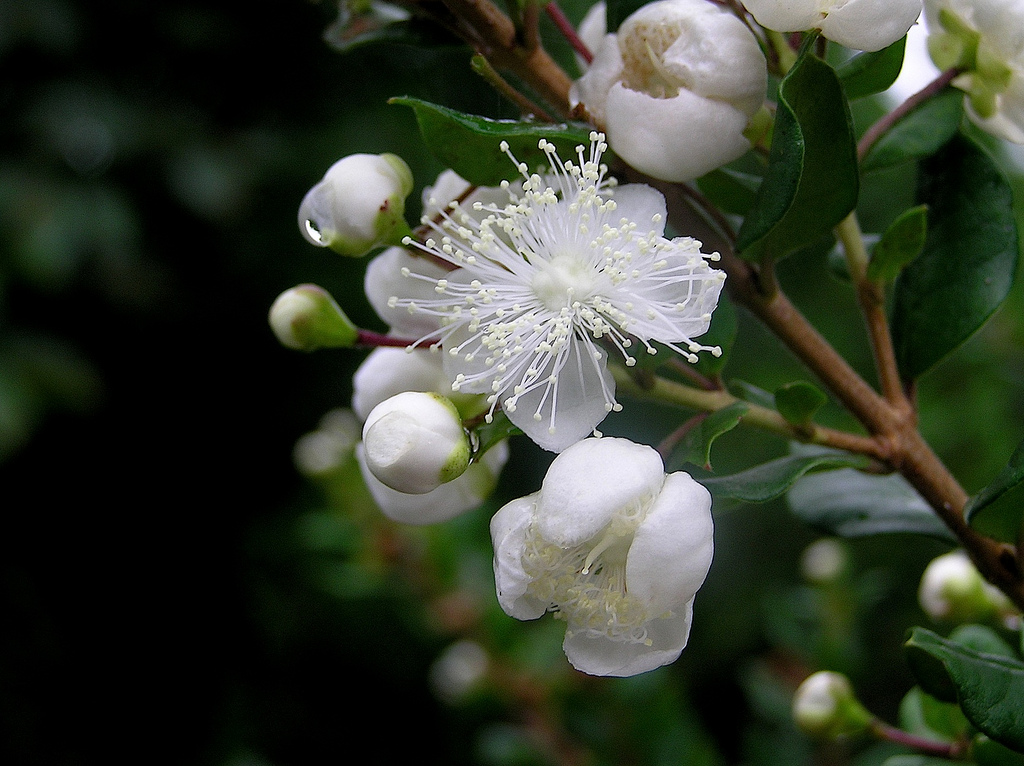
Of course it was down to the fact that our Myrtle bush, Myrtus communis is in full flower and presents a lovely sight. It is reasonably hardy (it was cultivated in Britain during the 16th century) and I am surprised that it is not seen more often, especially as it is a compact shrub which sits easily in a  tub and is generally well suited to today's smaller gardens. It is also much visited by bees. In all it surely deserves the Award of Merit granted on it by the R.H.S. 1972.


Our myrtle is confined to a tub. Stefen Hill, Daventry.
5 August, 2020


It gives its name to the Myrtaceae, a large family which, slightly surprisingly, includes the mighty Eucalyptus genus.


The flowers are visited by bees and the foliage is fragrant.


Of course, when the flowers of Eucalyptus are examined the relationship becomes a little clearer. In both genera the stamens are very long, creating a pom-pom effect. Then there are the leaves: those of myrtle are pleasantly fragrant; those of eucalyptus are also pungently scented but often with the 'cough medicine' smell with which we are all familiar. The oil from myrtle leaves is known as Eau d'Anges and is sometimes used in perfumery.


Eucalyptus globosus shares with myrtle long stamens, giving the flowers a
fluffy appearance.
There are in fact many species of myrtle and Hilliers list nine species in their invaluable, 560 page manual (Anon, 1974). At least one, Myrtus chekan, aka Luma chequen, is rather intriguing. It hails from Chile and would appear to be hardy. It certainly appears to be attractive, judging from photographs.
Myrtus chekan is apparently hardy.
Perhaps I should give a mention to the edible nature of myrtle berries. They are described as 'sweet, with juniper and rosemary-like flavour' but as I have tasted neither juniper nor rosemary, that is not helpful to me.  I have often noticed myrtle jam for sale in Greece and Italy and maybe I should have taken the plunge and bought some.


But perhaps the fact that it is often blended with figs should tell us something.
Reference                  


Anon, (1974 edition)  Hilliers' Manual of Trees and Shrubs  David and Charles, Newton Abbot

Tuesday, 4 August 2020

More from the wet basin

Just a month ago, i.e  on the 4th July, I made a visit to a nearby housing development, still under construction. The feature which caught my interest was a large 'wet basin' , designed to hold flood water should the need arise.


Today I made a further visit to monitor developments in terms of the flora and fauna. There has been no water (as far as I am aware) in the basin since its construction so I was surprised to find several pond snails beneath loose stones. They appeared to be specimens of the Wandering Pond Snail, Radix balthica, but I failed to bring any home for closer examination. There were willow saplings too plus Yellow Flag, Iris pseudacorus. Remarkable!


The flora consisted, as might be expected, of typical weeds of waste ground. Wall Lettuce, Mycelis muralis (= Lactuca muralis) grew on drier ground. It is not a photogenic plant; the specimens I noted were straggly things and my pictures were unsatisfactory so I won't trouble you with them, but it is one of those basic plants that the botanist needs to recognise. The leaves are reasonably distinctive.


Wall Lettuce was present in drier areas on waste ground at
Badby Road West, Daventry. 4 August, 2020. Photo via the internet
A waste ground plant par excellence is the Common Ragwort and it was almost inevitably present, although in small numbers. Its name has recently changed from Senecio jacobaea to Jacobaea vulgaris. Of course, although some botanists would argue that the new name is the 'correct' one, this is not the case. Is the name-change justified?  In this instance it is a matter of opinion and it may be some years before the new name achieves general acceptance.

Ragwort can be a lovely plant. Waste ground, Badby Road West, Daventry.
4 August, 2020
There can be little doubt that, weed or not, a well-grown plant is a handsome thing. Under different circumstances it could be a valued garden plant and there is no doubt at all that it is valued by many insects. Today Honey Bees, Apis mellifera, were tucking in.

A Honey Bee was busy at a capitula (the name given to this type of
composite flower head). Badby Road West, Daventry.
4 August, 2020
Docks are also generally unwelcome plants in gardens or on farms, but they are important for a surprising number of insects. Among butterflies both the Small and Large Copper, Lycaena phlaeas and L.dispar depend on docks for their larvae and up to about twenty moths also use docks as food plants. Today however it was the Dock Bug, Coreus marginatus which was the most obvious, being large and present in large numbers. I was astonished to find, on checking, that one of the best-known books on the subject (Salt and Whittaker, 1998) fails to give this insect a mention!


It is ubiquitous throughout Britain and, although strictly speaking it is not a shieldbug, it is generally regarded as such - an honorary shieldbug. Today there must have been hundreds of specimens present, with every plant (Broad-leaved Dock in this case) carrying several.

A Dock Bug on Broad-leaved Dock. Hundreds were present.
Badby Road West, 4 August, 2020
I photographed a Gatekeeper butterfly, just for the record so to speak. Its Latin name of Pyronia tithonus, bestowed on the creature by Linnaeus, recalls the unfortunate boy who sought immortality. Zeus granted his wish but failed to explain the implications. Tithonus remained alive but instead of staying young he degenerated into a senile, pathetic wreck.  Peter Marren (Marren, 2019) suggests that the shades of brown which the wings display are the secret;  '...the butterfly is one of the browns, and brown is the colour of melancholy and disappointment'.

The Gatekeeper, a study in browns. Badby Road West, Daventry.
4 August, 2020


And finally, just before leaving with a full specimen tube, I spotted a Nursery Web Spider, Pisaura mirabilis, at its web entrance. It posed long enough for a photograph but then, clearly overcome by coyness, scuttled back into its 'den'.


References

Marren, Peter 2019  Emperors, Admirals and Chimney Sweepers   Little Toller Books

Salt, D.T and Whittaker, J.B 1998  Insects on Dock Plants  Richmond Publishing Co. Ltd.


A female Nursery Web Spider on waste ground. Badby Road West,
Daventry, 4 August, 2020

Monday, 3 August 2020

Nettles

I have frequently broached the subject of nettles, and will doubtless do so again. They are ubiquitous, memorable (thanks to their never-to-be-forgotten sting), ecologically significant, conspicuous (individuals over 3 metres tall have been measured), commercially valuable - think fibres for ropes and cloth,  rich in folk-lore...and are thugs.


We are often encouraged to grow them in our gardens, but given the opportunity they will frequently form the near-impenetrable thickets with which we are all familiar. Insects which depend upon nettles have no trouble in finding bountiful quantities.
Nettles can soon create an impenetrable thicket.
Stefen Hill Pocket Park, 3 August, 2020

The list of insects dependent upon nettles is a long one and includes among the lepidoptera the Peacock (Inachis io), Small Tortoiseshell (Aglais urticae), Red Admiral (Vanessa atalanta), the Mother-of-pearl (Pleuroptya ruralis) and the Nettle-tap (Anthophila fabriciana). Many weevils and plant bugs are similarly dependent upon nettles.

Peacock butterfly feeding at Spear Thistle.
Byfield Pocket Park, 2 August, 2020
Not that nettles depend upon other organisms. Their flowers, held in pendulate, catkin-like inflorescences, are wind-pollinated and they are also able to spread via tough rhizomes (which, along with the leaves, make useful dyestuffs). Their various visitors simply use the highly nutritious leaves as a pabulum.
Urtica dioica showing the dangling strings of flowers.
Stefen Hill Pocket Park, 3 August, 2020


But how do taxonomists view them? We have two species present in Britain. All the remarks I have made so far were made with the common perennial stinging nettle, Urtica dioica, in mind but gardeners and farmers on lighter soils will also have come across the Annual Nettle, Urtica urens (urens means 'stinging or burning') but this species is rarely a problem. These plants together with their close relatives are generally placed in their own family, the Urticaceae. The late David Bellamy claimed that they were named thus because they 'urt you and indeed the Latin word urtica doesmean sting.

There are some 500 species in what appears to be a self-contained family. But life is never that simple. The Urticaceae is closely related to the Cannabinaceae family which, apart from its obvious significance in terms of drugs, is another source of important fibres.


I include a picture of cannabis for readers who, like myself, lead simple, sin-free and generally blameless lives.


Cannabis sativa; sativa means planted or grown, as opposed to wild.

Over recent years the advances made in molecular studies have turned many previously-held ideas on their heads. It appears that nettles more properly belong in the largely tropical Cecropiaceae family. Like the Cannabinaceae, the Cercopia family includes species of importance pharmacologically.
 Fruits of the Red Embauba, Cercropia glaziovii, are consumed by toucans
and sloths.

I have a suspicion that it will be many years before writers of British floras recognise the Ceropiaceae family as a component of our flora.