Monday, 2 March 2020

The Chaste Tree

Chris and I popped into Dennett's, our local garden centre today and I was surprised to see a plant of Vitex agnus-castus for sale. I have never seen this Mediterranean shrub in Britain, perhaps because it is borderline hardy, but I am always a sucker for the unusual so I snapped it up. In any case it is a worthy plant having been awarded the RHS Award of Garden Merit.


The Chaste Tree makes a handsome plant.
(Photo courtesy of Google)
It is known as the Chaste Tree, as it was once believed to be an anaphrodisiac, a tincture of it being taken by monks in the middle ages to quell their libido. (Its effectiveness is questionable and nuns at the Convent of St Matilda in Genoa complained that monks from a nearby monastery were constantly knocking on the door asking for what they called 'relief for the needy'. Fortunately, according to the Mother Superior, 'the laying on of hands' would often suffice.) [Sorry, I got carried away into the realms of fantasy there.]

The plant does make a substantial tree but I will keep it confined within a pot and there it should be manageable for a number of years.


I'm hoping our plant doesn't take on these dimensions.
(Photo courtesy of Google)
It has been placed in the Verbena Family, Verbenaceae, but is now generally regarded as being a member of the Lamiaceae. This family includes the  mints, lavender, sage and thyme so our Chaste Tree will hopefully attract a number of bees and other insects.

I am placing it in a sheltered spot and keeping my fingers crossed.


Tony White  E-mail: diaea@yahoo.co.uk

Sunday, 1 March 2020

First day of spring, 2020

And it isn't a bad day at all. We have got our daughter's dog for the day so I took it over to our local pocket park. It was a bit on the chilly side and although snowdrops are still in full bloom I saw no bees paying a visit.


Perhaps we need the temperature to rise a few degrees if these snowdrops
are to attract honeybees. Stefen Hill Pocket Park. 1 March, 2020
There were quite a few flowers about although for a variety of reasons they were not attracting insects. This rose, for example. The flower buds of roses may over-winter but usually get 'balled' and thus unable to open, but this flower has successfully made it through to the spring - but is unlikely to attract insects.

A rose has come through winter to produce a surprise bloom.
Stefen Hill, Daventry. 1 March, 2020
The curious male flowers of ash are also about to open, but again insect visitors are unlikely. I have featured their almost blackberry-like flower buds before but I am always struck by their curious form.

The male flowers of ash trees are easily overlooked.
Stefen Hill Pocket Park, 1 March, 2020

Laurustinus, Viburnum tinus, does attract insects, including honey bees - but not today. Throughout winter and into spring the leaves of this shrub may bear the mines of a moth, the Viburnum Midget - but I confess I forgot to check today.

Laurustinus, Viburnum tinus, is currently flowering profusely.
Stefen Hill, Daventry. 1 March, 2020
Whether insect pollination occurs on any scale I don't know but Laurustinus fruits are readily formed and neglected shrubberies occasionally harbour a self-sown specimen.


A very few flies were about. Phaonia tuguriorum and Eudasyphora cyanella but both are very common and have already been recorded from the pocket park. But I remain optimistic with a number of potentially exciting sites to explore.


Harley Equestrian

Tomorrow, the first of March, is meteorologically speaking, the first day of spring. But in fact today had a number of spring-like features about it, rather marred by a chilly wind and even a short flurry of gritty snow.


Chris and I managed a short walk and finished up at Harley Equestrian. As the name suggests it is a retail outlet for all things horsey. We do possess a clothes horse but basically we have no need for tack, neatsfoot oil, jodhpurs or any of the other curious items available. No, we were there for the rather good cafĂ©.


En route I couldn't resist photographing a Lawson's Cypress Chamaecyparis lawsoniana. The prefix chamae means 'low' but in fact this genus can produce some impressive trees up to 45 metres high. The specimen I looked at was quite a modest tree, though very graceful and enhanced by the lovely claret male cones. It deserves a place in any reasonably large garden.


Lawson's Cypress, showing the male cones.
Byfield, 29 February, 2020
Our stroll produced little to get over-excited about and a cluster of Jelly Ears on a dead elder branch was about the only highlight. This fungus, Auricularia auricula-judae, was once known as Jew's Ear and of course the Latin name means precisely that, but the name Jelly Ear is now, for obvious reasons, preferred.
Jelly Ear on dead elder


The fungus is, within my experience,confined to elder and its Latin name may refer to the tradition that Judas Iscariot hanged himself from this tree although I know of no evidence to give credence to this story.
  ,
More was present lower on the tree. Near Woodford Halse,
 29 February, 2020
Our short walk took us to a bridge overlooking the railway line which once ran from Towcester to Byfield and on to Stratford on Avon. The line at this point ran through a very fine cutting, now a nature reserve. The flora and fauna, particularly the insect life, is rich and Chris and I are resolved to take a closer look in a couple of months.


This cutting, on the line to Byfield, supports a rich array of wildlife.
29 February, 2020


At least it will give us an excuse for coffee and cakes.


Thursday, 27 February 2020

Snow (updated)

It was hardly a surprise when I flung open the curtains to see snow on the rooftops, after all, it is only February. Even so, it was a disappointment. I go on to Facebook and look with envious eyes at photographs of bees, butterflies and diptera being recorded elsewhere in Britain but I am doing badly.


Accordingly I set out to visit Stefen Hill Pocket Park but, although the morning was producing sunny spells, I was not optimistic. Coltsfoot, Tussilago farfara, was flowering but its heart clearly wasn't in it; was growing in a shady spot and had clearly decided to wait for warmer or sunnier conditions before fully opening. Apparently one old name was coughwort, the leaves having once been used as a herbal tobacco. During the Second World War coltsfoot rock was sold and, because it was regarded as a medicine, was not subject to sweet rationing (quoted by Richard Mabey, Ref. 2)


Coltsfoot had not fully opened but, with no insects about, what would
be the point? Stefen Hill Pocket Park, 27 February, 2020

Many flowering plants eschew clay but coltsfoot seems perfectly happy on this generally intractable material and often forms large colonies on it. The silky pappus on the fruit (and the felty layer on the underside of the leaves) has been put to various uses in the past, including tinder - "rapped in a rag and boiled in a little lee with salt-petre added." (Ref 1). Goldfinches will use the pappus to line their nests.

I carefully made my way over very squelchy ground to the one and only pond and was delighted to see it holding huge quantities of frogspawn.
The water may be chilly but the local frogs had been busy.
Stefen Hill Pocket Park, 27 February, 2020


No frogs were to be seen but having spawned I suppose they saw no reason to hang around.


It is not unusual for the spawn to break the surface.
Still treading warily I moved on to a group of ash trees 100 metres away. I had noticed on earlier visits that the (three) trunks of one specimen bore rather peculiar lesions. Once home I did a spot of research and found that they were caused by Pseudomonas syringae (it has other synonyms).

Pseudomonas syringae has caused the development of these odd-looking
burrs. Stefen Hill Pocket Park, 27 February, 2020

Though unsightly it does not appear to be a fatal disease. Its name is a reminder that lilac and ash are in the same family, the Oleaceae

I pushed on to where large drifts of snowdrops were in flower. Given reasonably warm conditions I would anticipate honey bees to gathering nectar and honey, but there were none to be seen. A Cherry Plum, aka Myrobalan Plum, Prunus cerasifera, was smothered in blossom. but, as with the snowdrops, bees were absent.

A Myrobalan Plum was in full flower. Stefen Hill Pocket Park.
27 February, 2020

The tiny flowers have no obvious scent individually but en masse they were giving off a lovely honeyed fragrance reminiscent of almond blossom - not surprising really as almonds are closely related, the Almond being Prunus dulcis. The flowers will be followed by small tasty fruits which I suspect are frequently taken by thrushes and other birds. With the flowers for bees and the fruits for birds it is an excellent tree for wildlife.


The flowers of the plum bear about a dozen stamens around a single
 carpel which narrows to form a slender stigma 


A gust of wind caught the branches and for a few seconds the petals gave us another shower of snow. I decided to call it a day but may return when the weather is less chilling.


References

1. Quoted by Harley, M. (2016) Wonderful Weeds  Papadakis Books
2. Mabey, R. (1997) Flora Britannica  Chatto & Windus   

Wednesday, 26 February 2020

Westhorpe Lane

Being Wednesday I visited Byfield of course and made my usual bee-line for the pocket park. It was again a cold, windy day with showers of rain mixed with a little gritty snow. Needless to stay I didn't hang about and all I noted was a hardy fly with a bright yellow abdomen, Phaonia tuguriorum, soaking up a brief sunny spell by loafing on a gatepost. I fled and made my way to Westhorpe Lane.


Few would take issue with me if I asserted that Westhorpe Lane is the most attractive road in Byfield. Elsewhere, dotted around the village, there are prettier houses but in Westhorpe Lane there is not a single unattractive building.
A thorpe was a secondary settlement, otherwise known as a daughter settlement, and it appears as an old Scandinavian element in places such as Mablethorpe and Kingsthorpe. (Byfield itself was, in 1086, Bifelde: 'by the forest clearing or open land'.) Westhorpe is - or was - separated from Byfield by a stream, sometimes known as the Bell Brook.


Recently villagers have attempted to enhance Westhorpe Lane by planting snowdrops and daffodils along the verges. So far they make little impact but they will probably spread.

I'm not sure that the daffodils and snowdrops planted along Westhorpe
Lane, make much of an impact. 26 February, 2020
They are pretty enough but prettier by far, in my opinion, are the verges further along the lane where Sweet Violets, Viola odorata, grow. They are of the white variety, with only the sepals showing the colour from which these plants get their name. Most of the Sweet Violets around Byfield, and indeed Daventry, are of this colour form.
Sweet Violets are present in some profusion further along the lane but their
 fragrance probably goes un-noted. 26 February, 2020

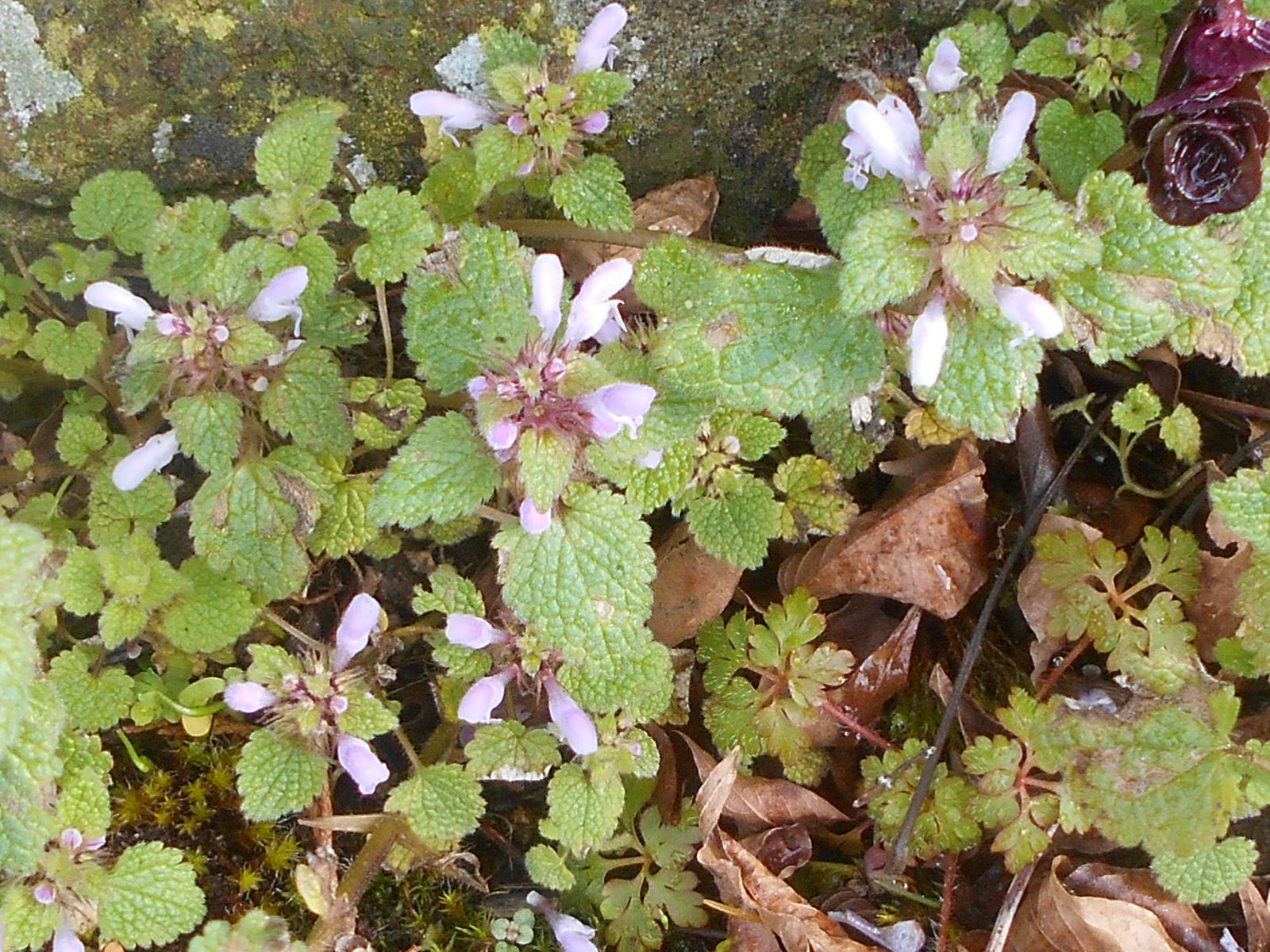
The only other wild plants in flower were some specimens of Common Whitlow-grass, Erophila verna, and numerous clumps of Red Dead Nettle, Lamium purpureum. This will provide nectar for early-flying bumblebees but will continue to flower for the next ten months or so. It is an archaeophyte, a plant which was probably introduced to Britain but has been established in the wild since 1500. I have never seen Red Deadnettle in any situation other than on disturbed, cultivated or waste land.
Red Dead Nettle. Should we regard it as a wild plant?  Opinions differ.
Westhorpe Lane, Byfield. 26 February, 2020


What else should I mention?


The village pump still exists but no longer functions as such, being purely an ornamental feature. Ornamental or not, few passers-by would be aware of its existence, concealed as it is behind a brick wall.
The village pump hides behind a brick wall along Westhorpe Lane.
26 February, 2020

And then there is Wistaria Cottage, which I may have mentioned in a previous blog. Should we regard this as a misspelling? This glorious climber was named after Caspar Wistar, professor of anatomy at the University of Pennsylvania, but Thomas Nuttall, who first described and 'christened' the plant, seems to have got the spelling wrong.
Whoops! Whether it is right or wrong is a matter of opinion.

Wrong or not, by the rules of the I.C.B.N (International Code for Botanical Nomenclature) the name Wisteria must stand - to the vexation of gardeners everywhere! A similar situation exists with another plant just coming into flower. The botanically correct spelling of Aubretia is Aubrieta - but does it really matter to anyone other than botanists?


Saturday, 22 February 2020

Polythenus vulgaris

Am I alone in detesting plastic flowers on graves?


Although I have no belief in life after death that is quite different from not respecting the dead, and I am at a loss to understand how putting a bunch of plastic flowers on a grave shows any kind of respect. If anything the opposite is true: the use of these polymer or artificial silk eyesores are indicative of a person who, for one reason or another, won't be returning to properly tend a grave. Worse, the hedgerows around Byfield Burial Ground are littered with the bits and pieces of these artefacts; the structures disintegrate but the components appear to be absolutely non-biodegradable.
Dozens of disintegrating artificial flowers litter the beech hedgerow
 around Byfield's burial ground. This poppy was presumably dropped on or
  11 November but shows no sign of decaying. 22 February, 2020


'BUY ARTIFICIAL FLOWERS FOR GRAVES ON AMAZON'


...screams one on-line advert I found on Google. But why? Carefully chosen bulbs should not only produce flowers year after year but with luck will thrive and spread. Now it is true that daffodils - perhaps the most popular choice - are very limited in their support for wildlife but they are infinitely more likely to attract bees and other insects than kitsch plastic substitutes.


Insect visitors to this 'flower' arrangement are unlikely.
Confucius famously said, 'Everthing has its beauty but not everyone sees it'.  I have tried to see beauty in these dusty, faded bunches of polythene 'flowers' but beyond Jimmy Saville and rap music I have failed to imagine anything uglier.
A wind-blown pot of 'flowers' beside the burial ground entrance.
Byfield, 22 February, 2020


Artificial flowers are now cleverly made and a glance from a distance can deceive the onlooker into thinking that they are the real thing, but they are by no means long-lasting. Unfortunately after a few months green 'leaves' can take on an odd blue-grey appearance, displaying a colour never seen in nature.
Although not obvious from the photograph, some of these 'leaves' are taking
strange glaucous grey-green colours. 22 February, 2020


On a different note, to see a furry teddy bear on a child's grave can be heartbreakingly sad, and the vision is worse when the teddy begins to decay, Yet oddly enough, the decaying flower heads on a real plant are symbolic of death itself. Though temporarily unsightly the withered stems and petals will be recycled, to give life elsewhere. Resurrection!


Footnote  I almost gave this blog the title of Polymerus vulgaris, a polymer being a long-chain, repeating molecule of the kind from which plastics are made, but then recalled that Polymerus is a genus of mirid bugs, including the British native, Polymerus unifasciatus. For all I know there may actually be a bug called Polymerus vulgaris. If so it will probably be of an insipid pink or a lurid purple colour.


Tony White   E-mail: diaea@yahoo.co.uk

Thursday, 20 February 2020

Never again

Almost a year ago to the day I had to visit Northampton General Hospital and make my way to the eye clinic. I had been pruning a euphorbia, or, to be more precise, Euphorbia myrsintes, Myrtle Spurge. I carelessly got some of the toxic milky sap into my eye but fortunately there was no lasting damage.

I removed one plant completely, gave away three seedlings and pruned the remaining plant hard back. It is now flourishing beside a Cordyline australis.
Our Myrtle Spurge accompanies a Cordyline Stefen Hill, Daventry.
20 February, 2020


This sap (actually a latex) is a reminder that Euphorbias are in the same family, the Euphorbiaceae, as the Brazilian Rubber Tree, Hevea brasiliensis.


The rather acid-yellow flowers provide early garden colour.


With a few exceptions the euphorbias are instantly recognisable and anyone who has spent much time in the Mediterranean region will have encountered a few specimens. They form one of the largest genera of flowering plants in the world, consisting of over two thousand species, with ten species occurring in Northamptonshire.  I generally encounter a few on a summer's walk. Several are agricultural weeds and, although some are garden escapes, E. myrsinites is not one of them - yet. But with climate warming...


The beauty of the plant lies in the contrast between its blue-green leaves and the bright yellow flowers in the form of a cyathium (plural, cyathia) and their equally yellow bracts (eu in Latin means 'beautiful'). The fact that it is a very early flowerer is a bonus. Chris fell in love with the species in the Essex gardens of Beth Chatto and since then we have never been without at least one plant.

But handle with care!