Tuesday, 16 May 2017

Monday, 15 May 2017
The garden in mid-May
Temperatures are steadily climbing and the drought of early May has at last been broken with some hefty showers. This has greatly benefited our allotment - but that's another story.
Here in the garden Clematis x cartmanii has been in flower for weeks. By and large I try to avoid hybrids but these flowers receive plenty of visits from bees, so it meets my approval! Its parents are two New Zealand species, Clematis marmoraria, from the Marble Mountains, and C. paniculata.
Here in the garden Clematis x cartmanii has been in flower for weeks. By and large I try to avoid hybrids but these flowers receive plenty of visits from bees, so it meets my approval! Its parents are two New Zealand species, Clematis marmoraria, from the Marble Mountains, and C. paniculata.
 |
Clematis x cartwrightii. We grow two plants facing each other.
Stefen Hill, Daventry. 15 May, 2017
|
The cross has been made on more than one occasion so several clones of this hybrid apparently exist. I'm not sure what we have but it is very floriferous.
Our rather featureless brick garage wall needed climbers to soften it and one of the plants chosen is Solanum crispum, a relative of the potato, S.tuberosum. It looks very much like our native Solanum dulcamara, but as crispum hails from Chile the similarity may be more superficial than actual. It is climbing rapidly and, with a clematis and a couple of fan-trained pears the rawness of the wall is being softened.
 |
Solanum crispum or Climbing
15 May, 2017
|
With relatively limited garden space, front and back, we have been forced to look at small plants, sometimes miniatures of larger and better-known plants. One species previously featured in this blog is Sophora microphylla. Greatly though I covet it, the space just isn't there.
 |
Sophora microphylla, Badby Road West, Daventry.
3 May, 2017
|
Instead we have its diminutive relative, Sophora prostrata, from New Zealand's South Island. For us it makes a small wiry shrub only eighteen inches or so high - in the wild it can reach two metres - and carries yellow flowers and tiny leaves on zig-zag stems.
 |
Sophora prostrata, curious rather than spectacular. Our garden,
15 May, 2017
|
We have it in a tub and the plan is to try and simulate its native habitat, where it grows in sun and in poor, gritty soil. Inevitably the flowers are small but nevertheless attractive. Although not bearing a typical pea flower it is in the Fabaceae, along with gorse, broom and broad beans. It is not a species with great impact but it is a curious and interesting little shrub.
 |
The flowers are yet barely open. Stefen Hill, Daventry.
15 May, 2017
|
Far more flamboyant, and currently at their best, are the aquilegias. Most people are familiar with Aquilegia vulgaris, perhaps unsurprising given that it is a native of much of Europe including Northamptonshire. I grow the dainty Aquilegia canadensis, an early flowerer which is already over, but lovely alternatives are in bloom. A. caerulea is blooming in one of our sink gardens. This species, native to the Rocky Mountains of the U.S.A., is rather variable but we seem to have a particularly attractive strain.
 |
Barely six inches high. Aquilegia caerulea in our back garden.
15 May, 2017
|
Aquilegias are promiscuous plants and seedlings are liable to pop up anywhere in a border, with various shapes, sizes and colorations represented. The colours may sometimes be a bit wishy-washy but occasionally we get a surprise and when a red and a blue plant, both of unknown provenance, popped up together in our front garden we were delighted with the serendipitous effect.
 |
Aquilegias of doubtful parentage have popped up in our front garden.
Stefen Hill, Daventry, 15 May, 2017
|
In the sink garden, alongside the Aquilegia canadensis, sits a dainty alpine, Geranium cinereum. It hails from the Pyrenees although mine hailed from an alpine nursery. Its neat, greyish leaves (the Latin word cinereum means 'ash-coloured') have given rise to its common name of Ashy Cranesbill, but its flowers are the main attraction.
 |
Geranium cinereum occupies a sink garden to the rear of our house.
15 May, 2017
|
It is an unfussy plant and, although I grow it in a gritty compost, it will quite happily grow at the edge of a border. It needs to be in a position where its petals, with their delicate veining, may be appreciated.
 |
The lovely flowers are large for the size of the plant.
|
Finally I must mention the Bitterwort growing in our front garden. In fact this 'common' name is rarely used; they are better-known as Lewisias, commemorating Captain Meriwether Lewis, senior leader of the Lewis and Clark expedition, the first to make the coast-to-coast crossing of North America. The genus hails, like the Aquilegia caerulea mentioned earlier, from the Rocky Mountains. There are several species but I have no idea which plant I grow. In fact the species hybridise easily and the true species are reputedly hard to find.
 |
Lewisias come in a range of colours other than this salmon-pink.
15 May, 2017
|
My plant has flowers of a salmon-pink, fading to a more delicate shell-pink. Early books suggested that they were hard to grow, and maybe the true species are, but modern hybrids give few problems providing one avoids wet conditions or clay soils. I intend to seek out more of these portulacaceous (lovely word but too long for Scrabble) plants if I can be convinced that they attract insect visitors.
Thursday, 11 May 2017
Grounds for complaints (medical)
I took Chris to Northampton General Hospital today where the excellent treatment received has successfully conquered her illness, but to ensure that it never returns she receives regular checks and routine medicine. We arrived to find the department desperately short-staffed and she spent over four hours for what should only have taken half that time. I killed an hour or so wandering around the hospital grounds. Conditions were pleasantly warm and dry, so why were the leaves of an Acer so wet? In fact the 'water' was honeydew raining down from the aphids feeding in the higher foliage on to the lower leaves. Woe betide anyone who parks their car under one of these afflicted trees.
 |
Rain? No, just leaves shiny with honeydew. Northampton General
Hospital. 11 May, 2017
|
Fortunately other trees were hardly affected and a nearby Paperbark Maple, Acer griseum, was looking very well. This species has featured in my blogs before but its curiously attractive bark is always worth a photograph. A number of species from several different families share this habit of shedding bark. The reasons are not completely clear but obviously as the bark falls to the ground it takes with it mosses and lichens, exposing fresh bark and allowing the lenticels to do their job.
 |
Messy? Perhaps, but the peeling bark on Acer griseum is bizarrely
attractive. Northampton General Hospital. 11 May, 2017
|
Lenticels are pore-like structures in the bark which allow the exchange of gases between the trunk or branch and the atmosphere. The Himalayan Birch, Betula jacquemontii, behaves similarly, as does the Paper Birch, Betula papyrifera, from North America. The second of these two species also grew nearby.
 |
Several birch species have peeling bark. Paper Birch at Northampton
General Hospital.11 May, 2017
|
The birches and acers (maples) would grace any larger garden but the same could not be said for two other plants also growing in the hospital grounds. One was Deadly Nightshade, Atropa belladonna. I went in search of it deliberately, confident that I would find specimens as it has been sporadically growing here for probably a century or more (and has appeared in a previous blog). At the moment, lacking flowers or fruits, its identity is far from obvious but fortunately I am familiar with it.
 |
Deadly Nightshade has long resided in the hospital grounds.
11 May, 2017
|
From a quite different family is Conium maculatum. This plant, with its graceful filigree foliage would look lovely in a border, rather like a stately, two metres tall carrot. Of course, it is never deliberately grown in a garden for this is Hemlock!
 |
Beautiful but deadly. Hemlock in the grounds of N.G.H.
11 May, 2017
|
The bases of the stems are purple and as the weeks go by purple blotches will appear on the stems too. It has an unpleasant smell, warning off most people and yet 'many people have died after eating hemlock' ('Poisonous Plants and Fungi', H.M.S.O. publications). Its poisonous properties have been known for over 2000 years and most people are familiar with the fate of Socrates, who died in 399 B.C. after drinking an extract of hemlock.
 |
| Red-purple coloration at the base of a hemlock stem. 11 May, 2017 |
Around Northampton and the west of Northamptonshire in general Deadly Nightshade is a rare plant but the same cannot be said of hemlock; it is common on riverbanks, beside canals and on waste ground generally. It is also common beside Boddington reservoir. Speaking of feathery leaves (and at the risk of overdoing the subject) Common Storksbill, Erodium cicutarium, was present on waste ground and in neglected flower beds. With its purple flowers it is a pretty little plant, worth a place in the rock garden but for the fact that its seedlings would soon be popping up everywhere. Storksbills differ from cranesbills most obviously in the shape of their leaves.
 |
The pale purple-pink petals of Common Storksbill are hard to see against
a stony background. 11 May, 2017
|
Cranesbills, Geranium species, have rather simple, palmate leaves, but those of Storksbills are pinnately compound. Cranesbills and storksbills have basically similar fruits but in the storksbills they are much elongated, making the reason for the popular name rather obvious.
These fruits become spirally twisted as they ripen and, corkscrew-like, twist themselves into the soil when they fall.
 |
| The palmate leaves of Geranium pratense. |
These fruits become spirally twisted as they ripen and, corkscrew-like, twist themselves into the soil when they fall.
 |
The feathery - pinnate - leaves of Storksbills help to distinguish them
from Cranesbills. Northampton General Hospital. 11 May, 2017
|
I'm sorry. I do go on and haven't yet mentioned the insects and galls noted on my stroll. Another time maybe.
The Twistle, Byfield
Delineating the western edge of Byfield is a lane known as The Twistle. I assume that its name comes from the fact that it involves three or four twists - quite hazardous for drivers - along the more northerly section.
 |
| The Twistle, Byfield, looking north. 10 May, 2017 |
There is nothing remarkable about it but my friend Pom Boddington had drawn my attention to a number of galls beside this lane that had caught her eye, so yesterday I visited the area for a closer look. They were oak apples, not remarkable in themselves and in fact I had featured an example in my latest blog ('Bucknell Wood') in which I wrote a little about the nature of these structures.
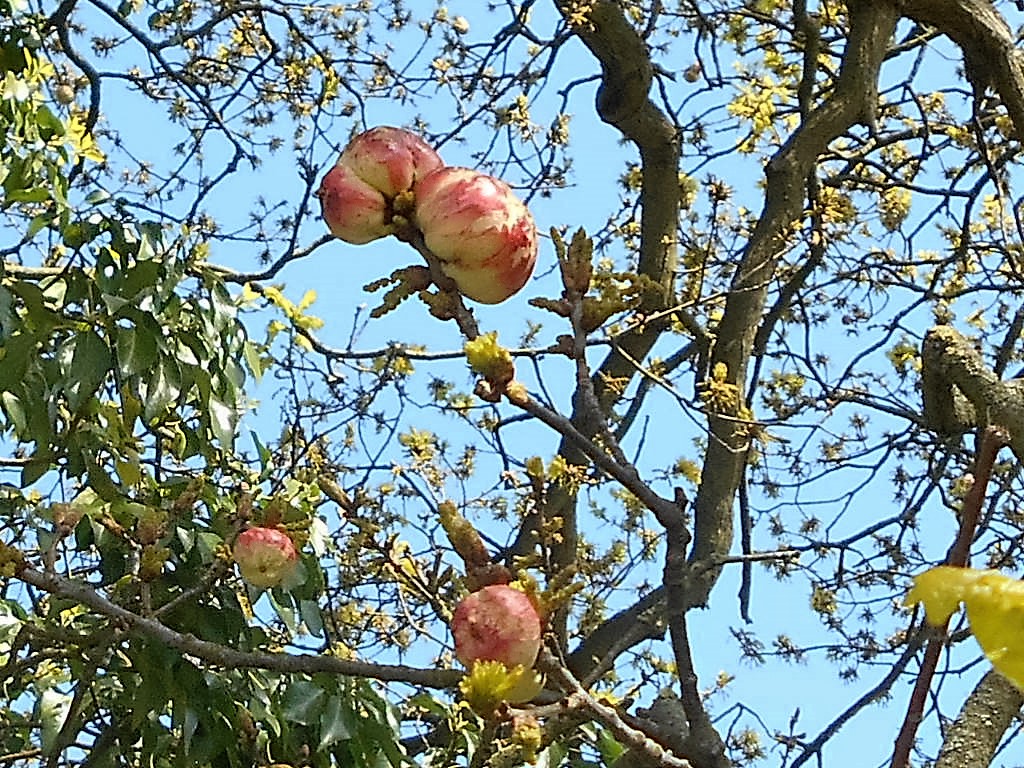 |
A group of oak apples beside The Twistle, Byfield.
10 May, 2017
|
But some twenty or more of these galls were easily visible on the first tree I examined and roughly the same number on a second tree, and it was the sheer profusion of them that made the sight unusual. No doubt this quantity is unremarkable but I cannot recall have seen so many.
 |
| Young foliage on an oak. Byfield. 10 May, 2017 |
On the trees the foliage was still unfolding and was of a delicate yellow-green colour; the catkins were of a similar colour. These too are likely to become galled over the next few weeks, again by cynipid wasps but of a different species.
 |
The catkins were similar in colour. The Twistle, Byfield.
10 May, 2017
|
It is still early in the season but already caterpillars were beginning their relentless nibbling. A Dark Dagger moth caterpillar, Acronicta tridens, was at work. The adult moth - the imago - is virtually indistinguishable from the Grey Dagger, Acronicta psi, but fortunately the caterpillars differ and are easy to separate. This larva was barely one centimetre long; it had a lot of growing up to do.
 |
| Larva of the Dark Dagger moth on elm. Byfield. 10 May, 2017 |
A few yards further on and another caterpillar was munching away at elm leaves. It was instantly recognisable as one of the geometrid moths. In America they are known as 'inch worms' from their looping progress in steps of roughly an inch at a time. In this case the species was the Mottled Umber, Erannis defoliaria. This specimen was also very small and only about twelve millimetres in length.
 |
Caterpillar of the Mottled Umber beside The Twistle, Byfield.
10 May, 2017
|
Only one bug was seen. A plant of Wood Dock was being investigated by a Dock Bug, Coreus marginatus. The females will lay their eggs on a dock plant but sorrels and rhubarb (likewise in the Dock Family, Polygonaceae) also act as hosts. The Dock Bug is generally regarded as a shieldbug and is usually included in books on the subject, although it is not a true shieldbug. Roger Hawkins, in his excellent book, Shieldbugs of Surrey, suggests it should be regarded as an honorary shieldbug; the term 'leatherbugs' is also used for the Dock Bug and its close relatives.
 |
Dock Bug on Wood Dock, Rumex sanguineus. The Twistle, Byfield.
10 May, 2017
|
Docks are generally undistinguished plants but support a surprisingly large fauna. The word dock comes from the Anglo-Saxon docca, perhaps related to the Greek daukos. The Greek word really refers to parsnip or carrot which, like dock plants, have long tap roots.
Further down The Twistle a bridge crosses the now-overgrown track-bed of the Stratford-upon-Avon and South Midlands Junction Railway. A camera-shot over the parapet had to be carefully positioned as an enormous amount of rubbish now litters the floor of this cutting.
 |
Best not to look down into this cutting. The litter is a disgrace.
Byfield, 10 May, 2017
|
A few yards further on and I was in Byfield, where a damselfly sat on the foliage of a Clematis. The insect had red eyes and the likelihood is that I was looking at a Red-eyed Damselfly, Erythromma najas. The adults have a cyan-blue thorax (not obvious in this photograph) as does the very similar Small Red-eyed Damselfly, Erythromma viridulum, but the former is more common and is known from the nearby Boddington Reservoir.
 |
Red-eyed Damselfly on clematis foliage, Bell Lane, Byfield.
10 May, 2017
|
I was now well into the village. My walk was over but, before meeting up with my wife, there was just time to look at that curious member of the Poppy Family, the Greater Celandine. This species, Chelidonium majus, is an introduced plant, first recorded in Northamptonshire in 1822, and has never become established in the wild. It is confined to odd corners of waste ground or, as here, at the base of walls.
 |
Greater Celandine grows at the foot of walls in Byfield.
10 May, 2017
|
The broken stems exude a bright yellow-orange sap, once used for topical application to warts but its scientific name has nothing to do with this, coming instead from the Greek word chelidon, a swallow, as the opening of the flowers tends to coincide with the arrival of the first swallows. It is only distantly related to the Lesser Celandine, which is placed in a different family.
Tony White. E-mail: diaea@yahoo.co.uk
Tony White. E-mail: diaea
Sunday, 7 May 2017
Bucknell Wood
For the second meeting of Northants Diptera Study group, John Showers had arranged for us to record insects in Bucknell Wood, near Silverstone. This is Forestry Commission land and, along with Hazelborough Wood, forms part of the Whittlewood Forest complex.
The weather forecast predicted chilly conditions and I was tempted to give it a miss but, as it turned out, conditions were gloriously sunny and pleasantly warm. As a former geography teacher I appreciate how tricky forecasting can be in Britain, but too often the predictions are way off beam.
I parked up and a few minutes later was joined by Brian Harding, a dipterist from Oxfordshire. He and I wondered if we'd got the correct meeting point, for no-one else turned up.
The weather forecast predicted chilly conditions and I was tempted to give it a miss but, as it turned out, conditions were gloriously sunny and pleasantly warm. As a former geography teacher I appreciate how tricky forecasting can be in Britain, but too often the predictions are way off beam.
I parked up and a few minutes later was joined by Brian Harding, a dipterist from Oxfordshire. He and I wondered if we'd got the correct meeting point, for no-one else turned up.
 |
One of the main rides in Bucknell Wood, near Silverstone, Northants.
7 May, 2017
|
It is a fine woodland in terms of trees but the ground flora was quite limited. There were bluebells and primroses but nothing like the show currently to be seen in, for example, Badby Woods. The conditions were very dry but this ought not to affect the situation.
Anyway, relatively few bluebells but as a small compensation there was Greater Stitchwort, Stellaria holostea. In Northants it was first recorded in 1843 from 'Daventry Wood'. Where, I wonder, was that? Perhaps one of the woods clinging on to the slopes of Borough Hill?
The dominant tree was, as anticipated, Pedunculate Oak, Quercus robur. Here and there Oak Apples occurred. This gall is about the size of a golf ball and is soft and spongy.
Anyway, relatively few bluebells but as a small compensation there was Greater Stitchwort, Stellaria holostea. In Northants it was first recorded in 1843 from 'Daventry Wood'. Where, I wonder, was that? Perhaps one of the woods clinging on to the slopes of Borough Hill?
 |
| Greater Stitchwort at Bucknell Wood. 7 May, 2017 |
On the generally rather bare woodland floor the Wood Sedge, Carex sylvatica, was one of the few species to flourish. We have about 70 species of Carex here in Britain and a certain level of expertise is required to safely identify them. I do not have that expertise but am reasonably confident about this one.
 |
Wood Sedge on the rather bare woodland floor. Bucknell Wood.
7 May, 2017
|
 |
Oak Apples were occasionally to be seen. Bucknell Wood.
7 May, 2017
|
The insect responsible is a cynipid wasp, Biorhiza pallida, whose larvae induce this gross proliferation of tissue. At this time of the year the galls seem to be at their best.
In the trees a cuckoo, Cuculus canorus, was calling. I hope it finds a mate; small song birds will wish otherwise. I really can't remember the last time a heard a cuckoo. Sad.
In the trees a cuckoo, Cuculus canorus, was calling. I hope it finds a mate; small song birds will wish otherwise. I really can't remember the last time a heard a cuckoo. Sad.
In April come he will,
In May he sings all day,
In June he changes tune,
In July he prepares to fly,
In August go he must.
Trad.
Trad.
In fact most adults have left by late July and the juveniles depart a month or so later. Who or what guides them down to equatorial west Africa? This remains one of nature's unsolved mysteries. (Ed. What do you mean, 'unsolved mysteries'? If it is a mystery it is obviously unsolved!)
What of the insects? Beside the main ride a group of extraordinary moths were 'dancing'. They were Green Longhorn Moths, Adela reaumurella, and the photograph shows the extraordinarily long antennae, nearly four times as long as the forewings, which give this widespread species its common name.
 |
| A Green Longhorn Moth at Bucknell Wood. 7 May, 2017 |
I should also mention the strange-looking tachinid fly, Phasia hemiptera, also taken along the main ride. Tachinids are parasites of a range of other invertebrates including butterflies, moths, earwigs and centipedes. Phasia hemiptera is typically found at the margins of woods where it is known to parasitise the shieldbug, Palomena prasina.
 |
A male specimen of Phasia hemiptera, taken at Bucknell Wood. 7 May, 2017
|
Sure enough, on foliage nearby were numbers of these green shieldbugs, some of them mating, in a position not to be found in the Kama Sutra - or so I'm told!
 |
A pair of Green Shieldbugs, Palomena prasina, mating.
Bucknell Wood. 7 May, 2017
|
My final photograph I almost didn't include in this blog. It is the caterpillar of a widespread moth known as The Brick, Agrochola circellaris. When I parked my car I noticed a scattering of Wych Elm, Ulmus glabra, fruits on the ground. This is one of the larval food plants of The Brick although sallow, poplar and ash are also acceptable. The blackish triangular dorsal markings are typical and diagnostic. I found it on the soil surface among dead leaves but this is to be expected as it lies dormant there for about six weeks before it forms a cocooned pupa.
 |
Larva of The Brick, a noctuid moth. Bucknell Wood, Northants.
7 May, 2017
|
Apparently the adult is often brick coloured - but a brick can be red, yellow (in London), brownish or grey. The name doesn't tell us a lot!
Tony White. E-mail: diaea@yahoo.co.uk
Tony White. E-mail: diaea@yahoo.co.uk
Friday, 5 May 2017
Lombardy Poplars
The Black Poplar, Populus nigra, has always been rare in Northamptonshire and, according to the Forestry Commission, is the most endangered native timber tree in Britain. Yet earlier today, in Byfield, I photographed several specimens. Of course, there is a catch...
 |
Lombardy Poplars edging the Brightwell Playing Field, Byfield.
5 May, 2017
|
I did indeed photograph Black Poplars but they were specimens of Populus nigra 'Italica', commonly known as the Lombardy Poplar. This fastigiate form is hardy, easy to grow and quite architectural; rare it is not and must rate as one of the most recognisable trees in Britain.
For insects and other organisms the fact that it is just a form of the 'real thing' is of no consequence, so when I strolled over to take a closer look I was not surprised to find some poplar-loving creatures present. In several places the petioles (leaf stalks) were twisted into a helix of two or three turns.
 |
These curiously coiled petioles on poplar are the work of the aphid'
Pemphigus spyrothecae. Byfield, 5 May, 2017
|
This was the work of an aphid, Pemphigus spyrothecae. It is common in southern England and I have located it elsewhere in Northamptonshire. The aphids could not be seen and will not emerge from these swollen tissues until around August.
A couple of Yellow-barred Long-horn moths, Nemophora degeerella, were on the foliage but took to the wing as soon as I raised my camera. This was a pity since the males, with the antennae 3-4 times the length of the wings, are a remarkable sight. However they are common and I often see them in the nearby pocket park, so I may have an opportunity of photographing one later.
The edge of one poplar leaf blade was rolled under and the tissues were reddish. This is the work of another aphid, Thecabius affinis, one of the numerous species to have a secondary host forming part of its life-cycle. In this case it can be one of several buttercup species.
A couple of Yellow-barred Long-horn moths, Nemophora degeerella, were on the foliage but took to the wing as soon as I raised my camera. This was a pity since the males, with the antennae 3-4 times the length of the wings, are a remarkable sight. However they are common and I often see them in the nearby pocket park, so I may have an opportunity of photographing one later.
The edge of one poplar leaf blade was rolled under and the tissues were reddish. This is the work of another aphid, Thecabius affinis, one of the numerous species to have a secondary host forming part of its life-cycle. In this case it can be one of several buttercup species.
 |
Also on poplar, the gall caused by Thecabius affinis.
Byfield, Northants. 5 May, 2017
|
A trio of beetles completed my quick survey. All proved to be of the same species, Phratora laticollis. This is very common on poplars and seems particularly abundant hereabouts as it turns up regularly on poplars in the vicinity including aspen trees, Populus tremula, in the pocket park. It is a smart, glossy beetle with blue-green iridescence, but I have not included a picture as this colouring failed to show in my photographs.
Poplars and their hybrids, like their close relatives, willow species, play host to a wide range of insects and a close look is generally rewarding - if you are a naturalist.
Wednesday, 3 May 2017
Byfield Pool (2)
A recent visit to Byfield Pool turned out to be very disappointing, with cool weather limiting the invertebrates recorded. On the following Wednesday a second visit was made, hoping for more success.
The pool dates from the 1790's and, like the adjacent reservoir, was constructed to provide the Oxford Canal with a water supply. The area is now a reserve of the Northamptonshire Wildlife Trust with the pool and its surroundings covering 4 hectares (for oldies like me that is 10 acres).
A small quantity of Spindle, Euonymus europaeus, is present near the entrance. With its small, yellow-green flowers it is easily overlooked but later in the year it is a different matter. Its bright, sealing-wax pink fruit are quite striking - and poisonous.


The pool dates from the 1790's and, like the adjacent reservoir, was constructed to provide the Oxford Canal with a water supply. The area is now a reserve of the Northamptonshire Wildlife Trust with the pool and its surroundings covering 4 hectares (for oldies like me that is 10 acres).
A small quantity of Spindle, Euonymus europaeus, is present near the entrance. With its small, yellow-green flowers it is easily overlooked but later in the year it is a different matter. Its bright, sealing-wax pink fruit are quite striking - and poisonous.
 |
A few Spindle bushes occur near the reserve entrance.
Byfield Pool. 3 May, 2017
|
It was turning out to be a dull, breezy and rather cool day but there was plenty of shelter beneath the trees. The surroundings of the pool have a carr-like nature in places, being rather wet underfoot with the dominant trees being willows, often gnarled and twisted. Many had fallen and were slowly decaying, adding extra habitats for a range of organisms. Like all pools and lakes, without appropriate management the water will gradually become more shallow, filling up with silt, dead leaves and so on, eventually becoming dry land.
 |
| The path snakes between willow trees. Byfield Pool. 3 May, 2017 |
I made my way towards the edge of the pool to a point where the ground became rather wet and squelchy. In the litter among the reeds I hoped for a good haul of spiders.

There were not many obvious flowers but a few plants of Bugle, Ajuga reptans, added a little colour to the dominant green. This pretty member of the Mint Family, Lamiaceae, is a very useful bee plant, but when introduced to the garden at can become quite invasive.
 |
| A little Bugle was present. Byfield Pool. 3 May, 2017 |
The zygomorphic flowers are typical of the family and are worth a close look. The nectar guides are very obvious and I suspect that they would be striking in ultra-violet light.

I was soon at work and steadily built up a bag of spiders together with the inevitable crop of extras. One of these was the distinctive and quite colourful caterpillar of the Drinker, Euthrix potatoria, Nothing to do with potatoes of course; its specific name comes from the Latin potatorius - to drink (the species was once thought to imbibe drops of dew). This is a common moth and, given that the main food plants of the caterpillar are reeds and other grasses, it was not a surprising find.
 |
The caterpillar of the Drinker Moth. Byfield Pool. 3 May, 2017
|
Later in the year I hope to make another visit when, if past experience is anything to go by, I'll be tormented by midges, clegs and horseflies.
One of the problems
With Nature's great plan,
Is that a horse can't fly,
But a horsefly can.
William Robinson.
Post script In the event I recorded a slightly disappointing eight species of spiders - but it was a rather miserable day.
Post script In the event I recorded a slightly disappointing eight species of spiders - but it was a rather miserable day.
Subscribe to:
Posts (Atom)