Tuesday, 10 June 2014

Boddington Reservoir

A mile or so to the west of Byfield is Boddington Reservoir. It may be circumnavigated by a footpath and makes a pleasant walk of perhaps 1.5 miles; Chris does the walk on most Mondays with her friend Lynda, putting me to shame. Its function is not that of providing a supply of drinking water but of topping up the nearby Oxford Canal, but it is also a popular venue for carp fishermen (and a few fisherwomen). Carp fishing puzzles me; why can't people try to catch something useful, like spiders...

As I have implied, I am lazy and only do the walk occasionally but I did pay it a visit on 5 June, following a 'safari' at nearby Boddington Meadow.


A large wind turbine was erected there a year or so ago. There were many objections to it but I was in favour. In fact the original proposal was for two turbines but, as is clear, only one got the go-ahead. I like it and feel that it adds an interesting perspective to the landscape.


Wild Mignonette at Boddington
Reservoir. 5 June, 2014


Several interesting plant species are to be found at the water's edge and beside the footpath including Wild Mignonette, Reseda lutea. Its inflorescences do not always arch in the manner shown but this is not unusual. It is only thinly scattered in the western part of Northants but is common on the limy soils beyond Corby and Oundle to the east. It is found almost invariably on disturbed ground, suggesting to me that it may be an alien plant, but the experts seem to accept it as native.


The flower of Water Figwort
Boddington Reservoir. 5 June, 2014


Scrophularia aquatica is, as its name suggests, a waterside plant and is known as the Water Figwort. It is common throughout the county in suitable habitats although there is no record for Northants prior to 1841 Its flowers are quite tiny and my close-up pic greatly exaggerates their size. Small they may be, but plenty of insects call in for a nectar fix. The plant gives its name to the family, Scrophulariaceae and, if the flowers look vaguely like  snapdragons it is because they are in the same family.


Hedge Woundwort at Boddington Reservoir
5 June, 2014


Clumps of Hedge Woundwort, Stachys sylvatica, grow there too, clearly enjoying the conditions. As my photograph shows, it is a visually attractive plant, but is let down by an unpleasant smell. It is a member of the mint family and is therefore related to lavender, thyme, rosemary and so on. The family is noted for strongly scented leaves but unfortunately not all are pleasantly aromatic; horehound, like woundwort, is distinctly malodorous. However it does not deter bees, which are always to be seen taking the copious nectar.


Gastrophysa viridula on dock.
Boddington Reservoir. 5 June, 2014


Insects abound beside the water. Here is another egg-bloated Dock Beetle (see blog for 7 June) looking, I suspect, for a suitable place on this dock leaf to lay its eggs. Docks may be dull-looking plants but they support a surprisingly wide range of insects.


Wildlife enthusiasts in the Boddington area understandably make for the nature reserve at Boddington Meadow. Perhaps the reservoir deserves a little more attention.


Monday, 9 June 2014

Mid-June: pottering around the garden

I am a good potterer and my technique is much admired for its energy-saving nature. All gardeners should do this regularly; an old friend of mine once swore that it kept her emotionally stable. 


Leaves on my primulas (primroses and cowslips) are mined by the larvae of Chromatomyia primulae. This agromyzid fly is very common and, certainly around Byfield, most Primula leaves are mined. They may be mildly disfiguring but seem to do no harm.


Far more disfiguring are the discoloured spots caused by the fungus, Diplocarpon rosae.  My much-loved specimen of Rosa gallica 'Versicolor', aka 'Rosa Mundi' has been quite badly affected this year although only certain parts of the plant are really suffering. Its beautiful white, claret-striped petals should not be affected. 


Chris,working nearby, drew my attention to a largish moth fluttering across the lawn. It was a Large Yellow Underwing, Noctua pronuba. It obligingly flicked its forewings a couple of times to reveal the amber underwings. I ought to have killed it, as it a garden pest; anyone lifting a withered lettuce from the ground to find that its roots have been eaten away will not need to be told. The fat caterpillars, which live underground, are generally described as cutworms.


I was just pruning an errant branch from an Abelia grandiflora shrub when I spotted a Cockchafer, Melolontha melolontha clinging to an adjacent twig. These large insects, a type of scarab beetle, are often called June Bugs (or May Bugs in some areas), so the discovery should not have been a surprise.


These beetles tend to fly at dusk so, at mid-afternoon, it was not very lively and was easily coaxed on to my hand. Its size and colour, together with its remarkable antennae, make it quite unmistakable. Like cutworm moths, the grubs live underground and may do considerable damage to bulbs and corms. Badgers, digging up lawns, are looking for these and similar tasty morsels. I suppose I should have destroyed it. I didn't.


Less sympathy was shown for a Lily Beetle, Lilioceras lilii. It received short shrift but its corpse will be consumed by ants or some other scavenging creature.


A slight fold on the leaf of a Witch Hazel was all that was needed for a female Cucumber Spider, Araniella cucurbitina. These tiny creatures, only about 4 mm long, are very common but easily overlooked. Their prey probably consists of aphids and other tiny insects. The bright red tip to the abdomen allowed me to spot this specimen.


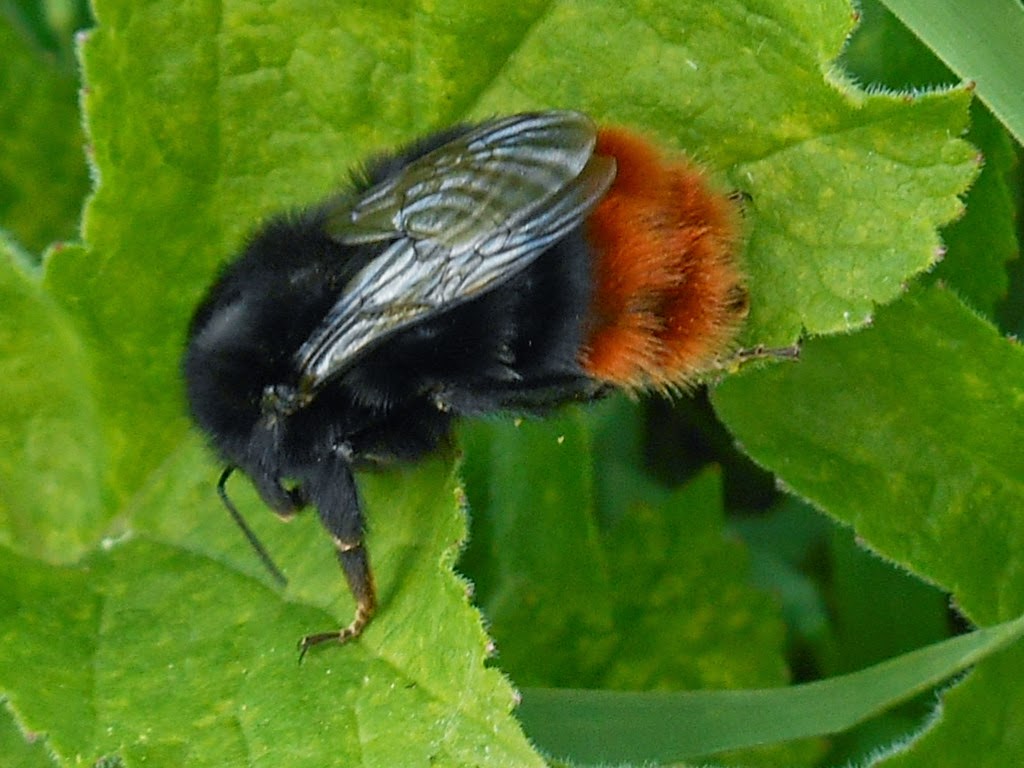
A bee was busy on the irises, Iris sibirica. It appeared to be Bombus hypnorum - but bees are are a self-imposed no-go area for me; spiders, bugs, beetles and two-winged flies are quite sufficient. I left it to continue its good work. It is a rapidly spreading species, much in the news lately, and has arrived in Britain so recently that it doesn't appear to have acquired a common name.


Hawthorn is plagued with attacks by many creatures, with those in my garden as badly affected as those in the open countryside. Here can be seen the pock-marks of a mite, Eriophyes crataegi; they are unsightly but seem to do little harm.


It has been many years since I did any serious studying of snails but I think I can still recognise Cepaea hortensis. It is slightly smaller than Cepaea nemoralis and usually has a white "lip" (the rim around the opening in the shell) but both snails are very variable, so a bit of care is needed. Both species are very common and do a little damage, but they fall short of being a real problem. Here it is on a willow in my garden.


I admit to having selected plants to attract insects but most gardens hold a surprising range of creepy-crawlies - if you can avoid the municipal planting so common in public parks. In some cases the insects or other organisms are dull in appearance and easily ignored in favour of more colourful creatures. But of course all of them have ecological importance and should be valued.


Saturday, 7 June 2014

Boddington Meadow L.N.R.

I have already written of my latest visit to Boddington Meadow local nature reserve, recounting something of the insect life on hogweed umbels. Elsewhere the meadow had lots to interest the naturalist. Orchids occur (although I saw none on my latest visit) together with plants typical of wet meadows.
Yellow-rattle at Boddington Meadow.
5 June, 2014

Yellow-rattle, Rhinanthus minor, was abundant. This annual is a hemi-parasite which, although it has green leaves and is therefore quite capable of photosynthesis. nevertheless taps into the roots of neighbouring plants and draws nutrients from them. This helps to suppress the growth of rank grasses, allowing less vigorous plants to flourish. It gets its name from the way that the seeds rattle when the plant is shaken.
Great Burnet at Boddington Meadow
5 June, 2014


Another plant typical of this habitat was Great Burnet, Sanguisorba officinalis.  The form of the inflorescence makes it hard to realise that this is a member of the Rose Family.
Great Burnet infected with Xenodochus carbonarius.
Boddington Meadow, 5 June, 2014


Many of the plants were afflicted with a yellow rust, Xenodochus carbonarius, but otherwise appeared healthy.


A pair of Urophora jaceana 'in cop' at Boddington Meadow


My visit threw up no rarities but I was pleased to find this pair of Urophora jaceana in my net. These flies, members of the Tephritidae family were very common together with Knapweed, the food plant for their larvae. I let them go to continue their procreative activities.


Dock Beetle, her abdomen distended by eggs.
Boddington Meadow, 5 June, 2014
On most of the dock plants there were specimens of Gastrophysa viridula, the females with grossly swollen, egg-filled abdomens. These are called - what else - Dock Beetles, common and widespread insects often found on waste ground. Some attempts have been made to use this species for biological control of the notorious Japanese Knotweed, but with little success.


Some attractive butterflies and moths were present. They aren't really my forte but I couldn't resist a photograph or three.


Yellow Shell moth at Boddington Meadow.
5 June, 2014


This pretty moth is the Yellow Shell, Camptogramma bilineata. It is a common but rather variable moth and feeds, among other things, on dock, but may also be found on chickweed.


Chimney Sweeper, Odezia atrata, at
Boddington Meadow. 5 June, 2014


I was pleased also to photograph a Chimney Sweeper moth, Odezia atrata. With a name like that you might expect a rather dull little creature. Not a bit of it! Black it may be but the white tips to the fore wing make it a very smart insect. It apparently feeds only on Pignut, a member of the Carrot Family. The Chimney Sweeper is common in the west of England, but further east it thins out to become rather scarce in East Anglia.


Male Common Blue at Boddington Meadow.
5 June, 2014


Finally a butterfly, a male Common Blue, Polyommatus icarus. It gets its name from the fact that it is common and blue but is perhaps less common than the Holly Blue, from which it can be distinguished by the fact that the Holly Blue has darker tips to the forewings. My comments refer to males. The common blue caterpillar feeds on clovers and vetches. There is no prize for guessing the food plant of the Holly Blue.


As we approach high summer a different suite of insects will make an appearance, so it goes without saying that I'll be returning to this reserve in a few weeks. Meadows like this are now rare; a habitat which, as a kid, I took for granted. Now relatively rare, these meadows are jealously safeguarded by wildlife organisations.

Friday, 6 June 2014

The Hogweed Restaurant

Hogweed, Heracleum sphondylium, is a very important plant for insects,and therefore entomologists, and it is now coming into flower. This member of the Carrot family, Apiaceae. is now to be found in abundance on roadside verges, field margins and woodland edges.

Many members of the Carrot family only secrete small amounts of nectar and therefore only attract "small fry". Hogweed produces it in such quantities that even honey bees find it worth their while to work it. And of course, pollen is also available.


I visited the Wildlife Trust reserve of Boddington Meadow earlier today and decided it would be interesting to record a few of Hogweed's visitors. The umbels of white flowers were a feature of the meadow's edge and some were gaining a foothold (sorry, roothold) in the meadow itself.


Hogweed mined by the larvae of Phytomyza spondylii.
Boddington Meadow L.N.R.  5 June, 2012


Almost immediately I noticed that it wasn't just the flowers providing sustenance for insects; the leaves were being utilised too. These mines are the work of an agromyzid fly, Phytomyza spondylium. Like many two-winged flies, this species has no common name.


A male Volucella pellucens on hogweed.
Boddington Meadow L.N.R. 5 June, 2014


The handsome hoverfly, Volucella pellucens, was present. With the clear white patches at the front of the abdomen and the dark areas on the wings it is easily recognised. Being a common species an entomologist will soon become familiar with it, not least because it frequently visits gardens. The large compound eyes are almost touching, showing that it is a male.


Epistrophe diaphana on hogweed at Boddington
Meadow.  5 June, 2014

Another hoverfly - also a male - was present but little more care is needed to identify this species. It is Epistrophe diaphana, again a fairly common species, and seems to have become more widespread in recent years. I think we can all agree that it is a rather good wasp mimic.


Merodon equestris


Many hoverflies mimic bees too. This is Merodon equestris, a very variable insect which, in all forms, is a bumblebee mimic. Although a very handsome creature it can be a pest, and its common name of Large Narcissus Fly hints at the problem. Its larvae will burrow into the bulbs of daffodils but, in the wild, the bulbs of bluebells are more likely to be the target. There is a gap between the eyes, indicating that it is a female.


The next insect to present itself was a bee. Although not immediately obvious, it has four wings, whereas hoverflies and their relatives make do with two. I am not a hymenopterist and generally don't record bees, wasps and their kin, but I'm pretty confident that this is Andrena cineraria, one of the so-called mining bees. It is not infrequent in gardens.


A calliphorid fly, Lucilia richardsi, on hogweed at
Boddington Meadow.  5 June, 2014
Dozens of other fly species were present but not all could be called photogenic, so I will include just one more. This smart "greenbottle" is in fact a blowfly, i.e. a member of the family Calliphoridae. The females are very tricky to identify but fortunately the specimen I photographed was a male. It turned out to be the relatively uncommon Lucilia richardsi; in truth it is probably quite common but entomologists often seem to overlook bluebottles and greenbottles, so they get under-recorded.

So on to beetles.


Anyone studying beetles. i.e. coleopterists, soon becomes familiar with this distinctive species. It is Malachius bipustulatus and, with its green elytra (wing cases) tipped with red it is unlikely to be confused with any other beetle. It's common name is, unsurprisingly, The Red-tipped Flower Beetle.


But it is the Cantharidae which are most associated with hogweed. Indeed, one cantharid beetle, Rhagonycha fulva, is often referred to as The Bonking Hogweed Beetle because males and females meet on the flower umbels to mate. I was a little early in the year for the B.H.B. but several of its relatives were present. The one shown is Cantharis rustica, a fairly large cantharid common everywhere.


So, as can be seen, hogweed is a wonderful lure for insects of many kinds. This species will flower, albeit, more spasmodically, through to early December, but is at its best over the next few weeks. It hardly needs to be said that I will be keeping a close eye on the flowers from now on. 

Of course, insects were abundant elsewhere at Boddington Meadow. More about that later...


Monday, 26 May 2014

Return to Ramsden Corner

On 11 May I, together with a group of friends, visited Ramsden Corner, a local nature reserve of Northants Wildlife Trust (see blog for 13 May). Conditions were far from ideal so today, with the sun shining and having a spare couple of hours, I paid a return visit.

A hornet, Vespula crabro, greeted me just inside the gate. At around 30 mm in length these wasps look alarming, but may be regarded as gentle giants, not often provoked to sting. Nevertheless, I left it undisturbed.


Yellow-barred Longhorn, one of the micro-moths.
Ramsden Corner, 25 May, 2014
In the woodland small moths (generally known as micro-moths) flitted here and there. I netted one for a photograph and it turned out to be the Yellow-barred Longhorn, Nemophora degeerella. It is named after the famous Swedish naturalist Charles De Geer and is a common and widespread moth. Strangely, despite its mundane status, its larval food plant seems yet to be identified.


The bluebells, which had bloomed in beautiful swathes only a fortnight, were now a rather tatty mess, but fat capsules of ripening seeds showed that their future had been assured. Red Campions were still in flower; they have had a wonderful year throughout Northants and I have never seen them looking better.


Epiphragma ocellare at Ramsden Corner.
25 May, 2014


Small groups of craneflies danced beneath overhanging plants. Each group consisted of abot 6-10 individuals and it seems likely that these swarms are a mating ritual. I was able to photograph one and the the curious wing patterning is  (reasonably) clear. The species is Epiphragma ocellare, another widespread and common insect. It is not a true cranefly but belongs to a closely related family, the Limoniidae.


A Cardinal beetle, Pyrochroa serraticornis.
Ramsden Corner, 25 May, 2014

It would be difficult to overlook the brilliant red beetle Pyrochroa serraticornis. Even the head is red, thus distinguishing it from the closely related but much scarcer P. coccinea, which has a black head. This insect, and its close relatives, are called Cardinal Beetles. They are all predators.


I was able to secure very large numbers of insects and their identification will keep me out of mischief for some days.


Tuesday, 20 May 2014

Craneflies

We are all familiar with craneflies. Love them or hate them - and many people are frightened by them - they are unmistakable with their excessively long legs which, being like those of a crane, give these insects their name.

Although many people are fearful of them, they are harmless to humans, even though females appear to be armed with a long sting. Plants have more reason to fear them as the larvae of craneflies will feed on roots and may inflict significant damage.

I find them tricky to identify. A book on these insects has been written but lack of funding is holding up printing and publication, so we enthusiasts are making do with keys on increasingly dog-eared and heavily amended worksheets. As a consequence I tend to avoid craneflies and, when out in search of insects, pretend that I haven't noticed them.

One species is however instantly recognisable. Tipula maxima is Britain's biggest and, to my mind, most spectacular cranefly. It is quite common but I last saw one about ten years ago at Bradlaugh Fields, Northampton - until, that is, a few days ago. In a recent blog, "Ramsden Corner", I briefly mentioned how I had seen one but not captured it. Now, today, I have seen another - on a window frame in our living room!


Tipula maxima.  Byfield, 20 May, 2014


The slender pointed "tail" shows that it is a female. This slender structure is insinuated into the soil; eggs pass through it (it is known as an ovipositor) and soon the larvae emerge to seek out plant roots and begin a new life. The adult measures some 60-65 mm from wingtip to wingtip and, with its heavily patterned wings it is, as I say, immediately recognisable.


So, a wait of about ten years and then two in ten days. Perhaps it should be called the Service Bus Cranefly.


Thursday, 15 May 2014

A walk to Root Spinney

A wonderful day with wall-to-wall sunshine. "Get off your bum," I sez, "and get out there." So I did. 

Apart from an initial stretch of the busy A361 a walk to Root Spinney is generally enjoyable - so I decided to make it my destination and set out, best foot forward, with the other foot not far behind.


I had barely left the road before I came upon this pair of bugs, Corizus hyoscyami. Sometimes called the Cinnamon Bug (for reasons unclear to me) it was a rarity largely confined to sand dunes until a decade or two ago. In recent years it has spread rapidly to become a regular sighting. I netted this pair, photographed them and let them go.


Pushing on I was getting into my stride when this bee halted me in my tracks. The species is the Red-tailed Bumblebee (Bombus lapidarius) and is both common and easily recognisable. It was busy preening itself but posed for a photograph before continuing. I rarely take pictures of bees, but this one just asked to be given immortality via the blogosphere.


I strode on, keen to make my destination, but was again moved to stop and get out my camera. This time it was a young oak growing beside the track. It was bearing Currant Galls, the work of a tiny cynipid wasp, Neuroterus quercusbaccarum, and there were dozens of them. Despite being present in large numbers it is doubtful whether the tree suffers any significant damage.


On the bank beneath the tree a mass of Greater Stitchwort, Stellaria holostea, made a pleasant sight. I was having a closer look when I spotted an interesting tephritid fly, Anomoia purmunda, among the tangled stems. Its position meant that I wasn't able to get a photograph, but it prompted me to look for hawthorn bushes, as the larvae of Anomoia feed in the fruits of this shrub. 


Sure enough, there were hawthorn bushes only a couple of metres away, with leaves bearing galls - nothing to do with Anomoia but the work of a mite, Eriophyes crataegi. I checked the map for this species on the National Biological Network "Gateway" site; it showed one dot only. Nonsense of course - it is a widespread and common mite, but few people submit records for it.


A public bridleway passes through Root Spinney and I could have gone further. As it was I spent a pleasant hour at the woodland's edge before retracing my steps with many specimens to examine. I'll be in for a busy couple of days.