Sunday, 24 May 2020

Bittersweet

It looks as though we can now start going further afield for our relaxation. St Dominic Cummings (slimy bastard!) has led the way. I'm getting a bit fed up with our local pocket park. But having said that I did go there yet again today.


Bittersweet, aka Woody Nightshade (Solanum dulcamara) has come into bloom.


Woody Nightshade growing in Stefen Hill Pocket park.
25 May, 2020
It is a curious plant and is mildly poisonous. It is, or was, included in the British Pharmaceutical Codex but is probably never used, other than by refractory herbalists. The poisonous element, the alkaloid solanine, is found throughout the plant but is most concentrated in the unripe berries. However, in the succulent red berries the alkaloid is present in such small quantities that John Wright states 'I know of people who eat the ripe berries.' (Wright, 2016) But apparently the fruits are intensely bitter when first tasted; the sweetness is an aftertaste. I have never tried them nor do I intend to.


It is widespread throughout Northamptonshire but avoids dry, open situations. Open woodlands or damp hedgerows seems to suit it. John Clare noted it.
           
                                        And scrambling up the hawthorn's prickly bower,
                                        For ramping woodbines and blue Bitter Sweet.


                                                           Clare's Village Minstrel. 1821


The ripe fruits are fortunately only slightly toxic


Approximately 8% of flowering plants have poricidal anthers and this species is one of them. The pollen is dry and dusty, so visiting bees release the pollen by rapid vibration of their wings as they hang beneath the flower. This is sometimes called 'buzz pollination'.

We have a vigorous South American relative, Solanum crispum, growing against our garage wall. Currently it is flowering profusely but has disappointingly pale flowers. However it is regularly visited by bees. This species is frequently known as the Chilean potato vine.


Reference


Wright, John (2016) A Natural History of the Hedgerow  Profile Books


Friday, 22 May 2020

Llaregub

Llaregub? Well, that's not quite true, but nothing dramatic caught my attention today when I visited Stefen Hill Pocket Park. The day was very blustery and the ground was littered with twigs, bunches of immature ash keys, cherry tree petals and so on. Photography was tricky.


A froth of Cow Parsley in Stefen Hill Pocket Park.
22 May, 2020
The Cow Parsley was still in full, frothy flower. I have featured these delicate, zygomorphic flowers before but they are always worth a second look.

The flowers are fragile and the petals ephemeral.


On some umbels the fruits were already developing. When ripe they will look vaguely like tiny slim sunflower seeds but are structurally different and completely unrelated.

The fruits are developing on the Cow Parsley. Stefen Hill Pocket Park.
22 May, 2020
Only tiny insects visit Cow Parsley. Large insects besiege Hogweed flowers but although they are present all around Daventry they are apparently not in the pocket park. However some larger insects were around. This Batman Hoverfly, Myathropa florea, was busy on a cultivated rose which has found its way into the park. The most commonly grown garden roses tend to receive few insects as the stamens are inaccessible but this variety had a temptingly open flower structure.

The thoracic marking which have earned this insect the name of
Batman Hoverfly are not clear here. Stefen Hill Pocket Park. 22 May, 2020

Dragonflies and damsel flies are carnivorous and so pollen and nectar are of no interest to them. I swept a tussock of grass hoping to secure what I suspected was a tachinid fly, missed it but instead found this in my net. I am ashamed to say that I hadn't noticed it prior to its capture. I claim no expertise with dragonflies/damselflies but this appears to Be the Common Blue Damselfly, Enallagma cyatherigum.


Common Blue Damselfly about to be released. Stefen Hill
Pocket Park, 22 May, 2020
Neither of the insects featured here were new to the pocket park. The list currently stands at 313 and, as usual, I ended up with a few specimens requiring microscope work. So the day may ultimately have yielded a little more than Llaregub. (In fact the total rose to 317.)


Tuesday, 19 May 2020

Off the beaten track

Something like 90% of Foxhill Farm is sheep pasture but there is a significant amount of woodland and a small but interesting area of shrubs. It was this latter area I visited earlier today.


I made my approach via a flowery meadow with many buttercups. Being mildly poisonous buttercups do not make good grazing but they are certainly colourful and I noticed that many bore leaf-mines. These mines are the work of Phytomyza ranunculivora and under a lens it could be seen that the frass (poo) is distributed along the mine in well-spaced granules.


Several organisms create mines on buttercups but that of Phytomyza
ranunculivora is reasonably distinctive. Foxhill Farm, 19 May, 2020
This species is common and was not a new record for the farm.

And so on along a largely disused path into the area of scrub. It is an area of what I presume consisted of natural shrubs but it has been heavily augmented by thoughtful planting. I say thoughtful because the shrubs chosen are native to Northants, and include Guelder Rose, Viburnum opulus. Incidentally this plant is not a rose and is not even in the rose family. It is a member of the Adoxaceae, and as for the name Guelder - it is apparently so-called because an early cultivar came to this country from Gelderland, in Holland.
The Guelder Rose is one of the most attractive of our native shrubs.
Foxhill Farm, Badby, Northants. 19 May, 2020


Another shrub present in large quantities is Spindle, Euonymus europaeus. Some of the Spindle twigs were encrusted with a smut-type fungus. It could be Puccinia striiformis but I am by no means sure.


Spindle is pollinated by various small insects, but what is it that lures them? The flowers are hardly colourful and nor, as far as I am able to detect, is there any significant scent. But insects may well be attracted by something to which humans are oblivious. Who knows? Certainly Euonymus is attractive and the generic epithet means 'of good name'.


A puzzling species of smut was encrusting some twigs of Spindle.
Foxhill Farm, 19 May, 2020
From grass nearby I swept a fine specimen of the spider Tibellus oblongus. Its striping allows it to blend into dried grass stems extremely effectively and I would probably have overlooked it without sweeping. 


Tibellus oblongus at Foxhill Farm. 19 May, 2020

The spider had already been recorded from the farm and overall the visit was a little disappointing in terms of wildlife, but I have a number of specimens to place under the microscope so...who knows?


Spindle was flowering profusely. Foxhill Farm, Badby, Northants.
19 May, 2020


Monday, 18 May 2020

Fly Honeysuckle

We have only one honeysuckle native to the UK and that is the Woodbine, Lonicera periclymenum. There is a second species,the Fly Honeysuckle, Lonicera xylosteum, very rare and confined as a wild plant to Sussex. This was, until recently, also regarded as a British native but recent research has suggested that it it is probably an escape from cultivation.


Fly Honeysuckle is a very rare plant confined in Britain to Sussex
Given its rarity I was astonished to find a plant in Stefen Hill Pocket Park, when paying a visit earlier today.

The plant in Stefen Hill Pocket Park is currently in flower.
18 May, 2020
It is a non-climbing plant and rather undistinguished when in flower. It compensates for this by bearing large scarlet berries and I'll be looking out for these in two or three month's time. Although the plant is listed  in Hilliers' Manual of Trees and Shrubs I suspect it is rarely grown in gardens, so its presence in the pocket park is something of a mystery. It is frequently bird-sown elsewhere but could that be the case here?


Other than the Fly Honeysuckle I saw nothing remarkable today. An old tree stump demanded investigation and I put myself forward for the job.


Decaying tree stumps are always worth investigating.
Stefen Hill Pocket park, 18 May, 2020
Under loose bark was a specimen of the spider Harpactea hombergi - very quick, very elusive, impossible to photograph. Nuctenea umbratica was a different matter. Its cryptic coloration almost made me overlook it and, having taken its photograph, I carefully eased it back into its  original position.


Nuctenea umbratica is common but nocturnal, and so well concealed that it
is not often seen. Stefen Hill Pocket Park, 18 May, 2020
Nuctenea is a curious spider, darkly sinister in appearance. It is nocturnal and relies on a very strong and sticky web which will hold an insect secure for several hours until darkness has fallen, when it will emerge from its retreat and deal with any victims. It insinuates itself beneath bark or, indeed, panels of garden fencing. It is by no means as flattened as the remarkable 'wrap-around spider', an Australian species which wraps itself around a branch 'concealed in full view'.
The Australian Dolophenes conifera is known as the Wrap-around Spider. It is related to Nuctenea.


Both the Harpactea and the Nuctenea were new to the pocket park.


The Indian Bean Tree, Catalpa bignonoides, has long and thin - but
usually empty - seed pods. Beside Stefen Hill Pocket Park, 18 May, 2020
I set off home, momentarily distracted by Long-tailed Tits as they flitted through an Indian Bean Tree in an garden adjacent to the park.


Saturday, 16 May 2020

Beyond the windmill

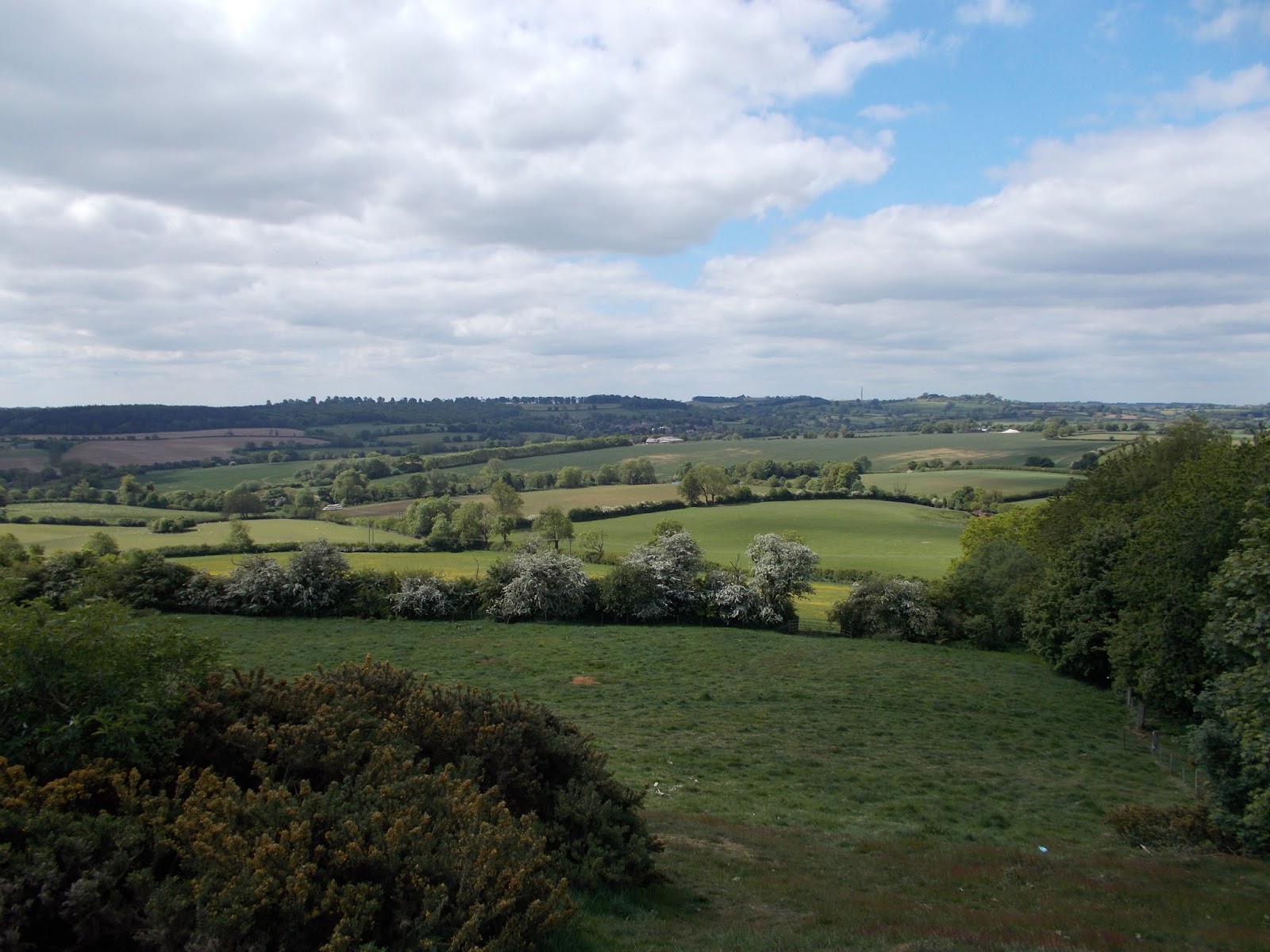
It was back to Foxhill Farm today taking advantage of fine weather. At the eastern edge of the farm stands Newnham Windmill and a little beyond there are interesting woodlands and steep furze-clad slopes. The scenery is wonderful.

Looking east from near Newnham windmill.
15 May, 2020
To the west the views take in Warwickshire and north Oxfordshire and it is a scene which I suspect hasn't changed dramatically for a century or more.

The gorse still bore a few flowers but had mostly gone to seed and was presenting a dull, scruffy brownish appearance. I paid little attention to it although I knew it would be harbouring countless beetles and spiders.
Gorse had passed its main flowering season although blossoms
will appear throughout the year. 15 May, 2020


Instead I turned my attention to a brightly coloured relative. As kids the Bird's Foot Trefoil, Lotus corniculatus, was always known to us as Eggs and Bacon. I spent a few minutes with it because I see it less often nowadays although it remains generally common.
It is easy to see why Bird's-foot Trefoil earned the local name of
 Eggs and Bacon. Foxhill Farm, 15 May, 2020


It has an abundance of local names and Geoffrey Grigson in his Dictionary of English Plant Names lists over 70, including Fingers and Thumbs, Granny's Toenails, Cuckoo's Stocking and Dutchman's Clogs. To John Clare it was the Lamb-toe and he wrote:

                   
                                   The yellow Lamb-toe I have often got
                                   Sweet creeping o'er the banks in summer time.

                                                                                   Clare's Village Minstrel, 1821

It is technically poisonous although the active ingredient, hydrogen  cyanide, is only present in very low quantities. It is the food-plant of the Six-spot Burnet Moth, Zygaena filipendulae. This insect, when a caterpillar, extracts the cyanide from the plant and stores it in its body, retaining it when it emerges as the imago. It warns would-be predators of its unpalatability with striking coloration, a dodge known as aposematism.


The imago of the Six-spot Burnet Moth wears warning colours.
Photo courtesy of Naturespot
A closer view of the flowers shows that they are pea-like, making it a member of the Fabaceae family. They produce enough nectar to make them valuable to bumblebees although, worryingly, I saw none feeding.

The egg-yolk flowers are favourites with bumblebees.
Foxhill Farm, 15 May, 2020
The plant pops up in our garden from time to time, posing the question: have the seeds been lying dormant since the houses were built, some 35 years ago? It never becomes a weed and I welcome these occasional plants. Incidentally the word corniculatus means 'horn-shaped'. Does it refer to the pod or the flower? I have no idea.


And of course, it has nothing to do with the 'lotus eaters' mentioned by Homer in the Odyssey.


Thursday, 14 May 2020

A galling experience

Cecidologists love oak trees. They bear galls on their leaves, their twigs, the catkins, acorns and their acorn cups; they even bear galls on their roots and trunks.


In Stefen Hill Pocket Park there are only, as far as I know, three oak trees and two of those are Turkey Oaks, Quercus cerris. Nevertheless I did pay close attention to the one Pedunculate oak, Quercus robur, on my visit earlier today.


A pale, rather globular swelling at the leaf base was the work of a wasp, Andricus curvator. Although I was pleased to see it I had recorded it last year from, I suspect, the same tree.


A true gall, caused by Andricus curvator, a cynipid wasp.
Stefen Hill Pocket Park. 14 May, 2020
A quite different species was responsible for a gall-like blister mine on the same tree. This was caused by a moth, Dyseriocrania subpurpurella. It has been given the 'common name' of Purple Blister Moth although, as I have said before, it is unlikely that lepidopterists actually use this name. Pleasingly, this was a new record for the park. This blister is not a true gall as it did not involve the production of any new material or thickening of the plant tissues.


A blister mine, the work of the Purple Blister Moth.
14 May, 2020
Yellow is currently the colour most obvious in the pocket park. I have already mentioned the Yellow Flags in the pond so will say no more about them.

Yellow Flags, Iris pseudacorus. Stefen Hill Pocket Park. 14 May, 2020
Another yellow flower doing well at the moment is Wood Avens, Geum urbanum. Close up the flowers of this member of the rose family are quite attractive but this can be a pestilential weed, hated by gardeners, allotment holders and the like.

The rather small flowers of Wood Avens
Stefen Hill Pocket Park. 14 May, 2020
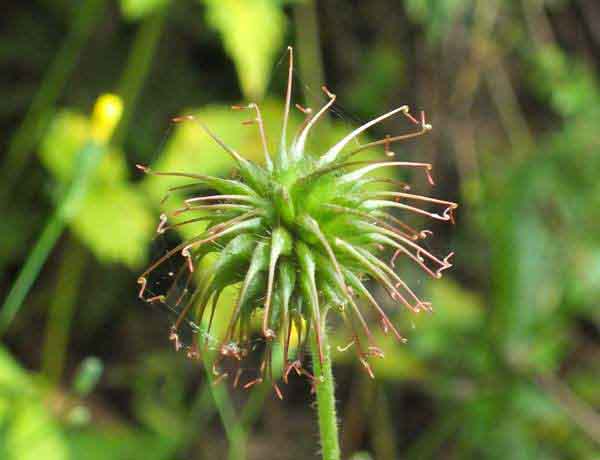
It has bristly fruits which cling to animal fur, trousers and woollen spats (although the latter are now sadly rare). By this means they are spread hither and thither. The roots of this plant were once to used to give a clove-like flavour to ale.
The hooked bristles of the Wood Avens fruit.

Buttercups are coming to their peak with Meadow Buttercup, Ranunculus acris, to the fore. Although there are several ways of distinguishing this species from Creeping Buttercup, Ranunculus repens, the leaves are generally sufficient for recognition.


The Meadow Buttercup is common in Stefen Hill Pocket Park.
14 May, 2020
Those of Meadow Buttercup are finely divided and generally distinctive, even if the flowers are not present.

The leaves of the Meadow Buttercup are distinctive.
Stefen Hill Pocket Park. 14 May, 2020
On the other hand the leaves of Creeping Buttercup are softly hairy and divided into three more obvious lobes, frequently with pale markings.
 

Although faint in this picture, the leaves of Creeping Buttercup frequently
carry pale markings. Stefen Hill Pocket Park. 14 May, 2020
The Bulbous Buttercup, Ranunculus bulbosus, is very common and is likely to be present in the pocket park, but I have not yet noted it.

All buttercups in Britain are poisonous due to presence of an alkaloid, ranunculin. The name Ranunculus acris reminds us that the plants have an acrid, burning taste, so they are unlikely to be eaten by humans. However, buttercups can be abundant in pastures so consumption by livestock may be unavoidable. Fortunately the drying process involved in hay-making renders the poisons more or less harmless.

Celandines are common in the pocket park. They were once called Ranunculus ficaria but are now separated and referred to as Ficaria verna.

The word ranunculus means 'little frog' and I have yet to hear a satisfactory explanation as to why it is applied to these colourful and unappreciated plants.


Finally, I swept up a caterpillar from long grass. Butterflies and moths aren't my thing but I eventually identified it.


The Timothy Tortrix is a very widespread moth, found as far east as China.
Stefen Hill Pocket Park. 14 May, 2020
It was a Timothy Tortrix, Zelotherses paleana. It feeds on grasses including Timothy Grass, but is found on other plants too. New for the pocket park.


Tuesday, 12 May 2020

Stefen Hill Miscellany

What with rain and other distractions I have seriously neglected Stefen Hill Pocket Park. In fact it must be all of four days since I was last there! Today was cooler than on my last  visit but it was dry and sunny, so I went for it.


As the days slip by galls are developing on various plants, especially trees. I recently mentioned Aceria nalepai on alder leaves and this has now been joined by Eriophyes laevis. This is a tentative identification as I have not examined the actual mites but is 99%likely to be correct.


Alder leaves were galled by a mite, Eriophyes laevis.
Stefen Hill Pocket Park, 12 May, 2020
On a nearby Field Maple another rash of galls was present. They were the work of Aceria myriadeum, another mite - not very exciting.

And on Field Maple another mite, Aceria myriadeum, was inducing galls.
Stefen Hill Pocket Park. 12 May, 2020
Far more interesting was a Wasp Beetle, Clytus arietis. Although common and obviously eye-catching it was a new record for the pocket park.  It sat quietly in my net before I returned it to the bramble bush where it had been before I rudely disturbed it.

The Wasp Beetle is striking and common, and yet can easily be
overlooked. Stefen Hill Pocket Park. 12 May, 2020

This beetle is often seen in full view in a leaf, making no attempt to conceal itself. The bold, wasp-like coloration apparently makes it safe from would-be predators.

Only a few feet away, also on bramble foliage, was a Large Red Damselfly, Pyrrhosoma nymphula. When I examined the area with more care I saw three other specimens and I had also seen one a few days before on meadowland adjacent to Christchurch Drive.

This Large Red Damselfly was only one of several present.
Stefen Hill Pocket Park. 12 May, 2020
All this was very encouraging because this species seems to be in decline right across Britain, perhaps because of ponds being drained and agricultural intensification in general.

The pond is being choked by Yellow Iris, Iris pseudacorus.

The park's one pond is in danger of being choked.

It is a beautiful plant but is very robust and some kind of clearance work will soon be required. In some parts Britain it is known as Jacob's Sword and elsewhere is called Segg. This latter is surely a variation on the word sedge. This plant may also  be the origin of the heraldic Fleur de Lys.


The culprit is the Yellow Flag Iris. Stefen Hill Pocket Park.
12 May, 2020
The Pocket park list is steadily growing and could reach 350 species by the end of the month.