Monday, 11 May 2020

Kentle Wood: umpteenth visit (with addendum)

A blazingly hot day yesterday (9 May) with a high phew! factor. I risked sunstroke and took a walk around Kentle Wood. Although I have called it visit number umpteen I haven't been there for quite a long time.


The approach to Kentle Wood, beyond Daventry Recycling Centre is certainly not scenic and yet can be full of interest. Several plants of Common Vetch, Vicia sativa, provided a splash of colour.
Common Vetch was common on the approach to Kentle Wood.
9 May, 2020


As I approached the entrance I saw my first hogweed of the year - or at least the first one in flower. The umbels of this plant, Heracleum sphondylium, are immensely attractive to a wide range of insects so I'll be keeping an eye on developments.


Hogweed is just coming into bloom. Near Kentle Wood. 9 May, 2020
A Kentish Snail, Monacha cantiana, clung to the stem of a stinging nettle, patiently awaiting the evening dew or, better still, a shower of rain. It may not have long to wait: the forecast is ominous! I brought it home for a better picture - but this species always has a chalky,washed-out appearance.


Stinging nettles are extremely nutritious (nettle soup anyone?) and, like the Kentish Snail, a number of creatures have developed ways of avoiding being stung and are thus able to benefit - nibbling, galling and mining the leaves and stems.


The gates were locked. Surely a reaction to the Covid19 virus and yet to lock them seems a strange decision. Anyway, risking severe injury to my fundamentals I climbed the gate. The main ride stretched before me.
An inviting walk leads into the woods.


Immediately beyond the gate a young oak tree (almost all the trees are in fact young) was hosting literally hundreds of bugs, all of the same species. It was once again Harpocera thoracica, the same species which had been present in 'Meadow X' a few days before. So abundant were they today that they crawled over my arms and shirt.

Harpocera thoracica posed awkwardly on my wrist, making a 
photograph tricky. Kentle Wood, Daventry. 9 May, 2020
Many other people had straddled the gate to enter and yet they were easily avoided on the broad tracks. Red Campions were present in small numbers. They will readily hybridise with White Campions to produce a taxon with pink flowers and these were decidedly pale. However I know of no white campions in the Daventry area so I doubt they were hybrids.

The Red Campions were very pale.
An abundance of insects were present and I was kept too busy securing specimens to use my camera. I paused to photograph a large crane fly. With its green eyes and streaky wings it was easily recognisable as Tipula vernalis. This is very frequent at this time of the year.


The cranefly, Tipula vernalis, at Kentle Wood. It occurs widely
around Daventry. 9 May, 2020
The only other insect I photographed was a male St Mark's Fly, Bibio marci. I expected to see quite a few in flight but was a week or so too late (St Mark's Day was 25 April) and all I found were the corpses of several males. I suspect that as adults the males feed very little, if at all, but are simply looking for an opportunity to mate. Having done that they die, their life-cycle complete.
The shrivelled corpse of  a St Mark's Fly, one of several on leaves.
Kentle Wood, Daventry. 9 May, 2020


It was mega-hot by 1300 hours and it was time to beat a retreat. I got in the car and drove home listening to a CD of Fearful Symmetries by John Adams. No one uses saxophones like John. Brilliant!


Addendum


I gathered a few insect specimens for closer examination later. New additions pushed the number of insects, etc. recorded up to 546. A specimen of the tachinid fly Phorocera obscura was present and appears to be the first record for Northamptonshire.


Saturday, 9 May 2020

Laburnums

I have always fancied growing a laburnum tree but have restrained myself, not because it is poisonous in all its parts, but in my small garden I just can't spare the space.


A fine tree stands in Bodleian Close and as I paused to take a photograph earlier today I could hear the humming of bees.


A fine specimen of Laburnum anagroides in Bodleian Close.
8 May, 2020
If ever the tree is cut down the valuable timber would readily be employed by someone doing fine wood turning or marquetry.


The genus contains only two species and both are native to Europe. The so-called Scotch Laburnum (Laburnum alpinum) grows wild in south central Europe but rarely self-sows. The other European species, and the one photographed above, is L. anagroides; it occurs wild in roughly the same region. It is far more commonly seen in gardens and frequently self-sows on to waste ground, railway banks and so on. For some puzzling reason it seems to have been widely planted in the west of Wales


The flowers show clearly that laburnum is a member of the
pea family, Fabaceae.
There can be little argument regarding the tree's beauty and this led to laburnums being extensively planted in, for example, school grounds. The poisonous properties of the plant are down to the presence of an alkaloid, cytisine, and it is particularly concentrated in the seed pods. It is hard to imagine kids going round munching these but they do look like tiny peas and during the 1970's there were estimated to be 3000 hospital admissions a year due to their ingestion. Fortunately in most cases the children's stomachs were pumped before too much harm was done. But this led to a mini-panic and many trees were removed.

Should we have been so worried? Lupins also contain various alkaloids and again it is the pods and seeds that contain the highest concentrations. Lupins could potentially be a valuable fodder crop but they are toxic to many animals. Fortunately there are a number of lupin species and strains which are harmless and their use of fodder is on the increase. Foxglove are potentially dangerous too although it must be admitted that their unpleasant flavour would quickly repel a would-be eater.


Insects of course are happy with laburnum. I have - just once - found the Gorse Shieldbug, Piezodorus lituratus, on laburnum, although I find it regularly on gorse in the Daventry area. 
The Gorse Shieldbug is one of our largest shieldbugs.


Ah, if only I had a larger garden...


Laburnums at Bodnant.


Friday, 8 May 2020

Lions' Teeth

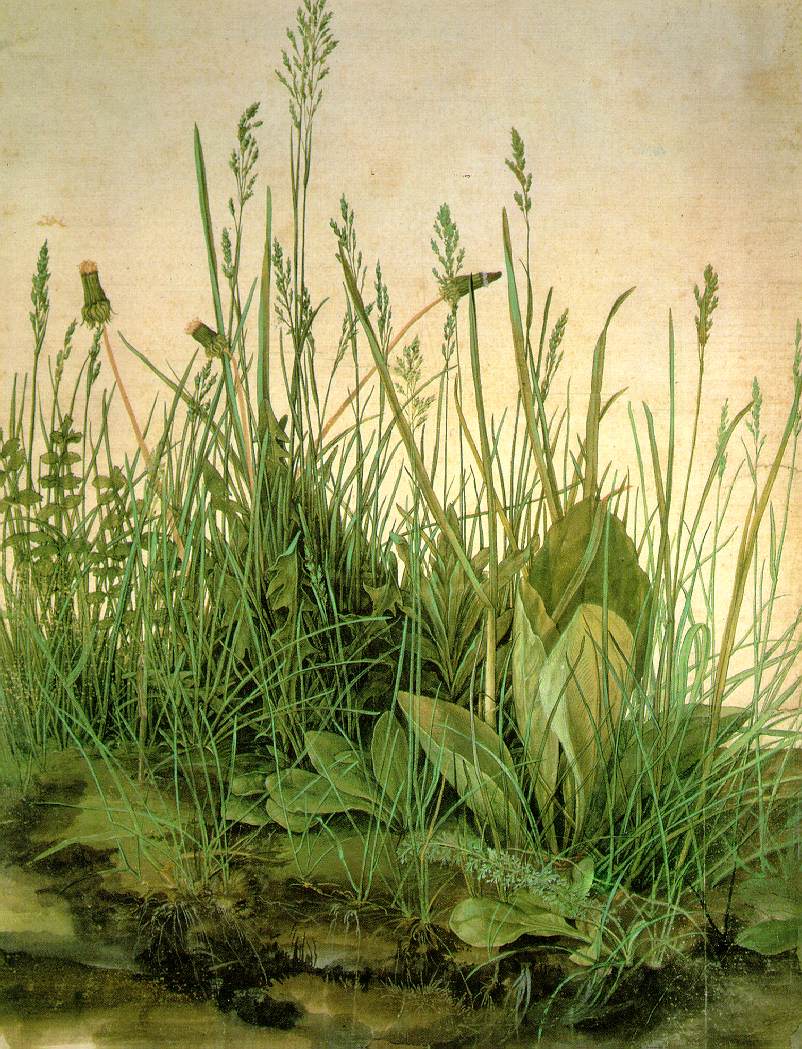
Buttercups and daisies are very much connected with childhood. Only a few days ago I saw a mother patiently teaching her child how to make a daisy chain and quite recently I have seen kids using buttercups to see who likes butter. But dandelions, though familiar to everyone, are rather less connected to these innocent customs. Except of course, as a foolproof way of telling the time by blowing the 'chimney sweeps' formed by the fruiting heads. (The closed heads feature prominently in Albrecht Durer's beautifully observed painting, 'A large tuft of herbs', dating from 1503.)
Durer's famous painting, showing dandelion heads in
the background


The word dandelion comes, as most people know, from the French dent de lion - lions' tooth, but the jagged leaves look nothing like any lion's teeth I have seen.


The jagged leaves of a dandelion. Christchurch Drive, Daventry.
8 May, 2020
The flowers are currently at their peak, but occasional flowers will bloom almost throughout the year.  As I child I would pick bunches and get told off by my mum. 'You'll wet the bed!' she would exclaim. Dandelions are indeed a diuretic and another French name for the plant is Pis-en-lit. I hardly need to elaborate.


Regarding names, the Latin name for the dandelion is Taraxacum officinale. The specific epithet 'officinale' crops up again and again in familiar herbs for it simply means 'of shops' or 'of apothecaries'. 'Taraxacum' is more of a problem but it apparently derives from the Persian, and refers to some sort of bitter herb.


Bitter or not, the leaves of dandelions have been used for centuries as a salad herb, although the plant is usually blanched to remove some of the bitterness. The thick roots, dried, roasted and ground, have been used as a substitute for coffee and the milky latex has been investigated as a source of rubber. Only last year a German tyre-manufacturer stated that production was soon to begin using rubber from dandelions for bicycle tyres. It helps that dandelions are very variable and they have been divided up into 'microspecies, with 46 of these recorded from Northamptonshire and about 240 microspecies in Britain as a whole.


And then there is dandelion wine...


A helpful picture for those people who have never seen a dandelion!
Stefen Hill Pocket Park, 8 May, 2020.
Poets have, for centuries, waxed lyrical over violets, daffodils, roses, daisies and so on, but few have given much space for the dandelion. Thank goodness for Northamptonshire's own poet, John Clare.


                         And Dandelions like to suns will bloom
                         Aside some bank or hillock low.  - Clare's Village Minstrel 1821


And again


                         There the dandelion's flowers
                         Gilt with dew, like suns, with showers.  Clare's Cowper Green


Perhaps were should accord the humble dandelion more respect. And incidentally, if you fancy growing something unusual, there is Taraxacum carneocoloratum, with purple-pink flowers. Now there's a thought!
Dandelion 'chimney sweep' with Lady's Smock alongside.
Stefen Hill Pocket Park. 8 Maay, 2020


Thursday, 7 May 2020

Meadow X

Not far from our house, between Christchurch Drive and the A45 Daventry by-pass is a lovely stretch of land consisting of woodland and meadow. Although the meadow contains little out of the ordinary the wooded area includes field maple, ash, oak, beech, sycamore and cherry.


Looking north across 'Meadow X'. Daventry. 7 May, 2020
Most of these trees have doubtless been planted but they are maturing nicely and include many features of interest. In these 'lockdown days' the A45 is rather quiet but normally carries a great deal of heavy traffic, so these trees provide a valuable baffle against the noise.

The catkins on oaks are now withering. Meadow X, Christchurch Road,
Daventry. 7 May, 2020
The oaks are inevitably of wildlife value although some of them are the less useful Turkey Oak, Quercus cerris. The catkins of the oaks have now withered, their task complete, but here and there they bear currant-like galls. These are work of a tiny wasp, Neuroterus quercusbaccarum. It has two generations, with the alternating generation producing galls of a quite different kind.


Oak Currant Galls can be abundant in some years.
Meadow X, Christchurch Road, Daventry. 7 May, 2020
Another wasp species is responsible for a familiar gall noted today, again on oak. This is the classic oak apple, and the wasp involved is Biorhiza pallida. It often has a rather lumpy structure and may be almost golf ball size.


Not exactly a pretty sight. An oak apple at the edge of Meadow X.
7 May, 2020

Leaves on the beech trees were also galled but in a far less obvious way. The galled leaf edges have a neat little rim, easily overlooked. These have been caused by a quite different creature, a mite called Acalitus stenapsis.

A neat little rim on beech leaves is the work of a mite, Aculitis stenapsis.
Woodland at edge of Christchurch Drive, Daventry. 7 May, 2020

Back to the oaks. Running over the withering catkins were many specimens of a bug (a true bug, that is) called Harpocera thoracica. It is very common but they are short-lived in the adult stage so, unless I remember to look for them at this time of the year, I do not often see them. They are about 5-6 mm long.
Harpocera thoracica seems to be found only on oak. Meadow X,
Daventry. 7 May, 2020


I passed my sweep net over some hawthorns and once again caught a specimen of the bright red weevil, Rhynchites aequatus. Its natural home seems to be on hawthorns but, as I have written in a previous blog, it is partial to apple, boring into the flesh with its long rostrum - much to the annoyance of orchardists. It is, in fact, known as the Apple Fruit Weevil.


Rhynchites aequatus is very common on hawthorn at this time of the year.
Meadow X., Daventry. 7 May, 2020

Wandering back towards my home I was pleased to see a damsel fly on a plant of Wood Avens. It is called, quite reasonably, the Large Red Damselfly, Pyrrhosoma nymphula, (pyrrhosoma translates as 'red bodied') and, as far as I know, is the only red damselfly found in Northamptonshire. Although these insects need water to breed they are, as in this case, often found at some distance from an obvious lake or river.

Large Red Damselfly on Wood Avens, Geum urbanum.
7 May, 2020
There were many small flies out enjoying the warm sunshine and I'll be busy at my microscope for a few hours identifying them. (Well, as I've said before, someone has to do it.)


Wednesday, 6 May 2020

Oak Leaf Roller

Visiting Foxhill Farm I had a surprise as soon as I walked through the gate. A fairly large oak tree guards the entrance and I made a check for galls. I found none but instead noticed a neatly rolled leaf. I was both pleased and mildly alarmed: pleased that the insect responsible was new to the farm but worried because an infestation of these caterpillars can defoliate an oak tree. The caterpillars I refer to are those of the Green Tortrix Moth, Tortrix viridiana.


Rolled up leaves on an oak tree betrayed the presence of  the
Oak Tortrix Moth. Foxhill Farm, Badby. 5 May, 2020
A number of insects can create leaf rolls of one sort or another but these are very distinctive.

The genus gives its name to the Tortricidae family, of which some 400 species are, or have been, found in Britain.


Beneath the tree Red Campion, Silene dioica, was flowering exuberantly. It does very well in this part of Northamptonshire but White Campion is far less common hereabouts, being commoner in the east of the county. The generic name is a reference to the woodland god Silenius. According to folklore he was important to fairies, as he gave protection to their honey stores. What he got in return no one knows.


Red Campion was flowering well in places where nibbling sheep
fail to reach. Foxhill Farm, Badby. 5 May, 2020


I spent most of my time working my way along the hedgerows but did delve into a few grass tussocks. A crab spider, Xysticus cristatus, was frequent in this habitat.

This female Xysticus cristatus was found in a grassy tussock.
Foxhill Farm, Badby. 5 May, 2020


The warm sunshine was encouraging lots of flies to bask on convenient surfaces with a blowfly, Calliphora vicina, being especially common.

Specimens of Calliphora vicina gathered in sunny positions.
Foxhill Farm, Badby. 5 May, 2020
The visit was a particularly productive one with the arthropod total for the farm now exceeding 510.


Tuesday, 5 May 2020

Dawdling


Now I'm not one to boast and people who know me well often remark on the fact. 'He has a lot to be modest about,' people often say. I am for example, modest about my dawdling. I had been tipped to represent Team GB in the dawdling event in Tokyo his year but Covid-19 means my chance has now gone.


Having said that, I did an hour's dawdling in our local pocket park today and in fact I earned bonus marks for the most boring observations of 2020.


One observation was of interest to me (but not to anyone else). There is a hedgerow of hawthorn bushes adjacent to the park's only pond, consisting almost entirely of Common Hawthorn, Crataegus monogyna, but with a single specimen of the Midland Hawthorn, Crataegus laevigata. As I have mentioned before, blossoms of the former have a pleasant enough scent but C. laevigata smells of stale fish. Whether it was a one-off atypical observation I'm not sure but the latter was attracting numerous greenbottle flies to its flowers but I saw none on the Common Hawthorn. Is this the function of the rank odour?


A greenbottle, probably a species of Eudasyphora, delves into a flower
of Midland Hawthorn, perhaps attracted by the smell of stale fish.
Stefen Hill Pocket Park, 4 May, 2020


I was recently discussing the Horse Chestnut in one of my blogs, but I failed to mention the park's other 'species', the Red Horse Chestnut, Aesculus x carnea. Rather than being a true species it is a hybrid with the common Horse Chestnut and a North American Red Buckeye, Aesculus pavia, as parents.
The appearance of Aesculus x carnea is distinctive.
Stefen Hill Pocket Park, 4 May, 2020
It is a lovely sight and, although it is attacked by the Horse Chestnut Leaf Miner, it seems rather less ravaged than the common species. I have never found viable 'conkers' inside the smooth casing.
The flowers are spectacular.

Incidentally Aesculus pavia is rarely seen although it is an attractive species in its own right.
Aesculus pavia is a relatively small species from North America.


A specimen of Prunus was bearing unusual 'fruits'. The shrub is probably Bird Cherry, Prunus padi, in which case the swollen, misshaped fruits have been attacked by the fungus Taphrina padi. This is the first time I have met this fungus.


What else? Well, not a lot really. The leaves of alder trees had, here and there, been attacked by a mite, Aceria nalepai, the resultant galls appearing as a series of symmetrical swellings down the midrib. It was not new for the park.


The park is much used but even so there are still secluded spots where wildlife can flourish.
There are small glades where wildlife can flourish.
Stefen Hill Pocket Park, 4 May, 2020
Only one species added to the park list today - the Birch Catkin Bug, Kleidocerys resedae - but I am optimistic regarding the nest five months.


Sunday, 3 May 2020

Encroachment

The glorious spell of warm dry weather has come to a halt, bringing showers and cooler conditions. There were compensations...


A particularly fine rainbow made a complete arch across the welkin.
Stefen Hill, Daventry. 1 May, 2020
Although the pocket park at Stefen Hill is surrounded by housing there is, by and large, a clear barrier of some kind between the gardens of the houses and the park itself. There is fencing, there are broad paths and there are thick hedgerows and as a consequence few garden plants find a toehold in the park.


But inevitably there are one or two plants that make, or are in the process of making, the jump - a leap for freedom.


I'll start with Eleagnus x submacrophylla (formerly known as E x ebbingei) although it has been deliberately planted as a barrier and as such forms a hedge with silvery, evergreen leaves. I'll have to wait until the autumn for the fragrant flowers to arrive. Commonly known as Oleaster or, less commonly, Russian olive, it is related to our native Sea Buckthorn. Given the opportunity it will produce reddish oval fruits which, it is claimed, become pleasantly flavoured when ripe. I photographed some last autumn in Byfield.


I photographed Eleagnus x submacrophylla in Byfield last year. It forms
a hedge adjacent to the village hall.
A genuine encroacher is the California Poppy, Escholtzia californica. It is found in California and adjacent states and also in Mexico. It was once grown only as an annual in Britain but is technically a perennial and increasingly survives the mild winters of recent years. However, it is self-incompatible, so that pollen will need to be received from another plant before its ovules and seeds can develop.
 
Californian Poppies are finding a toehold at the edge of Stefen Hill
Pocket Park. 3 May, 2020


It was another dull, rainy day when I attempted to photograph the flowers. Understandably they were reluctant to fully open.


Occasionally a weed can also make the leap from a garden into the pocket park. One example is Cornsalad, Valerianella locusta. It is quite a pretty plant but to appreciate this it is necessary to go on hands and knees for a close look. At a quick glance it can be mistaken for a forget-me-not.


Corn Salad at the edge of Stefen Hill Pocket Park.
29 April, 2020
I suspect Corn Salad will find it difficult to make its presence permanent for it needs patches of bare soil in order to flourish; these are not common in in the park. On the other hand the seeds can probably stay dormant for several years: they play a waiting game and will germinate when conditions are right. In Byfield several plants grow at the base of walls opposite the village school.


There are inevitably plants which make the reverse movement, winding up in gardens having stared in the pocket park. One example is Wild Cherry, Prunus avium. Some gardens bordering the park have cherry saplings popping up in borders and flower beds. Even when not in flower these plants are easy to spot for there are usually some glands on the leaf petiole, i.e. the leaf stalk. There are usually two but in the case shown there are three.


Glands on cherry leaves. Garden alongside Stefen Hill Pocket Park.
3 May, 2020
These glands secrete nectar (they are known as extra-floral nectaries) and in so doing they attract ants. It is possible that in searching for these glands the ants chance upon caterpillars and carry them away. If so then the arrangement is clearly of benefit to both ant and tree.