Monday, 3 February 2020

Vernal signs

The approaching spring was increasingly evident on my visit to Byfield Pocket Park earlier today. Conditions were dry and sunny with the thermometer reading 9 degrees but conditions were deceptive as a strong wind sought any weakness in clothing. So although crocuses and narcissi were flaunting their flowers I saw none receive visitors.


The narcissi have been present for as long as I can remember and appear to have spread a little.
The clumps of narcissi are small but seem to be spreading.
Byfield Pocket Park, 3 February, 2020

The crocuses are a fairly recent arrival, having probably been planted some two or three years ago but seem well-established beneath an oak tree and they too should gradually multiply.


The colony of croci under a central oak provided a splash of colour.
Byfield Pocket Park, 3 February, 2020
I confess to only taking a glance but I suspect they are Crocus chrysanthus, a native of Turkey and the Balkans. It is sometimes referred to as the Snow Crocus, being a particularly early flowerer. Bees will visit the flowers for pollen but, as I have said, not today.


The 'lambs tail' catkins on the hazel bushes have been out for some time and in some cases were turning brown. I kept an eye open for distorted catkins as they are often an indication of attack by mites, but I found none.
Bright sun made hazel catkins appear almost luminous.
 Byfield Pocket Park, 3 February, 2020


The oak trees proved more interesting with two very obvious galls present. One was  predictably the Oak Marble Gall, caused by a cynipid wasp Andricus kollari. The second was more common but proved a little trickier to spot. It is known as the Ramshorn Gall but in this example the gall looks more like a spring onion in shape. Again it is the work of a cynipid wasp, Andricus aries and occurs only on oak.


The Ramshorn Gall often has curved 'horns' but not in this case.
Byfield Pocket Park, 3 February, 2020


I had decided not to take any collecting equipment with me. This decision was logical as I had several other things to carry but it became frustrating as I exposed several interesting beetles when lifting loose bark on sycamore trees.

-------------------------------

So, here I am, two days later. Chris is visiting her friend Julie Ferguson and I, properly equipped, am hoping to pick up where I left off. The sycamore trees had not run away and this time I am armed with my trusty pooter  Within five minutes I had successfully secured a beetle specimen from beneath bark.

It proved to be Calodromius spilotus. The name is derived from the Greek kalos, beautiful, dromas, a runner and spilos, a spot. This rather common species, like those of its close relatives, is distinctly flattened and rather wedge-shaped, allowing it to insinuate itself beneath close-fitting bark.

Specimens of Caladromius spilotus were very common beneath loose bark.
Byfield, Northants, 5 February, 2020
Several other insects turned up including a Hawthorn Shieldbug and, on the tree trunk, a Green Shieldbug, Palomena prasina.
Removing loose bark also revealed a Hawthorn Shieldbug.
Byfield, 5 February, 2020

Despite its common name the Green Shieldbug was a dull brown. It will retain this colour until winter is over and will then turn green and so be inconspicuous against foliage.
A Green Shieldbug was still in its brown winter colours.
Byfield, Northants, 5 February, 2020


With a Winter Gnat, a mirid bug and a tiny beetle yet to be properly identified I was well pleased with my morning's efforts - but by heck it was cold!
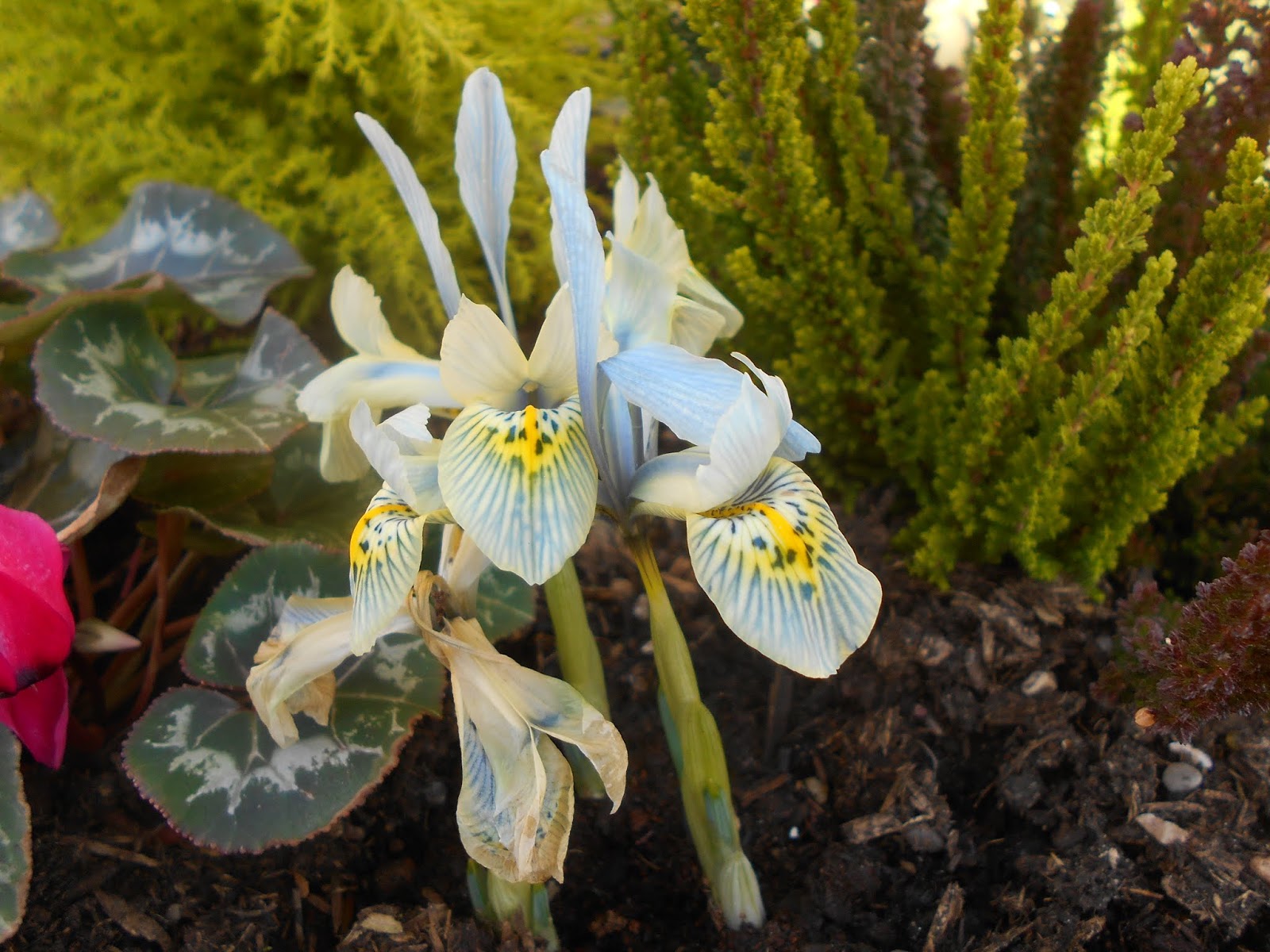
A group of Iris reticulata which I believe to be the form known as
'Eye Catcher' aroused feelings of envy when I spotted it in a Byfield garden.
5 February, 2020


Thursday, 30 January 2020

More mines

My recent blogs have all included a whinge about January and the paucity of wildlife. But of course, if conditions are mild - as they currently are - there are things to be seen. Nothing dramatic but nevertheless of interest, if tiny creepy-crawlies turn you on.


A stroll around Stefen Hill Pocket Park, camera in hand, was not particularly exciting but there were two or three surprises.


Plants of Wood Avens, aka Herb Bennet, Geum urbanum, bore the mines of the Golden Pigmy Moth, Stigmella aurella. In a way this was a disappointment because I had recorded this very common species only yesterday, in Byfield. There it was on bramble, but of course Geum and brambles are fairly closely related, both being in the Rose Family, Rosaceae.  Incidentally Herb Bennet is a corruption of the words Herba Benedicta, or the Blessed Herb.


Herb Bennet bearing a mine of the Golden Pigmy Moth. Stefen Hill
Pocket Park. 30 January, 2020
On the same plant, just a few inches away, a gall was present. It was caused by a mite, Cecidophyes nudus. Now I am forced to admit that, compared with the animals to be seen on the plains of Serengeti, it was not wildly exciting. But it was a new record for the pocket park so I was content.


The gall of  a mite, Cecidophyes nudus, on Herb Bennet. Srefen Hill
Pocket Park. 30 January,2020

Leyland Cypress, x Cuprocyparis leylandii, is notorious for provoking quarrels between neighbours, and it is generally pretty useless for wildlife, but it did have a surprise for me today. A dicoloured shoot looked suspicious so I took it home for closer inspection and found that a moth larva was present. It was a Triple-barred Argent Moth, Argyresthia trifasciata. This tiny but rather attractive moth was not recorded in Britain until 1982, when a specimen was taken in London but is now quite common in gardens. Of course it was new to the pocket park.


The much-maligned Leyland Cypress nevertheless provided a home
for a Juniper Ermine Moth, causing discoloured tips to the
branches. Stefen Hill Pocket Park, 30 January, 2020
I found little else to set my heart a-flutter. Yes, the Firethorn Leaf Miner, Phyllonorycter leucographella had left evidence of its presence on its eponymous host, but it is another extremely common micro-moth of no great significance.

Damage caused by the larva of the Firethorn Leaf Miner.
Stefen Hill Pocket Park, 30 January, 2020
I had a little surprise as I left the park. A salt-grit box stands at the entrance and I paused, not because I was enchanted by its beauty but because these boxes are often home to interesting spiders (no, I don't know why).

It may be a grit box to you...
I lifted the lid and found, not a spider but a Hawthorn Shieldbug, Acanthosoma haemorroidale. It is a very common species but to find one under these circumstances was a surprise.
...but it is a home for this Hawthorn Shieldbug. Stefen Hill
Pocket Park, 30 January, 2020


A pleasing way to end the day!


Wednesday, 29 January 2020

Mosses, mines and Male Ferns

I am not a person who generally suffers from Seasonal Affective Disorder (SAD). Even in the darkest months of the year there is usually something in parks, gardens and hedgerows to pique the interest. But having said that this particularJanuary has dragged on summat rotten.


Today I revisited old haunts and took a stroll around Byfield Pocket Park. An adjacent patch of pasture is technically part of the park although of late it has become a dumping ground for piles of cleared vegetation. But an old willow tree stands in this area. As an example of its species it is unremarkable, but it has developed some interesting features. Obvious are the luxurious patches of moss around the base of the trunk, making it a picturesque sight.


A moss-covered tree trunk is an attractive feature. Byfield
Pocket Park, 29 January, 2020
From a distance I took a guess that it could be Common Feather Moss, Eurhynchium praelongum. Certainly a tree trunk is a very typical site for this common species. I took a sample and quickly realised I was quite wrong and a closer inspection showed that it was Hypnum andoi.

It proved to be Hypnum andoi, and formed a lovely cushion.


This very common moss is known as Mamillate Plait-moss and its preferred habitat is indeed on wood.


Elsewhere bramble leaves had been mined by the Golden Pigmy Moth, Stigmella aurella. This is by far the most frequently encountered species within an aggregate of very similar species.


Stigmella aurella is an exceedingly common sight on bramble leaves.
Byfield Pocket Park, 29 January, 2020
Specimens of the Male Fern, Dryopteris filis-mas, are common in the wooded areas of the pocket park and I examined them closely (and without luck) for galls and leaf mines.

The Male Fern is a common species in Byfield Pocket park.
29 January, 2020
This fern is identified by the sori (reproductive organs) on the back of the fronds which are generally in clusters of about four to six. (Incidentally there is a species known as the Lady Fern, Athyrium filis-femina which is not quite as common in the county)

Sori on the back of Male Fern fronds.
I have had more exciting and productive visits to the site but I was cheered by noticing, just as I was leaving, that clumps of daffodils are close to flowering. They aren't great for attracting wildlife but they were good to see.

The daffodils are close to flowering! Byfield Pocket Park.
29 January, 2020
Spring is on the way!


Monday, 27 January 2020

Return to Delapre Abbey

Chris had a meeting in Northampton today so I travelled with her and resolved to pay a visit to Delapre Abbey.


I didn't need telling that a visit in late January was likely to be rather fruitless but I decided to give it a go regardless. In the event I had a mild surprise before I even reached my destination.


Travelling down the London Road towards the town I passed a line of fastigiate trees which, from a distance I took to be Lombardy poplars, but as I drove by I saw that oak-like leaves were clinging to the lower branches. I pulled over for a closer look.


A row of fastigiate oaks lines London Road, Northampton
Sure enough, the trees - about ten in all - bore typical oak leaves and I believe they were specimens of Quercus robur 'Fastigiata'. I have never regarded Northampton as a very imaginative local authority but I confess I was impressed for, although I know they are occasionally employed as street trees elsewhere, it was a surprise to find them in Northampton. Its neglected roads may make it a contender for the title of pot-hole champion of Britain but they've got something right.

The fairly typical oak foliage was, against the odds, clinging to the lower
branches. I assume the trees to be Quercus robur 'Fastigiata'
 27 January, 2020
Anyway, on to the abbey. It has, in recent years, received extensive restoration work but I had no intention of going inside whilst the sun was shining. (Incidentally Northampton once had another abbey, rather unimaginatively known as Northampton Abbey, and its remains are now buried beneath housing at Abbots Way.) Delapre Abbey as it stands incorporates some remains of a former monastery, the Abbey of St Mary de la Pre.

Delapre Abbey.The buildings, once sadly dilapidated, have been greatly
smartened up. 27 January, 2020

Anyway, enough of history, I was intent in looking at the walled garden to the rear of the buildings. The scene was one of desolation. I suspect the upkeep of the grounds relies to a considerable extent on voluntary labour so it is unfair to be over-critical but the area had a very uncared-for look. Not a single plant was named and the glasshouses (former orangeries?) were full of little more than rubbish.

A few Bergenias bloomed near the front entrance to the garden. Now the saxifrage family, to which the genus belongs, contains some lovely plants and I cultivate some, including Saxifraga oppositifolia, but I can find little to enthuse about regarding Bergenias. Their principal merit seems to be hardiness - they hail from Siberia.

The rose-pink flowers of Bergenia cordifolia are quite attractive...
Individually the flowers are rather attractive but the foliage, which gives the plants the common name of Elephants' Ears, is to my eyes ugly in the extreme.


… but the ugly foliage detracts from any beauty the plant holds.
Delapre Abbey, 27 January, 2020


Outside the walled garden the ground was very wet. clumps of bedraggled snowdrops scarcely lifted the spirits and a few hellebores, Helleborus argutifolius (otherwise known as H. corsicus), hardly added colour to the scene. Added to this was the disappearance of the sun. Grey day!

Helleborus argutifolius, sometime called the Holly-leaved Hellebore, is
hardly a colourful plant. Delapre Abbey grounds, Northampton.
27 January, 2020
It is sad that one of the richest countries in the world cannot find the wherewithal to provide proper funding for not just these building but the surrounds. Incidentally these buildings are set in parkland containing some fine trees. A huge Tulip Tree, Liriodendron tulipifera, draws many people to it when in flower and even in the depths of winter it is arresting.


This Tulip Tree has developed into a huge specimen and may be a couple
of centuries old. Delapre Abbey grounds. 27 January, 2020


If I sound depressed then I have given the wrong impression and walking round this mighty tree lifted my spirits. I was not at all surprised by what I found and departed, off to pick up Chris, in a bright frame of mind.

Friday, 24 January 2020

Careless!

A few days ago - 8 January to be precise - I mentioned in my blog that I found some woodlice under a stone in Byfield Pocket Park.


Any road, a couple of days ago I visited the aforementioned pocket park with a clump of Scots Pine as my target. My plan was a simple one: I intended to gather a few pine cones from beneath the trees and split them open in search of true bugs (Hemiptera) and, with a bit of luck, a false-scorpion.


A clump of Scots Pine stands at one entrance to Byfield Pocket Park.
22 January, 2020
In the event I found neither. All that emerged from the de-scaled cones were a couple of springtails and some very young woodlice. I was disappointed. Making a mental note of the fact that the woodlice were all specimens of the very common Philoscia muscorum I gathered up the debris and scattered it beneath the Garrya at the end of our back garden.

When, I wondered, had I first recorded this woodlouse - known as the Fast Woodlouse - from the pocket park? I checked my records and was surprised to find that I had never recorded any woodlice from Byfield Pocket Park!

With this in mind I re-examined a photograph I had taken on 8 January. Sure enough. It clearly showed Porcellio scaber and Oniscus asellus. So, along with the Philoscia muscorum I was able to add these three crustaceans (woodlice are related to crabs and prawns) to the list for the site. To have failed to record these creatures was very careless. But the site total, even with these additions, is still only a paltry 190. A phrase vividly  remembered from my school reports comes to mind: Tony must try harder!
Oniscus asellus, with pale edges to their rather shiny carapace, surround
 a few darker grey Porcellio scaber.  Byfield Pocket Park,  8 January, 2020
Incidentally, mention of the Garrya - Garrya elliptica to be precise - reminded me that the catkins on this shrub have now reached their maximum length. Out of interest I took a specimen catkin and measured it with my Mickey Mouse ruler: 250 millimetres. Size matters!
The catkins on our Garrya elliptica have now attained a length of
250 millimetres. 24 January, 2020


Wednesday, 22 January 2020

Spurge-laurel again

Virtually every Wednesday finds me in Byfield, but recently I seem to have exhausted the few opportunities it has to offer regarding January wildlife. I decided to visit the extreme north-east of the village, by journeying to The Causeway. Its name may be a corruption of 'Cow's Way' but I cannot confirm this.


I was surprised to find a number of plants in flower or with well-developed flower buds.
The most obvious of these was Winter Jasmine, Jasminum nudiflorum. Being a winter flowering shrub it probably attracts few, if any, insects; certainly I have never seen it receive visitors.


At a time of the year when there is not much colour about Winter Jasmine
is very welcome.  Byfield, 22 January, 2020
Unsurprisingly it appears to produce no fruit and I know of no records of it escaping into the wild. I suppose we take it for granted but it is a lovely thing and it received the coveted A.G.M. (Award of Gardening Merit) in 1923.


Nearby grew Stinking Hellebore, Helleborus foetidus. It was close to flowering and its green, claret-edged tepals* will soon become apparent.
Stinking Hellebore. Not foul-smelling but merely a bit...odd.
Byfield, 22 January, 2020

An alternative name for the plant is Setterwort but I have never heard the name used and it appears to have a north country origin.

The plant I had really come to see was Spurge-laurel, Daphne laureola. I had found it in the area some seven or eight years ago. Would it still be present? In fact I quickly found two robust plants threading their way through hedges in adjacent gardens.

Spurge laurel has evergreen, laurel-like leaves. Byfield, Northants.
22 January, 2010
The flowers of this shrub are hardly colourful, being of a yellow-green shade, and it relies upon its fragrance to attract early-flying moths and bees. I stuck my nose close to the blooms and detected a faint but pleasing scent, one which would be far more obvious to the insects it was courting.

The flowers are not striking but are neat and fragrant. They are followed by
poisonous black berries.

Its status around Byfield is problematic. It is native to those parts of Northamptonshire where lime is present in the soil, but that is not what we have around Byfield. Nor is it a plant which would be carefully propagated and passed from gardener to gardener. I suspect it is a rather uncommon wild plant in western Northants but with bird-sown plants (the juicy black berries seem attractive to birds) sustaining a robust local population. It is also present here and there in Daventry. Overseas it ranges across Europe to the Azores and has been introduced to North America where, in Washington state, it has become a noxious weed.


All-in-all I was pleased with the morning's findings and I may return to examine the spurge-laurel for Dasineura daphnes, a rare fly which causes distortion of the shoot-tips.


* Tepal. A term used when it is unclear whether the organ in question is a petal or a sepal.

Saturday, 18 January 2020

Small Tortoiseshell

Today we woke to a sharp frost, a frost which lingered in sheltered, shady places all day. Yet oddly enough it produced my first butterfly of the year.


It was a Small Tortoiseshell, Aglais urticae. Chris was the first to spot it, flitting up and down on the inside of the bedroom window. (The butterfly was flitting, not Chris). She was all for letting it go free but I didn't give much for its chances outside.


Small Tortoiseshell on the inside of our bedroom window. Stefen Hill,
Daventry. 18 January, 2020
Presumably the insect had been overwintering behind a cupboard or some such structure and I hoped it might spend a few more weeks inside.

Thomas Muffet (1553-1604), whose daughter Patience appears to have been the original Little Miss Muffet, was aware of this habit of spending the winter indoors, observing 'how commonly they (are) found in houses sleeping all the Winter like Serpents and Bears, in windows, in chinks and corners. Where, if the Spider do not chance to light on them, they live till the Spring.' (Reference 1) It is tempting to assume that they once tended to overwinter in hollow trees and so on but I can find little evidence for this.


Numbers of the Small Tortoiseshell seem to dropped off significantly in the 21st Century and one reason may be down to the increasingly common Sturmia bella. This fly belongs to the Tachinidae family. Whenever I net a tachinid fly I am always pleased as they form a fascinating group but unfortunately Sturmia bella lays its eggs on stinging nettles, the main foodplant of the Small Tortoiseshell. In feeding, the caterpillar swallows the egg of the fly which hatches inside the unwitting host and eats it alive.


Tachinids are invariably (?) parasites on creatures as diverse as stick insects, scorpions and centipedes (Reference 2).  They are potentially valuable for the biological control of various pests - but I wish that butterflies were free of them!

A north country name once applied to the Small Tortoiseshell was The King's Drummer. Those drums must now be a little muffled.


References

1. Quoted by Peter Marren in Bugs Britannica, Chatto & Windus, 2010.


1. Belshaw, Robert (1993) Tachinid Flies Royal Entomological Society.