Monday, 21 October 2019

Of mossy things

It was Tennyson who wrote in 1842:


                  In the Spring a young man's fancy lightly turns to thoughts of love...


                                                                                       Locksley Hall


It can only be an oversight which caused him to overlook the obvious corollary:


                 And in the autumn of his years his mind then turns to thoughts of moss.


Surely it would not have upset the trochaic metre of the poem too much.


Among the birds the summer migrants have fled; most flowers have withered away, their work done; the bees have departed in sympathy but may yet return to the ivy for a final feast. And it is at this time of the year that mosses and liverworts come into their own. In Britain we have over 750 species of moss alone and, at the last count, 297 liverworts. Enough to keep the enthusiast busy for a lifetime. I do intend to keep my eyes open for these neglected plants, which should be more obvious now, following a series of very wet days.


However, as I pointed out in a blog some years ago (7 November, 2016) Northamptonshire has a very poor bryophyte flora, reflecting the county's lack of mountain, moorland, heath, bog or, of course, coast. So when I set out this morning it was with realistically limited expectations.


I was on the look out for mosses but the first thing to catch my eye, growing on an old fence, was a lichen or, to be more precise, a Cladonia. The trumpet-shaped structures are the podetia and the way in which the cups (scyphi) expand rather abruptly from the stem (rather like a golf tee) suggests that it is Cladonia fimbriata.


Cladonia fimbriata is a common and widespread lichen, usually on wood
rather than stone. Christchurch Drive, Daventry. 21 October, 2019
Despite being on alert for mosses it was another lichen which next came to my attention. Lecanora chlarotera often forms roughly oval patches on bark - in this case an ash tree. As the tree grows and the trunk expands the patch of lichen is often split from top to bottom. It is tolerant of pollution and is frequent even in supermarket car parks.


Even trees in supermarket car parks are likely to bear a few patches of
Lecanora chlarotera. Christchurch Road, Daventry. 21 October, 2019


Then there were the mosses. Some, like this Rhytidiadelphus squarrosus, were easily identified. It is the bane of many a gardener, making large patches in any lawn where drainage is not perfect. It is know as Springy Turf-moss in the U.K. but this no more than a book-name; gardeners have more earthy names for it!


Rhytidiadelphus squarrosus. The oddly-shaped leaves are bent, pointing
down the stem and giving a star-like appearance. Christchurch Drive.
21 October, 2019


Avid readers of this blog will be in agonies of expectation, wondering what else my gimlet eye hit upon. I share those feelings but we must all wait until I find the time to get my specimens under a microscope.


Wednesday, 16 October 2019

Back in action

Chris and I have both been hors de combat for about four days, struck down by a heavy cold. Showing the courage for which the British are renowned we made it into Byfield today, keen to visit the coffee club and unselfishly share our virus strain with friends.


I had a stroll around my usual haunts, first dropping a letter in to my old friend, Angela Weller. An old (birch?) stump in her front garden sported an exuberant clump of fungi.


Armillaria species? Church Street, Byfield, 16 October, 2019


My limited knowledge of fungi suggests that it is some form of Honey Fungus, Armillaria species, but this is, I gather,  a complex group of several closely related species, challenging even for the expert.


With liverworts I am only slightly more comfortable. A flourishing colony of Marchantia polymorpha has found a congenial home in damp gravel beside Byfield's tennis courts.


The liverwort, Marchantia polymorpha, showing the female reproductive
 structures. Byfield Tennis Club, 16 October, 2019


The female organs are umbrella-like and, initially green, turn brown as they mature.
 
Marchantia polymorpha again. Here the bud-like structures seem to be
the female organs at an immature stage.
The bud-like structures in the second photograph appear to be the female receptacles in a developing state.

On to the pocket park, where I allowed myself to be distracted by various features formed by organisms on an oak tree.

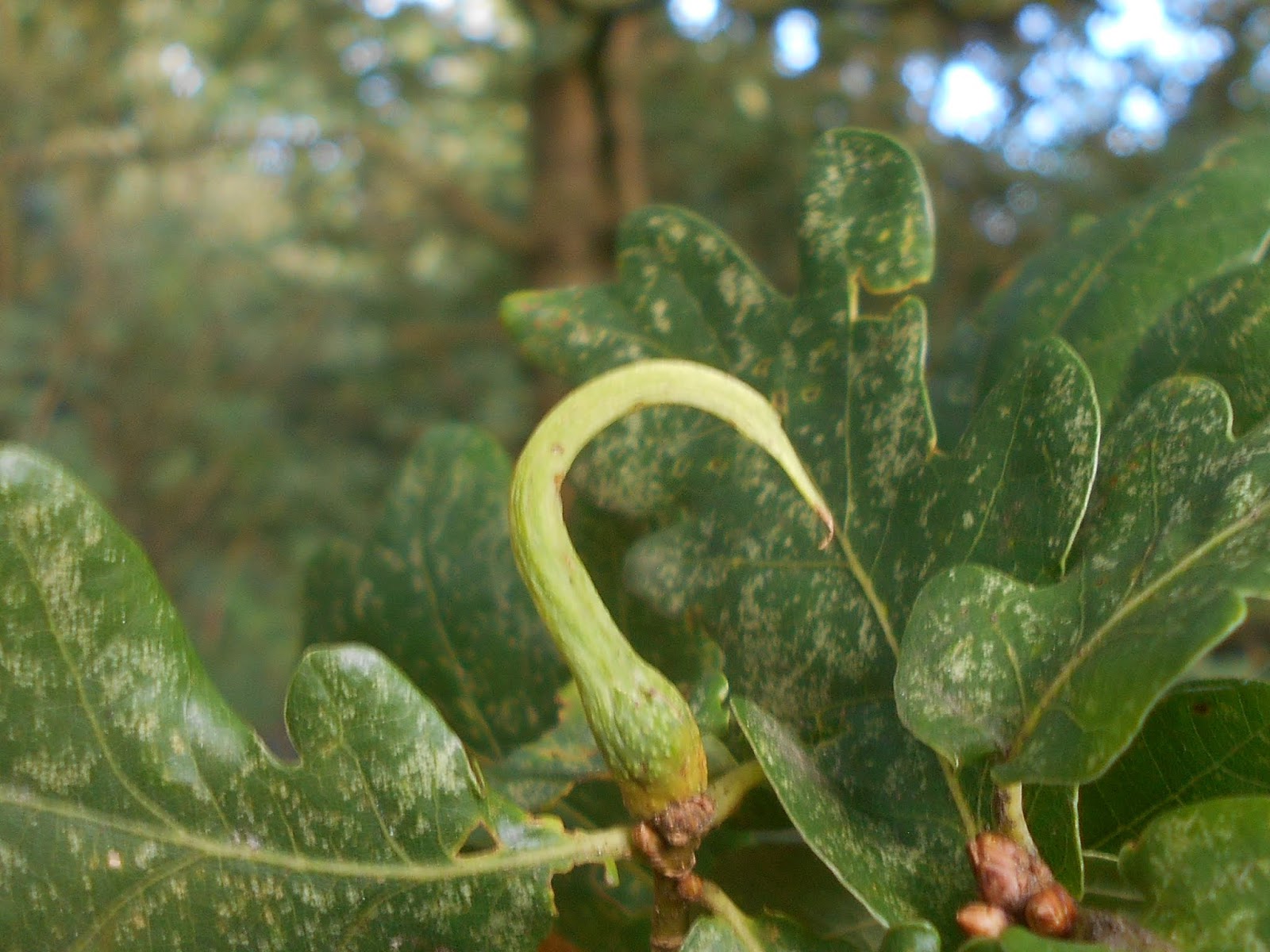
The first was easy-peasy. The Ram's Horn Gall, Andricus aries, is commonly present (despite being first recorded in the U.K. as recently as 1997) but rather easily overlooked as the structures can be less than impressive.


A number of leaf mines were also present but, as they are decidedly unphotogenic, I decided to spare readers the details.


Ram's Horn Galls can be unobtrusive and frankly dull. Byfield Pocket Park,
16 October, 2019


Friday, 11 October 2019

A boring surprise

Can a surprise be boring? Perhaps that's a question for philosophers. I had surprise today when visiting Stefen Hill Pocket Park but it was not at all exciting.
I must have visited the park 50+ times and yet today, strolling through a gloomy area beneath some scrubby trees I found a strongly-growing plant of Spurge Laurel.


Daphne laureola in the gloom beneath trees at Stefen Hill Pocket Park.
11 October, 2019
Despite the name it is neither a spurge nor a laurel, but is a daphne, Daphne laureola. It is a native of Northamptonshire but is largely confined to calcareous soils, and ought not to be here on the mildly acid soils around Daventry. It is hardly likely to be a garden escape, as it is not worthy of a place in most gardens, so perhaps this unassuming evergreen has simply been overlooked.

It may have been far more widespread in the past but was once much sought after by herbalists, with my copy of Potter's cyclopaedia stating... 'acts favourably in syphilis, scrofula and rheumatism'. (Ref.1). More importantly it seems to have been used to terminate unwanted pregnancies. All parts of the plant are poisonous.

It has pleasantly-scented if rather uninspiring greenish-yellow flowers in late winter, perhaps attracting the occasional bumblebee. John Clare was familiar with it, writing:

                            While Dark Spurge Laurel on the banks below
                            In stubborn bloom the autumn blight defies.

                                                                      Shepherd's Calendar, 1827


I will re-visit the plant in 3-4 months time to examine the flowers - should there be any - and make a further check for galls and mines 


In fact my main purpose for visiting the park today was to look for leaf mines, an occupation recently described to me as 'dangerously addictive'. As a study it is of limited general interest so I will spend little time on the subject, but one or two mines found today merit a mention. This mine on Red Valerian, Centranthus ruber, had me scratching my head.

Mine on Red Valerian. The red 'frass' in the mine is simply a reaction
to the activities of the insect. 11 October, 2019


The culprit responsible for this mine on Broad-leaved Dock was certainly the fly, Pegomya bicolor, a species widely found across England but scarce in Scotland. Pegomya species belong to a very tricky family, the Anthomyiidae, but the mines produced by the larvae can be a great aid to identification.


Broad-leaved Dock mined by Pegomya bicolor. Stefen Hill Pocket Park,
11 October, 2019


Away from leaf mines, a few shieldbugs were noted. Hawthorn Shieldbug, Acanthosoma haemorrhoidale, is seen on most of my visits but this colourful insect deserves a photograph.


Hawthorn Shieldbug on sycamore leaf. Stefen Hill Pocket Park,
11 October, 2019


The smaller Parent Bug, Elasmucha grisea, was on an alder leaf and also merited a picture but when aimed my camera at the leaf it was nowhere to be seen. I found the little rascal on my hand where a decent focus proved impossible.


Being difficult. A Parent Bug on the back of my hand.
Stefen Hill Pocket Park, 11 October, 2019

When I checked my hand a day later the bug had gone.                      


References

1.  Potter's Cylopaedia of Botanical Drugs and Preparations (1923 edition) Potter & Clarke

Wednesday, 2 October 2019

A chilly Byfield

It was distinctly nippy overnight, with temperatures getting uncomfortably near to freezing point, so when I visited Byfield Pocket Park today I was rather pessimistic about finding much in the way of insects. But in fact when the sun finally emerged lots put in an appearance, particularly on ivy blossom. A Noon Fly, Mesembrina meridiana, chose to abandon the ivy and alight on a nearby plum leaf although by and large the insects offered few photo-opportunities. They would never make it as politicians.


A Noon Fly basks in the sunshine on a plum leaf.
Byfield Pocket Park, 2 October, 2019

As I mentioned in my last blog, this is the season for galls, leaf miners and so on. A sinuous mine on the leaf of an Aspen, Populus tremula, proved to be that of Aulagromyza tremulae, and was the 171st species recorded for the site. I'd like to say that it was an exciting rarity but, alas, it is rather common.


Hardly exciting. The larva of Aulagromyza tremulae is responsible for this
mine on an aspen leaf. Byfield Pocket Park, 2 October, 2019
I was temporarily distracted by a clump of Cocksfoot Grass, Dactylis glomerata. The seeds had germinated within the panicles of flowers, giving the plant an odd appearance. These proliferous spikelets are not uncommon and in some grasses they are a regular occurrence and in some cases occur as a form of viviparity.
Proliferous spikelets on Cocksfoot Grass. Byfield Pocket Park,
2 October, 2019


Back to  leaf mines. A wild rose bore the mine of a moth, Stigmella anomalella. It is known as the Rose Leaf Miner - now there's a surprise! Again it is very common but had not been recorded in the pocket park before and proved to be the 172nd species for this location The neat, unbroken line of frass (poo) runs down the centre of the mine, helping to confirm the identification.


This sinuous mine is the work of a moth, Stigmella anomalella.
Byfield Pocket Park, 2 October, 2019
I casually took a picture of an ash tree leaflet bearing the gall of Psyllopsis fraxini. This psyllid bug is exceedingly common wherever ash trees occur but was astonished to find that it was also a new record for the site. 173!


The roll-like gall of Psyllopsis fraxini. Byfield Pocket Park, Northants.
2 October, 2019


It takes the form of a roll at the edge of a leaf, and is likely to turn reddish or purple over the next few weeks.
 
A cedar, planted some twenty years ago by my old friend Oliver Tynan is, he assured me, a cedar of Lebanon, Cedrus libani. I have been sceptical and have been waiting for the tree to bear cones for an identification.

Cedar of Lebanon or Deodar? I'm still not sure.
Byfield Pocket Park, 2 October, 2019
The male flowers are now present and he may well be right but I have a gut feeling it is a Deodar, Cedrus deodara. When the female cones have fully formed a clear answer should be possible. 'All will be revealed,' as the lady promised the cardinal.


Anyway, the total ended up at 181 species. It should pass 200 species by the year's end.This is of no particular interest in itself but, in 25 years or so, when I have long gone and the climate has warmed dramatically, my species-list will be of some interest to anyone who cares to re-survey the site.

Monday, 30 September 2019

A few odd blemishes


At this time of the year oaks are showing the blemishes and scars picked up during the growing season. A leaf on an oak tree in Byfield Pocket Park was displaying a curious oval group of speckles on its upper surface. They were easily overlooked and it first they seemed to have no obvious cause.
Curious speckles on an oak leaf. Byfield Pocket Park,
25 September, 2019

A look at the lower side of the leaf helped to explain what was happening. A blister-like mine had been created by a moth, Phyllonorycter quercifoliella. Known as the Common Oak Midget (although, as I have said before, no lepidopterists actually use these made-up English names) it is both common and widespread.


The underside of the leaf shows that Phyllonorycter quercifoliella
has been at work.
Oddly, although mines or galls usually leave a brown or greyish blemish, there are occasions when the opposite is the case. In this example, again on an oak, the normal development of autumnal coloration has somehow been interrupted by the work of - what? The effect is almost startling.

Curious areas of green on an otherwise autumnal leaf.
Stefen Hill Pocket Park, 29 September, 2019

In Stefen Hill Pocket Park a Sycamore, Acer pseudoplatanus, appears to have been sprayed with white paint. Uncinula tulasnei, otherwise known as Sawadaea tulasnei, is very commonly seen in the autumn and some years ago I recorded it at Byfield, Northants.

Who has been spraying these leaves with white paint?

It seems to do little harm, the affected trees growing vigorously the following year, and in a curious way can sometimes be quite attractive. If this was simply a genetic fault as in some variegated forms of ivy or hosta, the plant would probably be carefully propagated.

It is, of course a form of powdery mildew, more precisely the fungus,
Uncinula tulasnei. Stefen Hill Pocket Park, Daventry. 29 September, 2019

Can a gall be called a blemish? Certainly there are plenty to be seen at this time of the year, particularly on oaks. The Hedgehog Gall, Andricus grossulariae, tends to be rather sticky and, initially green, turns brown during the autumn.


The Hedgehog Gall is a frequent feature of oak trees in the early autumn.
Stefen Hill Pocket Park, 30 September, 2019


Perhaps more interesting is the Ram's Horn Gall, Andricus aries, also found on oaks. It is related to the Hedgehog Gall but takes on a quite different form. It can indeed look like a long curved horn, often double but very variable.


The Ram's Horn gall is very variable in shape.
Stefen Hill Pocket Park, 30 September, 2019
In some cases, like the second example, the 'horn' can be almost straight. It is a widespread species but both this and the Hedgehog Gall are new records for Stefen Hill Pocket Park.
Occasionally it can be almost straight. Stefen Hill Pocket Park, Daventry.
30 September, 2019

Galls, mines and fungi together make an interesting miscellany of species to look forward to on country walks during the early autumn.


Tuesday, 24 September 2019

Autumn equinox

Autumn equinox today, but nothing of an earth-shattering nature occurred. I visited Byfield Pocket Park today but, on looking around, I found nothing amiss.


I have recorded 168 invertebrates on the site so far. There will be many more but they may take a little teasing out. Beetles need work on them and I may have to put down some logs or perhaps a bait of some kind. However, on my visit today I concerned myself mainly with plants.


Hogweed is still flowering profusely and attracting a range of flies such as this tachinid fly, Tachina fera. This handsome insect is always common but seems to have been unusually abundant this year.


Hogweed attracts many specimens of Tachina fera.
Byfield Pocket Park, 23 September, 2019
Rosebay Willowherb, Chamerion (Chamaenerion) angustifolium also remains in flower but is of little interest to flies. Instead a dozen or so bees were busy harvesting pollen and nectar. It is an asset to many insects but a curse to the pocket park management team, spreading aggressively via its rhizomes.
Rosebay Willowherb is both an asset and a curse.
Byfield Pocket Park, 23 September, 2019

And of course White Dead-nettle, Lamium album. It may well flower throughout the winter and, on warm winter days, attract the occasional bumblebee.

Ever reliable, Lamium album can be found in flower throughout the
year. Byfield Pocket Park, 23 September, 2019

There was a little Hedge Woundwort, Stachys sylvatica, present too. It is, like the Deadnettle, a member of the mint family, Lamiaceae, but whereas mint, lavender, rosemary and other mint relatives have a pleasing fragrance when rubbed, the smell of Hedge Woundwort is thoroughly unpleasant. Yuk!
Beautiful in its sombre colours, but the foul smell of Hedge Woundwort
bars it from the garden. Byfield Pocket Park, 23 September, 2019

Also present was a tiny amount of Yellow Toadflax, Linaria vulgaris. Around eight species of Linaria have been recorded in Britain but this species is the only one likely to be native. It's kinship to snapdragons - Antirrhinums - is obvious, but Linaria species possess a long spur at the base of the flower.

Yellow Toadflax. Byfield Pocket Park, 23 September, 2019

I remember them well from my childhood but applied the same name to them as antirrhinums, referring to them as 'bunny rabbits'.


Two plants not in flower were of some interest.  The leaves of a Lesser Burdock, Arctium minus, had been mined by the larvae of the fly, Phytomyza lappae, common and hardly exciting but a new record for the site.

The mines of Phytomyza lappae often disfigure Burdock leaves.
Byfield Pocket Park, 23 September, 2019 
Even less exciting was a clump of Horse-radish, Armoracia rusticana, but its presence reminds us of the origins of the pocket park. Its position marks the site of Byfield railway station, and like most such stations, the station-master had a vegetable plot beside his domain. His pay (and it was always a he) was hardly generous and the vegetables, cultivated at quiet times, were probably welcome.

The leaves of Horse-radish look rather like those of a Dock, but it is quite unrelated. It is in fact a member of the cabbage family, Brassicaceae. It seems to have originated somewhere in the east Europe - west Asia region and is completely sterile. So instead of being propagated by seed the plant is grown from chunks of the rootstock, not unlike rhubarb. All parts of the plant contain sinigrin, making the plant technically poisonous, but although animal deaths have been reported from its consumption, human cases are very rare. Like maize and broad beans, the plant is unknown in the wild except as an escape from cultivation.
Tall clumps of Horse-radish are usually easy to spot but here it was growing
unobtrusively among common weeds. Byfield Pocket Park,
 29 September, 2019

So this plant has long outlived the long-defunct railway and its employees, growing unobtrusively among Dandelions, Wood Avens and other weeds.