Sunday, 6 January 2019

Nothing doing

I've lost three pounds in four days. Actually, that's not quite true: I haven't lost them. I know where they went, but I won't go into physiological details.


Early January in the garden brings few excitements, merely a few observations. A mild morning meant that I had no excuse for indolence and I ventured out to do a few jobs. Task number one was to tidy up the passion flower. These vines, regarded as rather tender fifty years ago, are not only rampant but a few seedlings are popping up here and there. Birds eat the fruit and I'm guessing that the seeds pass through their gut before finding a suitable spot in the garden to germinate. The fruits have long gone of course - or so I thought, until my pruning revealed a fully-formed but unripe example.


The Blue Passion Flower, Passiflora caerulea, still bears
a lone fruit. 6 January, 2019


The Passion Flower received a pruning along with our Chinese Creeping Bramble, Rubus tricolor. It is an attractive plant with, according to the literature, edible fruits, but despite these merits I may find it too vigorous and regret its introduction. I have been tempted to plant its relative Rubus cockburnianus but, its specific name being so rude, I decided against it.


On the same section of fencing grows our Garrya, Garrya eliptica. Over the last few weeks its silky catkins (it is a male plant) have steadily lengthened and are, in my opinion, most attractive. It was awarded the A.G.M. (Award of Garden Merit) by the R.H.S. in 1960.
Garrya elliptica on our back fence.
6 January, 2019


Despite the catkins it is not at all related to plants such as hazel and for a long time botanists were unsure how to classify it. Walter Judd, perhaps the world's leading authority on plants systematics, has not only placed it in its own family, the Garryaceae, but gives it its own order, the Garryales, a high honour indeed.


Myrtle Spurge is seeding itself around our front garden at Stefen Hill.
6 January, 2019
Other than that, the only thing requiring attention was the Euphorbia myrsinites. Known as Myrtle Spurge, this lovely perennial from south-east Europe has spirally arranged glaucous and fleshy leaves on sprawling stems. The flowers are interesting but relatively inconspicuous. From time to time I have to trim back these stems because, as they lengthen they smother more delicate species (and sprawl across the footpath).   Furthermore the plants have a reputation for being allelopathic, chemically suppressing the growth of nearby plants - although I have not observed this in my own garden.  As with the Passion Flower, several seedlings have appeared around the front garden. The euphorbia has also received the A.G.M. from the R.H.S.


So, nothing of great excitement, but with many fat buds sitting at ground level there is promise of considerable interest over the next few weeks.


Wednesday, 2 January 2019

Fighting the Flab

Perhaps 'flab' is putting it a bit strongly but shedding a few pounds wouldn't be a bad thing. I made a start yesterday, losing a pound, but that's all it was - a start.


Today I went for a longish walk around streets in the south of Daventry. That's all you need to know. Read no further because what follows is a tedious account of what I saw. Just an illustrated diary entry really.


As I strode out I could not fail to observe the amount of 'chewing gum' lichen that was on the paving slabs. This is the name frequently applied to Lecanora muralis, and I put its abundance down to the fact that people are more likely to jump in their cars for even short journeys rather than walk. In short, the pavements are under-used.
Lecanora muralis can sometimes look remarkably like chewing gum.
Daventry. 2 January, 2019

There can be no doubt that, if a pandemic wiped out humanity our paving slabs would soon disappear under a thick encrustation of lichens and mosses.

It is quite remarkable how many plants are still in bloom in our gardens. Of course, shrubs such as Viburnum x bodnantense (a hybrid of V. farreri and V. grandiflorum) are planted partly because they are expected to be flowering in mid-winter.

As well as flowering in mid-winter Viburnum x bodnantense is very
fragrant. Daventry. 2 January, 2019

With some other shrubs the flowers are something of a surprise. Ceanothus species are all American endemics and the one photographed, probably Ceanothus thrysiflorus, hails from California. Californian or not, it has no business to be bearing flowers in January, although it is not an infrequent occurrence.

This Californian Lilac bore several clusters of flowers.
Christchurch Drive, Daventry. 2 January, 2019
These so-called Californian Lilacs belong to the Buckthorn Family, Rhamnaceae, and are thus related to our own Common Buckthorn, Rhamnus cathartica. (True lilacs are in the Olive Family.)

A number of herbaceous plants are in flower. Elephants' ears, Bergenia species, are like the Viburnum, expected to be in flower in January, but Centranthus ruber is not. I saw several specimens of the latter blooming today but they are not at their best, looking weather-beaten and generally bedraggled.

Red Valerian was in flower at several places on my route.
Daventry, 2 January, 2019
Lavatera species are the Tree Mallows. Their rose-pink flowers are a feature of autumn gardens but in Daventry town centre a specimen carried many blooms.

Tree mallows were in flower. Daventry town centre.
2 January, 2019
The species is probably Lavatera thuringiaca but the whole group has been subject to much revision and all Lavatera species are now placed in the genus Malva. It should now be referred to as Malva thuringiaca. The flowers are much visited by bees - but not today.

With feet aching I turned for home; paving slabs are not kind to walkers. I paused only to photograph our local Eucalyptus gunnii and surprised a local passer-by who stated: 'Do you know, I pass that tree every day and I'd never noticed the flowers.'
The Cider Gum, Eucalyptus gunnii. Daventry. 2 January, 2019


Tuesday, 1 January 2019

New Year's Day

Whoops! Twelve stones and five pounds. Not surprising of course, but something must be done about it. The BBC Weather Forecast for Daventry predicted only a 3% chance of rain so I drew aside the bedroom curtains with optimism, only to find that a heavy drizzle was falling. But was I discouraged from walking? Well, yes, a bit. Chris, incidentally, was going out walking with our daughter Jacqui. I tend to walk alone, not through anti-social traits but because, constantly stopping, I hold up my companions. 


A small spider, Tenuiphantes tenuis, had come in to avoid the rain and was clinging to the curtains. I could spend the day going around the house looking for more creepy-crawlies, but we Whites are made of sterner stuff. I decided to wrap up and set forth, only to get my first surprise before even five yards had been covered. A Pasque Flower, Pulsatilla vulgaris, was in bloom in our front garden!


A lone, rain-wet Pasque Flower is in bloom in our front garden at
Stefen Hill, Daventry. 1 January, 2019
It shouldn't be blooming before April but, as I have often noted, flowers and insects haven't always read the books. Its common name of 'Pasque' comes from Paschal - of Easter. Easter is a movable feast - but not that movable! John Clare wrote of it to his publisher:

'I coud [sic] almost fancy that this blue anenonie [sic] sprang from the blood or dust of the Romans for it haunts the roman bank in this neighbourhood  & is found no were [sic] else...'  At the time Clare was living at Helpston, near Peterborough (then in Northamptonshire, now in Cambridgeshire.).

As my photograph shows, our specimen is wine-red rather than blue.


Anyway, I set out, following Tyne Road, on the western edge of The Grange, and then crossed the A45 by means of a footbridge. This carries a footpath following the line of the disused old Daventry-Leamington Road and is now largely forgotten.


This bridge over the A45 is a wheelchair-friendly structure.
Daventry, 1 January, 2019
Part of the old once-metalled road is now grassed over and I was pleased to spot what is undoubtedly an orchid. I am not knowledgeable enough to identify the species simply from a rosette so a return visit in late spring-early summer would be interesting.

An orchid rosette grew in the mown grass beside the old track.
Daventry, 1 January, 2019
A little beyond this point I turned on my heel and returned more or less by the way I came. At this point I almost, on January the First, broke a New Year's Resolution. I was drawn by malign forces to a toadstool and got as far as photographing it when I remembered my vow. I am refusing to try and identify it.


I must be strong and refuse to identify this toadstool.
The Grange, Daventry. 1 January, 2019
At this time of the year trees have lost leaves, catkins, fruits or whatever. If we are to identify them we must rely on overall shape together with bark and buds.

Plane Trees stand out, their bark making them very distinctive, Sycamores can also lose patches of bark but the results are never as striking.

Among the gloomy limes and sycamores a plane tree stands out.
The Grange, Daventry. 1 January, 2019
A close-up view shows the very pale new bark beneath the old. When losing bark in this way they also rid themselves of sooty deposits, making them popular in towns.
The new bark is of a delicate, palest of green shades. Tyne Road, The Grange, Daventry.
1 January, 2019


Another tree with easily recognised bark is White Poplar, Populus alba. This is a native tree of wettish areas but where I was walking today there were several planted specimens. Often - though not always - the bark bears marks of a rhomboid form, making it rather eye-catching.

 White Poplar has a distinctive bark. Tyne Road, The Grange, Daventry.
1 January, 2019


Three miles or so. Barely sufficient but with approaching spring I should be able to do better. It turned out that Chris and Jacqui had tackled Borough Hill, a much sterner task.

Saturday, 29 December 2018

Burning off the Christmas calories

In mid-winter a decent walk in the country is probably helpful when it comes to repairing the damage wrought by mince pies and brandy butter, but if you're looking for interesting plants, particularly flowers, you are better off on an urban walk - and it isn't as muddy either.


With this in mind I set off yesterday for a walk around the western part of the Grange, in Daventry. Burning off calories? You've got to be kidding! I was only strolling, but it was marginally better than being a Couch Potato, Solanum tuberosum, subsp. indolens.


I was quickly rewarded by flowers, having only travelled about two hundred paces from home. A clump of Pot Marigold, Calendula officinalis, had survived winter's icy blasts (What icy blasts?) to create a cheerful sight. It is easy-peasy to grow, brightly coloured and attractive to insects. What's not to like?


Calendula officinalis or Pot Marigold. Christchurch Drive,
Daventry. 28 December, 2018

After half a mile I encountered my first fungus. It was, I believe, Velvet Shank, Flammulina velutipes, and was growing in a typical situation on a dying tree stump. I also, three days early, made my first New Year's Resolution for 2019: I must NOT allow myself to be distracted by fungi; they really aren't my thing.

Flammulina velutipes? Probably. Nr. Badby Road West, Daventry.
28 December, 2018
I pushed on to reach a road called Grovelands. It is in an area of neat manicured gardens with common or garden (naturally) plants. It was not a promising prospect but I was pleased to find a hedgerow (neatly clipped of course) of a familiar plant. It was the delightful barberry, Berberis darwinii and it was sporting a few flowers. They are of a lovely egg-yolk yellow and are set in evergreen foliage of neat, holly-like leaves.

Berberis darwinii must rank among the finest of all hardy shrubs.
Grovelands, Daventry. 28 December, 2018

This shrub, like several other berberis species, is from South America, but its generic name is a Latinised form of the Arabic word berberys. The specific name is of course in honour of Charles Darwin, who discovered it in 1835, but is not given a capital letter. My understanding is using only a lower-case letter for the specific name is not a rule but is a convention invariably followed. If I could choose only one Berberis this would be it.

Trees were proving to be of interest. A handsome eucalyptus, probably Eucalyptus gunnii, caught my eye. We can not always be sure of the species because eucalypts (as they are called) have a marked tendency to hybridise. But whatever it was, it looked lovely, with peeling bark revealing the smooth, unblemished surfaces below.
A Eucalyptus (E. gunnii?) sheds its bark. Staverton Road, Daventry.
28 December, 2018
 

A fern in a lime tree nearby also brought my camera into action, where a  specimen of Western Polypody, Polypodium interjectum, was growing in moss as an epiphyte. Of our three species of polypody this is the most likely species to be seen in town. It is more likely to be found on walls of natural stone.

Western Polypody had taken root among moss in a lime tree.
Staverton Road, Daventry. 28 December, 2018
Time to turn homewards but a couple of plants made me pause. A geranium, Geranium pyrenaicum, was in flower. It is commonly called the Hedge Crane's-bill but I generally find it on waste or disturbed ground. It is probably an introduction, but it has been known in Britain for at least 350 years and was first recorded in Northamptonshire in 1874.

Geranium pyrenaicum on waste ground near Staverton Road, Daventry.
28 December, 2018
It is quite a pretty plant and could feasibly have been introduced for ornamental use in the garden.


Finally a viburnum. Viburnum rhytidophyllum was introduced from China by Ernest Wilson and a fine shrub it is too. At this time of the year the off-white flowers are unspectacular but any flowers are welcome in December. It was in a municipal bed of shrubs.
The flowers of this Leatherleaf Viburnum are not really at their best.
Daventry, 28 December, 2018


At their best they make a fine show but for me the handsome foliage is also noteworthy. The leaves are semi-glossy and rugose (wrinkled) and in fact the generic name comes from the Greek rhytis, a wrinkle. (People worried about their advancing years can have a rhytidectomy to expunge these offending features.) Another name for this shrub is the Leatherleaf Viburnum.
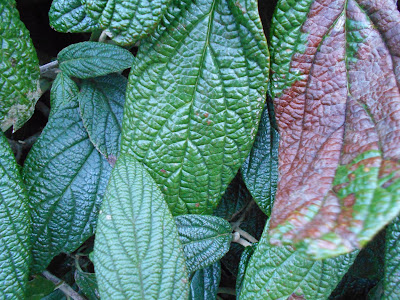
I regard the handsome foliage of Viburnum rhytidophyllum as an
 important feature.


I turned on my heel and headed homewards, consoling myself with the knowledge that I'd blown away a few cobwebs even though, three miles or not, my weight essentially remained the same.


Friday, 21 December 2018

Wandering around Woodford.

In south west Northamptonshire is the village - just a hamlet really - of Halse. In central Northants lies the larger settlement of Woodford. But only about eight miles from Daventry, combining the words, lies the largest of the three, Woodford Halse. It too was just a small village until the becoming of the Great Central Railway and, when it was decided to locate a large locomotive power depot (a 'shed') nearby, the village boomed to become a small town.


Some would argue that it is only a large village, but with a school, a largish Co-op supermarket, a smaller grocery shop, a hardware shop, a hairdresser's, an estate agent, a newsagent, quite a large restaurant, a smaller café, a post office (until a couple of months ago), two churches, a veterinary practice, a butcher's, a public library, a dispensing chemist, a pub and even a biggish shoe shop, I think the description of small town is justified. I go there to get my hair cut, even though it is a 16-mile round journey.


Having time to kill, with Chris being at a  U3A meeting, I had a stroll round. Not for long mind you because the bright morning sunshine was replaced by cloudier, chillier conditions and, eventually, rain. I made my target the churchyard of St Mary the Virgin. This greatly predates the coming of the railways, the nave probably being 12th Century. The church is mostly of ashlar construction, using the local iron-rich Jurassic sandstone.


The church of St Mary the Virgin, Woodford Halse.
20 December, 2018
Immediately prior to entering the churchyard I photographed a wonderful large shrub, bedecked with catkins, overhanging the (old) school yard. I assume it was hazel but the catkins were unusually long and, rather than being a wild plant, it may have been a specially selected form.
A large (hazel?) shrub to the rear of the church. 20 December, 2018


The area immediately before the church yard is kept very neat and it seems likely hat recent activities around the war memorial have led to an extra effort being made. Since my last visit a rather unusual bench depicting members of the armed forces, has been installed.

Adjacent to the war memorial is this recently-installed bench.
Churchyard of St Mary the Virgin, Woodford Halse. 20 December, 2018

The area to the rear of the church is wonderfully neglected, and long may it remain that way. Graves are being overrun with brambles and rank grass so a wildlife haven is now developing.


The wonderfully neglected churchyard.
Not surprisingly, the headstones of the graves and the masonry of the church have developed a rich variety of bryophytes (mosses and liverworts) and lichens.
I wish I had the knowledge to identify them.


Thursday, 20 December 2018

Holly, mistletoe and ivy

We are all familiar with these plants. Holly and ivy are exceedingly common and in certain parts of southern Britain mistletoe is frequent too, though it is very scarce here in Northamptonshire. So why am I bothering with a blog about this trio; is it simply that these evergreens have associations with midwinter festivals?


In fact they share a curious feature.


Holly, Ilex aquifolium, is a member of the Aquifoliaceae family. It is not blessed with an enormous number of species - about four hundred species spread over three genera, with Ilex being overwhelmingly the largest genus. The family members are spread all over the world, particularly in the Americas but, and here is a surprising fact:


Holly is the only member of the Aquifoliaceae in Britain.


Holly in the churchyard of St. Mary the Virgin, Woodford Halse.
20 December, 2018


Ivy, Hedera helix, belongs to a somewhat larger family, the Araliaceae with some 700 members. A large number of the family members are climbers and many are lianas. These are long stemmed, woody vines found in tropical and sub-tropical situations and many of them were probably utilised by Tarzan as, in old films, he swung from tree to tree in a variety of ludicrously improbable scenarios.


Ivy is the only member of the Araliaceae in Britain (although, to be fair, it is often split into two subspecies).
Ivy climbs over a headstone in the churchyard of St Mary the Virgin,
Woodford Halse. Bonfire smoke billows in the background.
20 December, 2018


And then we come to Mistletoe, Viscum album. Here the situation is rather more complicated. Traditionally it has been placed in the Loranthaceae and this is the largest of the families under consideration, for it contains about 1000 members.  But some botanists would place the Loranthaceae in the same family as the sandalwoods, the Santalaceae. This is a group of around 400 members which includes Sandalwood itself, Santalum album, giving the family a combined membership of around 1400 species. We do have a member of the Sandalwood family, the Bastard Toadflax, Thesium humifusum. ('Bastard' here is used in its original sense of being false.) In Britain it is rare, and is more or less confined to an area within about fifty miles of Southampton. Bastard Toadflax does not grow in Northamptonshire and I have never seen a wild plant.


Be that as it may:


Mistletoe is the only member of the Loranthaceae in Britain.


So each member of this trio of plants is the sole representative of a much larger, generally tropical, family and for my money, this makes them more interesting than any of their various connections with midwinter celebrations.


And once the festivities are over:


                              Down with the rosemary, and so
                              Down with the bays and mistletoe:
                              Down with the holly, ivy all
                              Wherewith ye dressed the Christmas hall.


                                                                Robert Herrick


Wednesday, 19 December 2018

Posts and pills

In Byfield today, posting a few cards to friends. Many had been trusted to Postman Pat (or as likely, nowadays, to Postlady Patricia) but a handful remained.


Byfield was looking very festive and many holly trees around the village were sporting a fine crop of berries. In Banbury Lane there was a specimen of Ilex aquifolium 'Bacciflava', displaying its yellow berries. The varietal name sounds like a fragrant tobacco but of course it simply comes from the Latin, bacca, a berry, and flavus, yellow.


Yellow-berried holly makes an attractive change.
Banbury Lane, Byfield. 19 December, 2018

All very nice. For some reason I recalled a story told of Sir Thomas Beecham. He was a scion of the 'Beecham's Pills' family and his father asked the young Thomas to compose a Christmas jingle. The best he could come up with was:

                         Hark the Herald Angels sing,
                         Beechams Pills are just the thing,
                         Two for a woman and one for a child,
                         Peace on earth and mercy mild.
 
Apocryphal? Maybe, but Sir Thomas always claimed it was true. As I went about my business I found myself humming the tune to the point where it became irritating.


Hard by the holly was a clump of Stinking Gladdon, Iris foetidissima, aka the Roast Beef Plant.


The berries of Stinking Gladdon are as yet being eschewed.
19 December, 2018
Birds have stripped many berries from plants such as rowan but, tempting though they look, these Iris fruits have been left untouched so far. A hard January may change all that.

Of invertebrates little was to be seen although a few winter gnats danced here and there while on warm fencing a few flies sunned themselves, almost certainly the common bluebottle Calliphora vicina.
Flies warmed up on sunny fences. Byfield, 19 December, 2018

 Crevices in walls harboured the blue-grey webs of Amaurobius similis.

Webs of Amaurobius similis are found on many walls and window
frames. Byfield, 19 December, 2018

In theory it could equally well have been Amaurobius fenestralis for their webs are identical, but 'fenestralis' is more of a country dweller, favouring loose tree bark in woodlands. For both species the main prey is probably creeping insects such as earwigs (although earwigs can, of course, fly). 'Similis' is very common on tightly clipped hedges of yew or box.

Not the most exciting of days, perhaps, but the relatively mild conditions with lovely blue skies made the jaunt very pleasant.