Wednesday, 19 December 2018

Posts and pills

In Byfield today, posting a few cards to friends. Many had been trusted to Postman Pat (or as likely, nowadays, to Postlady Patricia) but a handful remained.


Byfield was looking very festive and many holly trees around the village were sporting a fine crop of berries. In Banbury Lane there was a specimen of Ilex aquifolium 'Bacciflava', displaying its yellow berries. The varietal name sounds like a fragrant tobacco but of course it simply comes from the Latin, bacca, a berry, and flavus, yellow.


Yellow-berried holly makes an attractive change.
Banbury Lane, Byfield. 19 December, 2018

All very nice. For some reason I recalled a story told of Sir Thomas Beecham. He was a scion of the 'Beecham's Pills' family and his father asked the young Thomas to compose a Christmas jingle. The best he could come up with was:

                         Hark the Herald Angels sing,
                         Beechams Pills are just the thing,
                         Two for a woman and one for a child,
                         Peace on earth and mercy mild.
 
Apocryphal? Maybe, but Sir Thomas always claimed it was true. As I went about my business I found myself humming the tune to the point where it became irritating.


Hard by the holly was a clump of Stinking Gladdon, Iris foetidissima, aka the Roast Beef Plant.


The berries of Stinking Gladdon are as yet being eschewed.
19 December, 2018
Birds have stripped many berries from plants such as rowan but, tempting though they look, these Iris fruits have been left untouched so far. A hard January may change all that.

Of invertebrates little was to be seen although a few winter gnats danced here and there while on warm fencing a few flies sunned themselves, almost certainly the common bluebottle Calliphora vicina.
Flies warmed up on sunny fences. Byfield, 19 December, 2018

 Crevices in walls harboured the blue-grey webs of Amaurobius similis.

Webs of Amaurobius similis are found on many walls and window
frames. Byfield, 19 December, 2018

In theory it could equally well have been Amaurobius fenestralis for their webs are identical, but 'fenestralis' is more of a country dweller, favouring loose tree bark in woodlands. For both species the main prey is probably creeping insects such as earwigs (although earwigs can, of course, fly). 'Similis' is very common on tightly clipped hedges of yew or box.

Not the most exciting of days, perhaps, but the relatively mild conditions with lovely blue skies made the jaunt very pleasant.

Monday, 17 December 2018

Lean times

We are approaching the year's shortest day (21 December) and many insects and spiders seem to be lying low, or are even in a state of torpor. Plants also seem to have ceased putting on new growth but a little thought reminds us that this is far from the case: the shoots from several bulbs are beginning to push their way through the soil and there are even flowers to be seen.


Catkins, or aments to use an alternative name, are becoming quite conspicuous.
Hazel catkins near Worcester Way on Stefen Hill. 12 December, 2018

I have already mentioned hazel catkins in a hedgerow near Worcester Way but here in our garden we also have catkins on our Silk Tassel Bush, Garrya elliptica. Our plant is male; female specimens have much smaller and relatively inconspicuous catkins. The catkins on our specimen currently measure about 70 mm but still seem to be lengthening.


Garrya elliptica in our garden on Stefen Hill., Daventry. 17 December, 2018
This species come from western areas of the U.S.A. but there are about 17 other species, all shrubs, within the genus. It is currently placed in its own family, the Garryaceae, but botanists have at various times placed it in various families. It is a problem child.

Our Strawberry Tree, Arbutus unedo, continues to display flowers although the majority have now, task completed, begun to wither away. Will we be rewarded by its globular, inedible fruits? Oddly enough the Silk Tassel Bush and the Strawberry Tree are distantly related, both being members of the order Cornales.

Will we get fruit? Our Strawberry Tree remains in flower.
17 December, 2018
And that is about it, with only our specimen of Coral Honeysuckle, Lonicera sempervirens, remaining resolutely in flower.

Lonicera sempervirens, still in flower (if not quite in focus!)
Stefen Hill, Daventry. 17 December, 2018
Like the Garrya it is a native of the U.S.A. but from eastern regions rather than the west. In our garden it receives a little protection from a wooden fence but is clearly a tough hombre.

Am I being mean in failing to mention Aubretia, Aubrieta deltoides? Certainly it keeps producing the odd flower or two but this member of the Cabbage Family is not currently eye-catching. In spring perhaps...


Wednesday, 12 December 2018

No place like home

Chris was off to Northampton today for lunch with old friends. It pleases me enormously that she does this; she has a wide circle of friends from the past, often former work colleagues, and I know she will enjoy herself. I decided to walk locally.


In one of his  poems W.H.Auden wrote of:


                                           The healers and the brilliant talkers,
                                           The eccentrics and the silent walkers,
                                           The dumpy and the tall.


                                                  A Summer Night, 1938 (Also known as 'Out on the
                                                  lawn I lie in bed'.)


I very much fear I belong to the fourth of these six characters - and, if I'm honest, probably the third too.


So I set off shortly after Chris' departure, visiting the woodland and small meadow between Christchurch Road and the incessantly roaring A45. I saw little. As at Foxhill Farm a couple of days ago hazel catkins were swaying in the light breeze, ready to shed their pollen on to the tiny red female flowers.


Local hazel bushes have declared spring. Near Worcester Way, Daventry.
12 December, 2018
It was a chilly, grey, rather melancholy day and I didn't linger. Fifty minutes later I was back home where I had an interesting find. On the brickwork of our garage was a bug I had never encountered before, but its distinctive appearance made it instantly recognisable.

It was a Western Conifer Seed Bug, Leptoglossus occidentalis, sometimes abbreviated to WCSB. It is a native of the U.S.A. and was accidentally introduced into Europe in 1999. There it spread rapidly and is now being increasingly encountered in Britain, having first been recorded at Weymouth in 2008.

Western Conifer Seed Bug. Trinity Close,  Daventry
12 December, 2018
I placed it on patch of aubretia for a more natural-looking photograph and then brought it into the house for further examination. The white zig-zag markings across its forewings are diagnostic but what makes it a striking insect is its size, for it measures about 20 mm in length. The bugs in the Coreidae Family, to which it belongs, generally are only half that length.

As would be expected, the species feeds on pines but apparently does little damage. It will sometimes enter houses, attracted by light, where it will emit a loud buzzing noise.

Isn't it nice to come home to a surprise!


Yet another Daventry visit


A lovely morning tempted me into Daventry today and I decided to extend my walk by going via Stefen Leys Pocket Park. In truth there was nothing dramatic to be seen, this bracket fungus, Fomes fomentarius, being nationally very common. It is generally known as the Hoof Fungus and some are remarkably equine. Apparently Otzi the Iceman carried four pieces of this fungus, perhaps to be used as tinder. I found a few other fungi but I haven't yet decided what species they are.

Hoof Fungus, Fomes fomentarius, in Stefen Leys Pocket Park, Daventry.
11 December, 2018


On to the churchyard of Holy Cross. Examining the headstones on graves may sound a morbid occupation but some of the features can be curious, as in: 


ANN


RELICT OF THE ABOVE

A headstone in the churchyard of Holy Cross, Daventry.11 December, 2018

Today, referring to a widow as a 'relict' would be considered almost offensive but I have on other occasions come across the word used in this archaic sense, as I'm sure have many of my readers.


The churchyard is often a litter-strewn mess but it looks as though a big effort has gone into tidying it up. A stroll there today was a pleasant experience. 'A real oasis' was how a man, propped up against a sun-drenched headstone, put it to me.

The traditional Christmas Tree is a Norway Spruce and sadly many urban people are probably unaware of what a lovely tree a fully-grown specimen can be. But of course in Daventry they only need to visit their local churchyard. Its cones have a beautiful shape, far more attractive than the small and stubby cones of Scots Pine.

Norway Spruce with cones. Holy Cross churchyard, Daventry.
11 December, 2018

Nowadays the Norway Spruce is often replaced by the Nordmann Fir, Pinus nordmannia. It seems to me a less graceful tree when fully grown but, to be fair, I can only recall having seen one mature specimen.


I finally get to town, with every shop full of Christmas music. Oh dear...


Tuesday, 11 December 2018

The great mistletoe hunt

Mistletoes, belonging to the genus Viscum, are found nearly all over the world. There are about 80-90 species found in Africa, Asia, Australia and of course Europe. In North America they are replaced by the closely related genus Arceuthobium.


Our only native mistletoe is Viscum album, the generic name referring to the extreme stickiness of the seeds. Matt Moser assured me that it grows on Foxhill Farm where he apparently sowed seeds some years ago. Yesterday I went in search but Matt hadn't told be what species of tree it was growing on. Apples and Lime trees are common hosts but, although other trees sometimes bear this semi-parasite they are far less often encountered. Of course mistletoe from oak trees was traditionally associated with Druidic rituals but oaks bearing mistletoe are remarkably rare.


To cut a long story short my search was fruitless. I searched three separate areas of woodland without success and had to be content with other items of interest.


I recently looked at the subject of hedge laying but failed to mention holly.


Holly forms an impenetrable hedge. Foxhill Farm, Badby.
10 December, 2018
It is often used in gardens where it forms an excellent hedge but in the countryside it is seldom seen. It is a solid wall of a hedge, impenetrable by livestock, with the only downside being that one needs a first-aid kit on standby when laying it. On Foxhill Farm it has not been deliberately planted but where it occurs it has been incorporated into the hedgerow. Considering that it is a native plant there are remarkably few insects associated with it other than those seeking nectar from the flowers or eating the fruits. I often look on the dead leaves beneath the tree for a fungus known as the Holly Parachute, Marasmius hudsonii but have never found it.


What I did find was this small (cap about 2 cm across), rather unimpressive fungus. I believe it is Liberty Cap, Psilocybe semilanceata, and despite its appearance it is rather interesting because this common species is poisonous, hallucinogenic and obviously best avoided.


Liberty Cap growing in grass beneath a hawthorn hedge.
Foxhill Farm. 10 Decenber, 2018
The gills are of a  dark purple-brown colour. 
The gills of Liberty Cap, Psilocybe semilanceata.

Not surprisingly, given the time of the year, other fungi were in evidence, particularly on decaying wood. One example was this Yellow Brain Fungus, Tremella mesenterica, with the 'fruiting body' consisting of an irregular, gelatinous mass. Most sharp-eyed walkers in autumn woodland will come across this species.


Yellow Brain Fungus. Foxhill Farm, Badby. 10 December, 2018

The trees harboured a number of fungi, mainly resupinate species such as this one on a damp hardwood log:

Coniophora puteana? Perhaps - but perhaps not. Foxhill Farm, Badby
10 December, 2018
It may be Coniophora puteana but these fungi are very much a job for the specialist and I would be arrogant to claim any certainty for this identification. Certainly it is very common and can be a serious problem on timber in buildings.

More predictable was Candlesnuff Fungus, Xylaria hypoxylon, and as I have recently mentioned it in a blog I'll say no more.


Candlesnuff Fungus was present on rotting wood. Foxhill Farm.
10 December, 2018
Throughout this time I was peering into trees searching for mistletoe and, as I have said, I was without luck. Interestingly the hazels, which formed the coppiced understorey in some areas, were already displaying their catkins. They were fully developed too and a flick with the finger sent a cloud of pollen drifting away.

Catkins on the hazel were already releasing their pollen.
Foxhill Farm, Badby. 10 December, 2018
More surprising than the catkins was the foliage, for in several areas the leaves from summer were still clinging on, green and healthy. The areas involved were sheltered and away from the worst of the wind.

In some areas the leaves were still green and healthy. Foxhill Farm.
10 December, 2018

Hazel, when coppiced, produces an abundance of branches which are both straight and pliable. Unsurprisingly these yield well to the process of hedge laying although I suspect they are not reliably stock proof.
A typical hazel stool. Foxhill Farm, 10 December, 2018

Of similar dimensions are the bushes of Spindle, Euonymus europaea. These had lost their leaves and the striking, lipstick-pink fruit capsules were shrivelled, revealing their bright orange fruit. Many birds such as robins feed upon the fruit despite them being very poisonous - to humans at least. So poisonous is it that even breathing in the dust (it was once baked and powdered to be sprinkled in the hair to destroy head lice) could cause serious illness.

The brightly coloured fruit of the Spindle Tree is now revealed.
Foxhill Famr, Badby. 10 December, 2018
An interesting scale insect, Unaspis euonymi, has become established on Spindle in southern Britain, appearing as a crust of scruffy grey scales on the twigs in spring. I must remember to look out for them in four or five months time.

So in terms of the main object of my visit, the location of mistletoe, it was a disappointing day but I did find a number of spiders and bugs to be examined later.


Sunday, 9 December 2018

Byfield not at its best

Earlier today I had cause to visit Byfield. It is a rare occasion when I depart with nothing to write about, but today was a challenge.


True, the morning got off to a good start. A lovely Mahonia stood at the edge of the car park. It racemes of golden flowers are fragranced with the honey-scent of nectar and, given a spell of warm weather a hardy bumble bee with wrap itself in its fur coat and pay a visit. But not today. Mahonias are tricky beasts. This particular shrub may be Mahonia japonica, from south-east Asia but is more likely to be a hybrid involving a species from north west U.S.A. such as Mahonia x media. They provide a range of shrubs in flower from September until the flowing June.


A lovely Mahonia welcomed visitors to the car park in Byfield.
9 December, 2018

The churchyard is currently not at its best and we must be patient for a few more weeks for any spring bulbs to provide us with flowers. The only thing to catch my eye was a leaf of Herb Bennet, Geum urbanum, blistered and puckered by a mite. Cecidophyes nudus is a common enough species and the reptilian leaves left by its depredations are frequently encountered.
Herb Bennet showing the gross distortions left by Cecidophyes nudus.
Byfield, 9 December, 2018
These attacks seem to do little harm and gardens will continue to be plagued by this invasive weed.

Far less obvious, and overlooked at first, are the mines left on privet by the Lilac Leaf Miner,  Gracillaria (Caloptilia) syringella. The narrow mine often terminates in a large blotch but although is this case the blotch is absent I still think that this tiny moth is the culprit.

Lilac Leaf Miner on privet. Byfield, 9 December, 2018
It will attack privet, lilac and ash trees, all members of the Olive Family, Oleaceae.

At this point I had intended to give the pocket park a short visit but the weather took a downturn so I wimpishly scurried back to the warmth of my car.

Saturday, 8 December 2018

Hedgelaying

Several hedges on Foxhill Farm have been laid in the traditional manner, one stretch beside the A361 having been completed only in the last few days. It isn't cheap but the result is a stockproof barrier which should be good for many years.


A newly-laid hedge on the western border of Foxhill Farm.
8 December, 2018
Laid hedges have existed in Britain for many centuries, certainly since Saxon times, although to go back any further is problematic.

In this area hawthorn is by far the favourite tree for the purpose. It is moderately thorny but not viciously so and is quick to recover from the trauma of the laying process. Well over 90% of the hawthorn in this area is Common Hawthorn, Crataegus monogyna. Other names are may, quickthorn and whitethorn. It has quite deeply lobed leaves and, although hybrids are frequent the pure species is instantly recognisable.

Common Hawthorn, here showing the mine of  the Firethorn Leaf-miner,
Phyllonorycter leucographella.
Far less common is the Midland Hawthorn, Crataegus laevigata. It has shallowly lobed leaves and again although I have encountered hybrids, the 'real thing' is distinctive. The two species harbour, as far as I know, the same mites, caterpillars, bugs and beetles. 

Midland Hawthorn at Foxhill Farm. 17 September, 2018


In some cases a laid hedge will retain a few trees to grow on and perhaps provide shade for livestock.  Ash, Fraxinus excelsior, will quickly colonise a hedge and growth can be rapid. It can be laid along with the hawthorn and was to some extent encouraged a couple of centuries back, its timber being useful for a variety of tasks. Significant gaps can however develop in the hedge beneath an ash tree and to some extent its shade may be responsible. A more significant problem however is the spread of its considerable root system which will rob the surrounding soil of water and mineral salts.

Ash trees in a hedgerow at Foxhill Farm. Note the rather 'gappy' hedge
to the right of the trees. 8 December, 2018

In some respects Blackthorn, Prunus spinosa, makes a better hedgerow, with its long and very sharp thorns deterring, if not cattle, certainly any humans bent on mischief. A significant drawback to the use of blackthorn lie in its tendency to throw out runners. As the photograph shows, these form a thicket of new growth a few feet from the parents. Modern equipment makes short work of these but a few decades back the constant removal of this growth must have been an irksome task.

Blackthorn runners throwing up new growth.
Foxhill Farm. 8 December, 2018
Today, besides strolling along and musing about hedges I was, as ever, on the lookout for invertebrates. Despite the chilly conditions (about 10 degrees Celsius but with a strong wind) a few seven-spot ladybirds were about but little else. Not until, that is, I found some uprooted tree stumps to investigate. 
Uprooted tree stumps formed an interesting habitat for me to
investigate. Foxhill Farm, 8 December, 2018
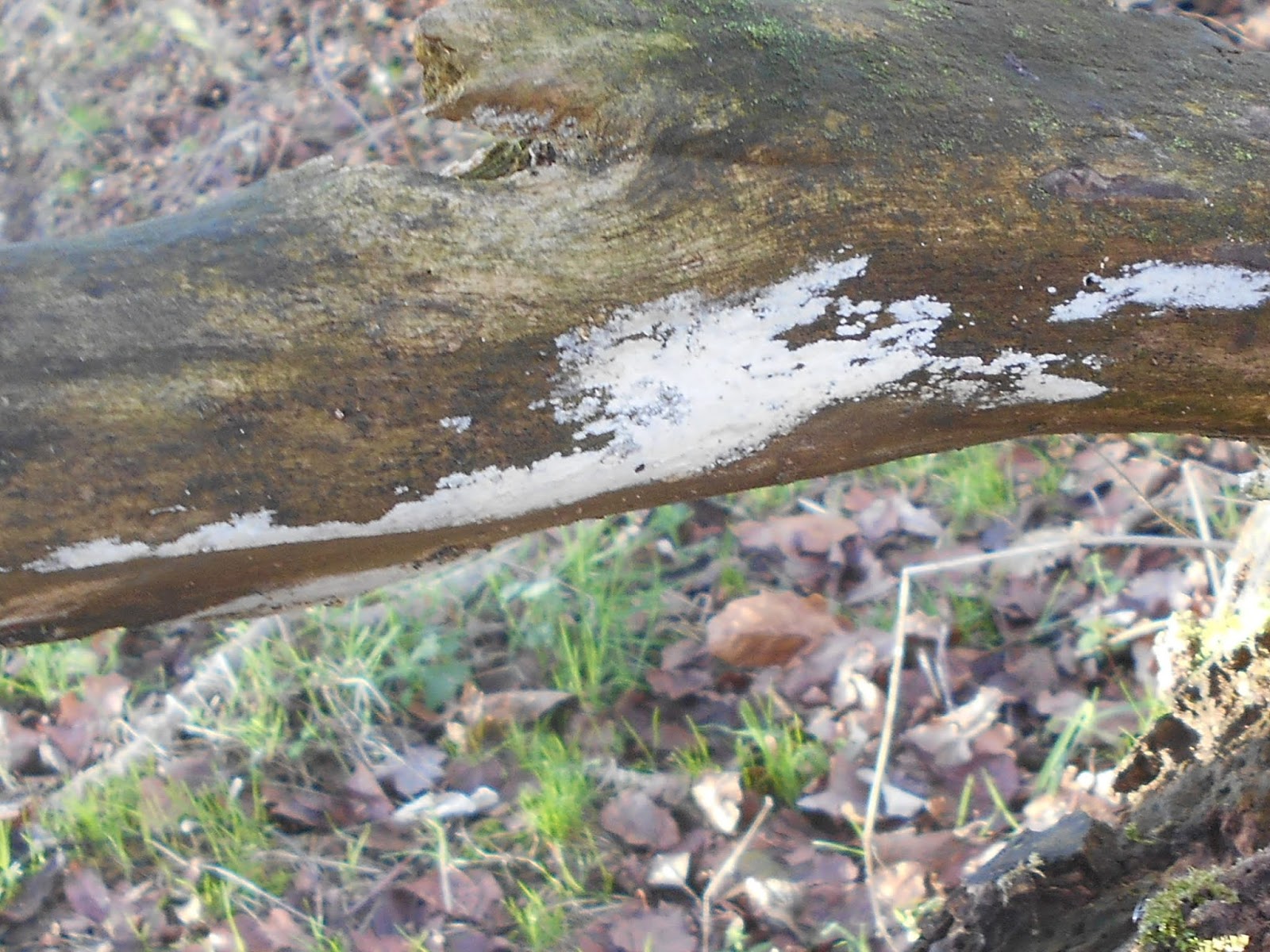
Some of the stumps were elder, Sambucus nigra, a hedgerow plant par excellence. It is not everyone's favourite but I have a soft spot for it, not least because it supports a surprising variety of wildlife. Not today of course, standing leafless or dead, although in fact even the dead branches have their points of interest, with Elder Whitewash, Hyphodontia sambuci, very evident. Common names can be pointless, even silly, but this fungus really does give the impression that someone has smeared the wood with white emulsion paint.


Elder Whitewash on a dead branch. Foxhill Farm, 8 December, 2018
A close examination of the rotting wood and loose bark revealed several beetles and bugs. The beetles will be a challenge as they aren't really my speciality and some were less than 3 mm long. The bugs were specimens of Drymus sylvaticus. This is a widespread species and, as the specific name indicates, it is frequently found in woodlands (Latin sylva, wood). Pleasingly it was a new species for the farm.


So having demonstrated unbridled courage in facing the weather I felt the effort was worth it.


.