Wednesday, 6 June 2018

Hospital: nearly there

To Northampton General Hospital. A couple more visits after today and that should wrap things up for Chris, giving her a clean bill of health.
Often, I am pleased to say, she dozes over the couple of boring hours whilst her medication is slowly administered. For my part I again slope off and stroll around the hospital grounds, witness to the seasonal changes: Chris improves but the insect and plant life is generally becoming impoverished. Never mind - so long as the world's pesticide manufacturers can turn in fat profits. Yes, cynical I know but the toll on wildlife is now at intolerable levels.
I did my usual rounds, looking for...anything really. Weeds, cultivated flowers, insects and galls - all are of interest.
As I have remarked in previous blogs, the hospital grounds are unusually blessed in toxic and officinal plants. Opium Poppies, Papaver somniferum, seem even more abundant than ever, tall despite growing in apparently poor soil.
Opium poppies are abundant on dry banks. Northampton General Hospital.
6 June, 2018
The colours vary from almost white through to a deep plum-purple and the species is understandably admired by gardeners. No true poppies yield nectar and visiting bees are seeking the pollen, produced in copious amounts. Sadly and worryingly I witnessed no bees today at all.
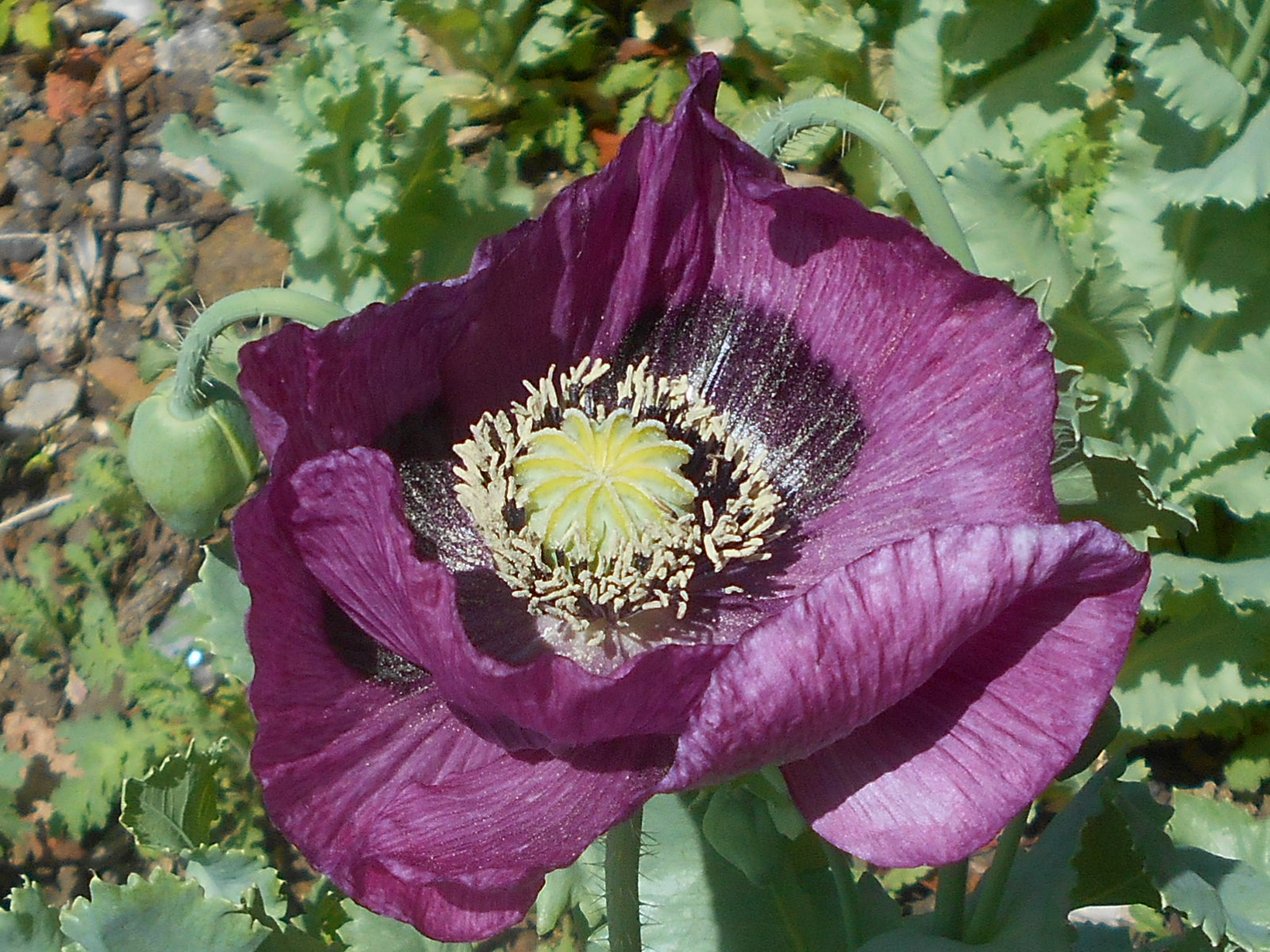
Their numerous stamens produce great quantities of pollen.
Also growing tall were plants of Hemlock, Conium maculatum. It is general assumed to be a British native plant and yet there are a number of records of hemlock from ancient Roman settlements across Britain - perhaps introducing a scintilla of doubt?
Hemlock towers almost two metres high. Northampton General Hospital.
6 June, 2018
I looked, too, for Deadly Nightshade, Atropa belladonna, but all I found were its dead, skeletal remains, having been given the coup-de grace by a weedkiller. It may have been present in the grounds for a century or so and I hope that it may yet reappear - although I doubt the hospital authorities would share my sentiments.
The only 'new' plant I noted was Scarlet Pimpernel, Anagallis arvensis. In Clare's time this little annual was abundant; by 1930 Druce was describing it as 'common' but Gent & Wilson only called it 'occasional'. This pretty member of the primrose family was inevitably remarked upon by John Clare:

                            And with eye of gold
                            And scarlet-starry points of flowers,
                            Pimpernel dreading nights and showers,
                            Oft called the Shepherds' weather glass
                            That sleeps till sun have (sic) dried the grass,
                            Then wakes and spreads its creeping blooms,
                            Till clouds with threatening shadows come -
                            Then close it shuts to sleep again...

                                                               Clare's Shepherd's Calendar, 1827

In the bright sun scarlet pimpernel was spreading its petals.
6 June, 2018

The scarlet pimpernel can hardly be called toxic although handling the leaves can cause a mild dermatitis.
Its days as a 'weed' in the hospital car parks are surely numbered. Wouldn't it be lovely if hospitals could not only care for its patients but for the wildlife in its grounds.


.

Monday, 4 June 2018

Of flowers

Today was cooler than of late and the cloud cover was 100%. Nevertheless I decided that I'd do a spot of recording, especially as Chris was also out rambling with friends. She dropped me off and I set out walking but after some ten minutes it began to drizzle. Nevertheless I was not to be daunted although the insects seemed to be lying low.
Although my interest nowadays is mainly in the recording of insects and spiders it has not always been so. In terms of wildlife I started with botany, and given the weather today it seemed a good time to pay a little more attention to the flora on and around Matt Moser's land.
The approach to the more interesting eastern part of the farm is made via a minor road which goes over the A45 Daventry by-pass by means of a bridge. The bridging required the construction of quite a big embankment and on the slopes of this is a small group - no more than a handful really - of Foxgloves, Digitalis purpurea grows. The local soil is neutral to slightly acid and therefore suitable for foxgloves but they are only occasional and this little colony may have been imported with the soil used to build the embankment.
A small number of foxgloves occur on the side of the Daventry by-pass.
4 June, 2018
Foxgloves are among the most flamboyant of our wild flowers and also extremely popular in our gardens. Horticulturists have made a wide range of colours available but our native plant in its original form is surely the finest. Gill Gent and Rob Wilson, in their 1995 flora (Ref. 1), described it as 'rare' although I would now simply term it 'uncommon'. (Incidentally Rob died less than a month ago on 9th May.)
A couple of forms grow in our back garden, Stefen Hill, Daventry.
4 June, 2018
The foxglove is poisonous of course, with two dangerous, heart-stopping chemicals, digitoxin and digoxin, in its make-up, but very few people wander around gardens chomping at leaves and flowers or at least, the number who do is fast dwindling! Bees are very fond of foxgloves but cannot access their nectar by, as it were, standing on the doorstep ; they need to completely clamber into the tube-like flowers and of course in so doing make a thorough job of pollination. The corolla tube is covered in hairs barring the entry of small insects useless for the foxglove's requirements.  In my last blog I mentioned the Angle-barred Pug moth, Eupithecia innotata, usually found on ash trees. Many plants seem to have their own pug moths and there is a Foxglove Pug too, Eupithecia pulchellata.
Flourishing beside the road were clumps of Ox-eye Daisy, Chrysanthemum leucanthemum. My grandmother always called them Marguerites, a name which commemorates Margaret of Anjou. The fifteen-year old had a spray of three ox-eye daisies embroidered on her robes when, in 1445, she married Henry IV.
Ox-eye Daisy beside the London Road, Daventry.4 June, 2018
At one time this species was abundant to the point where it could be a nuisance in cornfields; those days are no more but this lovely plant is still widely distributed on waste and disturbed ground. It normally attracts a wide range of insects but in today's cooler, sunless conditions it was receiving few visitors.
Cooler it may have been but Field 5411, into which I strolled, was a mass of colour, mainly the yellow of Meadow Buttercup, Ranunculus acris, and Yellow Rattle, Rhinanthus minor. There are several common buttercups to be found in pastures but Meadow Buttercup is a tall species with deeply dissected leaves and spreading, not reflexed, sepals. Ranunculus species are harmless when dried in hay but when green can be a problem in pastures, causing irritation to the digestive system because of the high concentration of ranunculin. This when broken down will produce the toxin, protanemonin but in fact livestock generally avoid buttercups.
The spreading sepals of Meadow Buttercup. Foxhill Farm, Badby.
4 June, 2018


In the distance the yellow was stained with a rusty red. This was due to the presence of Common Sorrel, Rumex acetosa. Its wind-pollinated flowers, male and female on different plants, may be individually small but they make certain pastures very distinctive.
Golden buttercups and yellow rattle with, in the distance, the rusty
stain of Common Sorrel. Foxhill Farm, 4 June, 2018.
Sorrel is a member of the dock/rhubarb family and its sharply sour leaves have been - and sometimes still are - sprinkled on salads.

Sorrel surrounded by yellow rattle. Foxhill Farm. 4 June, 2018
Of course, there were insects to be seen, especially as the earlier drizzle began to clear up. One very common but distinctive species was the Malachite Beetle, Malachius bipustulatus, with its red-tipped elytra but most other specimens taken were 'small fry' and will require microscopic examination.
The Malachite Beetle is both common and distinctive. Foxhill Farm.
4 June, 2018
I now have a daunting backlog of insects to be identified and a pint or two of midnight oil will be consumed over the next few days.


Reference

Gent, G and Wilson, R (1995) The Flora of Northamptonshire and the Soke of Peterborough. Northamptonshire Flora Group


Saturday, 2 June 2018

Flaming June

Flaming 'eck more like. It was hot today but the humidity was even more of a factor. Of course I went a-hunting and very productive a session it was too, but I certainly worked up a sweat! A lesser mortal would have succumbed to the heat but I was brought up on Virol and cod-liver oil so I was untroubled.

In the hedgerows wild roses are coming into bloom. The only species present was the Dog Rosa, Rosa canina. Perhaps I shouldn't use the word 'species' as this lovely plant is really a complex aggregate whose different forms are to be distinguished only by an expert.
Dog Roses have little fragrance but their simple beauty is unsurpassed.
Foxhill Farm, Badby. 1 June 2018 
Some claim that it was originally called 'Dag Rose' on account of its dagger-like thorns. As kids we would grind up the seeds - or use them whole - as 'itching powder' but I'm not sure the were really much of an irritant. During the war we collected the hips to be taken into school and weighed. We earned a few coppers this way. The hips really are very rich in vitamin C and I believe that it is still possible to purchase Rose Hip Syrup.
At the base of the hedgerows Ground Ivy, Glechoma hederacea grew and I was pleased to find one specimen bearing an impressive gall. As is often the case it was the work of a gall wasp, in this instance Liposthenes glechomae.
Liposthenes glechomae forms a remarkably large gall on Ground Ivy.
Foxhill Farm, Badby. 1 June, 2018
Distribution maps suggest that it is widespread but not particularly common. The gall is more frequently recorded than the actual wasp.
A speculative sweep with my net captured an interesting geometrid caterpillar (in America they are called 'inch worms'). It turned out to be an Angle-barred Pug, Eupithecia innotata and is another widespread species.


The caterpillar of the Angle-barred Pug, beaten from a hedgerow(from ash?).
Foxhill Farm, Badby, Northants. 1 June, 2018

This is a variable insect, so variable that different forms were once thought to be different species, and I must admit that I spent over an hour examining various features of it before coming to a decision regarding its identity.
In my previous blog I mentioned Yellow Rattle and commented on it being a hemi-parasite on grasses. The area where I was recording today contained a great deal of this ecologically important plant and it was interesting to note that, where it was abundant, few grasses flourished.
Where Yellow Rattle is present grasses are supressed...
Yet in an area barely a metre away, devoid of Yellow Rattle, grass was growing strongly. It illustrated forcibly what a dramatic effect even a hemi-parasite can have.
...but a metre away they are lush. Foxhill Farm, Badby. 1 June, 2018
This was a splendid visit and once again I was struck by the effects of a thoughtful management regime. Let's hope that this is the start of a developing trend, allowing nature to recover from the shocking agricultural methods of the last half century.


Friday, 1 June 2018

More Moser meanderings

Rain has fallen in bucketfuls over the last few days bringing serious flooding to parts of Northampton, Birmingham and Walsall. We have been quite fortunate locally but wet or sunless conditions have precluded any meaningful wildlife work. Today was something of an improvement but wellington boots were definitely needed when I visited the area around Newnham windmill in the morning.


Despite the conditions a surprising number of insects were flitting around and I was pleased to flush several specimens of Silver Y, Autographa gamma, moths from the wet grass. I was pleased not because it is rare (it is arguably Britain's most common migratory moth) but I saw few if any last year. I pursued a specimen for some fifty yards before it came to rest and I was able to photograph it; the distinctive 'y' mark on the forewings make the reason for its name very obvious.
Silver Y Moth on sorrel at Foxhill Farm, Badby, Northants. 31 May, 2018
Its caterpillars feed on a range of plants such as clovers, peas, cabbages and nettles so it seems surprising that this insect has not become established but, as with a number of other migratory moths, the winters are too cold for the caterpillars to survive.
'Bloodsuckers' were abundant. This is the name we applied as children to certain cantharid beetles and it seems that all across Britain this name was commonly used. It can only be as a result of their coloration for they are perfectly harmless to humans.
Cantharis rustica on a sycamore leaf. Beggars Bank, Foxhill Farm, Badby.
31 May, 2018
I must have noted fifty or so specimens and all were Cantharis rustica. Apparently some fly fishermen will try to produce an imitation to use at times when this beetle is abundant.
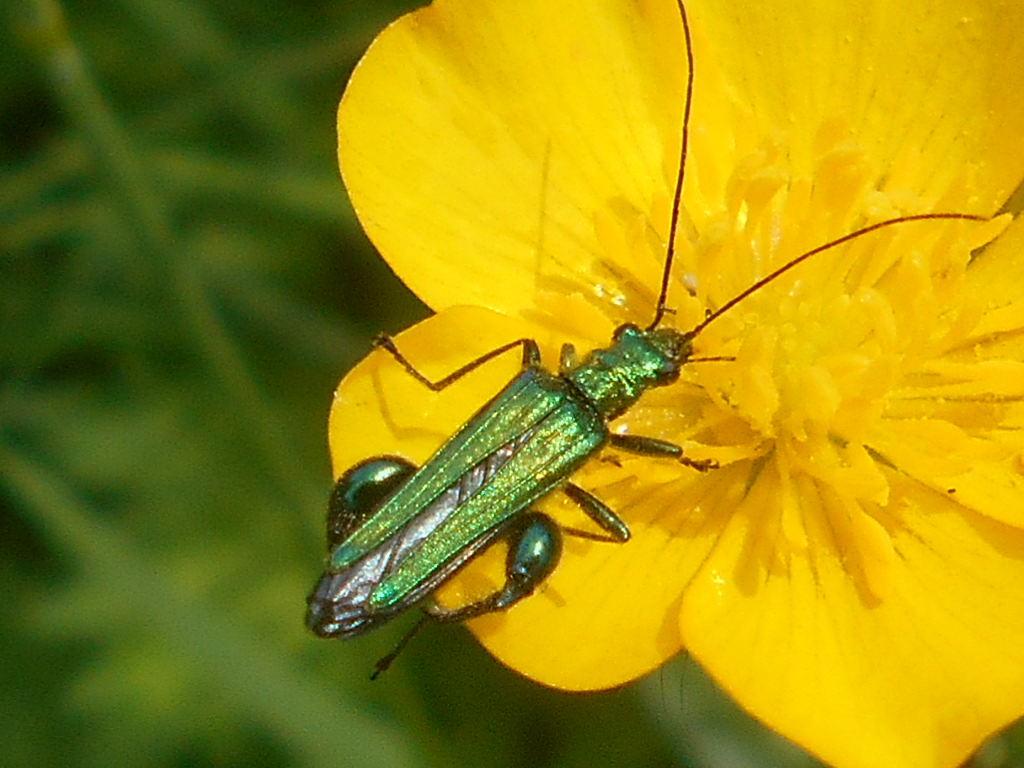
Another common beetle was the Swollen-thighed Beetle, Oedemera nobilis. It is a pollen feeder and was frequent on buttercups.
A male Oedemera nobilis on a buttercup flower. Foxhill Farm, Badby.
31 May, 2018
Only the males have the grossly swollen femorae, the females being more, er, svelte. The wing cases on both sexes are usually gaping and it would be difficult to confuse this insect with any other species.


Many familiar insects go through a larval stage in the form of a maggot, grub or caterpillar. However some insects spend their early stages as a nymph, in many cases looking rather like a scaled-down version of the adult but without wings. The true bugs are insects of this type and during their development they pass through a series of instars, with each instar a little closer to the adult form. I was photographing this shieldbug when, just as I was about to net it for a closer examination, it dropped to the ground and was lost in long grass. Nevertheless I am confident that it is a Forest Bug, Pentatoma rufipes.
The nymph of Pentatoma rufipes is not yet as handsome as the adult form.
On an ash leaflet, Foxhill Farm, Badby. 31 May, 2018
When fully adult it will have reddish legs hence, of course, the specific epithet 'rufipes'. Despite lacking bright colours the adult is a rather handsome insect and among one of our larger shieldbugs. It is quite common and I have occasionally found this species in our garden. A Green Shieldbug, Palomena prasina, was on the same branch.


Matt Moser, the farmer to whom this land belongs, is keeping livestock off this and associated fields, allowing the grass to grow tall. But Yellow Rattle, Rhinanthus minor, is also present and, being a hemi-parasite (see footnote), helps to control the more rampant grasses, allowing the associated meadow flowers to flourish.

Yellow Rattle is a hemi-parasite on grasses, preventing them from
becoming too exuberant.  Foxhill Farm, Badby. 31 May, 2018
Over 95% of Britain wildlife has shown a catastrophic decline during the past fifty years but I was enormously encouraged by the flora and fauna seen today and it demonstrates that, with sympathetic management our wildlife can recover.

Footnote  I could have employed the term 'semi-parasite'. 'Hemi' is Greek and 'Semi' is Latin (and 'Demi' of course, is French): all mean 'half'.


Thursday, 31 May 2018

Squiggles and lumps

The leaves of plants are attacked by a wide range of insects and fungi and I find it an interesting exercise to do a bit of detective work and identify the culprits. (Someone has to do it!) In the early spring months leaves are by and large free of blemishes but as the weeks roll by the damage becomes more obvious and by late May there is much to be seen.
I have already mentioned Neuroterus quercusbaccarum  (My blog, 'Rolling our sleeves up', 18 May). This is a curiosity in that this tiny wasp will induce the production of differently-shaped galls depending on where and when the attack occurs. The photograph shows the gall produced on the leaf of a Pedunculate Oak, Quercus robur.

Neuroterus quercusbaccarum. Gall on an oak leaf in Byfield Pocket Park
Neuroterus quercusbaccarum will also form a Currant Gall on catkins but Andricus grossulariae forms a very similar gall also on catkins. A specimen on a Turkey Oak, Quercus cerris, outside the village hall in Byfield, Northants will require further examination to establish which of the two species is involved. 
Neuroterus quercusbaccarum or Andricus grossulariae? Turkey Oak in
Byfield, Northants. 30 May, 2018


A gall is an abnormal growth on a plant consequent on an attack by another organism and involves some sort of swelling or thickening of the tissues and discoloration is common. They may not be as obvious as the example shown above and may take many forms. Ash tree, Fraxinus excelsior, leaflets are frequently attacked. This violet-purple roll on the edge of a leaflet is the work of a psyllid bug, Psyllopsis fraxini. It is exceedingly common and sometimes very disfiguring yet little serious harm appears to result.
A psyllid bug, Phyllopsis fraxini, causes this rather distinctive gall on
ash tree leaflets. Park Leys, Daventry. 29 May, 2018
A rather odd gall on poplars is that formed by an aphid, Pemphigus spyrothecae. It causes the leaf petiole to form a spiral of two or three twists and apparently only attacks Black Poplar or one of its hybrids. Here it is affecting Lombardy Poplar, a fastigiate form of Black Poplar, in Byfield, Northants.
The gall of Pemphigus spirothecae on 'Lombardy' Poplar. Byfield,
Northants. 30 May, 2018
Anyone who cares to examine the leaves of Common Lime, Tilia x europaea, will almost certainly find galls. A dozen or so organisms are involved but perhaps the most frequent one is that induced by the mite, Eriophyes tiliae. I recently counted over twenty galls on a single leaf.
The galls of Eriophyes tiliae on Common Lime. Byfield, Northants.
30 May, 2018


Besides galls a leaf will frequently exhibit mines, usually formed by insect larvae tunnelling through the leaf. A rather typical example is this mine on a lilac, Syringa vulgaris, caused by a moth, Gracillaria syringella. The mine starts as a discolored patch but eventually the leaf becomes grossly distorted and curled at the edges. The moth bears the unexciting name of The Common Slender and will also attack privet and ash trees - not surprising given that all these three species are all in the Olive Family, Oleaceae.

The Common Slender is the micro-moth responsible for this damage to
the leaves of lilac. Park Leys, Daventry. 29 May, 2018 
There seem to be very few plants fortunate enough to be free of attacks by one insect or another. Even the humble buttercup is victim to the larvae of several insects. Here Meadow Buttercup, Ranunculus acris, exhibits the mines of Phytomyza ranunculivora, an agromyzid fly.
Meadow buttercup mined by the larvae of Phytomyza ranunculivora.
Foxhill Farm, Badby. 31 May, 2018

As I said in the opening paragraph, detective work is always interesting for the naturalist and the solving of these little puzzles adds much to a country walk.


Monday, 28 May 2018

Work on the lottie

Our allotment work tends to be spasmodic and is governed by the weather, available time and the urgency of the tasks pending. We had a slow start: winter was colder than usual and spring sunshine was slow to warm up the soil. We impetuously put in our runner beans at the beginning of May, only for a frost a few days later to do rather a lot of damage. They have since recovered and things are now looking far better.
After the set-back of a frost our runner beans are doing nicely.
Drayton Allotments, Daventry. 28 May, 2018 
Rhubarb is pretty foolproof and is doing well, but we won't attempt to pull any of the sticks this year and instead let it build its strength up. It is in the Dock Family, Polygonaceae, and will occasionally attract Dock Bugs, but not so far this year.
It is tempting to pull a stick or two of rhubarb but we must show restraint.
Our allotment, 28 May, 2018
Taters are doing nicely. We grew a lot in 2017 but this year are confining ourselves to 'Charlotte', one of the best of the earlies. We took a risk (only a very slight one) and used 'ware' potatoes - bought simply in a bag at Waitrose - rather than 'proper' seed potatoes. They seem to be doing fine and should be O.K. It is important to avoid ground where they grew last year.
Potatoes seem to be doing well
I put in a row of Phacelia, Phacelia tanacetifolia. This annual from the south-west of the U.S.A. is not only ornamental but is very attractive to bees. I have lots of seed and will use it as a 'green manure' towards the end of summer, digging it in when it is maybe six inches high.
Phacelia should give a colourful show of pale lilac
flowers and attract lots of bees.
We are very pleased with our raspberries. They are growing strongly and we are hoping for a good crop from early August onwards. Gooseberries are doing well too.
Out raspberries are a late variety so we'll have to be patient.
28 May, 2018
But there have been failures. We sowed some sugar snap peas but didn't net them quickly enough; a rather nice row of seedlings was completely taken by Wood Pigeons, Bluddi nuisancii. We won't re-sow.

Tony White: diaea@yahoo.co.uk


Friday, 25 May 2018

Garden goodies


Twice recently I have been out recording wildlife and on both occasions I have forgotten to take my camera. To exacerbate the problem I lost my phone and therefore couldn't use its camera facility. (The phone has turned up at the Errol Flynn Cinema in Northampton and there awaits my collection.) In consequence my blogs have temporarily dried up.
Lots of country walking has led me to neglect our garden, at least in the photographic sense, but today I got around to checking it over - once the rain had ceased.
The petals of our Pasque Flowers, Pulsatilla vulgaris, a species native to Northants, have long since withered and gone but these plants have a second phase of beauty. The styles become elongated and feathery, forming a globular seed head, allowing seeds to be distributed by the wind. Around the garden are lots of seedlings from last year's flowers and I am able to give them away to friends.

The seed heads of pasque flowers are attractive in their own right.
Stefen Hill, Daventry. 25 May, 2018
On the subject of seedlings, our Fairy Foxgloves, Erinus alpinus, have seeded so prolifically that their progeny have assumed an almost weed-like status. Pretty though they are I am having to be ruthless in taking out most of them. Although only two or three inches high they really are related to foxgloves.
Mauve Erinus alpinus in our front garden at Stefen Hill,
Daventry. 15 May, 2018

Various forms of thyme have steadily spread over rocks and gravelled areas and are just coming into flower. Thymus vulgaris, T. serpyllum, T. herba-barona and others offer a range of colours and textures. All are lovely.

Aquilegias offer a contrast in height. Stefen Hill, Daventry.
15 May, 2018
Most of the plants in our front garden are low-growing, even ground-hugging, but aquilegias are an exception. Like Pasque Flowers they are members of the buttercup family and one species, Aquilegia vulgaris, is also a Northamptonshire native. The long, nectar-containing spurs point backwards and are hooked like an eagle's bill, probably giving rise to the Latin generic name (Aquila: an eagle).
The flowers merit a closer look and have clearly evolved for long-tongued
insects. Stefen Hill, Daventry. 25 May, 2018
The plants currently in bloom overwhelmingly have lilac, purple or reddish flowers but members of the Stonecrop Family, Crassulaceae, almost invariably have yellow or white flowers. Various species are readily available and one of the plants I grow is the Mongolian Stonecrop Sedum hybridum in its form 'Immergrunchen' - cheerful and easy.
It is apparently from Mongolia but Sedum hybridum is happy in Daventry.
Stefen Hill. 25 May, 2018
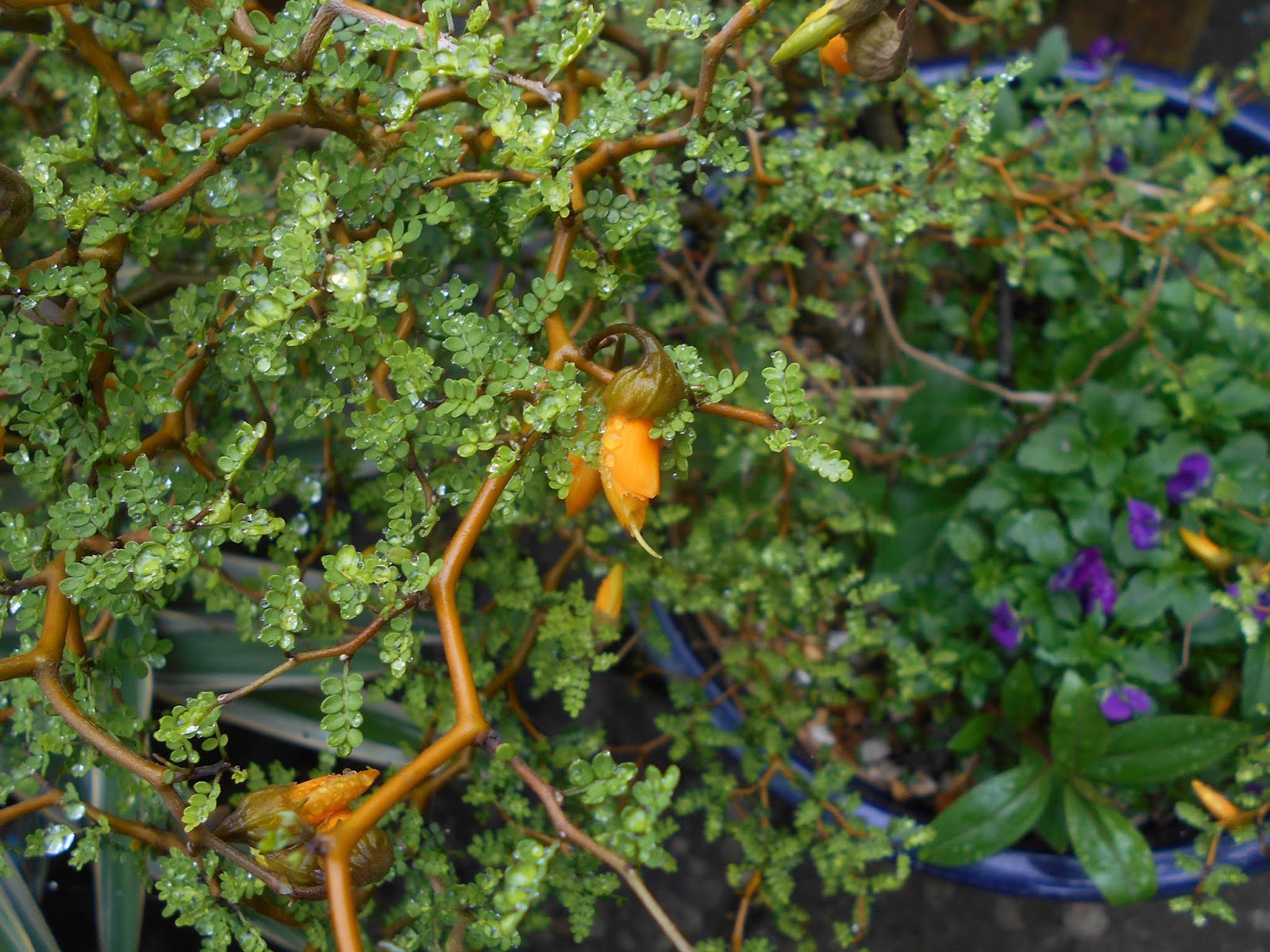
Speaking of yellow flowers, I must mention Sophora prostrata. This is an odd member of the Pea Family, Fabaceae, and comes from the South Island of New Zealand. It has a framework of wiry stems with tiny leaves. Not spectacular but certainly unusual.
Not spectacular and not particularly photogenic but Sophora prostrata is
a plant I cherish. Stefen Hill, Daventry. 25 May, 2018
I am not convinced that it is completely hardy so I grow it in a container. Nevertheless it survived some fairly hard frosts this winter so eventually I may plant it in the front garden.