Friday, 18 May 2018

Rolling our sleeves up

The pocket park at Byfield needs more maintenance than Pom Boddington and her team can provide, but we do our best. Chris and I went along this morning to do a couple of hours because, although we no longer live in the village we retain a sort of attachment.
A team of about eight people had assembled to roll their sleeves up and do what they could; this is a slightly larger group than usual but to be honest it was hardly enough.
Rose-bay Willow Herb, Fireweed, call it what you will, is a constant problem. This plant, Chamaenerion (or Chamerion) angustifolium, is a puzzle. In 1930 Druce, in his Flora of Northamptonshire called it 'local' but added 'rapidly expanding its range'. One possibility is that a tiny but significant mutation occurred sometime in the years following World War I, conferring this sudden aggressive trait.  Along with nettles and brambles it has become a pernicious weed and, in one area of the pocket park we have all three of the buggers little rascals.
Rosebay Willow Herb forms a dense stand, but it is wonderfully
colourful in late summer. Byfield Pocket Park. 18 May, 2018
If we could get on top of it other, more delicate plants would stand a chance, but full clearance would probably require a herbicide - and we are trying to avoid that route. As it is only a few species, such as Red Campion, Silene dioica, are robust enough to survive. Be that as it may, plenty of insects visit this particular patch for nectar or to lay their eggs on these plants.
Red Campion flowers are a valuable source of nectar.
Byfield Pocket Park. 18 May, 2018


Busy with spade, trowel and secateurs, I had little chance to look for wildlife but a couple of things came to my attention. We had a mid-morning break for coffee (and Pom's delicious biscuits) beneath an oak tree and on the underside of several of the leaves were spherical galls. They are the work of a cynipid wasp, Neuroterus quercusbaccarum. Similar galls, formed by the same species, are often found on the catkins, looking like succulent berries.

The spherical gall of Neuroterus quercusbaccarum is always on the
underside of the leaf. Byfield Pocket Park. 18 May, 2018
Literally six inches away a very common mirid bug was present. I use the word 'bug' in the proper sense - an insect with mouthparts modified into a structure almost like a drinking straw and used for piercing plant stems or leaves to feed on the sap. (The Bed bug, Cimex lectularius, is making something of a comeback in the UK and is proving more resistant to insecticides, with increased foreign travel has being blamed. In the case of this creature the pabulum is human blood.) However, mirid bugs feed exclusively on plants, and the species in question was the very common and conspicuous Calocoris stysi. So that's ok.
Calocoris stysi is a common, quite variable and colourful bug.
Byfield Pocket Park. 18 May, 2018
Another hour of steady work didn't seem to make great inroads into the weeds and all I felt I'd achieved was getting my forearms nettled. I shouldn't have rolled my sleeves up! Eh bien.


Thursday, 17 May 2018

More of this and that

Yesterday was rather chilly and I wimped out of countryside capers and instead worked on the identification of specimens. There was quite a back-log.


Today there was far more sunshine and therefore no excuse for sitting around. It was a case of best foot forward (actually it could have been second best; I can't remember) and off to Foxhill Farm. If my visits there seem excessive I plead guilty - up to a point. The fact is that it is geographically convenient and the area is becoming well-known for wildlife enthusiasts. Today, for example, I met Brian Laney, a frequent lecturer on wildlife topics and a well-known botanist with a particular interest in alpines. He told me that in an adjacent field he had just found a specimen of Sheep's-bit, a scabious-like flower which, according to Northamptonshire's latest flora, is extinct in the county! I found nothing so rare but was pleased to find plenty of Pignut, Conopodium majus. This is one of those plants which, though once common, is now increasingly scarce as a result of 'improvements' to pastures and is now only thinly scattered across the county.
Pignut was present in considerable quantities. Foxhill Farm.
17 May, 2018
The small tuber - less than golf-ball size - is said to be very palatable but I have never sampled it. Various books give instructions on how to locate the plant and find the edible part, but I hope few people go around digging up specimens.
Lots of Meadow Buttercups were in bloom. Their scientific name, Ranunculus, as I have said before, comes from the Latin for 'little frog', perhaps because they often are found in rather wet habitats. Sure enough, hopping along...
A frog had to put in an appearance!

Moles had been busy in places and the bare soil was attracting flesh flies, basking on the warm surface. Two species are particularly common, Sarcophaga subvicina and S. carnaria. The females can be difficult (nothing new there!) but the males are less of a problem although a decent microscope is required.

Flesh Flies, Sarcophaga species, enjoy warm surfaces in the sun.
Foxhill Farm, 17 May, 2018
Changing the subject completely, I was at Daventry's hospital (The Danetre) earlier today and saw a Gorse Shieldbug, Piezodorus lituratus, on Spanish Broom, Genista hispanica. The Gorse Shieldbug, whilst most commonly seen on gorse, will visit a range of woody plants in the pea family and is occasionally even seen on laburnum. As soon as I approached it scampered on to a nearby bramble leaf but it was on the Genista - honestly.
Gorse Shieldbug on a bramble leaf, having just left a branch of Spanish
Broom. Danetre Hospital, Daventry. 17 May, 2018


Monday, 14 May 2018

4213 and 2997 - with postscript

Today's forecast promised sunshine and warmth. That sounded like a good excuse to visit Foxhill Farm again but today, instead of visiting the steep slopes of Beggar's Bank I decided to have a look at some of the lower pastures and I spent the morning in fields 4213 and 2997. These are wet in places and have not been grazed for the best part of a month, consequently many plants are on flower including buttercups and lady's smock. Orange-tip butterflies, for whose caterpillars the Lady's Smock is a food-plant, were flitting about.
Both fields contain a great deal of Yellow Rattle, Rhinanthus minor.

Yellow Rattle was once placed in the Figwort Family but is now in the
 the Broomrape Family, Orobanchaceae. Foxhill Farm, 14 May, 2018
In nature reserves this plant is an excellent component of meadowland as, being a partial parasite on grasses the coarser ones, which could overwhelm more delicate species, are weakened and suppressed. From the point of view of a pastoral farmer strongly-growing grasses are probably a bonus and yet Matt Moser, the landowner, seems happy to have Yellow Rattle on his land. (I even have a sneaky suspicion that Matt, being a wildlife lover, sowed the seeds deliberately.)
The hedgerows forming the field boundaries were mostly hawthorn, with a little blackthorn. Sone elm was present too and, almost predictably, many of the leaves bore tiny galls caused by a mite, Aceria campestricola.

Elm leaves galled by the mite, Aceria campestricola.
Foxhill Farm, 14 May, 2018
Several quite large trees are present here and there, breaking up the regular lines of the hedgerows. Oak, sycamore, field maple and ash will all be worth checking over the next four months for galls and already some are appearing. On Field Maple, Acer campestre, the galls of another mite, Aceria macrochela, were present as small red pimples in the angles of the leaf veins. They appear to do little harm.
Aceria macrochela is a common gall-inducing mite of Field Maple.
Foxhill Farm, Badby. 14 May, 2018
Cecidology, the study of galls, is of considerable interest and importance because, although galls generally go unnoticed they can occasionally be damaging to crops or the horticultural trade.
In a corner of field 2997 is a small pond, fenced and inaccessible to livestock. I took a number of insects in the area although none was particularly associated with water. It will probably be important later in the summer.

This pond may be of importance to wildlife later in the summer.
Foxhill Farm. 14 May, 2018
Craneflies were abundant in the area including Limonia phragmitidis, with three wing spots, a cream-coloured body and a distinctive mark on the top of the thorax.
Limonia phragmitidis is among the commonest of spring craneflies.
Foxhill Farm, 14 May, 2018
Finally I should mention that in another corner of the same field a group of conifers has been planted including larches but as far as I could see only Japanese Larch, Larix kaempferi, was present. These light brown developing cones would be cherry-red if the species were European Larch.
Larch trees are at their loveliest in spring. Japanese Larch at Foxhill Farm,
Badby, Northants. 14 May, 2018
Although the conifers are exotics they are nevertheless worth keeping an eye on as they have a number of interesting beetles and bugs associated with them.
Prior to today I had recorded 144 species of arthropod (insects, spiders, centipedes, etc.) from Foxhill Farm but with today's findings the total could reach 180 or above.


Postscript


Sorting through my specimens later I find that I have taken a nice example of Criorhina floccosa. It is not a rarity but I cannot recall the last time I recorded it. Despite its general appearance it is not a bumblebee but is a hoverfly. A very pleasing record.


Criorhina floccosa. Foxhill Farm, Badby. 14 May, 2018


Saturday, 12 May 2018

Clematis cartmanii

About 3-4 years ago we - Chris and I - bought a plant of Clematis cartmanii. It turned out to be a very attractive climber and so we bought a second specimen. What at the time I hadn't realised is that this 'species' is a hybrid, the parents being two New Zealand species, Clematis marmoraria and C.  paniculata. Furthermore the cross between these two species has been made on a number of occasions, each time with a slightly different result. The consequence is that we have finished up with two forms of the hybrid.
We grow two forms of Clematis cartmanni. Stefen Hill, Daventry.
12 May, 2018
The differences are obvious: the first plant we bought was the form with smaller flowers and green centres. Small it may be but it is a prolific flowerer but neither this nor the larger version are equipped with tendrils; instead the petioles - leaf stems - will curl around suitable twigs or other projections. We constantly have to tie in the straggly branches.
On the left is an example of the four-petalled flower occasionally
produced. 12 May, 2018
The flowers of the larger form have more impact and, interestingly, a four 'petalled' flower is frequently produced. In this form the flower resembles our native Clematis vitalba or Traveller's Joy. The 'petals' are of course really sepals with a petaloid form. Interestingly the parents, Clematis marmoraria and C. paniculata are attractive species in their own right although the flowers of the former are rather small. They are not commonly seen in cultivation outside larger collections.
Our native Clematis vitalba produces four-petalled flowers.
Northampton General Hospital, August, 2017


Tuesday, 8 May 2018

Bing walking

Bing belongs to my daughter Jacqui and it doubles as the school 'therapy' dog. It will sit with children who are upset and seems to calm them down; they will often talk to about their problems when Bing is present where they would not otherwise unburden themselves to their form teacher or a child psychologist. But although Bing normally accompanies Jacqui to school I looked after her today as my daughter was otherwise engaged.
I picked her up from Jacqui's house and set out, with Bing as tugging at the lead, as lively as a cricket. She is an epic sniffer and will pause at any number of posts, trees or even tussocks of grass.
We maintained a cracking pace, and, as there are still areas of Daventry I barely know, I decided to take a roundabout route to my house on Stefen Hill, going via the Royal Oak industrial estate. It would, I felt, run some of the steam out of Bing.
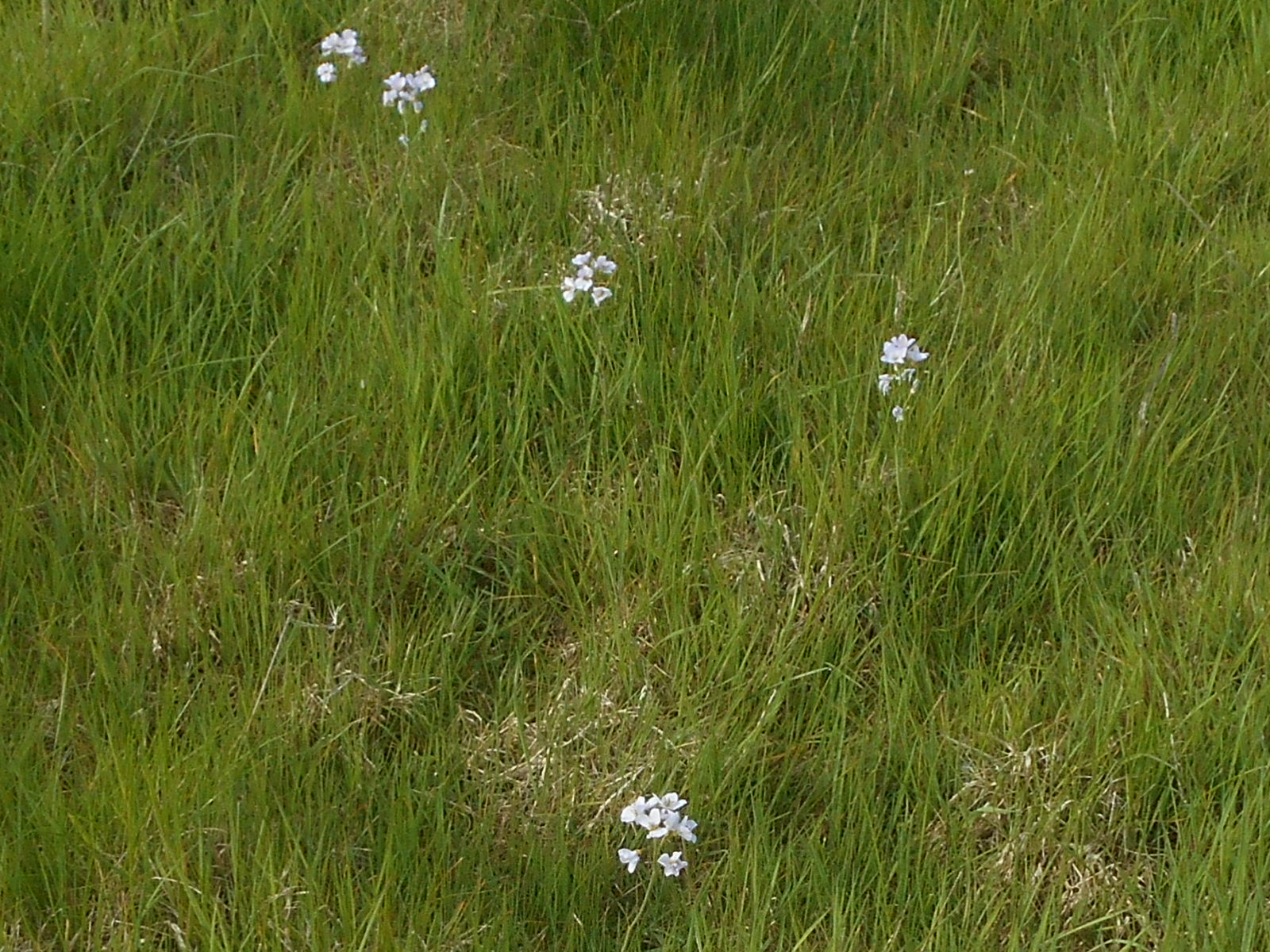
The term 'industrial estate' suggests a rather uninteresting, even grim, area for a wildlife enthusiast such as me, but there are still large area of open grassy fields yet to be built upon. Hundreds of plants of Lady's Smock, Cardamine pratensis, were present, reminding us that this was once meadowland. In a month or so I would not be at all surprised to find an orchid or two in this area.
Open areas on the Royal Oak industrial estate are studded with
Lady's Smock. Daventry, 8 May, 2018
But even where buildings were present the scene was brightened with species such as Oxford Ragwort, Senecio squalidus. Although the specific epithet implies it is a plant of squalid places this is not always the case and it certainly provides a splash of colour wherever it grows, and as a bonus it is also the food plant of the Cinnabar Moth. 
Plants of Oxford Ragwort brightened up waste ground and roadsides.
Royal Oak, Daventry. 8 May, 2018
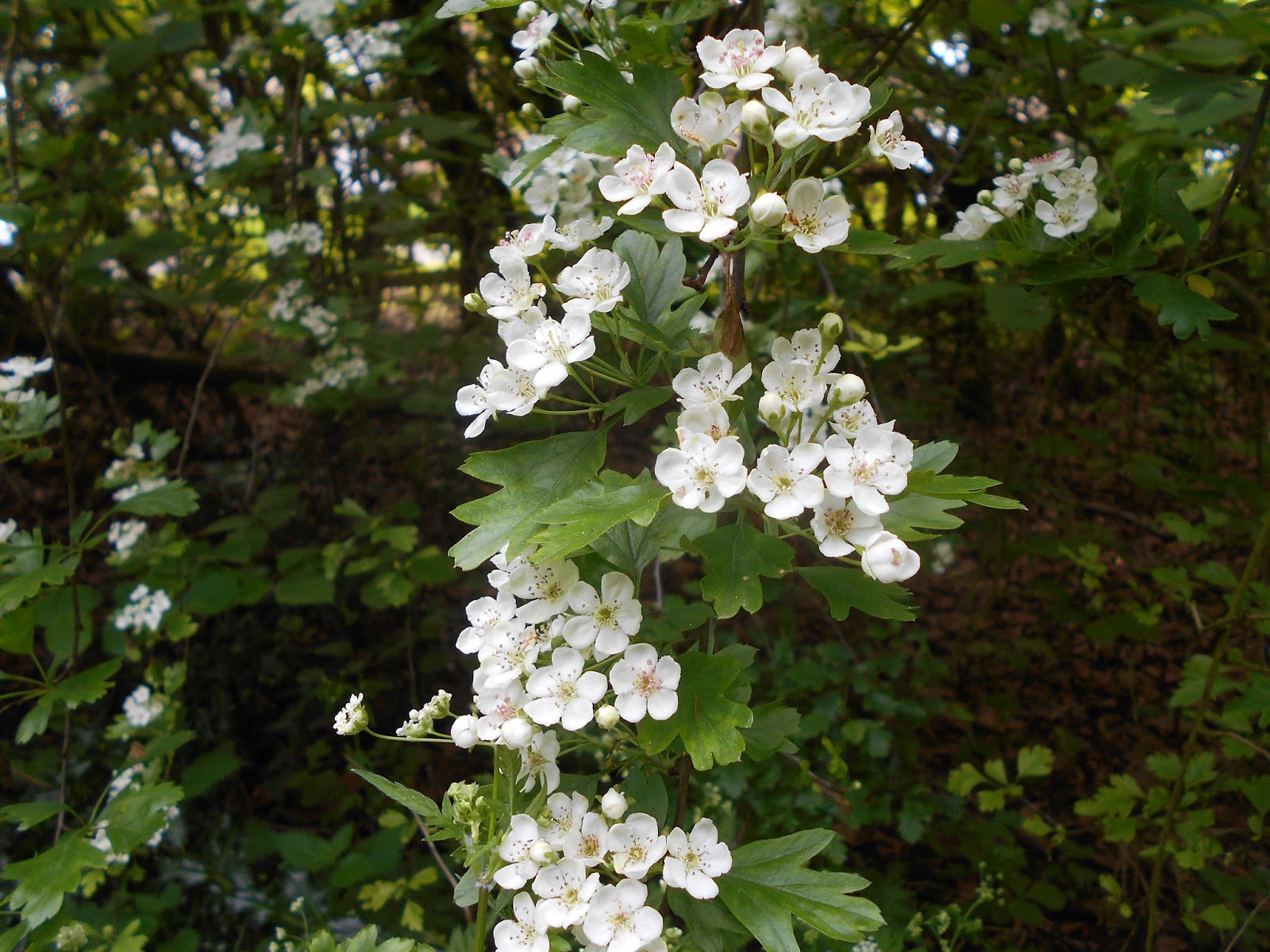
Hawthorn, Crataegus monogyna, bushes were covered with a froth of blossom so, with May out I can cast a clout. And as the temperature rises later in the day the plants should be visited by numerous insects including many which will induce the development of galls.
Hawthorn (May) is at its finest. Royal Oak Industrial Estate, Daventry.
8 May, 2018
A little further on in fact a few hawthorn bushes did have grossly distorted leaves but this was not the work of insects but was caused by a fungus, Taphrina crataegi.
Taphrina crataegi was causing the distortion of hawthorn leaves in
The Grange area, Daventry. 8 May, 2018

As we entered The Grange housing estate I expected to see the last of any meadow flowers so I was delighted to find that in a neglected garden dozens of Lady's Smocks were in bloom. Please, whoever you are, don't mow for a while.
Delightfully neglected gardens provided a habitat for Lady's Smock.
The Grange, Daventry. 8 May, 2018
Perhaps even more surprising, in the shade of a relict hedgerow, a Wood Anemone was in flower! Again it was evidence that, perhaps as recently as the 1970's, this area was still open countryside or even woodland.
Even a Wood Anemone had survived. The Grange, Daventry.
8 May, 2018
But by and large traces of the original vegetation had disappeared, to be replaced by ruderal plants such as groundsel, shepherd's purse and Herb Robert, Geranium robertianum. The word Geranium is derived from the Latin geranos, a crane, the seeds taking the form of a long, beak-like structure and leading to the name Cranesbill being applied to the genus.
Herb Robert, a pretty if smelly weed. The Grange, Daventry.
8 May, 2018
And that was about it, with Bing now trotting gently alongside me, much of her earlier energy having been burned off. There was just time to photograph a plant superficially like a white bluebell (not a true oxymoron I suppose) but which was in fact a type of onion.
Also smelly is this onion relative, Three-cornered Leek. The Grange,
Daventry. 8 May, 2018


The Three-cornered Leek, Allium triquetrum, is a native of the west Mediterranean region (and, perhaps, the Channel Islands) but has become thoroughly naturalised in southern Britain, being first recorded in 1759, and seems to be steadily on the increase. I gather that it has been a nuisance at the Chelsea Physic Garden for years and here it was trying to escape from a garden. 

A closer look shows the green stripe down each 'petal', typical of onions.
The Grange, Daventry. 8 May, 2018


If anyone offers me a clump I'll say 'Thank you very much, but no.' Spreading by both seeds and bulbs it would soon become unwelcome, as it was a few years ago in our garden in Byfield.


Tony White. E-mail: diaea@yahoo.co.uk


Sunday, 6 May 2018

Harlestone Heath

North-west of Northampton, near to the villages of Upper and Lower Harlestone lies 'Harlestone Firs'. In fact it should perhaps be called Harlestone Heath, but even that would not quite be correct as the land in question also includes Dallington Heath.
Northamptonshire has never been known for its heathland although little exists east of Northampton at Billing Lings, the name of which reminds us that Ling, Calluna vulgaris, once grew extensively there. By far the largest area of heathland was, and still is, Harlestone Heath.
Sadly, in an act of what today would be called gross environmental vandalism the land, belonging to the Spencer family, was almost completely planted over with conifers around a century ago. No doubt it seemed at the time a reasonable use of agriculturally unproductive land but for a particular suite of plants and animals it was a disaster.
Anyway, in wonderful weather, with the temperature already approaching 20 degrees, four enthusiasts assembled at the entrance to the 'Firs' and we set off 'spirits high and hearts aglow'.
One of the most interesting areas consists of a strip of damp heathland parallel to the Northampton - Rugby railway line. It receives some protection as a nature reserve and the four of us made this our target although predictably we paused en route, distracted by various creatures such as solitary wasps. Indeed, so often did we pause that when we eventually arrived at the reserve we had insufficient time to do it justice.

Robin, Brian and John, busy along one of the main rides. Harlestone Heath.
 6 May, 2018

I was probably as guilty as anyone, poking around for spiders, bugs and this moth which is, I believe, the Meadow Long-horn, Cauchas rufimitrella. My photograph fails to do justice to the brilliant brassy forewings.

Meadow Long-horn Moth on sycamore. Harlestone Firs, 6 May, 2018
When we finally reached the reserve I was pleased to find Broom, Cytisus scoparius, in full bloom. It is quite widespread across Northamptonshire but less common than
its relative, gorse and I had forgotten that it occurred here. I had hoped to find Gorse Shieldbug on the flowers but had no success. There were worryingly few butterflies on the wing, surely an indication of the devastation our wildlife has suffered in recent decades.
Broom, with its flowers forming golden showers. John examines the
contents of his sweep net. Harlestone Firs, 6 May, 2018
I left the area with a vague sense of dissatisfaction, knowing that a more thorough survey was called for. However, I have a few specimens to sort through including a rather intriguing fly and there could be a surprise. We'll see. 


Footnote  In the event the only species of any interest turned out to be of interest were a conopid fly, Myopa testacea, and a click beetle, Ampedus balteatus. The former is quite common but the latter is rather less so and is associated with birch trees.


Thursday, 3 May 2018

Bounteous May!

Well, we've waited patiently and finally it is here - a lovely, warm and sunny day. Rather predictably I set out for Foxhill Farm, feeling very optimistic.
I paused a little below Newnham Windmill and looked out at the landscape. It was beautiful but rather daunting and I must accept that I'll never adequately record all the insects and spiders present but as I say, I was in an optimistic mood and weeks ago I had resolved to give it a bash.

Looking west across Foxhill Farm. The white building in the distance is
Badby Care Home. 3 May, 2018
Flowers are beginning to make their presence known, particularly in places where they are out of the reach of ever-nibbling sheep. Greater Stitchwort, Stellaria holostea, was present, often behind barbed-wire fences. Apparently it really was once thought to ease a 'stitch' in the side. Children (and adults) are amused  to find that when the seeds are ripe it is only necessary to brush against the plants for the capsules to go off with a pop, scattering seeds over some distance.
Greater Stitchwort is still quite common over much of Northamptonshire.
Near Newnham Windmill, 3 May, 2018
My suspicion that some of the tree cover is of considerable age was strengthened by the presence of patches of English Bluebell, Hyacinthoides non-scriptus, for this plant is recognised as a good indicator of ancient woodland. The drooping, one-sided inflorescence is quite distinctly different from that of the Spanish Bluebell and is of a deeper blue. It can be argued that Hyacinthoides hispanica is a better garden plant, being stouter and therefore less prone to flop untidily, but it all-too-readily hybridises with our native species.
Our native bluebell has drooping flowers forming a one-sided
inflorescence. Beggars Bank, Foxhill Farm. 3 May, 2018
Rosettes of violets were scattered over the woodland floor. We have seven species of Viola in our country (eight, if escapees of Garden Pansy are included) but these were Common Dog-violet, Viola riviniana.
Common Dog-violets were frequent on the woodland floor.
Beggars Bank, Foxhill Farm. 3 May, 2018
Gorse was in flower of course, and so abundant as to be taken for granted, but I was pleased to see that, finally, Gorse Shieldbugs, Piezodorus lituratus, were present. I have been looking for them, without success, for the last three weeks, but today, suddenly, they were present in dozens. It cannot be called an exciting-looking bug but it is beautifully camouflaged against the young seed pods.
A remarkable number of Gorse Shieldbugs were present.
Foxhill Farm, Badby. 3 May, 2018


Also present was the Sloe Bug, Dolycaris baccarum, but although I had expected to find other species it was not to be.
Sun-warmed wooden fences were attracting hordes of flies, but none more handsome than the Noon-fly, Mesembrina meridiana. With its golden face and conspicuously yellow wing base it is a striking insect. It breeds in cow-dung - and clearly thrives on it.
The striking Noon-fly loves sun-warmed surfaces. Beggars Bank,
Foxhill Farm. 3 May, 2018
Perhaps I should close with a mention of the woodland tree trunks. Many were showing bright rust-coloured patches of the alga Trentepohlia. There are a number of species and I currently have no key for separating them. The colour is due to the presence of a carotenoid - the pigment which gives the same colour to carrots. I have a feeling that these algae are becoming more common, but have no evidence to back up this idea.

Rust-coloured patches on tree trunks are usually species of an alga,
Trentepohlia. Beggars Bank, Foxhill Farm. Badby. 3 May, 2018.
I suspect I'm going to be kept very busy during the coming weeks.