Tuesday, 20 June 2017

The Duke of Argyll's Teaplant

I was strolling down Daventry's London Road earlier today when my attention was caught by a scrambling shrub, cascading over a hedge of hawthorn. It was Lycium barbarum, otherwise known as the Duke of Argyll's Teaplant.  it is an untidy plant but can add interest to an otherwise 'ordinary' hedge. Despite being an introduction it is quite widespread and I have been familiar with it since my youth. Its curious name relates to a spot of confusion which arose way back in the 1730's when the  3rd Duke of Argyll, a keen plant collector, was sent a specimen of this shrub. It was incorrectly labelled Thea (Tea) and apparently he planted it as such.
Lycium barbarum scrambles over a hedge. London Road, Daventry.
20 June, 2017
The true tea is a Camellia, Camellia sinensis, with quite different flowers; the duke's plant was a member of the Nightshade Family, Solanaceae, and one assumes that as soon as his 'tea' flowered he realised his mistake. Although the Solanaceae includes tomatoes, sweet peppers and potatoes, one might suspect that Lycium is poisonous but the berries are perfectly safe to eat and have become quite popular, being marketed as Goji Berries. The public have been led to believe that they are a 'superfood' yet there is little evidence to back up this claim. Over the decades this species has garnered a host of common names, including Chinese Wolfberry, Barbary Boxthorn and - goodness knows why - the Matrimony Vine.
A closer look at the flowers on the same shrub.
If only the duke had realised the potential of his strange plant. Mind you, the family didn't suffer from the mistake; the present Duke of Argyll, in his home at Inveraray Castle, is said to be worth £115 million. Spare a penny for a cuppa tea, guv?

Monday, 19 June 2017

Horse Chestnuts

A little earlier on today I was strolling through Stefen Leys Pocket Park - or should I say ex-pocket park (its status has changed) when I was struck by the remarkable differences between the Common Horse Chestnut, Aesculus hippocastanum, native of the Balkans, and the rose-pink flowered Red Horse Chestnut, Aesculus x carnea. The flowers have long since withered and fallen but the differences are still distinct. On the former the spiny fruits are swelling, and will eventually hold the familiar conkers, much prized by us when  but now battling with computer games for the attention of children.
Developing fruits of Aesculus hippocastanum. Stefen Leys Pocket Park.
19 July, 2017

The fruits of the Red Horse Chestnut are immediately different, being virtually spineless but sometimes having a few blunt protuberances. Fruit are sometimes produced but the tree is a hybrid between Aesculus hippocastanum and the North American A. pavia. The unreliable nature of the fruits are perhaps the main reason why it is often grafted on to the Common Horse Chestnut.
The more oval fruits of Aesculus x carnea. Stefen Leys Pocket Park,
Daventry. 19 July, 2017
But it was not the nature of the fruits which made me pause but the foliage. The leaves of the Red Horse Chestnut gave no cause for comment and no surprise; they were unblemished and much as I remember them from my youth.
The leaves of Red Horse Chestnut are unblemished.

But the Common Horse Chestnut leaves were in a disastrous condition. The depredations of the moth, Cameraria ohridella, known as the Horse Chestnut Leaf Miner, had wrought havoc.
Horse Chestnut leaves are in a dreadful state.
This tree has been described as 'Possibly the most beautiful of large flowering trees hardy in the British Isles' (Hilliers' (sic) Manual of Trees and Shrubs). Now I suspect no one plants this species as the moth, only known in the British Isles since 2002, has apparently spread to all parts of the U.K. At least sixteen species of parasitoid wasps attack the moth larvae but their effects are minimal. However, as noted, the Red Horse Chestnut appears immune from attack and for owners of large gardens this species offers an alternative.
A close-up of the damage caused by Cameraria ohridella.
Stefen Leys Pocket Park. 19 June, 2017
Another option could be the Sweet Buckeye, Aesculus flava, from the south-east of the United States but this is not fully immune from attack either. What of Aesculus pavia? This is certainly a lovely species (I seem to recall seeing it in Oxford University Botanic Gardens) but is no more than a large shrub. Nevertheless, it's a thought.

Sunday, 18 June 2017

Byfield Gardens

From time to time some gardens in Byfield are open to the public. This is not an annual event nor are the same gardens always open. Anyway yesterday, 17 June, they were open so Chris and I, together with our friends Ann and John Pimm, decided to have a look around. It was blisteringly hot day with temperatures around the 28-29 degrees mark so we proceeded in a sedate manner and missed out on a couple of the gardens.
In about three hours of wandering around we saw one butterfly - a peacock - but as a compensation I found Rosemary Beetle, Chrysolina americana, in Geoff Broad's garden, where a few were going about their business on a lavender bush. Despite the name bestowed upon it by Linnaeus, it is not an American species but is native to southern Europe. This beautiful beetle appears to be one of the insects moving north in response to climate warming.
The beautiful Rosemary Beetle, found in a Byfield garden. 17 June, 2017
Not all insects were so welcome. A garden in Church Street one of many places where the Solomon's Seal Sawfly, Phymatocera aterrima, was wreaking havoc. Solomon's Seal, Polygonatum multiflorum, is closely related to the False Spikenard, Maianthemum racemosa; we grew this interesting perennial when living in Byfield but fortunately it does not seem to be affected by the sawfly.
The larvae of Solomon's Seal Sawfly - not a pleasing sight for a gardener!
Church Street, Byfield. 17 June, 2017
We visited the gardens of many friends and saw much of interest but for the 'plant of the day' we had to wait for the last call of the afternoon, when we strolled around the small but very neat garden of Val Egan. She was growing the yellow foxglove, Digitalis lutea. This is native to much of central and southern Europe but surprisingly has not established itself in the wild in Britain. It is a magnet for many insects.
Digitalis lutea, a small yellow foxglove in Byfield. 17 June, 2017
Of a similar colour but less commonly seen is the Yellow Wolf's-bane, Aconitum vulparia, sometimes referred to as Aconitum lycoctonum, subspecies vulparia. Although not a British native, this unlikely member of the Buttercup family has become naturalised here and there in dappled shade beside streams.
Yellow Wolf's-bane, Fessey Road, Byfield. 17 June, 2017
Despite being extremely poisonous, as are all Aconitum species, with its curious flowers and deeply dissected leaves it was, for me, the find of the afternoon.
The oddly-shaped flower in close-up.

Saturday, 17 June 2017

Bourtree blossom time

'Beauty is in the eye of the beholder and it may be necessary from time to time to give a stupid or misinformed beholder a black eye.'


Coming back from Chipping Norton recently I saw a man gathering bourtree blossom. Was he planning to use it for a spritzer or for a cordial? Probably neither; an array of casual workers gather in the flowers and sell them on to commercial organisations and their output will eventually make its way to supermarket shelves. By bourtree I refer of course to the short-lived shrub commonly known as elder, Sambucus nigra, valued for its blossom and, perhaps more traditionally, for the ripe fruit. Once a member of  the Honeysuckle family, Caprifoliaceae, genetic research has resulted in Sambucus being transferred, along with Viburnum and a handful of minor genera, into the hitherto tiny Adoxaceae family.
A mature elder. Byfield. 17 June, 2017
A year or two ago I devoted a blog to the culinary uses of elder, (failing to mention the liqueur known as Sambuca, a drink originally from India, made from aniseed and having no connection whatever with the genus Sambucus), but it has long been valued for other reasons. Judas Iscariot apparently found it quite handy when he came to hang himself*, but I'm not referring to that. Among its uses was that of  a dye, unsurprisingly producing a mauve colour. I can also remember my mother using a 'blue-bag' for whitening linen, and it seems that elderberry juice, combined with copper, was used in Germany around 300 years ago for the same purpose.
Medicinally the bark and the flowers have been 'successfully employed in epilepsy' (Potter's Cyclopaedia of Botanical Drugs and Preparations, 3rd Edition, 1923), and in more modern times it has appeared in products sold by The Body Shop, who used the flowers in eye-gel and eyelash cream (goodness knows why).  The heartwood is extremely hard, so much so that it has been used in the making of mathematical instruments.
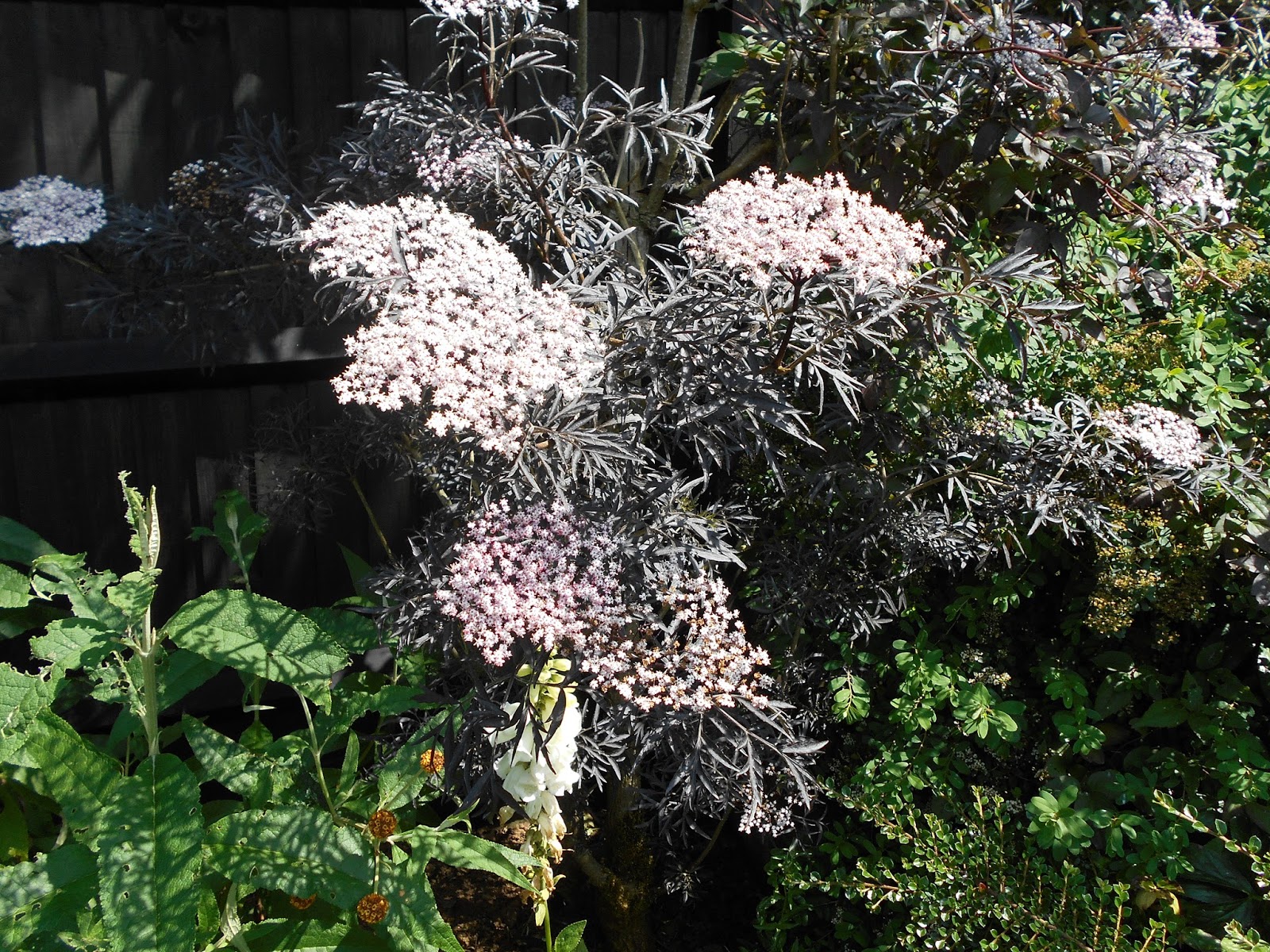
Elder. The individual flowers could hardly be more simple.
Daventry. 17 June, 2017
In folklore elder is associated with many beliefs and traditions. A witch could turn herself into an elder tree and the wood could be used for the making of magic wands (was Harry Potter's wand made from elder?). The trees were also planted beside houses to ward off evil spirits and in some regions a cross made of elder was placed on new graves to protect against these same spirits. The word 'elder' is related etymologically to the Scandinavian word hylde; Hyldemoer was the 'Elder Mother' who needed to be appeased via prayers and offerings lest she take her revenge - for what, is not clear. The church naturally took this body of folklore into account when establishing itself in Northern Europe and to suggest that Judas Iscariot hanged himself from an elder was an almost predictable development.
Elder once had a reputation as a 'flu remedy and modern research suggests that a constituent in elder berries deters the virus from invading our cells as well as boosting our immune system.
Richard Mabey, in his book Flora Britannica, described Elder as a 'mangy, short-lived, opportunist and foul-smelling shrub'. Perhaps it is now time for this much-maligned tree to be re-evaluated, for it is now regularly being seen in gardens in the form known as 'Black Lace'.

Sambucus nigra 'Black Lace' in a Byfield garden. 17 June, 2017
This has deeply divided (laciniate) leaves of a red-purple hue and the flowers are suffused with pink. This is altogether an attractive shrub for the larger garden, with fruit to attract birds such as thrushes and blackbirds. Their feces are often stained with purple during the season.
Elder is attacked by relatively few insects but frequently a gall fly, Plagochela nigripes, will attack the flower buds, causing them to remain closed. The spherical gall is easily recognised among the normally developing flowers.
The gall of Plagochela nigripes. The Croft, Daventry. 19 June, 2017
 I manage to find one or two examples in most years and a few days ago I located a dozen or so within ten minutes.
So, far from being an uninteresting shrub to be ignored or grubbed up, it deserves a little more scrutiny. John Clare, in a curiously ambiguous reference, spoke of it thus:
                                             Around the elder-skirted copse,
                                            The village dames, as they grow ripe and fine,
                                            Gather the branches for their elder wine.
                                                                             Clare's Shepherd's Calendar, 1827

I always reckon you can't beat a ripe and fine village dame!


* Although Sambucus nigra is found throughout Europe and across much of North America it is apparently absent from Israel and there may be more truth in the belief that Judas Iscariot hanged himself on Cercis siliquastrum - otherwise known as the Judas Tree.

Friday, 16 June 2017

Herb Robert

Is it me or has Herb Robert, Geranium robertianum, become more frequent in recent years? It has always been very common but recently beside footpaths, on waste ground and in neglected gardens it has, for me, been even more noticeable. I have also found it growing surprisingly well in deep shade.
I suppose it is quite a pretty plant, but the flowers  - usually pink, occasionally white - are rather small. The plant itself can reach fifty centimetres across but is a sprawling, untidy thing and this habit goes against it in horticultural terms. But above all it is the pungent smell that is the problem and some would rate it downright disagreeable.

Herb Robert.The flowers are quite pretty though rather small.
Roadside at Stefen Hill, Daventry. 15 June, 2017
It has always been common and this familiarity has given rise to a host of names such as Poor Robin, Robin's Flower and so on, and there may be a link here with Robin Goodfellow, otherwise known as Puck. If people were in favour with Robin Goodfellow he might be persuaded to help with jobs around the house, but he was mischievous and not to be completely trusted.
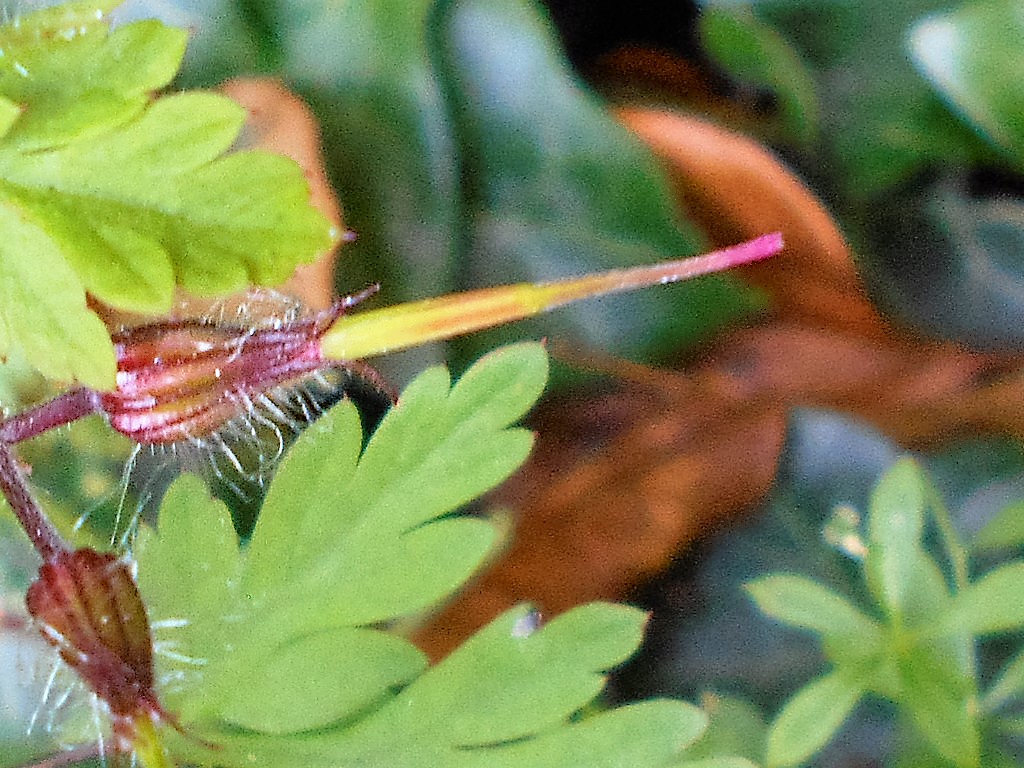
The plant is covered everywhere - except for the petals - with glandular hairs as can be seen on the photographs.  These glands are responsible for the odd smell. Nectar is secreted by the flowers and they are apparently visited by the hoverflies Rhingia campestris and R. rostrata, but although I do observe and record hoverflies I have not witnessed this behaviour myself. Anyway these visits are sufficient for fruits to develop. The seeds, in their ovaries are attached to the long styles which, tight together, form a beak-like structure (remember, this plant is a type of cranesbill) which, when dry, will spring back and catapult the seeds into the air.

The long styles develop into a 'crane's bill' and will eventually fling the
seeds into the air. Stefen Hill, Daventry. 15 June, 2017
The plant was once employed medicinally to aid with the healing of wounds and the leaves could be rubbed over the body to ward off mosquitoes - and would probably ward off your friends too!Growing in similar situations is a close relative, Shining Cranesbill, Geranium lucidum. It is often to
be found growing at the foot of walls, and in this situation it is common around Byfield, perhaps appreciating the lime from crumbling mortar. Its common name refers to the glossy leaves, less deeply cut than Herb Robert, usually tinged with red and lacking the pungent smell.
The flowers are of the same general shape but rather smaller than its congener.
Shining Cranesbill, made distinctive by its glossy leaves.
Chipping Norton, Oxfordshire. 16 June, 2017
Despite being common in Byfield I photographed this example beside the town hall in Chipping Norton, Oxfordshire, where I had visited the town's excellent bookshop to purchase a copy of Victor Hugo, by the French author, Les Miserables - however, that's another story.
The flowers of Shining Cranesbill are similar to those of Herb Robert
but rather smaller. Chipping Norton. 16 June, 2017

Thursday, 15 June 2017

Pearlwort


There is a plant, native to parts of Britain, called Bloody Cranesbill, Geranium sanguineum. Its name probably refers to the crimson petals although in the autumn its leaves may also turn red.
We have in our garden a small amount of bloody pearlwort - it is a nuisance and is probably known as bloody pearlwort by many other gardeners too. We only have a small amount because Chris is constantly weeding it out, otherwise the crevices between our stone slabs would be choked by it. I notice that a great deal of it grows on the bowling greens at Byfield, Northants, and it probably does so elsewhere.
Its posh name is Procumbent Pearlwort, Sagina procumbens, and despite looking vaguely like a moss is in fact a flowering plant and a member of the Pink Family, Dianthaceae.
Procumbent Pearlwort in our back garden at Stefen Hill, Daventry.
15 June, 2017
The tiny flowers are remarkably, even stultifyingly, dull but they nevertheless produce copious quantities of dust-like seed by means of self-pollination. These, I suspect, are often carried around on muddy footwear although they are probably blown around by the wind. Hand weeding will bring it under control but herbicides are an alternative (although I am told that it is quite resistant to this means of treatment). We have a strict policy of  'no weedkillers' anyway, so for us the point is academic.
The flowers produce huge numbers of seeds. Our garden at Stefen Hill,
Daventry. 15 June, 2017

Were it not for its nuisance value the plant would attract little interest but it does have an odd place in folklore. Apparently in remote parts of Scotland it is believed to be the first plant Christ stepped on when he came to earth and for this reason is believed to ward off evil spirits. (No, I don't understand it either.) Anyway, if any hag-ridden Caledonian cares to drop me a line, I can let him have a sprig or two.

Saturday, 10 June 2017

A Kentlemanly pursuit

Yes, Kentle Wood again. On my visit today I saw a butterfly, and I saw one yesterday too! Of course I should be counting them in the dozens, and in my childhood the figure would have been in the hundreds. The situation hereabouts really is dire.
Today's butterfly was a Brimstone, Gonepteryx rhamni, and it was nectaring at bramble blossom. When resting on, say, a lime tree leaf, they are quite hard to spot; when in flight it is different.
A brimstone butterfly visits bramble blossom. Kentle Wood, Daventry.
10 June, 2017
I made my way to the colony of Common Spotted Orchids to confirm that the had not been damaged; the placement of my feet had to be carefully chosen for in fact the patch seems to have spread. Some of the flower spikes were very robust and I just hope that a casual dog-walker doesn't decide that they'd look nice in their garden!
Some of the spikes on the Common Spotted Orchid were very robust.
Kentle Wood, Daventry. 10 June, 2017


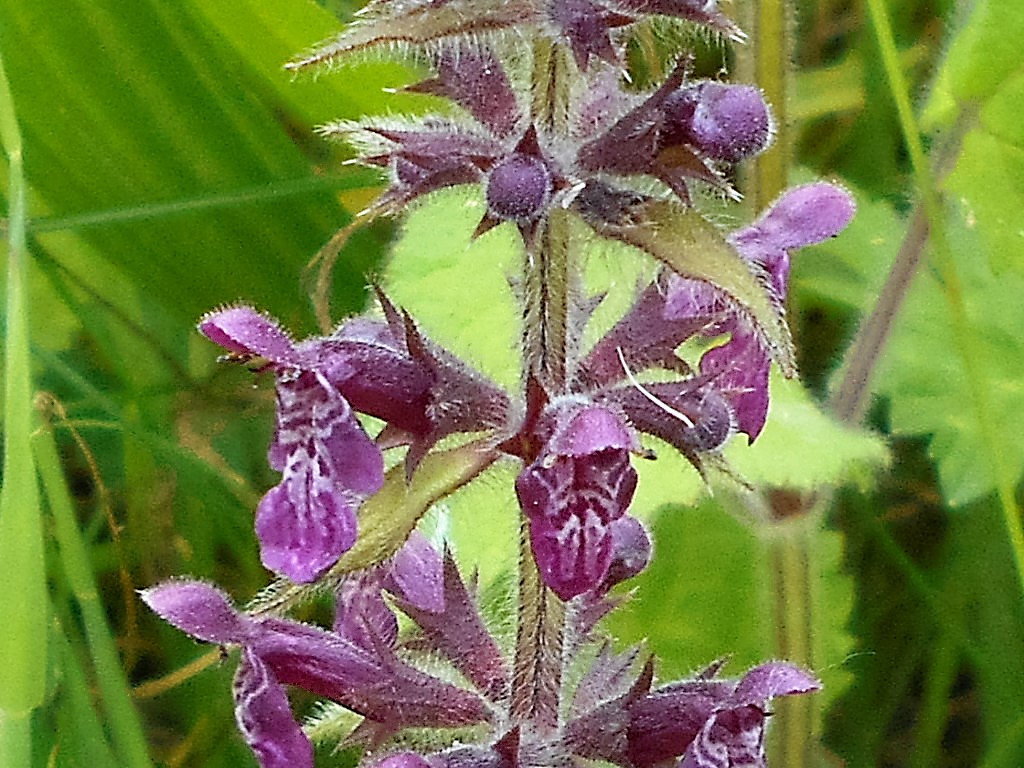
They would certainly not take a clump of Hedge Woundwort, Stachys sylvatica. Attractive though the red-purple flower spikes are, the unpleasant smell of the leaves when handled is distinctly off-putting. It doesn't deter bees and they are enthusiastic visitors.
Hedge Woundwort - a good bee plant. Kentle Wood, Daventry.
10 June, 2017
A plant of White Clover, Trifolium repens, had white patches on the leaves. These were the work of a fly, Agromyza nana; in this context 'nana' means 'dwarf', and if you live much of your life inside a clover leaflet you can't be over-large. Not an exciting record I agree but it is my solemn duty to report these matters.
White Clover leaves mined by Agromyza nana. Kentle Wood, Daventry.
10 June, 2017
I've not recorded many true bugs this year and those I have seen have been commonplace. However, being commonplace does not render them unattractive. A specimen of  a myrid bug, Grypocoris stysi, found itself in my net and was quickly released before I'd realised that my photograph was poor.
Grypocoris stysi is a very common bug even in many gardens.
Kentle Wood, Daventry. 10 June, 2017
Scorpion flies may apparently cause alarm because the males have a vicious looking 'sting' at the rear of the abdomen. In fact it is nothing of the sort. It is the genitalia or technically, in human terms, the 'meat and two veg'. At one time it was thought that the patterning on the wings was sufficient to distinguish the species but it is now realised that the aforementioned genitalia, whether male or female, need to be dissected under the microscope. This, with practice, is not as difficult as it sounds but this specimen was a female and these are, in my experience, a little more tricky. Nevertheless this was identified turned out to be - surprise, surprise - Panorpa communis, arguably the commonest of Britain's three known species.
A female scorpion fly. This one is Panorpa communis. Kentle Wood,
Daventry, 10 June, 2017
And that was about it, except for the small matter of about fifty insects to be identified once I got home. The total number of species recorded continues to climb steadily and now begins to approach the figure I was hoping for this site. Currently the figures are: 44 flowering plants and 401 invertebrates, including 23 spiders, 50 bugs, 33 butterflies/moths, 80 beetles and 153 diptera (two-winged flies).


Tony White. E-mail: diaea@yahoo.co.uk