Friday, 18 December 2015

Daventry: the Country Park

I concluded yesterday's blog by suggesting that, for the time being at least, I would do better by sticking to gardens. How weak that resolve turned out to be!

Conditions were good for walking today so I visited our local country park. It has been awarded a green flag and is a local nature reserve so I ought to pay it more attention. I have paid several visits before but, pleasant though it is, I have failed to note anything of great interest.

I was photographing lichens on a tree when a lady approached me and said that, a couple of days before, she had heard a nightingale singing just a few hundred yards away! I gently pointed out that the nightingale, Luscinia megarhynchos, is a migratory species and its diet consisted mostly of insects. 'They are in Africa now,' I stated. But she wouldn't have it, basing her belief firmly on the fact that the bird was singing at night. Ah well. Some yer win... (The general belief among birdwatchers is that, when 'a nightingale sang in Berkeley Square', it was a robin.)
Ivy restricts the areas available for lichen colonisation.
Daventry Country Park. 18 December, 2015


Truth be told, the lichens were of very little interest. There could have been a greater variety but many trees bore a thick growth if ivy, thus losing much potentially valuable tree bark habitat. Local authorities are strapped for cash, otherwise perhaps some of this ivy could be cleared.


Amandinea punctata is common on tree bark.
Daventry Country Park. 18 December, 2015

Where bark was exposed Amandinea punctata (= Lecidea punctata) was probably the most common species. This lichen has an almost worldwide distribution but its stronghold is N.W.Europe. The black apothecia, like tiny buttons, are distinctive.


In itself it is of limited interest but I was intrigued to note how, as the tree's girth increased, the normally oval patches were split apart in a very distinctive manner.


A Trentepohlia species formed orange
patches on bark. Daventry Country Park.
18 December, 2015


Here and there orange patches were to be seen on the bark. Often mistaken for a lichen it is in fact an alga belonging to the genus Trentepohlia. It is, perhaps, T. umbrina, but I do not have access to the literature required for certain identification. T. aurea is almost identical, but whatever it is, it brightens up the scene.


I left the beaten track in the hope of a surprise or two but all I found were a few clumps of Hart's Tongue Fern, Asplenium scolopendrium. For a century or so it has been known as Phyllitis scolopendrium, so I now have yet another name to memorise!


A few imprudent hazels were in flower. Daventry
Country Park. 18 December, 2015


Here, as at Kentle Wood a few days ago, hazels were in flower, i.e. the male catkins had opened up. I flicked one with my forefinger and a cloud of pollen drifted away on a very light breeze. Once again I failed to locate any of the female flowers with their protruding red stigmas. The pollen was wasted.


Alder catkins stayed resolutely closed. Daventry
Country Park. 18 December, 2015


In contrast the catkins on the Alder trees, Alnus glutinosa, wisely showed no signs of opening. This is a widespread native tree but in many of our parks the related but alien Grey Alder, Alnus incana, is being used instead.


Thursday, 17 December 2015

Making the best of it.

Northamptonshire has to be rated as scenically a rather dull county. It is true that many pretty villages, often with houses of a warm, apricot-coloured sandstone, nestle in the folds of its gentle hills, but with no mountains, no moors, no marshes and, of course, no coast, it has obvious limitations. Local naturalists console themselves with the thought that we have some fine, though often unappreciated, areas of deciduous woodland, particularly parts of the former Rockingham Forest.

Here around Daventry these limitations are keenly felt, especially in the dull days of winter, when we must be content with little pockets of interest.


Field maples are bare in winter. Christchurch Road,
Daventry. 17 December, 2015

No more than three hundred metres from our house is a belt of trees, planted by the local authority to filter out noise from the nearby A45. Overwhelmingly the trees consist of Field Maple, Acer campestre; quite a good choice except that, being deciduous, they do not perform their job very well in the winter.


A number of trees have annulated bark, but
cherries are the most commonly seen.
17 December, 2015


A handful of other trees are present, with the annulated bark of cherry making the species very obvious...


...and golden leaves still clinging to a small beech tree also catching the attention. Despite the proximity of the A45 (barely ten metres away) many trees bore thick encrustations of bright, though commonplace, lichens.


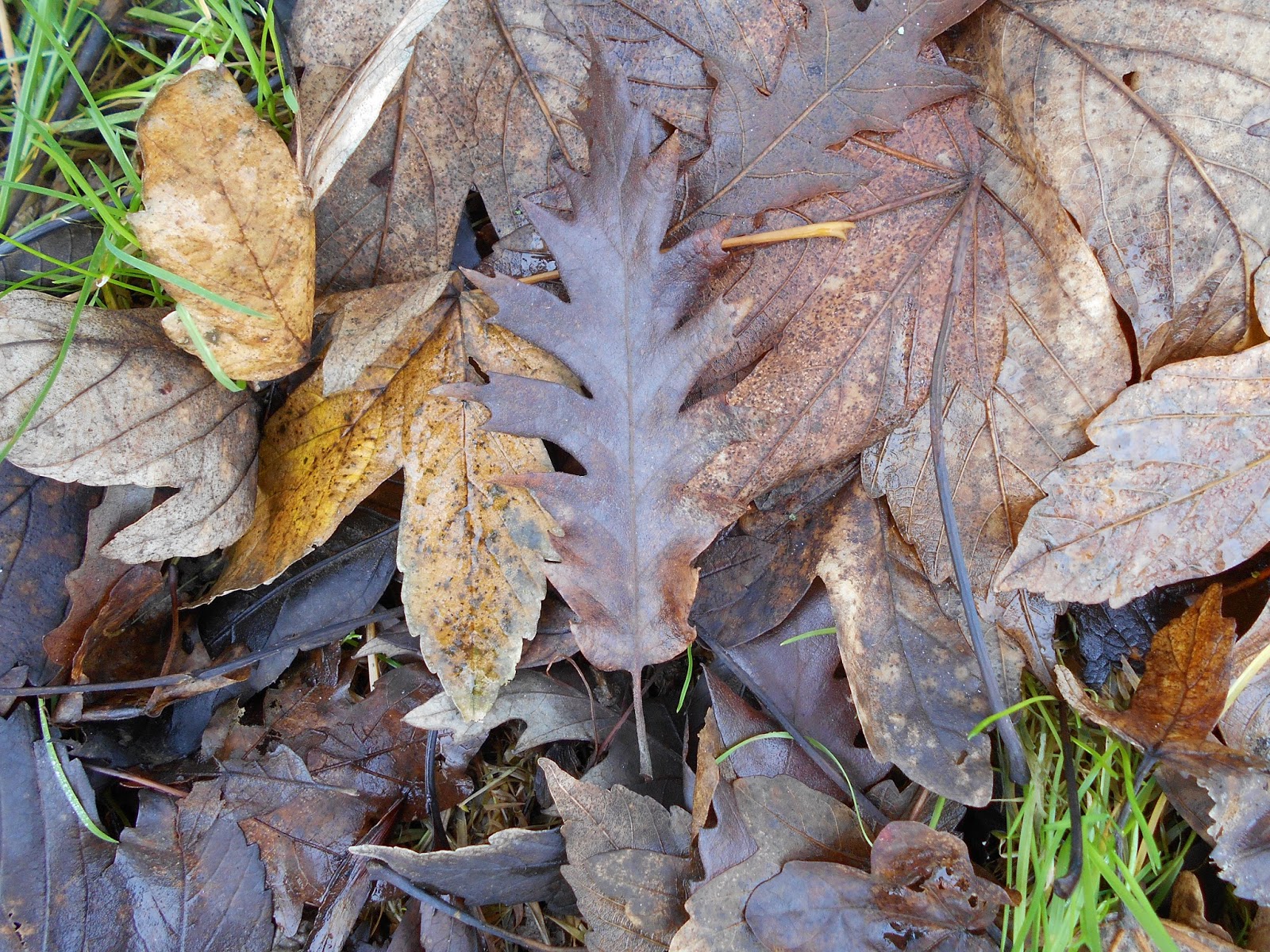
Where had this come from?  Red Oak leaf among Acer
and cherry leaves. Christchurch Road, Daventry
17 December, 2015

A leaf of a North American species, Red Oak, Quercus rubra, lay amongst the more mundane material forming the litter but I was unable to track down the tree from whence it came. Perhaps recent high winds (storm Desmond) had borne it over a considerable distance.


In this predominantly brown  layer it was easy to overlook the tan coloured toadstools dotted around. Difficult for us but no problem for fungus gnats, mycetophilidae, which will readily seek out this essential larval pabulum.


Candle-snuff Fungus was very common. Christchurch
Road, Daventry. 17 December, 2015

Other fungi were present on chunks of damp, rotting wood. Here a few specimens of Candle-snuff Fungus, Xylaria hypoxylon, are shown. This is an abundant species in such a situation.


Nearby - in fact on the same log - was a very close relative, Xylaria longipes. It is almost as common as the previous species. In Britain it is known as Dead Moll's Fingers and in French, Penis de bois mort. (The French are such wildly imaginative people!)


The ground flora was poor with a clump of Pendulous Sedge, Carex pendula, and a few ferns being the only obvious herbaceous plants.


Pendulous Sedge may be charitably described as a thug. Graceful it may be but once established the clumps are difficult to remove. On top of that the seeds seem to retain viability for a long time so unwanted seedlings pop up in all sorts of unsuitable places. Introduce into your garden at your peril!


Male fern on the woodland floor. Christchurch Road,
Daventry. 17 December, 2015


The ferns were specimens of Dryopteris filix-mas, commonly known as the Male Fern. This is one of our county's commoner ferns, so its presence was no surprise. Smaller plants may often be found in the mortar of dampish walls.


Although the ground flora was poor there were a few epiphytes to be found. This term is used to describe plants growing up in a tree, perhaps exploiting a rot hole or forked branch where humus has accumulated. This habit can allow them to grow well above ground level and thus able to access more sunlight.


Mosses and ferns typically exploit these situations and, as shown, flowering plants such as Cleavers, Galium aparine, are also to be found. (I have even found a gooseberry flowering and fruiting in a similar place.)


But, to be honest, I really had to scratch around for items of interest. The truth is, gardens are as productive a habitat in the winter, at least in this region. Perhaps that should be my next target.

Tuesday, 15 December 2015

Winter fare and Bittersweet

Warm air moved in overnight and, mixing with and replacing chilly air, brought fog. This soon cleared leaving mild, but grey and damp, conditions.

Divers jobs took me into Daventry, 'Athens of the North', as it is never called. Around Stefen Hill many rowan trees have been planted but their crop of fruit had been cleared by birds as soon as it ripened. In the centre of Daventry berries have lingered on, especially on the Pyracantha, Pyracantha coccinea, shrubs.


Pyracantha bushes are a reliable source of food for
many birds. Daventry, 15 December, 2015


These scarlet fruits are untouched so far but, as winter tightens its grip, hunger will outweigh caution and birds will begin to feed on them. Redwings, and their close relatives fieldfares, are likely to be among the diners and, with luck, a few waxwings will move in as food in their Scandinavian homelands becomes scarce.


The yellow-berried forms seem less attractive to birds.
Daventry, 15 December, 2015

Although 'coccinea' means 'bright red' there are yellow-berried forms too but, in my experience, these will be untouched until most of the red berries have gone. Is it the colour or the taste? I'm not sure but I suspect it is the former. Regarding their relatives, the rowans, red fruits are preferred to the yellow, and as for white berried forms such as Sorbus hupehensis, they are generally pretty safe.
In some places ivy berries are already ripe.
Daventry, 15 December, 2015


Around neglected fringes of car parks ivy is, in places, abundant. The berries of ivy tend to ripen over several weeks, making it a particularly valuable source of food for birds. In some cases the fruits were already ripe and should soon be consumed.
...elsewhere berries are still green


Elsewhere there is a little way to go. Ivy can, in a favourable year, keep birds going until well into February. Although it is, with its nectar-rich flowers as well as fruit, a very valuable wildlife species, I would not allow it into my garden; it is ubiquitous in the countryside so, like the equally valuable Stinging Nettle, there is no need.


This last point is made in a very useful book which I would commend to wildlife gardeners. Many books cover much the same ground but this is not a glossy, coffee table book, it is a very well-written and thoughtful account of the topic and must count as one of my more sensible purchases.


Now, where was I? 


The berries of Woody Nightshade.
Daventry, 15 December, 2015
Just as I was about to get into my car I noticed more berries gleaming brightly among other weeds. They were those of Woody Nightshade, Solanum dulcamara, a close relative of the potato. The berries have a foetid, off-putting smell, but what do they taste like? The plant's other common name is Bittersweet and, of course, 'dulcamara' means 'sweet bitter' (dulce, sweet and amara, bitter) but I suspect that we would find the fruit most unpleasant - as well as being mildly poisonous. Thrushes are known to eat them but they also may regard the berries as something of a last resort.

The plant has a place in homeopathic medicine where, over the centuries it has been used for the treatment of a range of conditions with, one suspects, little efficacy. (One recalls the quack Dulcamara in Donizetti's opera L'elisir d'amore). Its relative Deadly Nightshade, Atropa belladonna, is still widely used but is rare hereabouts.

So, at the moment there is food a-plenty for birds. It will be interesting to review the situation in two months time.


Monday, 14 December 2015

Pasque Flowers

My most recent blog attracted nearly a hundred hits; not in the Wayne Rooney league of course but then I rarely mention football (I must be one of Britain's few 77 year-olds who have never been to a football match) and I suspect he rarely mentions lichens or blowflies). 

Today is grey, damp and chilly but I could - and should - have stretched my legs with a walk. Instead I've contented myself with planting some Pasque Flowers, Pulsatilla vulgaris. They won't flower of course until next May, although in theory they should flower around Easter or, strictly speaking, around the Feast of the Passover (Hebrew: pesach, the passover). 

It is a native of Northamptonshire, occurring on limestone in the east of the county where it was once known from six sites. It is now found at only one of these sites, a disused limestone quarry at Barnack but there it is afforded strict protection and seems secure. Oddly, although John Clare must surely have been familiar with it, he seems not to have afforded it a mention.
Pasque flower with slightly atypical 'petals' in my
garden. May, 2014


Our native species has flowers of a glorious shade of purple but, for variety, I have planted a white and a reddish form. In theory it is an easy plant to recognise, with silky-hairy leaves and fruiting heads consisting of achenes with long feathery styles. I say in theory, for when I have searched for them in the Tyrol I frequently find that I am looking at Ranunculus species or even a Geum.


In my youth it was included in with the Ranunculus genus but botanists feel now that is sufficiently distinct to merit its own genus, along with thirty or so other species found not only as far east as China and Korea but also in North America. I must keep an eye open for these other Pasque Flowers.

It is one of the 'awkward squad' in that what appear to be petals are really sepals - one of several features it shares with the closely related Clematis genus.

As I have mentioned, in our county it grows on lime, and certainly it likes a taste of lime in the soil. It my garden it will have to put up with a neutral loam, to which I have added gritty sand for drainage. It should survive.


Tuesday, 8 December 2015

Highlights of Christmas shopping

A rather hefty storm passed through in the night, leaving everywhere very wet. Anyway, I had to go into Daventry so a country walk was never on the cards.


Turkish wreaths were on display in all the florists.
Daventry. 8 December, 2015
Local florists were selling 'Turkish wreaths' and I stopped to have a closer look. Brightly coloured fruits proved to be those of the Strawberry Tree, Arbutus unedo. Use was being made too of Italian Cypress, Cupressus sempervirens, and pine cones. From their shape the latter were probably Austrian Pine, Pinus nigra; despite its name this species is by no means confined to Austria, but is common in the eastern Mediterranean region. Some wreaths also contained Laurustinus, Viburnum tinus.


The Strawberry Tree is quite unrelated to genuine strawberries but is a member of the Heather family, Ericaceae. It is unusual not just because of the fruits but is one of the few members of the heather family to tolerate lime. In fact I generally find this shrub (or small tree) growing on limestone. With its lovely glossy reddish bark, its little sprays of flowers rather like Lily of the Valley, and bright (but dreadfully insipid) fruits, it makes an excellent garden plant.


Arbutus andrachne generally has darker fruits than its
commoner relative, A. unedo. Daventry,  8 December, 2015


The fruits have a slightly warty appearance and in a couple of cases I'm sure that darker fruits were those of the Greek Strawberry Tree, Arbutus andrachne.
Not exciting but reliable. Brachyglottis greyi
in Daventry. 8 December, 2015


There were still roses stubbornly in bloom, together with Brachyglottis greyi (formerly Senecio greyi), whose felted foliage gives the plant an overall greyish appearance. This native of New Zealand is a useful rather than a must-have species.


Lavatera was still in bloom.
Daventry. 8 December, 2015

My friend John grows Lavatera or Tree 
Mallow in his front garden. Whether it is currently flowering I'm not sure, but this specimen near the front of Holy Cross Church certainly was. I suspect it is Lavatera olbia; certainly this species is common in cultivation.


The sandstone masonry of Holy Cross Church is not
very fossiliferous but a few belemnites are present.
Daventry, 8 December, 2015


And, apart from a small cluster of belemnites on the wall of the aforementioned church, that was about it. 'Dull' Daventry once again came up with a few items of interest to contrast with the utterly predictable Christmas carols in every shop I visited. 

Monday, 7 December 2015

Is it really winter?

Much of Britain has been lashed by torrential winds and rain over the last two or three days, as 'Desmond' swept across the British Isles. By contrast today was sunny and remarkably warm and, once routine jobs had been dealt with, I set out for a constitutional.


Convolvulus cneorum, aka Silver Bush. Stefen Hill,
Daventry. 7 December, 2015

In our front garden Convolvulus cneorum was still in flower; I had to remind myself that it is December. Forty years ago this shrub was regarded as borderline hardy but our winters are now kind enough to allow its survival, given good drainage, in all but the bleakest situations.


I'm not really that tall! In Kentle Wood,
Daventry. 7 December, 2015


It was midday by the time I reached Kentle Wood. Though the day was almost summer-like, my body in the low sun cast a long shadow down one of the rides, bringing to mind lines by Charles Cotton (1630-1687):

     The shadows now so long do grow,
     That brambles like tall cedars show;
     Mole hills seem mountains, and the ant
     Appears a monstrous elephant.

(I feel he got rather carried away towards the end!)


As I have mentioned before, the wood is immature, having been planted for the millennium, and one looked in vain for the gnarled trunks of ancient trees.


A handful of trees such as this ash tower over the youngsters, providing useful lookouts for hawks, wood pigeons and crows. They also receive regular visits from woodpeckers - but not today.


The hazel catkins were already in bloom.
Kentle Wood, Daventry. 7 December, 2015


The  leaves of hazel remained but a sombre brown tint now suffuses the green. Against this dull background the catkins stand out clearly and I was delighted to find that in some cases the male flowers had opened to expose their pollen, but if there were any female flowers ready for wind-blown impregnation, I failed to see them.


Young hazel at Kentle Wood, Daveentry,
Northants. 7 December, 2015


Hazel bark is very distinctive. having brownish, rather glossy bark covered with lenticular, greyish patches.


Lichens were abundant on hazel bark. Kentle Wood,
Daventry, Northants. 7 December, 2017


Closer examination showed that these patches were almost invariably home to a cluster of lichens with reproductive structures looking like tiny apricot jam tarts. I must return with a suitable knife and remove some of these ascocarps for identification.


Gulls wheeled overhead but otherwise the woodland seemed bird-free. This is, of course, an illusion. Had I settled down quietly for a while parties of small birds such as tits and treecreepers would have passed through, investigating loose bark, crevices and spider webs, each species tending to exploit a particular habitat.

But my time was up. Home...

Tuesday, 1 December 2015

The first day of winter

December the first; the first day of winter, meteorologically speaking. But the high winds and driving rain of the last three or four days have abated; today is mild, dry and calm. I decided to walk - and where else but Kentle Wood?

I clambered over the stile at the entrance just in time to see a muntjac deer race by, hotly pursued by a dog. 'Oh do come back Hugo!' wailed the owner. Her cries were ignored.

Now I am not a grouch and am happy to see dogs in, what is in effect, a nature reserve. But when the owner has allowed a dog off the lead without being able to exercise any control, I get a little cross. Needless to say, the deer easily outran the dog.


Lichens: overwhelmingly Xanthoria
parietina.
Kentle Wood. 1 December 2015


Looking at the bark of several trees I was struck, as I have been many times before, at how lichens appear to favour one species rather than another. A Field Maple, Acer campestre, was heavily encrusted with yellow lichens...


...yet only a few metres away the trunk of an ash was comparatively bare. I have little doubt that some varieties of bark are richer in nutrients than others.


Rose hips are now mostly past their best.
Kentle Wood, Daventry. 1 December, 2015


Also largely bare were those trees which, a few weeks before, had been laden with fruit. Now a few shrivelled and discolored hips remained on rose briars. 


Nearby hung a few apples, their wrinkles showing a distressing lack of acquaintance with L'Oreal products. 


These apples were untouched but where they had fallen to the ground the birds had quickly set to work. The occasional fly also showed an interest.


Is it worth sampling? A fly inspects a bird-pecked apple core
in Kentle Wood, Daventry. 1 December, 2015


Inevitably the ground had a carpet of fallen leaves, with oak and cherry being prominent - but no beech; their leaves were still firmly in place on the branches. Closely examined, it could be seen that each dead leaf bore a potted history in the form of nibbled areas, galls or other scars. By the spring earthworms will drag the leaves into the soil and help increase the humus content and this evidence will disappear.