Friday, 9 October 2015

Frustration - then a surprise

Chris and I were tied down by jobs all morning but sun shone from a clear blue sky. With a free afternoon I was looking forward to a visit to Kentle Wood or Newnham Windmill. But it was not to be.

As Chris was off to Byfield for a meeting the world was my oyster and I set off for Kentle Wood. I had managed about five hundred yards before frustratingly, threatening clouds gathered and, as on 8th October, prospects were not good. Time for Plan B!

Where the A361 joins the A45 a moderately complex junction exists. An 'island' of land, with grasses, herbs and shrubs exists and there the hand of man has never set foot - or only occasionally - and I'd had an eye on it for some time. It was easy to reach and I set off, virtually going back home in the process.


Stefen Hill is an area of attractive houses, with plenty of open space. I guess the area was developed when the land was relatively cheap. Here the horror of Leyland Cypress hedges has been replaced by the lovely blue-green of Lawson's Cypress, Chamaecyparis lawsoniana. An inappropriate name as the prefix 'chamae' means 'low' but, given a chance, these trees will reach a towering 140 feet.


Lawson's Cypess, Stefen Hill, Daventry.
8 October, 2015


Despite being a hybrid the Leyland Cypress does carry a few cones; Lawson's Cypress bears huge numbers and, whereas the former is very limited in terms of wildlife the latter can receive many visitors. I decided to investigate.


Juniper Shieldbug, from Lawson's Cypress. Stefen Hill,
Daventry. 8 October, 2015


The very first sweep of my net yielded the nymph of a Juniper Shieldbug,  Cyphostethus tristriatus. Once a great rarity, restricted to juniper shrubs in Surrey and adjacent counties, it began sometime in the 1960's to colonise Lawson's Cypress trees in local gardens. Soon it was spreading rapidly, but this seems to be the first record from the Daventry area.


Duller, but rather more interesting, were nymphs of a groundbug, Orsillus depressus. It was unknown in Britain until the late 1980's but has also spread quickly. It appears to be confined in Britain to Leyland's Cypress.


I was also surprised to capture two specimens of the picture-winged fly, Tephritis formosa, not because it is rare - it is quite common - but not usually associated with cypress trees. One specimen could have been a stray - but two? It is normally associated with sow thistles, but there were no obvious specimens nearby.


Red Admiral, Vanessa atalanta on ivy. Daventry
8 October, 2015


Ivy was in flower and, when the sun broke through, it received visitors including this Red Admiral (the butterfly, not a Russian naval officer). Hoverflies were also feeding but I didn't attempt to secure any.


I was intrigued by the mottled colours assumed by Sycamore, Acer pseudoplatanus, leaves. The white spots are, according to books, caused by powdery mildew, but these look quite different and I suspect a Rhytisma species.


I guess a species of Rhytisma is the culprit here too. The best known is Rhytisma acerinum. well- known as the cause of Tar-spot, but related species may cause different discolorations.


I pressed on to my traffic-island target and received a surprise. It quickly became obvious that the area was remarkably rich in species. At this late time in the year expectations were low, but I realised that this patch would not only need a close examination now, but merits further visits. 

A patch of Oxeye Daisies, Chrysanthemum leucanthemum, was in bloom but, although the sun deigned to make an occasional appearance, it had no insect visitors.


Wormwood Pug, swept from ragwort. Roadside at
Daventry, Northants. 8 October, 2015

Oxford Ragwort was also in bloom, and from it I swept this caterpillar. It is the Wormwood Pug, Eupithecia absinthiata. It will feed on a wide range of plants, obviously including wormwoods, Artemesia species, but ragworts are frequently chosen.
Long-winged Coneheads were common on roadside
vegetation. Daventry, Northants. 8 October, 2015


Finally, before the tolerance of my readers is too strained, I would mention this Long-winged Conehead, Conocephalus discolor. Though obviously related to grasshoppers, they display several differences. This is a female, and her long ovipositor to the left is very obvious. Three dark spurs beneath the hind legs confirmed the identification. I needed to bring it home to confirm the species and it had failed to survive the experience.


So, with fifty or so flies to sort through (all microscope jobs) I made my way home, resolved to pay another visit next spring.


Tuesday, 6 October 2015

Matthew Moser's Farmland

Matt Moser owns much of the land around Newnham Windmill. He farms the land with wildlife in mind and avoids weedkillers or pesticides in general. When I met up with him a few months ago I was given the go-ahead to survey the land; he was as keen as I to find out how species-rich the land is under his regime.

I set out this morning feeling quite optimistic. We have had two days of heavy showers, some of them prolonged, but as I prepared to go the conditions were dry and warm. As I gathered my kit - net, pooter, specimen tubes, etc - the sky began to cloud over and a wind picked up. 'B****r!' I muttered. It was definitely going to be welly boot weather.

But having girded my loins I set forth and was soon parked up on the Newnham Road.

I was reluctant to use my net for sweeping through wet grass. Today it would be a case of examining fencing, tree trunks and so on. A prominent tree stump held promise...


Red Admiral in disguise, near Windmill Hill, Newnham
Northants. 6 October, 2015

Nothing doing, was my first thought, but a closer look held a surprise. Clinging to the bark was a Red Admiral, Vanessa atalanta, looking like a dead leaf. As one of Britain's most brilliantly coloured insects it was, with its wings closed, remarkably well camouflaged.


Seven-spot Ladybird near Windmill Hill, Newnham.
6 October, 2015


On a nearby stump a Seven-spot Ladybird, Coccinella 7-punctata, had no need for protective colouring; would-be predators recognise the warning coloration and leave well alone.


I described them recently as poisonous and my very good friend, Lynda Moran, asked if there was any evidence for this. When disturbed a ladybird usual first reaction is to withdraw its legs safely into depressions beneath the abdomen and, if more alarmed, it will exude a yellow fluid from the leg joints, a phenomenon known as 'reflex bleeding'. The fluid has an unpleasant smell and a bitter taste. It also contains toxins, harmless to humans but probably quite dangerous to small birds.


A Green Shieldbug basks on a crab apple. Near Windmill
Hill, Newnham, Northants. 6 October, 2015

Crab Apples, Malus species often of doubtful parentage,  were turning yellow. As they soften and fall they will become an important food source for many thrush species and other birds. Here a Green Shieldbug, Palomena prasina, basks in a (very temporary) shaft of sunshine.


Phyllonorycter blancardiella mine? On Crab Apple near
Windmill Hill, Newnham. 6 October, 2015

One of the apple leaves bore a distinctive leaf mine, probably the work of the Spotted Tentiform Leaf Miner, Phyllonorycter blancardella. I have remarked before how the length of some of these micro-moth names seem to be in inverse proportion to the length of the moth itself.


Blackberries, Rubus fruticosus, were bearing large quantities of fruit. This was to be expected but, tucked a little further into the brambles, were flowers, still in bud!


These will open with the encouragement of a little sunshine, their nectar being a late-season bonus for bees and hoverflies. There will be blackberries around for a few weeks yet but towards the end of the month they become inedible. Not because, as the legend goes, 'the devil pissed on them', but because flesh flies, Sarcophagus species, deposit saliva on them. The saliva apparently contains enzymes which soften the fruit, allowing the flies - and many other insects - to feed on the juices. The fruits lose their firmness and become rather slimy.


Spear Thistle - only too common in pastures. Windmill
Hill, Newnham, Northants. 6 October, 2015

Spear Thistles, Cirsium vulgare, were forming their distinctive, viciously armed rosettes in preparation for flowering next year. They are weeds but support many species of insect. At the top right hand corner a tiny amber spot is easily overlooked and I very nearly missed it too. 


The tiny beetle, Sphaeroderma testacea. Windmill Hill,
Newnham. 6 October, 2015


It was the widespread and common Sphaeroderma testacea, and at only 3 mm it is not surprising that it can be missed. In fact it is not confined to thistles but occurs on other members of the Daisy Family, Asteraceae.


A lichen, probably Flavoparmelia caperata, on a
fence. Windmill Hill, near Newnham. 6 October, 2015

It is when flowers are near to their end that lichens come into their own. I believe this example to be Flavoparmelia caperata because, although it is not clear from the picture, the thallus had a pale green coloration.


Rain arrived at 10.30 in the form of a short drizzly patch but it passed over and I was able to snatch a further half an hour. Then it returned as much heavier rain. Time to beat a retreat, with quite a few flies to examine at leisure later.

Sunday, 4 October 2015

University of Oxford Botanic Gardens

I suppose that, generally speaking, most people would regard October as a bit late to be visiting botanic gardens. Certainly it seemed to me that the ideal flowering season was well behind us. Garden borders are looking 'tired'; municipal plantings will soon be grubbed up. But I would be proved wrong.

Together with our friends Ann and John, Chris and I set off on a rather grey Saturday morning to Oxford, with the aforementioned gardens as our main target. I drove to the park and ride at Water Eaton and we got the bus to the city centre. Neither Ann nor John had been to the very interesting covered market so we made a point of passing through there en route.

After coffee at Patisserie Valerie in High Street we continued our walk in ever-improving weather to arrive in quite sunny conditions.

The blaze of colour which met us was remarkable.


A lovely border of herbaceous perennials at Oxford Botanic Gardens. 4 October, 2015


I was expecting the bulk of the colour to come from Michaelmas Daisies; certainly they played a big part in the display but there was so much more.

Stipa arundinacea? Certainly a grass to covet.
Oxford Univ. Botanic Gardens. 4 October, 2015


Ann was very taken by this lovely grass, with its pinky-red stems. We couldn't find a label but it may have been a form of Stipa arundinacea called 'Scirocco'. It would have been at home near the front of any border, whereas...


Cor, what a whopper! How often have I heard those words!
Oxford University Botanic Gardens. 4 October, 2015


...this Gunnera manicata is not only huge but demands wet conditions. Despite coming from South America, e.g. Brazil, it is reasonably hardy. Known as the Giant Rhubarb it is in fact unrelated to our garden vegetable. Most definitely not a plant for the border!


Ladies of leisure at Oxford. 4 October, 2015


Chris and Ann took a five minute break while I wandered off to have another look at an oddity which had caught my eye.


Hiding away. A broomrape at Oxford University Botanic
Gardens. 4 October, 2015

Almost hidden beneath an unnamed shrub was a broomrape, probably a species of Orobanche. These parasites really need close examination with a lens before an identification can be made, but I could hardly start picking flowers! Nevertheless I suspect it could have been Orobanche ramosa. The bed consisted of members of the tomato family, Solanaceae, and O. ramosa is known to parasitise tomatoes, tobacco and so on.
Orobanche ramosa?As a parasite the plant
 lacks all green parts. 4 October, 2015


The word 'ramosa' refers to a branching habit. A close-up shows no obvious branching but I am not inclined to change my mind.


.


Looking tropical but quite tough. Akebia quinata at
Oxford University Botanic Gardens. 4 October, 2015


Another plant admired by Ann was Akebia quinata. It is a hardy climber for a sunny wall (and grows perfectly well in Byfield) but here it was being used, very cleverly, for trailing over the edge of large urns. The plant is sometimes called the Chocolate Vine.


Castor Oil Plant. Oxford. 4 October, 2015

Quite commonplace plants were often shoulder-to-shoulder with rarities. Here the well-known Castor Oil Plant, Ricinus communis, is happy in a border. It is a member of the Euphorbia family, but strikingly different from the spurges. Despite producing ricin, said to be deadly in even minute amounts, it is a great favourite of mine. Quite frequently it is found on waste ground in Mediterranean countries where it can form a disappointingly untidy shrub. 


Like small plums. Cornelian Cherry in fruit.
Oxford. 4 October, 2015

The Cornelian Cherry, Cornus mas, ought to be more widely planted, although I admit it is best in a fairly large garden. Not only are the flowers attractive but the fruits are interesting too. It is not a cherry at all but is often used in the eastern Mediterranean for jams and pie fillings. Here is was fruiting in abundance.


Speaking of pies, a picnic had been carefully prepared and, by common consent, it was now due. Our chatter was interrupted by much crunching and sighing.


A lingering flower on Magnolia grandiflora.
Oxford, 4 October, 2015


We sat beneath a fine specimen of Magnolia grandiflora and, as is often the case, the occasional, snow-white flower was still to be seen.


And we gazed across to a tree which had me puzzled. Surely it was a Service Tree, but those huge fruits...


It was a Service Tree; to be more precise it was Sorbus domestica, var. pomifera. As a youth I had understood that the word 'service' indicated that the fruits were used in the brewing of ale (cf. the Spanish word cervesa - beer) - but I was wrong. The Latin sorbus means 'reddish-brown' and came to us in medieval Britain as the now-obsolete word syrfe. As for 'pomifera' - it means 'apple-bearing', and certainly the large fruits have in the past been eaten.


The rather uncommon Ptelea trifoliata. Even if I had a huge
garden I'd hesitate to grow it. Oxford, 4 October, 2015
A tree with elm-like fruits turned out to be Ptelea trifoliata. It's leaves are not unlike those of Choisya which, like Ptelea, is a member of the Orange Family, Rutaceae. It was curious rather than beautiful, but the flowers had gone, so perhaps I'm being unfair. For reasons unclear to me, it is sometimes called the Hop Tree (although perhaps the cone-like bunches of hops look vaguely similar).


I could go on, but a quick visit to the greenhouses was called for. A Stag's Horn Fern was doing well but was unfortunately unlabelled. There are several of these Platycerium species; my best guess is that it was P. wallichii.


Nearby, and suspending from roof girders, was a Pitcher Plant. Again, frustratingly, it was unlabelled, and the genus contains a large number of species.  The 'pitchers' contain a tempting fluid, encouraging insects to enter and take their fill. But it doesn't quite work out like that, and the corpses dissolve in the fluid, making a range of nutrients available to the plants which could otherwise struggle.


Fron the southern U.S.A. Yucca gloriosa. Oxford.
4 October, 2015


It was time to go - but I cannot leave without showing this lovely yucca plant. Yet again it was unlabelled but it is undoubtedly Yucca gloriosa, and the name is certainly justified, for it is glorious.


So, notwithstanding our combined ages of around 300 years, we strode briskly back to Oxford just in time for a bus.

Thursday, 1 October 2015

Elephant Hawkmoth

'What is it?' exclaimed Chris.

She was referring to a very large caterpillar making its way across the slabs of our back garden. It was the larva of an Elephant Hawkmoth, Deilephila elpenor, and at a good three inches long it was certainly impressive.


The Elephant Hawkmoth caterpillar has a rather long neck,
hence the common name. Stefen Hill. 1 October, 2015


I strongly suspected that it was seeking a patch of loose soil in which to pupate, having reached its full larval size. On concrete slabs the chances of finding a suitable site were somewhere between nothing and zilch so I approached it with a view to picking it up and relocating it.


With the head drawn back. My garden, Stefen Hill,
Daventry. 1 October, 2015


As soon as it sensed my presence it drew its head back, with the effect that the region immediately to the rear of the head became greatly swollen.


A bird could find the appearance rather startling.
Stefen Hill, Daventry. 1 October, 2015


This action accentuated the eye-like spots behind the head and the assumption is that birds or other predators are alarmed by this vision. I have even heard it suggested that it imitates a Gaboon Viper!


I was puzzled by its presence in our garden because the usual food plant of the Elephant Hawkmoth larva is Willow-herb, of which there are about 160 species. It will also take Fuchsia, Evening Primrose, Clarkia and bedstraws, none of which is present in our garden.


Anyway I found a patch of friable soil, mostly consisting of potting compost, and left it there. I have been looking out for the adult moths over recent weeks without luck, so this was a nice surprise.

Wednesday, 30 September 2015

The first frosts

Our friends Ann and John tell us that their lawn has been white on a couple of occasions recently. They live in the very rural hamlet of Charwelton but our more urban situation in Daventry seems to have been frost-free so far, and when I set out for Byfield Pocket Park today the conditions were warm and sunny.


Calliphora vomitoria taking on nectar at ivy.
Byfield, 30 September, 2015


Ivy is now well in bloom in many places and, as usual, is proving a magnet for insects, including this female blowfly, Calliphora vomitoria


The flowers will be attracting insects for weeks now, until...

                         Save grey-veined ivy's hardy pride
                         Round old trees by the Common side,
                         The hedgers toil oft scares the doves that browse
                         The chocolate berries on the Ivy boughs.

                                           Clare's Shepherd's Calendar, 1827

...but the chocolate berries are yet a couple of months away.


White Dead-nettle, Lamium album,
 Byfield Pocket Park, 30 September, 2015


For nectar the ever-dependable White Dead-nettle is there for bees being in flower for nearly every month of the year. Here in the pocket park it is supplemented by plants of marjoram.


Marjoram in a flower bed at Byfield Pocket park.
30 |September, 2014


Sun Spurge in Byfield Pocket Park. 30 September, 2015
Marjoram, Origanum vulgare, was planted a few years ago in flower beds and has since multiplied greatly. It belongs to the same family, Lamiaceae, as the White Dead-nettle and for weeks has been a bountiful source of nectar.


Sun Spurge, Euphorbia  helioscopia, was also in flower on disturbed ground. It receives an occasional visit from insects but I suspect may also have a self-pollination mechanism. I was pleased to see it as it is new to the pocket park, being the 127th flowering plant I've recorded there. It was accompanied by Purple Dead-nettle.


The yellow berries of Viburnum opulus 'Xanthocarpum'.
Byfield Pocket Park. 30 September, 2015

For those creatures for whom berries form part of the diet, the red fruit of the wild Guelder Rose was supported by the yellow-berried Viburnum opulus 'Xanthocarpum', in a shrubbery. The berries are moderately poisonous to humans, causing stomach upsets, but seem quite acceptable to birds. Of course the Guelder Rose is not a true rose but a member of the Adoxaceae.


In places the shrubs and trees in the pocket park have grown to the point where they are obstructing footpaths. A job for our occasional working party!


Sunday, 27 September 2015

Kentle Wood - and the nights are drawing in

When I was given the go-ahead to do a survey of Kentle Wood I envisaged submitting an interim report in the late autumn/early winter. There could be a few weeks of recording left but I like to grab what fine days there are to crack on with it. At Byfield Pocket Park, a much smaller area, I have recorded 126 vascular plants and 547 invertebrates, so at Kentle Wood there is a long way to go.

Conditions were lovely when I set out although a heavy dew was making the grass sparkle in the bright sun. A Great Spotted Woodpecker, Dendrocopos major, drew my attention with the loud chip-chip of its alarm call and I soon picked it out high in an ash tree - too far away for a decent photograph. A little further on and a Green Woodpecker laughed at me as I sought to find in the thick foliage of the surrounding oaks.


Smooth Spangle Gall. Kentle Wood, Daventry.
26 September, 2016

The oaks, young though they are, continue to reveal galls. In addition to those noted in my previous blog, Neuroterus albipes was found on the underside of a leaf. Known as the Smooth Spangle Gall it is the responsibility of yet another cynipid wasp. The colours can vary considerably, but the one photographed is typical.


Andricus grossulariae on oak at Kentle Wood, Daventry.
26 September, 2015
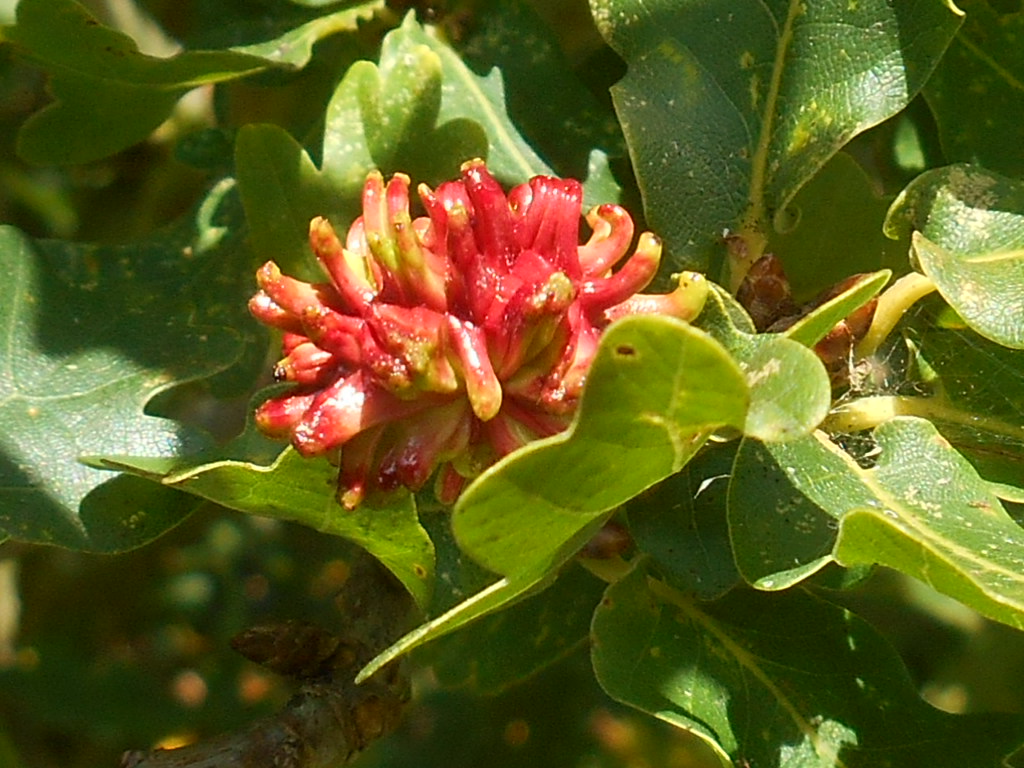
Far more spectacular is the gall of Andricus grossulariae. It grows from an acorn to produce this cluster of blunt, radiating spines. I need hardly mention that it is the work of another species of cynipid wasp and there were at least a dozen on one oak. The NBN (National Biological Network) Gateway map shows only two records for this species, one in England and one in Wales, but it is in fact far more common than that.


Syrphus ribes at Kentle Wood, Daventry.
26 September, 2015

The sunshine was bringing out insects in droves, including this hoverfly. I got a little excited at first, noting a weak dark stripe on the rear leg, suggesting it was the rare Syrphus rectus. I then realised that I was looking at the tibia, not the femur; it was the very common Syrphus ribesii.
The same species on dandelion. Kentle Wood, Daventry.
26 September, 2015


For insects seeking nectar the choice has become very limited. This is, of course, where gardens are so valuable, extending the season by weeks. A little ivy was found at the north end of the wood, and will be shortly in flower, otherwise there are a few dandelions, as shown...


Goat's Beard at Kentle Wood, Daventry.
26 September, 2015


...and this neat Goat's Beard, Tragopogon pratensis. There was also a scattering of the untidy and sprawling Bristly Ox-tongue, Picris echioides, offering nectar but with very few visitors as far as I could see.


Of course, not all insects require nectar; some, such as dragonflies, are carnivorous. I was pleased - though not particularly surprised - when one darted past and obligingly perched on a clump of grass just in front of me. This lack of surprise was because, although Kentle Wood is at some distance from suitable water, dragonflies are powerful fliers and will make considerable journeys in seek of suitable breeding habitats. (Their nymphs are, of course aquatic.)

With surprising ease I gently netted the dragonfly and it sat compliantly while I photographed it. I was anxious for decent pictures because I planned to let it go and needed clear photographs for identification purposes - sadly I am a tyro when it comes to these beautiful creatures.

A dragonfly sits in my net. Kentle Wood, Daventry.
26 September, 2015


Five families of dragonfly are to be found in Britain, largely separated by tiny differences in the wing venation, but in this case study of the wings was unnecessary. 


A close-up helped to establish its identity as a Migrant Hawker.
Kentle Wood, Daventry. 26 September, 2015
The combination of a late summer flight period, the size, the hairy thorax and general coloration showed that it was a Migrant Hawker. This is a widespread species in our county so its presence in Kentle Wood should not have been a great surprise. But as I have said, it was pleasing nevertheless. Despite the name it does not migrate but is resident here.


And that was about it. At the far north of the reserve I found a young Horse Chestnut tree, perhaps the result of a casually discarded 'conker',  and a small, scruffy clump of Hedge Woundwort; both were new records for the wood. My walk to the Braunston Road had been 3.5 miles and I had the return journey to make - in very hot conditions; I turned on my heel and somewhat wearily retraced my steps.


Hedge Woundwort. Kentle Wood,
Daventry. 26 September 2015