Wednesday, 15 April 2015

Tavira, Portugal. Part 1

'I've got some holiday photos to show you,' says Aunt Mabel.

You experience a horrible sinking feeling in your stomach. Sometimes the pictures turn out to be of well-chosen and interesting features. But it may be little Wayne with ice-cream running down his chin, or Uncle Harry doing something stupid on a Crazy Golf course. You discreetly stifle a yawn...

Well, these are my holiday snaps, so be warned. If in doubt switch off now. 

Chris and I are just back from a week's rambling around Tavira, a smallish town at the eastern end of the Algarve, not far from the border with Spain. The group was an interesting assemblage of twenty-one people - all fitter than either Chris or me. I chatted briefly with all of them and found them to be pleasant characters from as far away as San Diego in southern California. But to be truthful I didn't get involved in much conversation but was busily engaged in looking out for wildlife. In his poem, 'Out on the lawn I lie in bed,, W.H.Auden refers to the eccentrics and the silent walkers. I fear that I fit into this category only too easily!

Day 1 (Monday) was wet and cold, worryingly so as the weather forecast for the rest of the week wasn't very optimistic. 


Looking towards the sea from the Roman bridge. Tavira,
Portugal. 6 April, 2015


We gathered on the old Roman bridge over the River Gilao and looked through murky drizzle towards the sea. Raincoats were zipped up and hoods pulled over our heads. But no one opted out; ramblers are hardy souls.


Paronychia argentea was abundant on sandy
ground near the sea. Tavira. 6 April, 2015


We headed towards to sea and made our way across partially overgrown sand towards the beach. The ground was studded with patches of Paronychia. I neglected to break off a piece for later examination but there is little doubt that it was Paronychia argentea. This curious little member of the Pink Family, Dianthaceae, is very common in this sort of situation, its silvery stipules making it very distinctive.


Lotus creticus was common on sand.
Tavira, Portugal. 6 April, 2015


Also very common was the pretty pea flower, Lotus creticus, otherwise known by the rather clumsy name of Southern Bird's-foot Trefoil. With its silvery leaves this plant would not look out of place on a rock garden, but would need a sunny spot.


We made our way down to the sea and set off west for about five or six kilometres with intermittent rain showers and a cold wind off the sea. I've had more pleasant walks. Sanderlings, their feet almost a blur, sprinted along the water's edge looking for stranded prawns, sand flies or other titbits.

We eventually left the beach for a welcome hot coffee near Santa Luzia. Refreshed we then made a circuit via salt marsh and salt pans to head back to Tavira.


Cistanche phelypaea was very common at
the fringes of salt marshes. Tavira,
Portugal,  6 April, 2015


At the edges of the salt marsh we found many examples of the spectacular broomrape, Cistanche phelypaea. It is parasitic on various shrubby members of the Spinach Family.


Aristolochia baetica was very common
around Tavira. 6 April, 2015


Though the Cistanche was the most spectacular find of the day it was not the oddest. That title probably went to Aristolochia baetica. This curious little climbing plant is commonly known as Dutchman's Pipe and it proved to be common throughout the area.


Aristolochia sempervirens. Gythio, southern Greece
April, 2014


(Just for comparison, this is Aristolochia sempervirens, a species I found at about this same time last year in the Mani peninsula of southern Greece. It is fair to say that this is a much more colourful plant.)


Brachychiton populneus growing as a street tree
near Tavira, Portugal. 6 April, 2015


At the edge of town I glanced up in to a roadside tree and found myself looking at hundreds of dainty, thimble-sized flowers. This had me scratching my head but I knew I had seen one before. Was it on Madeira? 


Following vague memories I eventually identified it as Brachychiton populneus.
This is an Australian member of the largely tropical family Sterculiaceae. What a pity it can't cope with the British climate.


So, not the best of weather for the 14 kilometre walk but certainly not without botanical interest.


Day 2 involved a nine o' clock start in order to catch a service bus to Vila Real de Cacela small town some ten miles to the east of Tavira. We made our way through the little town, once again heading for the sea, enjoying far better weather than the previous day. 


Tropinota hirta feeding on pollen near
Vila Real de Cacela  7 April, 2015


On scrubby ground approaching the beach I chanced upon this beetle, almost the first insect I'd seen so far during the holiday. The silky hairs helped to identify it as Tropinota hirta, quite common in the Mediterranean region. Here it is on Centaurium pullata, a relative of thistles.


We made the beach and headed west towards Cabanas, where we were to have lunch.


Zerynthis rumina near Cabanas, southern
Portugal. 7 April, 2015


A butterfly, Zerynthia rumina, posed nicely for me. Known as the Spanish Festoon this is a widespread insect throughout Iberia. It is also found in part of southern France, but nowhere else in Europe.


A wasp, probably Polistes dominulus, busy constructing
a comb. Cabanas, Portugal. 7 April, 2015


On the side of a building a wasp, perhaps Polistes dominulus, was constructing a comb. The comb was on a pedestal (known as a petiole) and consisted of the 'paper' typically used by many wasp species.


A rock rose, Cistus albidus. Cabanas,
Portugal,  7 April, 2015


The Cistaceae Family is well represented in the region and this species, Cistus albidus, was very common. Here it is growing at the edge of a barley field near Cabanas. 


Leptopalpus rostratus near Cabanas, Portugal.
7 April, 2015


Just a few feet away a beetle, Leptopalpus rostratus, was feeding on pollen. Although vaguely like a ladybird (ladybug in the U.S.A.) it belongs to a different family but I will not tax your patience with details.


A jumping spider, Menemerus semilimbatus, hunts on
 a rock near Cabanas, Portugal. 7 April, 2015


I saw relatively few spiders during the holiday but this smart jumping spider, Menemerus semilimbatus, was noted on a rock. This specimen is a male. Jumping spiders are known scientifically as salticids, from a word meaning 'to jump' (think somersault).


So, refreshed by lunch we plodded on. Approaching the hotel I paused to photograph a trio of plants on nearby waste ground.


Convolvulus althaeoides on waste
ground, Tavira , Portugal. 8 April, 2015


One was a type of bindweed, Convolvulus althaeoides. With its rather large, rose-pink flowers it is a lovely plant. It will happily grow in Britain and, although it can be invasive, I'm surprised it isn't often seen.


Common though it is throughout most of the Mediterranean region, I couldn't resist photographing this Judas Tree, Cercis siliquastrum. Again, this will cope with the British climate, particularly in southern counties, and I am mystified that it isn't grown more. Though often seen as a tree, this specimen shows that it will respond well to pollarding.


Chrysanthemum coronarium var discolor on waste
 ground. Tavira, Portugal. 8 April, 2015


In suburban areas the Crown Daisy, Chrysanthemum coronarium. Usually the petals are all yellow but around Tavira the form shown, var discolor, with most of each petal white.


For Day 3 the rain returned and it was even more miserable than Day one. A walk went ahead but a handful of people opted out including Chris and me. We had been told that the fishing port of Olhao, about twelve miles to the west, had a couple of interesting markets so Chris and I took the train (remarkably cheap) and spent most of the day there. A White Stork was feeding in a field adjacent to the line.

When we returned to Tavira there was time to visit a supermarket, where a macabre sight awaited us. 

Outside the supermarket was a line of pine trees. These are protected by attack from pests such as the Bagworm Moth by a sticky trap around the trunk.


Moorish Geckos, Tarentola mauretanica, dead  on a
sticky insect trap. Tavira, Portugal. 9 April, 2015


Unfortunately a number of lizards had also become trapped. Not only did they die an unpleasant death but these lizards feed on insects!


I make no claims to be a herpetologist but the species involved appears to be the Moorish Gecko, Tarentola mauretanica. Whatever the species, these sticky traps surely need to be re-designed.


Thursday (Day 4) involved a 16.5 km walk to the west of Tavira, going as far as Fuseta.
The first half of the walk took is through rather neglected agricultural land.


A fine specimen of Eriobotrya japonica.
Tavira, Poruguese Algarve. 9 April, 2015


Anyone visiting the Mediterranean region soon becomes familiar with the Japanese Loquat, Eriobotrya japonica. I find loquats rather insipid but a tree in full fruit makes a fine sight and we saw many like this one on the edge of Tavira. In fact they are grown as much for ornament as for the fruit.


The orange-spotted form of Pararge aegeria near
Fuseta. 9 April, 2015


I was a little surprised to see a Speckled Wood, Pararge aegeria, basking on a leaf. But it is a widespread species, with this form having orange spots; those in Britain are paler.


Chrysolina menthastri feeds on mint near
Fuseta, Algarve.  9 April, 2015


A bed of mint in a ditch was home to several Mint Leaf Beetles, Chrysolina menthastri. This one, feeding voraciously, shows its bright metallic green coloration which makes it so distinctive. It is common in Britain.


The second half of the day's walk took in some coastal walking and salt pans. Black-winged Stilts, Avocets and Flamingoes were feeding.


Glistening white mounds of salt were a background to
the pans near Fuseta, Algarve. 9 April, 2015

Sunday, 29 March 2015

Evenley Wood

Evenley Wood is a lovely woodland garden just outside Evenley and a couple of miles from Brackley, in the south west of Northamptonshire. I haven't been there for many years so when Chris and I heard that there was to be a Rare Plant Fair there we decided to go for it. We told our old friends Sue and Derrick about it and they were happy to join us.

After a reasonable meal at the Red Lion in Evenley (Derrick is a vegetarian and, as is often the case, he didn't come out of it too well) we made our way to the gardens. The wind was picking up, bringing with it some rain. In fact by the time we got out of our cars the wind was strong enough to take the breath away.

We spent a few minutes perusing the plant stalls and, in my case, purchasing a few, and then down came the rain. We dashed for shelter and waited for the worst to pass over before venturing forth.

This early in the year my expectations were on the low side but there were surprises in store.


Narcissus cyclamineus brightened the edge of a ride.
Evenley Wood Gardens, Northants.  29 March, 2015


Beside the woodland rides were clumps of Narcissus cyclamineus, unmistakable with their reflexed 'petals'. It is native to the north-west of Spain and Portugal but was happy here in dappled shade. It is one of the parents of the very popular Narcissus 'Tete-a-tete.


Galanthus plicatus: nothing to get excited about.

A little further on on were clumps of Galanthus plicatus. I cannot work up a great deal of enthusiasm for snowdrops and these were a little past their best anyway. Nevertheless this species from the Crimea and adjacent areas was pretty enough.


A river of Scilla siberica runs through Evenley
Wood.  29 March, 2015


A lovely ribbon of blue ran, river-like, through the woodland. It had been created by planting many thousand of bulbs of the Siberian Squill, Scilla siberica, and the effect was quite dramatic. These will take advantage of the sunlight filtering through the leafless trees and, by the time the canopy has closed, the bulbs of the squills will have fattened for the next year.


Cyclamen coum. The now-invalid name of Cyclamen orbiculatum
 would be more appropriate. Evenley Wood. 29 March, 2015

Cyclamens had been used to great effect. The species chosen was Cyclamen coum. It has previously been known as Cyclamen orbiculatum and, if 'orbiculatum' refers to the rounded leaves, it seems more appropriate. But however appropriate it may be, that name seems to be regarded as invalid. The flowers are very fragrant but sadly, in the very windy conditions, we were unable to detect the scent.


Drifts of Cyclamen coum made a lovely sight. Evenley Wood Gardens. 29 March, 2015


Expectations may have been low but there were still surprises.


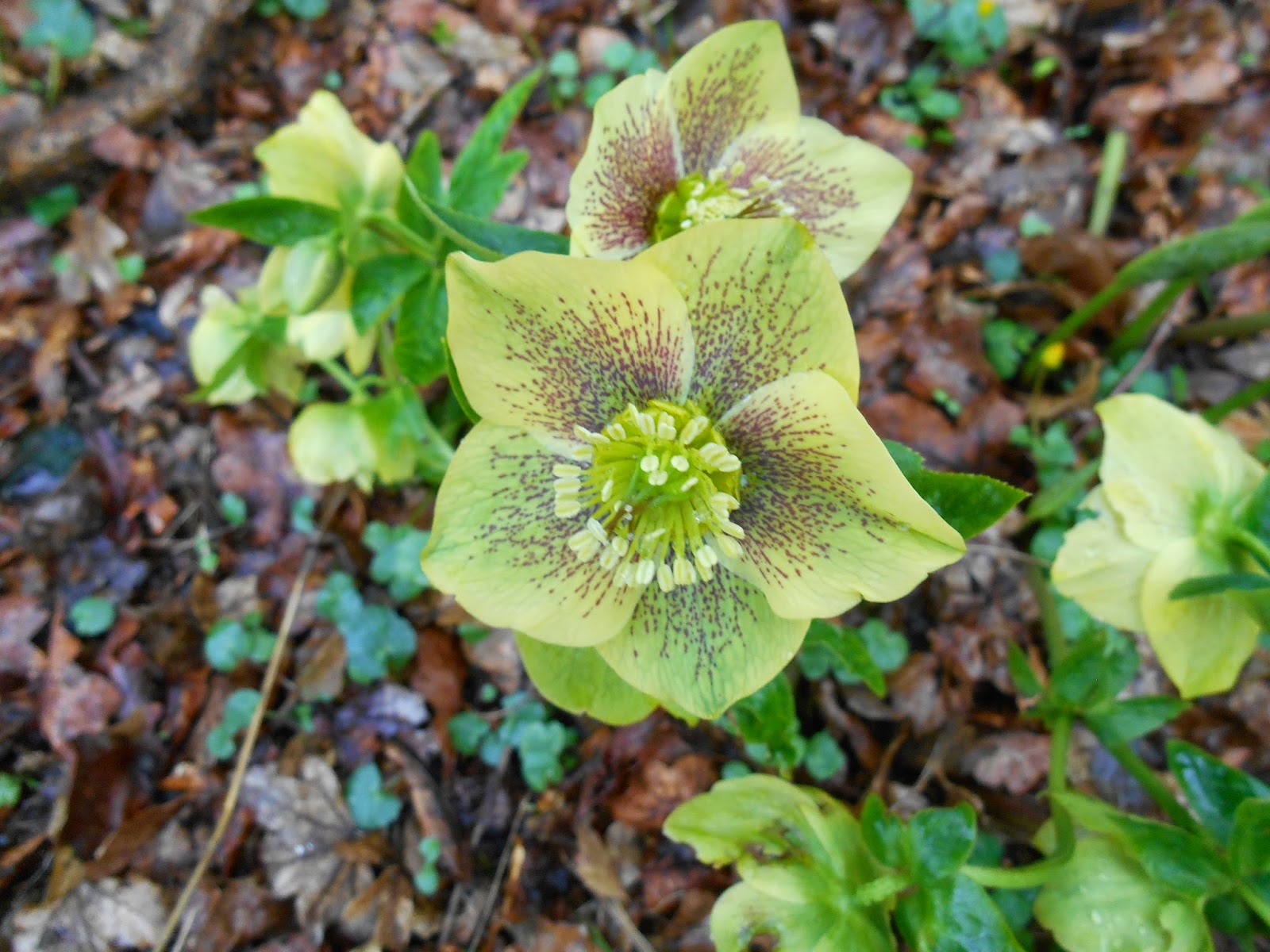
As with snowdrops, hellebores are not among my favourite flowers but I had to admit that there were some most attractive specimens to be seen. Am I beginning to change my mind about these lovely members of the buttercup family? Of course, they couldn't be accommodated in our very limited garden.


These hellebores are all hybrids, some with quite complex parentage. Helleborus niger, H. orientalis and more recently even H. thibetanus can be involved.
The yellow blotch-mine of Phytomyza ilicis scars this Holly
leaf. Evenley Wood Gardens.  29 March, 2015


Some interesting hollies were being grown. This very narrow-leaved specimen may look odd but is just a variety of our common holly, Ilex aquifolium. Not surprisingly, given its narrow leaves, it is called Ilex aquifolium 'Angustifolium' but, odd or not, the leaves still bear the yellow mines of the fly Phytomyza ilicis.


The rather neat leaves of Ilex 'Lydia Morris'
Evenley Wood Gardens. 29 March, 2015
Sporting only a few prickles to each leaf is Ilex 'Lydia Morris'. It is a cross between two Chinese species, Ilex cornuta and Ilex pernyi; I could find no trace of an attack by the Phytomyza - and it was still bearing a few berries.

Other hollies merited attention but wet, muddy condition discouraged us from lingering.


Cornus officinalis was new to me. It is very similar to the Cornelian Cherry, Cornus mas, the yet-leafless branches being wreathed  in pale gold flowers. 


The pale yellow flowers of Cornus officinalis brighten a glade.
Evenley Wood Gardens. 29 march, 2015

The fruits of the true Cornelian Cherry are edible and, I am told, delicious. Whether C. officinalis, known as the Japenese Cornelian Cherry, are also edible, I don't know.


I could go on but will restrain myself to the 
mention of one other plant. Zanthoxylem piperitum, known as the Japanese Pepper, is not often seen and I was sorry that, so early in the year, it was not displaying its curious pinnate leaves or, indeed, its flowers. Very obvious however were the vicious spines on the trunk and branches.


The branches of Zanthoxylem piperatum are armed with
vicious thorns. Evenley Wood Gardens. 29 March, 2015
Anyone stumbling against this tree would clearly receive severe lacerations. 

The Latin name is pleasingly simple to translate: zantho (or often xantho) means yellow and xylem means wood. Piper is the name of the true pepper trees and again comes from the Latin piper, meaning pepper. Would that all names were so easy to unpick.


By now our footwear was thoroughly muddy and we decided to call it a day. Chris so enjoyed the visit that she is keen to go again. I wouldn't argue against that.

Tony White.  E-mail: diaea@yahoo.co.uk

Friday, 27 March 2015

Creating a sink garden

Here in Daventry our garden is far smaller than the one we had in Byfield, so now I'm thinking small scale.

Our friends Lynda and Damien have passed on to us an old glazed sink. My intention is to hide the glazing by coating it with hypertufa, a blend of coarse sand, cement and peat-free compost in the ratio of 3:1:1; this gives a stone-like appearance and texture, hopefully making the sink look authentic. Lots of alternative mixtures for hypertufa are suggested on line, but yer pays yer money...

The job I wasn't relishing was chipping the glaze. This is done to give the hypertufa a better bond with the sink surface, but what do I find? Damien has already gone over the sink with some sort of chisel. Job done. (I owe him a pint!) But I may also apply a coating of black bitumastic sealant to the surface.

Ugly and unwanted. 27 November, 2014


The sink is already very heavy; once the hypertufa has been applied it will be even heavier (what an advantage to know a bit of physics!) so I'll manhandle it into its final resting place before starting.


I decided to wait until the chance of a hard frost had receded. I could have started in mid-winter, applying the hypertufa and then and draping the sink with sacking but decided to exercise a little prudence.

So it was early March before I decided it was safe to go ahead. I was anticipating a slow, laborious job but the hypertufa clung better if I slapped it on firmly and I got the sink covered in about half an hour.


Nearly there. 14 March, 2015


It looked a bit rough and lumpy but that was really the finish I was looking for. Obviously there was no point in treating the inside.


The soil had to be free-draining - most alpines hate wet conditions - and I used equal parts of coarse sand, John Innes No 2 and multipurpose compost. Chunks of York flagstone were used to provide crevices. It looks rather like some sort of limestone but in fact contains little or no calcium carbonate, making it conveniently neutral.


All planted up! 27 March, 2015
On 26 March, having received a box of plants I was able to get them in.  I only put in six plants as it was important to allow room for them to grow. Now it is just a question of keeping an eye on the watering - and waiting.


Saxifraga x irvingii 'Jenkinsii'  27 March, 2015

Elsewhere some of my alpines are now in flower. This is Saxifraga x irvingii  'Jenkinsii' and considering that I only planted it a few weeks ago I am pleased at how it has settled in. The Saxifrages ('rock breakers') include some lovely little plants and I can see me growing lots of them.


Saxifrage'Peach Melba'. 27 March, 2015

The rather similar Saxifraga 'Peach Melba' (both this and 'Jenkinsii' are members of the Porphyrion group) has also settled in well and the cushions should get larger each year.


I am encouraged by progress so far and in two or three months there could be lots of colour. Who needs half an acre!


Thursday, 26 March 2015

Woodford Halse: St Mary's Church

Chris was in Woodford Halse yesterday for a tonsorial operation. As it was likely to take about an hour and a half I took a stroll - not for the first time - around the churchyard of the St Mary the Virgin. 

It is a large area, neat and tidy in places but very neglected elsewhere.


Some of the graves were so overgrown that only a protruding piece of masonry revealed their whereabouts.


The Yellow Meadow-ant had played its part too with large mounds covering graves here and there. In these mounds root aphids will be farmed. For most of the year they will provide the ants with honeydew but during the winter many of the aphids will be eaten.


There are some fine trees in the churchyard including some lovely examples of Lawson's Cypress, Chamaecyparis lawsoniana (not to be confused with the notorious Leyland Cypress). Currently the male cones are a beautiful wine-red colour, giving the whole tree a striking appearance.


Cones on a cedar. St Mary's churchyard, Woodford Halse,
Northants. 26 March, 2015

A rather fine cedar tree stands to the rear of the church. From the form of the needles I believe it to be Atlantic Cedar, Cedrus atlantica. The cones are streaked with white dribbles of resin.


A yellow coating to a cone on this cedar is probably algal growth.
St Mary's churchyard. 26 March, 2015


The cones are rather persistent and in one case the cone had been there for so long that it had developed an odd yellowish patina of (presumably) algae. Here it can be seen that the leaves are grey-white, showing it to be the popular cultivar 'Glauca'.


I had no intention of delving into the tussocky grass but even so there were insects to be seen, including an attractive ladybird, so glossy that the edges if the wing cases appear blurred.


It was a 10-spot ladybird, Adalia decempunctata, but not with the typical patterning; it was the less common form  
decempustulata, a variation I had not seen before. It is one of the smaller of the British ladybirds, being only 4 mm long.


Sitticus pubescens blending in against a lichen-scabbed
gravestone. Woodford Halse. 26 March, 2015

Also difficult to photograph clearly - for obvious reasons - was this well-camouflaged spider. It is Sitticus pubescens, one of the jumping spiders. It is commoner around buildings than in the open countryside, and will occasionally find its way into our houses. Again it was tiny - barely 3 mm long, and had it not moved I would probably not have spotted it.


This early in the year there was little else of note but I had just left the churchyard when I saw a plant of Nipplewort, Lapsana communis, growing at the base of a wall.


The fungal rust, Puccinia lapsanae. has attacked this
Nipplewort. Woodford Halse, 26 March, 2015

The species is very common but this example had grossly distorted and discolored leaves, the result of an attack by a rust, Puccinia lapsanae.
 It is widespread, but I had not seen it for many years.


So, only an hour's break but imo time well spent. And Chris's hair looked very nice too.

Tony White. E-mail: diaea@yahoo.co.uk


Tuesday, 24 March 2015

Kentle Wood.progress

With conditions still chilly I began investigating grass tussocks. The reason was simple: the micro-climate deep in a tussock is remarkably stable with conditions in the winter frost-free and moist whereas in the summer it is cool and humid. Small creatures can survive there all the year round.
Tandonia budapestensis at Kentle Wood,
Daventry. 23 March, 2015


But the first creature I recorded was beneath a log beside a tussock and it was hardly exciting - unless you are a conchologist. A Budapest Slug, Tandonia budapestensis, can be recognised by a yellow stripe down its back.


For certain identification - and I know you will be keen to do this - turn the animal over and examine its sole. (No vicar, sole not soul!)


The pale sole has a broad, dark grey stripe down its middle. The species is very common and can be a pest in gardens but is regularly encountered in the countryside.
The so-called Fast Woodlouse, Philoscia muscorum.
\Kentle Wood, Daventry. 23 March, 2015


On to the main objective. Having loosened part of a tussock I shook it over a white cloth and out came several specimens of the Fast Woodlouse, Philoscia muscorum. It is a smart creature, easily recognised by the dark stripe down the back - plus the fact that it moves very quickly, making photography tricky.


Soon other creatures were tumbling on to the sheet, with beetles being of particular interest.


Demetrias atricapillus. Kentle Wood, Daventry.
23 March, 2015


By far the most common was the ground beetle Demetrias atricapillus. At one time there were seven of them on my sheet. Despite being so abundant it appears to have no common name.
Oulema sp.  Kentle Wood, Daventry 23 March, 2015


And this smart insect is one of the leaf beetles. It is either Oulema rufocyanea or Oulema melanopus; experts find their separation tricky and here I am a tyro. On the balance of probabilities it is the former but ideally I will find a male and dissect the genitalia; today I found only females.


A number of tiny spiders await identification together with a couple of weevils. The spiders should be straightforward, the weevils less so.


Friday, 20 March 2015

Surveying Kentle Wood

I have now received the go-ahead to do a survey of Kentle Wood. I'll concentrate on the flora (which won't take long!) and arthropods - woodlice, centipedes, millipedes, spiders and insects. I am fond of birds and have done a lot of bird watching over the years but I'm hoping that there will be local bird watchers keeping an eye on them.


A typical grass tussock at Kentle Wood, Daventry
17 March, 2015
I am starting with spiders. Although they are not very obvious at this time of the year tussocks of grass - of which there are many at the woodland edge - should yield 'money spiders'. These are members of the Linyphiidae family. Most of them are very tiny so, although I found them very tricky at first, that is what makes them an interesting challenge.


Grass tussocks are not only home to spiders but springtails, beetles and many other creatures. As the trees form a canopy these grassy habitats will slowly disappear, hopefully to be replaced by woodland perennials; these would have to be planted by working parties.


Common Fumitory at the entrance to Kentle Wood,
Daventry. 17 March, 2015


A pretty specimen of Common Fumitory, Fumaria officinalis, was growing at the entrance, leaning against a gate post. When en masse the greyish, deeply divided leaves have a fanciful resemblance to smoke, hence the common name. The old French name was fume-terre or 'earth smoke'. Not a lot of people know that.


It has to be said that my first visit was not very productive. Two spider species, some millipedes and a beetle are not much of a reward for a lot of bending and cold, wet hands. The consequence is a very short blog.

But it's a start.