Wednesday, 18 March 2015

A Fawsley to Daventry walk

Despite a foggy start the day looked promising. Chris was going to Byfield so I got her to drop me off on the A361, about half a mile west of Fawsley. The fog was already dispersing, allowing the sun to break through as I struck out along a minor road. Minor it may have been but a surprising number of vehicles kept me on my toes. This, plus a drab landscape, made the first few hundred yards less than pleasant.

Norman St John Stevas, who on his ennoblement became Baron St John of Fawsley, died in 2012 so I was unlikely to meet him. Today, Budget Day, he would have been stuck in front of the telly anyway.


Dog's Mercury is one of our earliest native plants to
come into bloom. Fawsley,  18 March, 2015
Beside the road plants of Dog's Mercury, Mercurialis perennis, were pushing up through dead twigs. This curious member of the Spurge Family, Euphorbiaceae, would come high in a vote for 'Britain's dullest plant' but it is of some interest. It is regarded as an indicator of ancient woodland and here we must suspect that this location was once well wooded. It attracts few insects but a couple of not-very-exciting fungi sometimes attack it. 
Evernia prunastri clings to a tree trunk near Fawsley Hall
18 March, 2015


A tree trunk with flourishing tufts of the lichen, Evernia prunastri, did little to raise the level of excitement but I was shortly to leave the road and take to the fields.


The Fawsley Estate boasts some largish lakes and, as I was leaving the road, Horse Pond came into view. Like all the lakes here it has been formed by damming a stream, a tributary of the River Nene. A Great Spotted Woodpecker in an alder sidled out of view around the trunk as I approached.


Trees are not easily killed. This ash tree has lost its crown and the dead side branches are sprouting fungi, but new growth is flourishing on the other side of the trunk and there is plenty of life there yet.
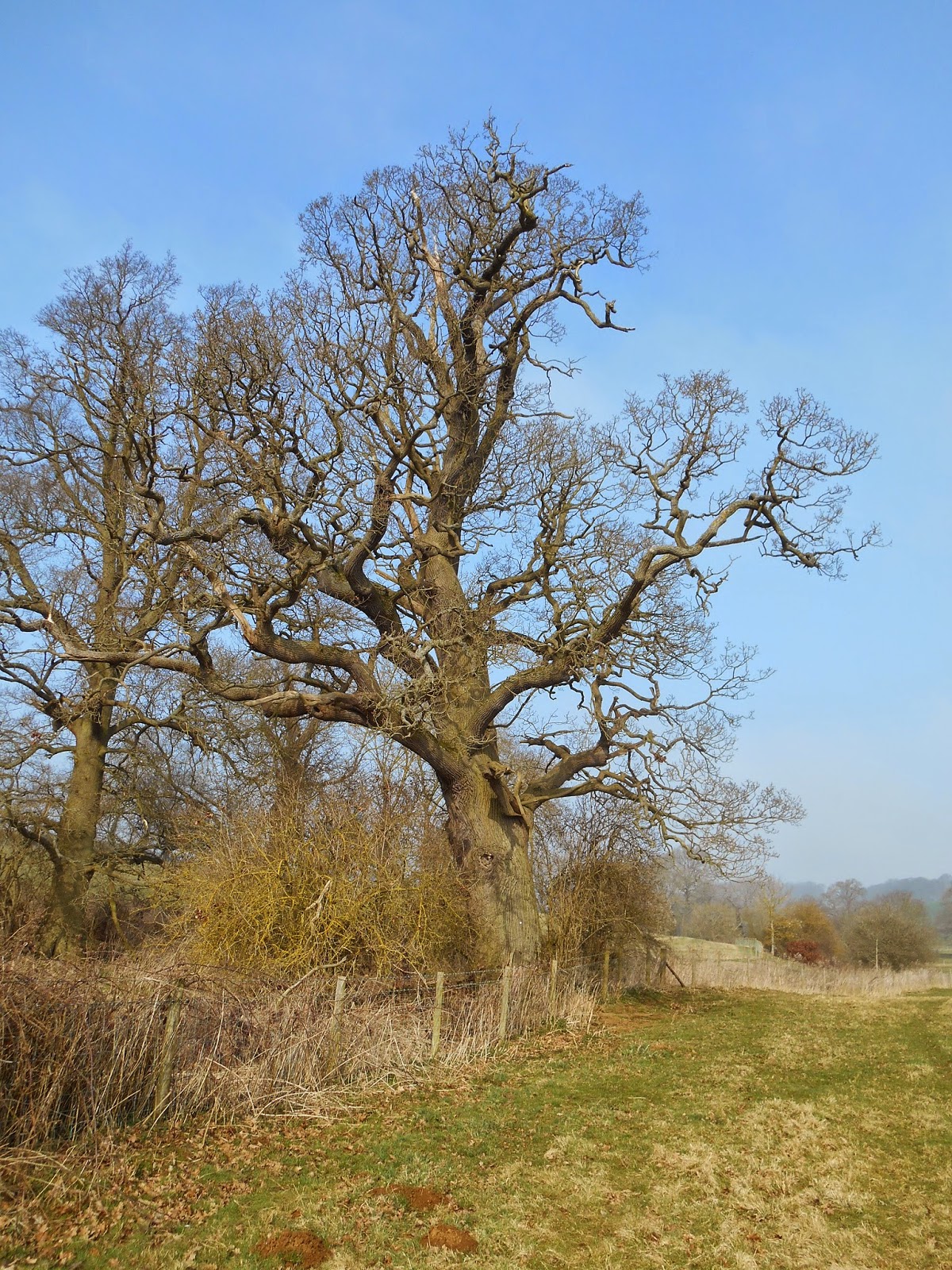


Apart from ash and alder there were some fine oak trees. Devoid yet of leaves the typically angular branches stood out clearly against the now blue sky.


Not all were in the peak of condition.


Some were dying...


...and some were dead. I was pleased to see that these giants were being left to slowly decay. They will support a whole new suite of organisms over the next few years...


Oak sapling with sheep-proof surrounds.
Fawsley Estate, 18 march, 2015


...and the landowners were ensuring that a new generation of oaks would be there in the next century and beyond. 

A flock of fieldfares took to the wing at my approach, chak-chakking with alarm.


Beech, Fagus sylvatica, had been planted.
Between Fawsley and Badby, 18 March, 2015


Beeches had also been planted but, unlike oak, ash and alder, these are not native to Northamptonshire. Nevertheless they are welcome because imo they are among the most handsome of trees. The elephant-grey bark is a good way of recognising a beech and the slender tapering buds are a clincher.


These were not all in the best of health either, with fungi eating away at the base of the trunk on more than one specimen.


Ganoderma pfeifferi (probably) at the base of a beech trunk.
Between Fawsley and Badby, Northants. 18 March, 2015


A closer look suggests that this fungus is Ganoderma pfeifferi. It is particularly associated with beech in parkland - exactly the situation in which I found it. But I should state that I never submit fungus records to the Wildlife Trust; I am not an expert.


Another couple of hundred yards and I found myself entering Badby Woods and simultaneously joining the Knightley Way. 

The Knightley family (sometimes spelled Knightly) came from Staffordshire and settled at Fawsley in the early 15th Century, becoming one of the county's most distinguished families.


I worked my way through the woods, with thousands of green spikes of bluebell pushing through the soil, to come out into green fields beyond.


By now my legs were feeling a bit heavy so I was glad to see the tower of Badby church through the trees. But there was quite a way still to go...


Dog's Mercury was present at the edge of the village but here it was a little more advanced, with the stamens clearly showing.
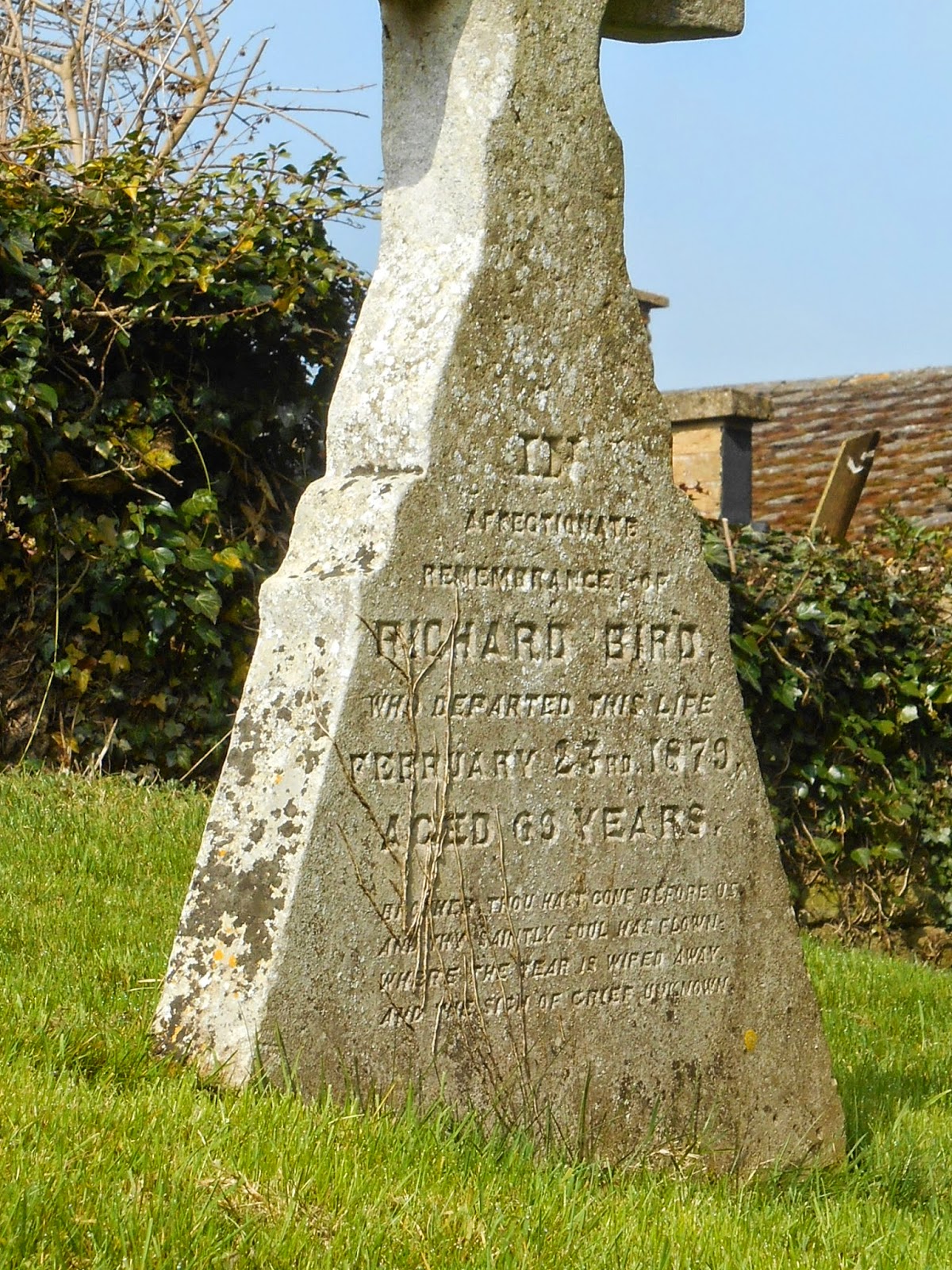


As I passed the churchyard I was surprised to see that Dickie Bird was interred there; I didn't know he was dead! However a closer look revealed that our National Treasure had not departed Lord's cricket ground to be at hand for other Lord's works; the dates didn't match. He is 82 next month and still very much with us.


Then it was a long slog up from Badby to Daventry. It is only about fifty metres of ascent but all I can say is that on the unforgiving tarmac it felt more. 


Coltsfoot, Tussilago farfara, was flowering in profusion
at the edge of Daventry. 18 March, 2015


Right at the edge of the town, as I crossed the A45, I was greeted by a bright 'golden throng' of Coltsfoot, Tussilago farfara. It is a plant that tends to favour heavy clay soil but that didn't seem to be the case here. It doesn't take a botanist to recognise that it is in the same family, the Asteraceae, as dandelions.


The bee, Bombus terrestris, was working the
flowers. 18 March, 2015

A bee was tucking in to the nectar. I am not an expert on bees either but there is little doubt that it is Bombus terrestris. It is very common but it pleased me greatly to see it, and I completed the last few hundred yards of the four and a half miles heavy footed but light hearted.


And if you have stuck with this blog to the very end - well done!

Thursday, 12 March 2015

Kentle Wood 3

I have written to the Woodland Trust asking for authorisation to do an invertebrate survey of Kentle Wood. I am still waiting for a response so today, on my third visit, the only specimens I took were taken with a camera.

As I have mentioned before, Kentle Wood is new to the landscape, having only been planted about fifteen years ago. Its flora and fauna are therefore inevitably limited, nay impoverished, and I wasn't expecting to see anything sensational. Nor did I.


The ground flora of Kentle Wood is
very limited.  12 March, 2015


The young trees have grown rapidly and the lower branches, robbed of light, have died off leaving the ground littered with these dead branches. The trees stand in regimented rows and, although the lines will become blurred over time, the original planting scheme will always be clear. The ground flora is very limited


Dead branches are in themselves a valuable habitat. Over the decades numerous fungi will make their presence known but already some are very obvious.


Probably Sarcoscypha austriaca. Kentle Wood, Daventry.
12 March, 2015
People who visit woodland with any regularity soon become familiar with the Scarlet Elf Cup, Sarcoscypha austriaca. But unfortunately Ruby Elf Cup, Sarcoscypha coccinea is so similar that microscopic examination of the spores is required for a certain identification. Quite unscientifically I am going for S. austriaca on the grounds that it is the commoner of the two species. I'll bring a specimen home from my next visit.


Turkey-tail, Trametes versicolor on dead wood.
Kentle Wood, Daventry. 12 March, 2015


The less problematical Turkey-tail fungus, Trametes versicolor was also present. So common is it that I only include a picture on the grounds that it is rather photogenic. It was occupying the same habitat of fallen branches as the Scarlet Elf Cup.


Xylaria longipes. Kentle Wood, Daventry.
12 March, 2015


Finally we have the charmingly named Dead Moll's Fingers, Xylaria longipes. Common but easily overlooked this was also on dead wood. Xylaria polymorpha is similar.


In the course of lifting dead wood I recorded all four of the common, larger woodlice:

Philoscia muscorum. Not very common in gardens but abundant in the open countryside, this is a glossy, fast-moving creature with a distinct stripe down its back.

Armadillidium vulgare. Well-known to every inquisitive child, it is the only common woodlouse able to roll up and make a more or less perfect sphere.

Porcellio scaber. Matt grey or pinkish it is very common under pieces of wood and often wanders into our houses.

Oniscus ocellus. Larger, flatter and fairly shiny, this is also common under wood. It has a greyish edge to its carapace.

So, with no permit I was limited in what I could record and, although I set out in bright sunshine the weather deteriorated to become dull and cool, so there were few insects about either.

No matter, the year is yet young.

Tony's e-mail:  diaea@yahoo.co.uk


Tuesday, 10 March 2015

Two steps forward, one step back.

After the lovely sunny weather of the weekend we had a sharpish frost on Sunday night and we were left with a day of cool, grey, showery weather.

In fact I hardly ventured out at all, suspecting that there wouldn't be many insects about. I could perhaps have found a few of those neglected orders of creepy-crawlies which rather intrigue me - and probably bore most other people, and I'd have been content with that. 

                      With coarse rice to eat, with only water to drink,
                      and my bended arm for a pillow, I am happy.

                                                                                    Confucius

So instead I 'bended' my back around the garden, planting a honeysuckle, a rose and a passion flower.

Tuesday, 10th March was far better and I grabbed the chance to visit Stefen Leys Pocket Park. Quite a few insects were around; all were diptera and all were basking on foliage or sunny tree trunks.


Eudasyphora cyanella basks on a sunny tree trunk.
Stefen Leys Pocket Park, Daventry. 10 March, 2015

This female Eudasyphora cyanella was one of many taking advantage of warm, south-facing tree trunks. The eyes are hairy but in the case of this specimen, only slightly so. The concept of hairy eyes perhaps seems odd to the non-entomologist but it should be remembered that these eyes are compound, and the hairs grow in between the hexagonal facets. Though very common this insect has no common name.


Signs of spring were gradually becoming apparent with a solitary flower of Celandine, Ranunculus ficaria, making a splash of gold beneath a hawthorn bush.


The male catkins of alder were now fully open and, just above them, the reddish, ellipsoid female flowers which will eventually form the 'cones' by which alder is so easily recognised. Do any insects take the pollen? I watched carefully for a few minutes and no insects appeared, but that proves nothing.


I have a penchant for turning over stones or logs. (A penchant is a grubby stick found nearby, useful for turning over equally grubby stones [Not funny, Tony]). Woodlice, centipedes, millipedes and ground beetles are frequently to be found, but today I mostly revealed slugs.


The slug to the right, with dark bands running along the side is Arion distinctus, a common species frequently found in gardens.  On the left is a Budapest Slug, Tandonia budapestensis, an equally abundant species. In the bottom left-hand corner is a cluster of translucent slug eggs, perhaps belonging to the Budapest Slug. 


This picture is so blurred that I am displaying it only because it is rather interesting. When I got home I was sorting through a few flies when I found that I had unknowingly secured a tiny spider, an immature and unidentifiable member of the Araneidae family. In approximately the middle of the spider is a yellow structure like a tiny sausage. 


My first thought was that it is the larva (grub) of a fly called Ogcodes gibbosus, but the grub of that species tends to be pear-shaped. It is more likely to be the grub of an ichneumonid wasp, but as to the species, I haven't a clue. These are not uncommon and I have taken many over the years. The grub positions itself so that the host, i.e. the spider, is unable to dislodge it so it will feed unhindered until its unfortunate host has died. It will then probably pupate within the corpse.

I suspect people rarely feel sorry for spiders but this is a rather grisly death.

For the record, the only other flies recorded were:

Pollenia rudis - a very common 'cluster fly'. Pollenia species have distinctive golden hairs on the thorax.

Calliphora vicina -  A blowfly important in forensic work because of its arrival on a corpse
within a fairly precise time frame. 

So, only three species, but it's early days yet.


Wednesday, 4 March 2015

Walk: Daventry - Newnham - Daventry

The weather forecast promised a dry day, dull at first with sunshine breaking through later. The prediction was correct. It could promise temperatures no higher than about 7 degrees Celsius; unfortunately that was correct too.

I walked to the edge of Daventry and followed the A45 south-east towards Northampton for about three quarters of a mile and then set off on a minor road going south-west. It was a relief to get away from the thundering traffic of the busy main road. The first part of the journey involved a steady climb of 40 metres; the climb I welcomed (I need to get fit) but the walking was less than exciting. I turned around, anticipating fine views of Daventry but all I got was a landscape of industrial units set in a drab winter landscape (yes, I know meteorologists claim that spring started on 1 March but 20 March is a more generally accepted date). 

Anyway, I pushed on until I was almost at the edge of Newnham before turning NNW across sheep pastures. There were some fine oaks dotting the hillsides together with a rather picturesque Scots' pine.


Pines are not native to Northamptonshire or, indeed, anywhere in England but they are very commonly planted. I am told that sheep drovers on their way from Wales to Northampton or London would plant pines to indicate places where they would get a friendly reception, good accommodation, pasture, etc. But in this present case I am sure the pines are simply there to enhance the landscape.


A little further on a couple of trees had been felled and their trunks lay on the ground. Hopefully they will simply be left to moulder away. Already some wildlife was taking advantage of the habitat.


Amaurobius fenestralis was found beneath bark.
Near Newnham, Northants. 4 March, 2015


A spider, Amaurobius fenestralis, was concealed beneath loose bark, accompanied by several woodlice, Porcellio scaber (to the left of the picture). The woodlice need have no fear for spiders generally ignore them. However Dysdera species are woodlouse specialists, injecting them with a venom so powerful that the victim can be dead within seven seconds. These amber-coloured spiders occasionally find their way into houses and, with their large sinister-looking jaws, can cause some alarm. I seldom record Dysdera species in Britain but frequently note them in Mediterranean regions.


Polydesmus angustus. Perhaps our commonest millipede.
Near Newnham, Northants.  4 March, 2014


A short distance away a flat-backed millipede was revealed as I lifted another section of bark. These creatures are much neglected in general but, with about 65 species present in Britain, they are not too daunting a group to study. This one turned out to be Polydesmus angustus - no surprise really as it is probably Britain's commonest millipede; certainly it is our most common Polydesmus species. 


These slow-moving creatures appear vulnerable to predators but they secrete cyanide in the form of hydrocyanic acid (with benzaldehyde). Some people have claimed to detect an almond scent as they handle these creatures but I have never noticed it. Despite this defence they have been found in the stomachs of frogs and toads.


Heterogaster urticae, with the membranous wing-tips appearing
white with reflected light. Near Newnham, Northants

Finally the loose bark yielded a bug - my first bug of the year. In fact there were dozens of them. Disappointingly the species turned out to be Heterogaster urticae. This is extremely common but I generally find them on nettles. Clearly they must overwinter somewhere and loose bark seems as good a place as anywhere. The membrane at the wing tips is glossy and in the picture they are reflecting light and so appear white.


Usually loose bark will yield a snail or two but, although slugs were present it was a snail-free zone. I replaced the bark as carefully as possible.


I had already noticed that the soil thrown up by moles was distinctly sandy and, combined with the snail clue, I suspected that the soil was rather acid. Obviously snails require lime in their habitat for the development of shells.


A little further on I came across some gorse bushes and this more or less clinched the acid soil theory. As I have remarked elsewhere, gorse doesn't demand an acid soil but it tends to avoid lime.


I soon found myself on the Newnham-Byfield road. The walking was unpleasant, not just because the narrow, winding road was rather busy with traffic but a disgraceful amount of litter was present on the verges. Much of the discarded material consisted of wine bottles! It was good to get to the margins of Daventry and a relatively litter-free environment.


Tuesday, 3 March 2015

Stefen Leys Pocket Park - again

Tuesday, 3 March, turned out to be a fine day. The bitter wind which has plagued us for the last 72 hours, and had hindered me in my quest for blogworthy material, has eased off to just a breeze. I took advantage of the conditions to have a stroll around Stefen Leys Pocket Park.


Aspen, Populus tremula, showing the
distinctive bark. Stefen Leys Pocket Park.
Daventry. 3 March, 2015
There are quite a few aspen trees, Populus tremula, present, easily recognised by the distinctive patterning of diamond shaped impressions on the bark. The trees throw out lots of suckers from which other trees grow and a clump of aspen may prove to be just one clone. A similar situation usually exists with regard to elms.

The bark was - and is - highly esteemed by herbalists and my copy of 'Potter's Cyclopaedia of Botanical Drugs and Preparations' suggests that it may be 'freely given' in cases of 'debility, indigestion, faintness, hysteria... gonorrhoea, gleet and other urinary complaints'. Gleet was new to me but Chamber's Dictionary tells us that it is 'a viscous, transparent discharge'.  Hmmm.


Turkey-tail, Trametes versicolor on dead
aspen. Stefen Leys Pocket Park, Daventry
3 March, 2015


Dead and dying stumps of aspen bore clumps of Turkey-tail, Trametes versicolor. I have mentioned this fungus species in previous blogs but that is hardly surprising as it is with little doubt the commonest of Britain's wood-rotting species. In older books it is called Coriolus versicolor. Throughout the winter clusters of this fungus have kept appearing and then dying off, only to be replaced by new patches.


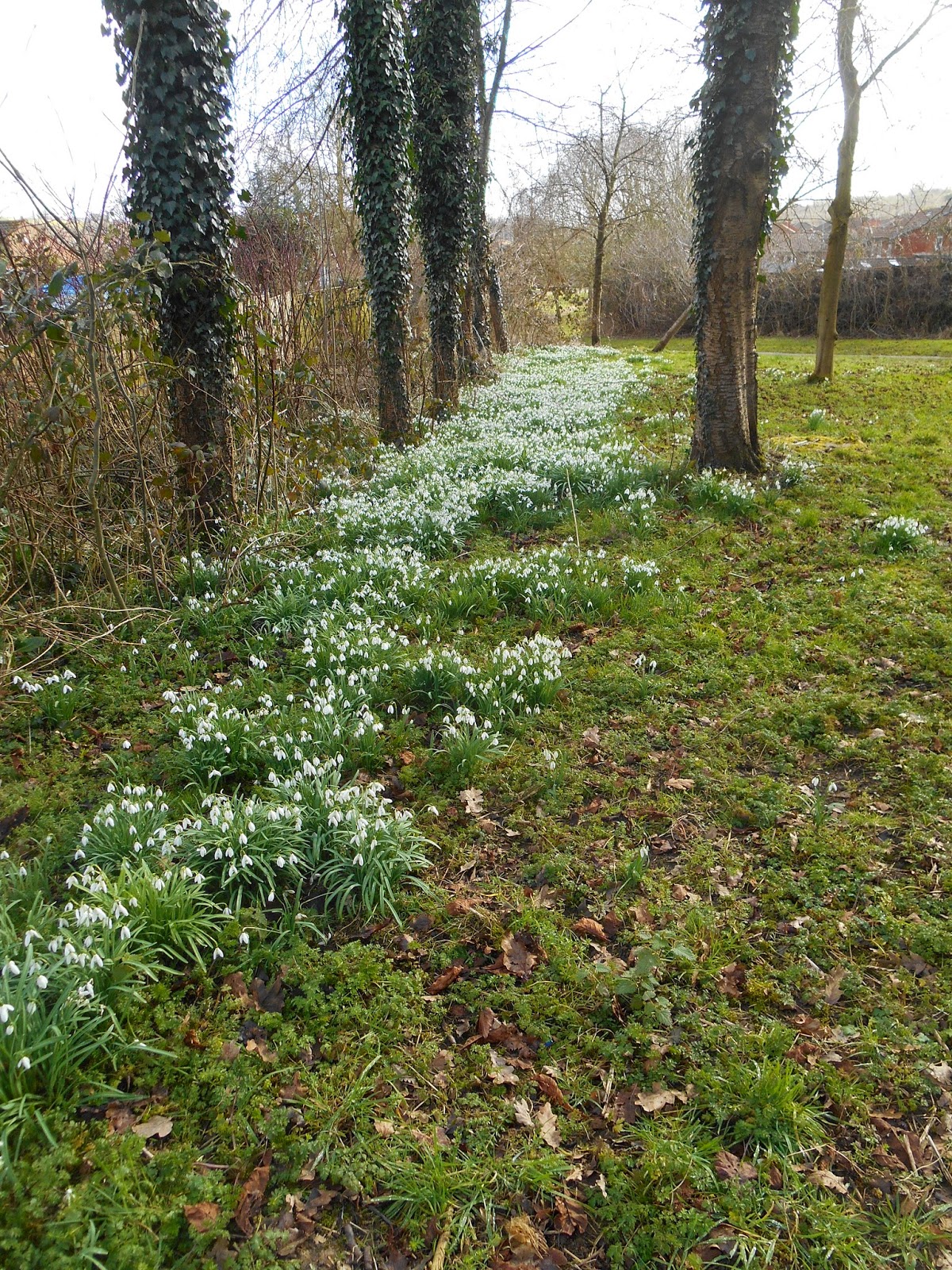
Drifts of snowdrops remain from my previous visit. The perianth segments of the flowers (it is not clear whether they should be regarded as petals or sepals) will remain until fertilisation has taken place, but with bees sensibly not venturing out the flowers should remain as they are for some time yet. Many people love snowdrops but I am not one of their ranks. To me galanthophilia is a strange malady but thankfully any outbreaks are over by May.


As far as I know the pocket park is not subject to any management regime so, although it has great potential, it is quite limited in terms of wildlife (I would like to be proved wrong on this point). The situation is not helped by people dumping litter there and leaving dog faeces everywhere.


Someone (the local authority?) has gone around spraying these droppings with a bright orange spray and hundreds of these patches now highlight the mess in a way which, hopefully, will shame dog owners into clearing up.


Limax flavus in Stefen Leys Pocket Park, Daventry.
3 March, 2015

Someone had dumped some bedding at one point and, reprehensible though the act was, I found on turning it over that it had provided a congenial home for at least a hundred specimens of the Yellow Slug, Limax flavus. This is one of our larger slugs (up to about 10 cms) and is frequent in gardens.


Spawn of the Common Frog, Rana temporaria. Stefen
Leys Pocket Park, Daventry. 3 March, 2015
A short distance away was the pocket park's only pond. I was pleased to see that it contained 20-30 masses of frog spawn. There were more frogs in the water still mating so, barring disease or interfering humans, there should be plenty of tadpoles around in a month or so. The species involved was the Common Frog, 
Rana temporaria.


(Rana is the generic name of our commonest European frog; Ranunculus, meaning 'little frog' is the generic name for buttercups. I have read several explanations for describing buttercups as little frogs but to me none seems satisfactory.)


Mounds of the Yellow Meadow Ant,  Lasius flavus.
Stefen Leys Pocket Park, Daventry. 3 March, 2015


Several species of ant will build mounds. The commonest of these species is the Yellow Meadow Ant, Lasius flavus. A few mounds are present in a grassy area of the pocket park and, although I will do a check in mid-summer, I have no doubt that Lasius flavus is responsible. 


Research has shown that the microclimate inside these mounds is remarkably constant in terms of temperature and humidity. If necessary the adult ants will move the various juvenile stages to the most favourable spot. So, far from being dumps of waste material left simply as a consequence of the ants' burrowing activities, they are well-organised structures of considerable complexity. 


Snowdrops, frog spawn... Things are now moving ahead nicely but I won't tempt fate by dwelling on this issue. (We had a flurry of snow a few hours later!)


Thursday, 26 February 2015

Daventry to Kentle Wood: an aborted trip

I set out earlier today for a third visit to Kentle Wood ...and never made it. Although I set out in fine weather huge purple clouds soon began to loom up in the west and moved threateningly in my direction. I let prudence be my guide and turned 180 degrees to head back home.

Nevertheless I had covered a mile or so before my retreat and some features of interest had already been noted.


Oyster mushrooms on a dead branch. Yeomanry Way,
Daventry. 26 February, 2015


On a partially dead tree in Yeomanry Way a clump of Oyster Mushrooms, Pleurotus ostreatus, flourished. It is not as destructive a species as Honey Fungus and is best described as weakly parasitic and is usually found on already-dead wood.


Oyster mushrooms, though fairly easily recognised in terms of structure, are very variable in the colour of the cap. These delicious fungi, commonly seen nowadays in the high street, often have steel-grey caps or even a rather violet coloration.


Parmelia saxatilis bearing thousands of isidia.
Thames Road, Daventry. 25 February, 2015


Also on a tree trunk, this time in Thames Road, was the lichen Parmelia saxatilis. The specific name 'saxatilis' means 'of rocks' but this species is happy on suitable tree trunks.


A close-up shows that, instead of jam-tart shaped ascocarps, the main reproductive structures are isidia - tiny outgrowths on the thallus which may become detached and act as reproductive units.


An Ash tree branch sweeps down to make
photography convenient.  Leamington Way,
Daventry. 25 February, 2015


Beside the busy A45, here known as Leamington Way, Ash trees, Fraxinus excelsior, were close to flowering. A close look is needed to make out the nature of these reproductive organs.


The purple stigmas of an Ash tree.
Daventry. 25 February, 2015


Looking vaguely like succulent purple fruits, these are the large fleshy stigmas. The male flowers will open within a few days and the rather mealy pollen will be scattered by the wind.  It seems a haphazard, inefficient process but the thousands of winged seed capsules (the 'keys') carried by trees bears testament to the success of this strategy. 


Neither male nor female flowers bear petals, thus making less obvious the fact that Ash is related to Lilacs, Forsythias and Jasmines. 


So, as I have said, I scurried off home at this point to beat the rain. And it never came!