Thursday, 10 April 2014

The Buttercup Family. Part 2: mid-spring to mid-summer

With its first flowers opening around mid-March comes the Marsh-marigold, Caltha palustris. In their 1962 "Flora of the British Isles" the authors, Clapham, Tutin and Warburg state: 'The flower of Caltha palustris is perhaps the most "primitive" in the British flora'  - but that was over half a century ago and modern taxonomists would not necessarily agree. I will say little more about this species as it has been the subject of a previous blog (Horse-blobs and Bee-flies, 16 April, 2013). I am not an authority on Shakespeare but the following stanza from Cymbeline ( which I had unaccountably overlooked!) has come to my attention:

                      "Hark, hark! the lark at heaven's gate sings,
                       And Phoebus' gins arise,
                       His steeds to water at those springs
                       On chaliced flowers that lies:
                       And winking Mary-buds begin 
                       To ope their their golden eyes:
                       With every thing that pretty is,
                       My lady sweet arise:
                       Arise, arise."  


Kingcups, aka Marsh-marigolds
Byfield 26 March, 2014


Flowering near to Easter the flower apparently held religious significance, with 'Marigold' being a corruption of 'Mary's Gold'. Shakespeare's 'Mary-buds' is clearly a reference to the same flower.


Anemones, of which there are over 100 species, also begin to display their flowers from mid-March onwards.


Anemone blanda in my garden.
20 March, 2014

The lovely blue Anemone blanda, sometimes called the Balkan Anemone, is the first to bloom in this area. It is understandably a popular garden plant, being a very easy to obtain and grow. As it so widely cultivated, I presumed that it would be a frequent escapee and I was therefore surprised, having trawled through my various floras, that it is not often recorded outside gardens. A patch grows in our pocket park and, although it is persisting, it is not yet showing signs of spreading. 


All anemones have an acrid taste and, containing the narcotic and toxic compound anemonin, are dangerous to cattle. Whilst not as dangerous as the related Monkshood, human fatalities have been recorded from ingesting our native Wood Anemone.

Wood Anemone or Windflower, Anemone nemorosa, (Greek: anemos - wind) is one of the daintiest members of our native flora. Presently, thanks to careful management of reserves, it is "probably more common now than for any time in the last sixty years" (Gent and Wilson, 2012, "The Flora of Northamptonshire"). In the Byfield area it is to be found in Root Spinney (blog for 26 February, 2014).


Wood Anemones in a Byfield garden.
31 March, 2014


The Wood Anemone is occasionally to be found in gardens. Those pictured are flourishing in the border of a Byfield garden. It usually has 6-7 "petals", compared with the far greater number (up to 20) of Anemone blanda.


Pasque Flower in my garden. The silky edges
 to the tepals can be seen. 10 April, 2014
Our native Pasque flower was named Anemone pulsatilla by Linnaeus and the name was retained until around 1960 when the name Pulsatilla vulgaris became preferred. The word 'pulsatilla' also has connections with the wind, deriving from a Latin word meaning beaten about or buffeted - as on a windy day. Again, it is a plant about which I have previously written (blog: 'Pasque Flowers' 24 April, 2013). In Northamptonshire it is well known around Barnack (see footnote), and John Clare must have been familiar with it. Strange, then, that he seems to make no mention of it in his poems.


Pasque Flowers in my garden.
Byfield, 3 June, 2014


Of course, Pulsatillas have a second season of attraction, their feathery fruits having a beauty of their own, particularly after light rain, when the silky styles glisten in the sun. The fruits are technicakky achenes; the "feathers" are the greatly elongated styles.


Anemone coronaria 'Bordeaux' in Angela Tiffin's garden.
Byfield. 7 March, 2014


For gardeners, one of the most familiar Anemone species must be Anemone coronaria. The species photographed is Anemone coronaria 'Bordeaux'. Does this lovely variety have any Anemone pavonina in its genetic make-up? Certainly breeders have played around a lot with the Anemone genus, and this is such a striking colour...


At this point I must mention the Globe Flower, Trollius europaeus. This lovely plant is native to Brtain but is largely confined to wet hill pastures in the north of England, together with Wales and Scotland. I have seen meadows bright with it in Austria. It is a plant I have never grown although a close relative, Trollius chinensis was, until two years ago, a feature of one of my garden borders, only to have been carelessly lost during a reorganisation. It is yet another genus in which the sepals perform the function of petals and all the plants so far mentioned clearly share a common ancestor.

Clematis is a large genus of around 300 species which are familiar to us as woody climbers although quite a few are more or less herbaceous.


Clematis armandii in Bell Lane, Byfield.
19 March, 2014


We generally associate Clematis with the summer but some open quite early in the spring. Clematis armandii, a native of China, begins to bloom here in Byfield in mid-March but is not completely hardy. Being evergreen I use it to help hide an ugly fence. Some species such as Clematis tangutica have feathery styles, showing their relationship to Pasque flowers.


I am not a huge fan of the large-flowered Clematis hybrids, colourful though they undoubtedly are. They attract very few insects and the variety shown was purchased by me to disguise an ugly chain-link fence. It failed.


Aquilegias are favourite garden plants. As Columbines they have been popular for centuries and my maternal grandmother called them Curly-headed Boys - a reference to the curving, horn-like spur at the base of the petals. This vaguely resembles an eagle'sbeak, thus giving it its scientific name (Latin: aquila - an eagle). it has to be said that their membership of the buttercup family is not obvious to the non-botanist.
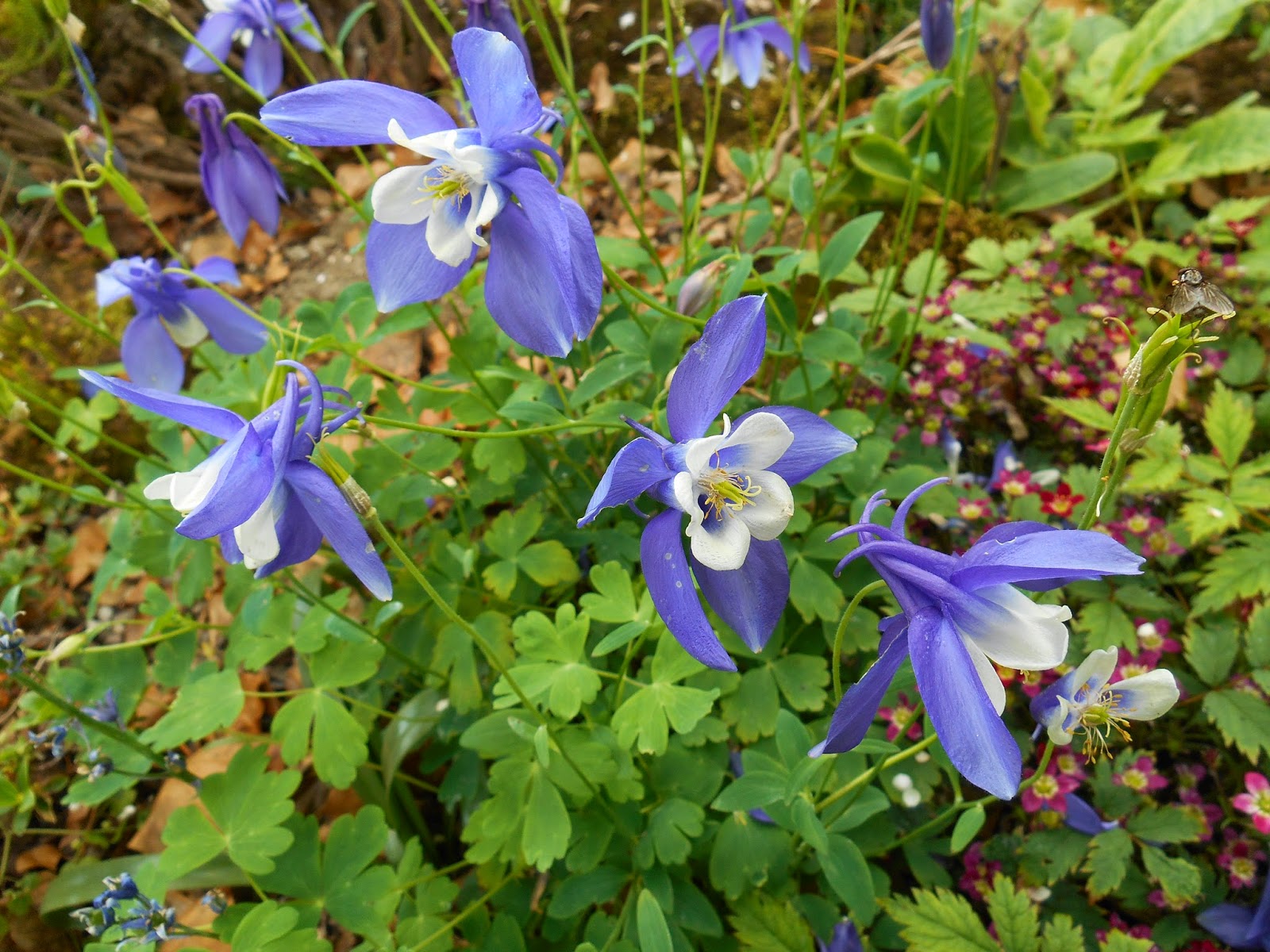


There are some 50-60 species of Aquilegia around the northern hemisphere and crossing them has produced some lovely hybrids such as this example in my back garden. One species, Aquilegia vulgaris, is native to Britain including Northamptonshire. 


Footnotes

1. Barnack is now in Cambridgeshire but is still in Northants as far as biological recorders are concerned. In 1852 H.C.Watson introduced the concept of the vice-county (VC) and for well over a century his county boundaries were accepted and widely used for recording purposes. At that time Barnack was in the Soke of Peterborough, and included in Northamptonshire (VC32). The system is gradually falling out if use in favour of grid-based recording.

2. There should have been a Part 3 but we moved house in late summer so life got in the way a bit. 


Wednesday, 9 April 2014

Pocket Park safari

Last month we had a false spring, and I was grumbling about 'perfidious March'. Today was sunny and warm and I couldn't help feeling that this was the real thing. As Thomas Nashe put it:

                                    Spring, the sweet spring, is the year's pleasant king;
                                    Then blooms each thing, then maids dance in a ring,
                                    Cold doth not sting. the pretty birds do sing...

But this poem was a 16th century job. For us birds and flowers are far less abundant; things to be studied - and cherished.

I strolled over to our pocket park, with as much spring in my step as a 75-year old could muster. The drumming of a Great Spotted Woodpecker was immediately apparent but it was coy and I struggled to get a photograph.


Great Spotted Woodpecker.
Byfield Pocket Park. 9 April, 2014


This was the best I could manage. I was just lining up for a better shot when a heavy tractor passed nearby, with predictable results. A few minutes later it was drumming again - but much too far away.


I pressed on, keen to see whether any of the meadow flowers, planted so laboriously about eighteen months ago, had survived. I was not optimistic as the area had subsequently been overwhelmed with nettles and Rose-bay Willow Herb. But...


Cuckoo Flower, Cardamine pratensis
Byfield Pocket Park.  9 April, 2014


Pink Campion was flourishing, with flower-buds fattening up nicely and Cuckoo Flower, aka Lady's Smock had miraculously survived too. The faint lines on the petals are nectar guides, leading an insect to the nectaries at the centre of the flower. The lines are faint to us but radiate light in the ultra-violet spectrum, visible to many insects. The leaves can apparently be used as an alternative to its close relative, Water Cress but the Cuckoo Flower is also an important food-plant for Orange-tip butterflies. I'll leave it for them.


.


Female Melanostoma scalare, a very common hoverfly.
Byfield Pocket Park. 


As I watched hoverflies and other insects were calling in for re-fuelling. This specimen ended up under my microscope as it had some of the features of Melanostoma dubium
(a species normally of high ground) but I decided after close examination that it was the exceedingly common Melanostoma scalare.


The plants seemed happy though the species generally prefers wet meadows, as John Clare was well aware:

               And wan-hued Lady's Smocks that love to spring
               Side the swamp margin of some plashy pond.

                                                          Clare's Village Minstrel, 1821


Ground Ivy, a creeping plant of the Mint Family.
Byfield Pocket Park.  9 April, 2014


Ground Ivy, Glechoma hederacea, was also flourishing, attracting numerous bees. This charming species had not been planted by our working party and is abundant hereabouts. It is usually passed by without a glance, but the flowers merit closer examination.


Pied Shieldbug, Sehirus bicolor, poses on a stone.
Byfield Pocket Park.  9 April, 2014


White Dead-nettle is a close relative of Ground Ivy, both species being members of the Mint Family, Lamiaceae. It too was abundant and was attracting Pied Shieldbugs, Sehirus bicolor


Another shieldbug, the Forest Bug Pentatoma rufipes was also present but refused to pose for the camera.


Green Shieldbug on a fence post.
Byfield Pocket Park. 9 April, 2014


Less shy, basking on a fence post, was a Green Shieldbug, Palomina prasina.  It is, with little doubt, Britain's commonest shieldbug although today it was outnumbered by Pied Shieldbugs. It will have overwintered in a drab brown hue but the arrival of spring has prompted the green colour to develop.


Fence posts are always worth examining for insects. Wood warms up quickly in the morning sunshine and various flies will be observed basking.


A female Common House Fly basks on a fence post.
Byfield Pocket Park. 9 April, 2014


The Common House Fly, Musca domestica, is often - as in this case - found well away from buildings. It breeds in excrement and decaying vegetable matter. We learn from Peter Marren and Richard Mabey's book, 'Bugs Britannica' that "it is suspected of transmitting some 65 diseases, among them cholera, typhoid, dysentery, anthrax and leprosy".


Pisaura mirabilis on a dock leaf.
Byfield Pocket Park. 9 April, 2014


Numbers of flies were also basking on leaves. I crouched very still, camera in hand, to photograph a small group on a dock leaf. Suddenly they were gone: a spider had crept on to the leaf. It was a Nursery Web Spider, Pisaura mirabilis, very distinct with the yellow stripe on the 'head' (technically the cephalothorax) and the dark flanks to the abdomen.


I have been disparaging in the past regarding daffodils and their role in supporting wildlife. Certainly a few bees will pay a visit and today a Green Lacewing was present on a 'petal'.


Close examination confirmed that it was the very common Chrysoperla carnea. It is a valuable insect in the garden, where the female lays its eggs on suitable leaves. When a larva hatches it will begin feeding on aphids (greenflies). A lacewing may lay up to 300 eggs and each larva may consume up to 10,000 aphids. Valuable indeed.


Numerous other insects were present, generally of interest only to the enthusiast. I'll be spending the next few hours crouched over a microscope.


Tuesday, 8 April 2014

Fritillaries

Let me start by clarifying the topic. Charming and interesting though Fritillary butterflies are, I am referring to the flowers.

Like Dog's Tooth Violets, to which I referred a few blogs ago (29 March), Fritillaries are members of the Lily Family. The genus Fritillaria consists of about 130 species, most of which are found in Europe and Asia plus a few (about 20 species) in North America. I am very fond of this genus and have, over the years, grown - with only partial success - Fritillaria uva-vulpis, F persica and F. michaelovskii. Vexingly, the least attractive of these, F. uva-vulpis, is still with me, but does not really flourish.

We have only one native Fritillary in Britain but it is a very attractive one - the Snake's Head Fritillary, Fritillaria meleagris. In his 1930 "Flora of Northamptonshire" George Claridge Druce gives five locations for the species, although the precise sites are not clear. Much more recently the 2012 "Flora of Northamptonshire and the Soke of Peterborough", by Gill Gent and Rob Wilson is able to add further locations but all are, to some extent, under suspicion of being deliberate introductions. I have seen a colony occupying a natural-looking setting in grassland beside Pitsford Reservoir; again they are suspect. The species is still to be found as a genuinely wild plant at a number of locations in southern England as far north as Staffordshire, favouring damp pasture and meadowland. My friend Oliver Tynan has a flourishing colony in a suitably damp lawn. Strange therefore that when I grew it successfully in Northampton it was on a south facing slope in stony ground, parched in the summer; it produced copious seed every year and spread steadily.

Fritillaria meleagris in Oliver Tynan's garden.
Byfield, 8 April, 2014
...and the white form.


Snake's Head Fritillaries generally have a chequered purple coloration. A white form is also very common but often bears a trace of purple staining.


Now for the annoying species - the Crown Imperial, Fritillaria imperialis. I have, three time in recent years, planted bulbs of this gorgeous species in what I felt were suitable positions in my back garden. However, they were under constant attack from Lily Beetle, Lilioceris lilii and, after a couple of years, succumbed. For my friend Russ Mallace they flourish wonderfully in a back garden where, he cheerfully admits, they receive no attention. 


The yellow form of Crown Imperial in a hedgerow,
The Twistle, Byfield. 7 April, 2014


Most trying of all, a hedgerow along The Twistle, on the edge of Byfield, hosts a fine colony from what appear to have been bulbs or plants simply thrown out, unwanted! But do I whinge? You bet I do!


...and a closer look


Like the Snake's Head Fritillary, the Crown Imperial comes in two colour forms, a rust-orange and a clear primrose yellow. If they have a fault (apart from being irresistible to Lily Beetles) it is the odd, foxy smell of their flowers - which bothers me not at all.


I find that there is a species called Fritillaria byfieldii which, as an inhabitant of Byfield, caught my interest. It is apparently a rare Turkish species and a trawl of the internet failed to produce any images. (There is also an orchid, Lepanthes byfieldii, named after the Jamaican forestry worker who discovered it. It may not be in cultivation - unsurprising as the flowers are only 5 mm long and usually borne only one at a time.)

Sunday, 6 April 2014

More life under stones

Going around turning over logs and stones can be very revealing (if you can do it before the men in white coats arrive to whisk you away) with various cryptic animals to be found. Many of these creatures seem to be nocturnal, emerging from their lair to browse (slugs, etc) or to hunt (many carabid beetles). Woodlice also tend to emerge in cool, damp conditions after sunset. They are crustaceans, i.e. related to prawns, and, unless they have the ability to roll up into a ball (Armadillidium vulgare is the common "roly-poly") they could die from dessication. 


Platyarthrus hoffmannseggi revealed in my garden in
the "nest" of Lasius niger. 17 March, 2014
By far the commonest woodlouse under logs is Porcellio scaber, a rough-backed, dull grey animal (although pinkish forms are frequent) but if, when turning over a stone, you reveal an ants' nest, have a look for the myrmecophilous woodlouse Platyarthrus hoffmannseggi. Not only is it without eyes but it is albino, with neither sight nor pigmentation being required for a permanently subterranean existence. It is common throughout Northamptonshire and it occurs in my garden with the even commoner ant Lasius niger. It appears to be a scavenger in the nest, feeding on ant faeces. It is perhaps because it performs a useful function that ants accept its presence


Oniscus asellus is extremely common if marginally less so than Porcellio scaber, and tends to be a little larger. The exoskeleton of a woodlouse is impregnated with calcium salts and so in general they are commoner on limy soils, but Oniscus asellus seems able to tolerate acid conditions better than most.

Oniscus asellus in my back garden
29 March, 2014


Glossy, with pale edges to the sternites, Oniscus asellus is distinctive.


Tachypodoiulus niger  Found under a log at Calves Close
Spinney, near Chipping Warden. 13 March 2013


Some 45 species of millipede are found in Britain, with the majority generally occurring beneath stones or logs. The most familiar are the Julids, and the picture shows a typical and very common species, Tachypodoiulus niger.


Slugs are much-maligned creatures - and understandably so if you are a gardener. In fact, with over thirty species native to Britain, they deserve a blog to themselves. Many dwell beneath stones. The most infamous of all is the Common Garden Slug, Arion hortensis. The under-side of the animal (the sole) is orange in colour, as is the mucus. Also very common - and very distinctive - is the Leopard Slug, Limax maximus.


Leopard Slug at Steppington Spinney SP533568
3 April, 2014. The 


The Leopard Slug (the specimen shown has drawn its head in) is large, reaching 20 cms. The name is quite appropriate as it is usually distinctly spotted, although there are several colour varieties.


Creatures living under logs and stones - in fact animals in any habitat of this nature - are known as cryptozoans. The distribution and behaviour of many cryptozoans is poorly understood, making any observations useful. And always try to replace objects with as little disturbance as possible. 


Friday, 4 April 2014

To Steppington Spinney

I set out earlier today in rather murky conditions, light south to south-easterly winds having brought in polluted air from the industrial regions of Benelux and Germany, augmented by dust from the Sahara!


Having parked my car on a minor road a little to the north-west of Charwelton I donned welly boots and was soon using a little bridge to cross an equally little stream, a tributary of the River Cherwell. Around here the Cherwell is pronounced "Charwell", thus giving its name to the hamlet of Charwelton. Does this tiny stream have a name? The Ordnance Survey map says nothing.


Fifty years ago powerful locomotives would have been thundering past, only a few metres away. Most would be heavy freight locomotives hauling wagons of coal towards London - or returning unladen to the coalfields of Nottinghamshire, Derbyshire or south Yorkshire. 


Great Central trackbed looking towards Charwelton
3 April, 2014


The Great Central line  was tragically closed in 1966. It would be a vital communications link today and we could forget HS2. This superbly engineered line would have done the job brilliantly.


It had been my intention to walk north-west along the line towards Catesby, as I have done on several occasions,  but...


This, I suppose, is a consequence of the nation's obsession with health and safety. The old line provides perfectly safe walking but the British Railways Board (Subsidiary) Ltd is clearly taking no chances. This kind of action seems against the spirit of CRoW (Countryside and Rights of way Act) of 2000.


Instead I followed a parallel path through pleasant enough countryside as far as Steppington Spinney, SP533568. To enter the spinney it is necessary to cross the stream via stepping stones, and it is tempting to believe that Steppington is a corruption of "stepping stones" but the name is obviously very old, seemingly straight Anglo-Saxon. I assumed it would come from the words "ton" (farm), "inga" (the people of), and Steppa - or a similar name. But once home I checked and my guess was wrong: I find it comes from the Saxon words "steap" (steep) and "dun" (hill). 

This early in the year the woodland had little obvious to offer in the way of insects and as for its flora, the only ground layer plants I noted were Celandines and Lords and Ladies. Holly was present, as usual showing the tell-tale mines of the fly Phytomyza ilicis.

Holly leaves mined by Phytomyza ilicis.
Steppington Spinney.  3 April, 2014


It is rare to find a Holly bush not attacked by this pest. It is one of the Agromyzidae family, most of whose members attack plants in some way or another.


Gently turning over logs did reveal creatures typical of the micro-habitat.


Leopard Slug (Limax maximus) together with the woodlouse
 Porcellio scaber and a flat-backed millipede, a Polydesmus species.
Steppington Spinney, 3 April, 2014

Several Leopard Slugs were present. This species is famous for its remarkable nocturnal mating routine, which takes place with the pair suspended at the end of a thread of mucus.

In this photograph the slug has withdrawn its head, tortoise-like, under its projecting mantle.


Also present were centipedes, all keying out as the abundant Lithobius forficatus. This glossy, chestnut brown, fast-moving creature soon becomes familiar to anyone inclined to turn over wood or stones. Beetles too were present in large numbers. They are not a group in which I have particular expertise but I did examine some of the glossy black beetles, members of the Carabidae. For the record, the large (19 mm) and fast-moving Pterostichus niger was present, together with the smaller Pterostichus madidus and the even smaller Pterostichus melanarius. All are very common.


Blushing Bracket (?) at Steppington Spinney
3 April, 2014


Some well-developed fungi were also present. This is, I believe, Blushing Bracket, Daedaeopsis confragosa.


...and the underside to show the gills.


The woodland floor was very wet and I suspect it will remain so through much of the summer. If this is the case there could be many interesting insects about. Yet another place to be revisited.


Tuesday, 1 April 2014

The Snowdrop's big brother

The snowdrops have ceased flowering, leaving fat capsules of seeds to be tediously removed if the species isn't to take over the garden completely. "Rarely seeding" states Clive Stace in his "New Flora of the British Isles"; he must be joking! 

Summer Snowflake, Leucojum aestivum, in the garden
of Oliver Tynan. Byfield, 7 May, 2013

Snowdrops are exceedingly common - and not really a favourite plant of mine. Far less commonly grown are the Snowflakes. Despite being placed in a separate genus they are closely related, being in the same subfamily of the Amaryllidaceae Family. There are two species native to Britain, the more familiar one being Leucojum aestivum, known as the Summer Snowflake. It is found in damp meadows, mainly in the Thames valley, where it often grows among willows. In similar conditions it grows in the grounds of Castle Ashby House and at Kelmarsh Hall, but these are deliberate plantings. Two subspecies have been recognised: ssp aestivum and ssp pulchellum, but these may merely be forms - not meriting the status of subspecies. The species is native across southern Europe as far as the Caucasus.

Clearly distinct is our second species, the Spring Snowflake Leucojum vernum. Though generally regarded as native to Britain there must be a question mark against it. Certainly it grows in "natural" conditions in Somerset and Dorset but it may be a long-established introduction (as indeed may the Snowdrop).

Both are quite garden-worthy plants and should be seen more often. They like damp conditions and for my friend Oliver Tynan his damp lawn seems to suit them very well.


Summer Snowflake, again in Oliver's garden.
1 April, 2014
Leucojum vernum usually bears only one, occasionally two, on each flowering stem. The cluster of flowers shown here make it clear that the species is Leucojum aestivum.

Saturday, 29 March 2014

Dog's Tooth Violets

Let's make one thing clear, they're not violets at all - in fact they're not even distantly related but are members of the Lily Family. Considering how beautiful they are I'm surprised that they aren't in every garden. I grow three species.


The most eye-catching of the genus is lovely Erythronium 'Pagoda'. It is hard to fault this plant although, as a keen entomologist, I have one small complaint: the plant is a hybrid (parentage not known for certain but it may be E. tuolumnense x E. californicum) and, as is often the case, the flowers have nothing to offer insects and they receive no visitors. On the other hand, as they are not pollinated the flowers last for rather longer than would otherwise be the case.


Erythronium 'Pagoda'. My garden in Byfield.
2 May, 2013


My clump of E. "Pagoda" is steadily spreading and is perfectly happy in a neutral loam with dappled sunlight. 


Another I grow is Erythronium californicum in a selected form called "White Beauty. As a species rather than a hybrid it may produce seed and, as it grows adjacent to "Pagoda", any offspring could be interesting.


Erythronium dens-canis in my garden.
29 March, 2014
The third one I grow is Erythronium dens-canis. This is the only European member of the genus and occurs in woodlands in southern Europe. It gets its odd name from the white bulbs, which resemble dogs' teeth. It is a short plant - not more than 2-3 inches in height - and therefore not as immediately eye-catching as the first two. However, its lovely delicate lilac blooms and striking mottled leaves make it my favourite and, fortunately, it too is spreading.


Other species are in cultivation, many from North America, and I'll be keeping my eyes open for them.