Friday, 28 March 2014

Attracting beetles

A Mrs Trellis of North Wales has written: 

"Dear Kate Humble, 
                            I have been trying to attract beetles into my garden with no success. Please advise."

Well Mrs Trellis, as it happens there is exciting news on this front. Working at Royal Holloway, University of London, Dr Deborah Harvey has found that powdered ginger can be of help.

The problem for Dr Harvey concerned Stag Beetles. In an attempt to attract this priority species a number of potential baits were used, and ginger turned out to be highly effective. Ginger contains alpha copaene, a chemical that will attract not just Stag Beetles but a range of interesting insects, including other beetle species.

I certainly intend to give it a try. Around Byfield it is very unlikely that Stag Beetles occur, but other beetles may turn up. Watch this space.


Female Stag Beetle photographed by me at
West Cowes, Isle of Wight. June, 2013

 Footnote

The introduction will be enigmatic for anyone not a fan of "Sorry, I haven't a clue".


Thursday, 27 March 2014

Goldcrest

It was only the gentlest of thumps on our bedroom window. When I opened up and peered down on to the patio there it was - a Goldcrest.

No wonder it was such a gentle impact; it is Britain's smallest bird. In my childhood the farthing (1/4 penny) bore the image of a wren; Britain's smallest bird on Britain's smallest coin - or that was the theory. But the designers were wrong. At 4.5 to 7.0 grams the Goldcrest (Regulus regulus) is significantly lighter than the Wren (8 to 13 grams). Incidentally, in a poem by Charles Tennyson Turner the Goldcrest is called "the Gold-crested Wren.


A Goldcrest sits dazed on the doorstep.
27 March, 2014


I scurried downstairs and looked it it for a few seconds. Was it badly injured or just dazed?


At least its eyes were open.


I gently coaxed it on to my hand to look for obvious injuries: a drooping wing perhaps, or blood around the bill - not that I could have done much. It looked ok.


I wanted to withdraw as quickly as possible in order to avoid causing it further stress, but first I put it on to an old log where a cat would be less likely to spot it. It sat there for ten minutes or so then, after flicking its wings and turning its head to left and to right, it flitted off, first to perch in a nearby apple tree and then to resume normal activities, seeking insects with its delicate little bill.


A good start to the day.


Wednesday, 26 March 2014

Perfidious March!

With the sun warm on my face I set off to Byfield's pocket park. Long-tailed Tits flitted about in a Birch tree, reminding me what a mild winter we've had. These tiny birds are vulnerable in a harsh winter but they seem to have done well. 

A little further on a Hornbeam was heavy with catkins.


Catkins on Hornbeam approaching Byfield Pocket
Park. 26 March, 2014


In recent years the Hornbeam, Carpinus betulus, has been placed in the Birch Family, Betulaceae. Fifty years ago Clapham, Tutin and Warburg* had it in the Hazel Family, Corylaceae. Some classification systems even give it its own family, the Carpinaceae. Yer pays yer money...


Perfidious March! By now the sun was sulking behind clouds and conditions became chilly. I didn't linger in the pocket park but made my way to the churchyard.


Male cones on Lawson's Cypress.
Byfield churchyard, 26 March, 2014


Not for the first time I reflected on what a fine tree is Lawson's Cypress, Chamaecyparis lawsoniana. The bright pink male cones were a lovely sight and released a cloud of pollen as I swept the branches in a fruitless attempt to find a Juniper Shieldbug.


My return journey took me past the Blindle or Bell Brook, on the banks of which Marsh Marigolds were in bloom.


Marsh Marigolds beside the Blindle
Byfield, 26 March, 2014


Every year I vow to collect seeds from these Marsh Marigolds to sow beside the brook in my garden; every year I unfailingly forget! 


A not very obvious patch of Danish
Scurvy-grass.  Byfield,  26 March, 2014


I was about to cross Thomas Close when I noticed, along a scruffy roadside kerb, a mass of tiny white flowers. They belonged to Danish Scurvy-grass, Cochlearia danica. The story of this plant is well-known but deserves repeating. It is a halophyte, found on rocky and sandy banks beside the sea where it seems to enjoy the taste of salt. With the widespread use of a salt-grit mixture on winter roads it has found a new habitat and since the late 1980's has become a familiar sight as a white ribbon of flowers on roadsides, with the display often stretching for miles.


Eveywhere I looked today Daffodils were in flower. For several years I taught Year 6 pupils and, towards the end of the school year they took their SATs. Invariably the Science Test involved a question about flower structure. Other Year 6 staff would come to school bearing bunches of Daffodils for the children to examine - and by the end of the day teachers would be at their wits' end trying to explain which were the petals and which were the sepals. There is a papery bract beneath each flower and above that are what. Petals? Sepals? Botanists get around this by craftily referring to them as 'perianth segments' - not helpful for the pupils. As for the trumpet - botanists unhelpfully use the word 'corona'. 


A confusing and, imo, unattractive Narcissus beside
Byfield Playing Fields. 26 March, 2014


What would they have made of this specimen?


I always tried to take in some Wallflowers or, failing that, Anemones. With the latter there was a little confusion over the sepals/petals but a mini-problem compared with the daffodil's pitfalls.

Happy days! (But not so happy now. As I write weary teachers are on strike trying to get a deal which will reflect their dedication.)


* Clapham, Tutin and Warburg, "Flora of the British Isles (1962)

Wednesday, 19 March 2014

Poplars in Parsons Spinney

Although I visited Parsons Spinney as recently as 11 March I decided to take another look. A very limited variety of plants occurs on the floor of the spinney, but these include stinging nettles and brambles and by high summer they make progress difficult without a machete!


Sallow, Salix caprea. Parsons Spinney.
19 March, 2014
A single plant of Goat Willow, aka Sallow (For us as children it was always Pussy Willow) was in bloom on the edge of the spinney. The most recent "Flora of Northamptonshire" (Gent & Wilson, 2012) states: 'Always a common tree in all parts of the county.' All I can say is that it isn't common in the Byfield area. Incidentally I haven't been able to establish the plant's association with goats but I suspect that the branches were fed to them.


Catkins of Grey(?) Poplar. Parsons' Spinney,
near Byfield. 19 March, 2014
I pushed on through the spinney and after 150 metres or so began to notice pink-red catkins littering the woodland floor. I looked up and saw that they were from Poplars. There were quite a lot of the trees, all of about the same height and girth, so were almost certainly planted. As they were not in leaf I wasn't sure of the species but were probably  Grey Poplar (Populus canescens). Whether deliberately planted or not, poplars in general are excellent trees for their wildlife value, with our native Black Poplar, Populus nigra, known to be used by over 100 insect species. Most of these insects feed on the foliage but a proportion are wood borers.

The majority of the trees appeared to be healthy but further on I found a number of specimens that had died. They were a loss to the landowner who had doubtless planted them as a long-term cash crop, but wildlife was still utilising it.


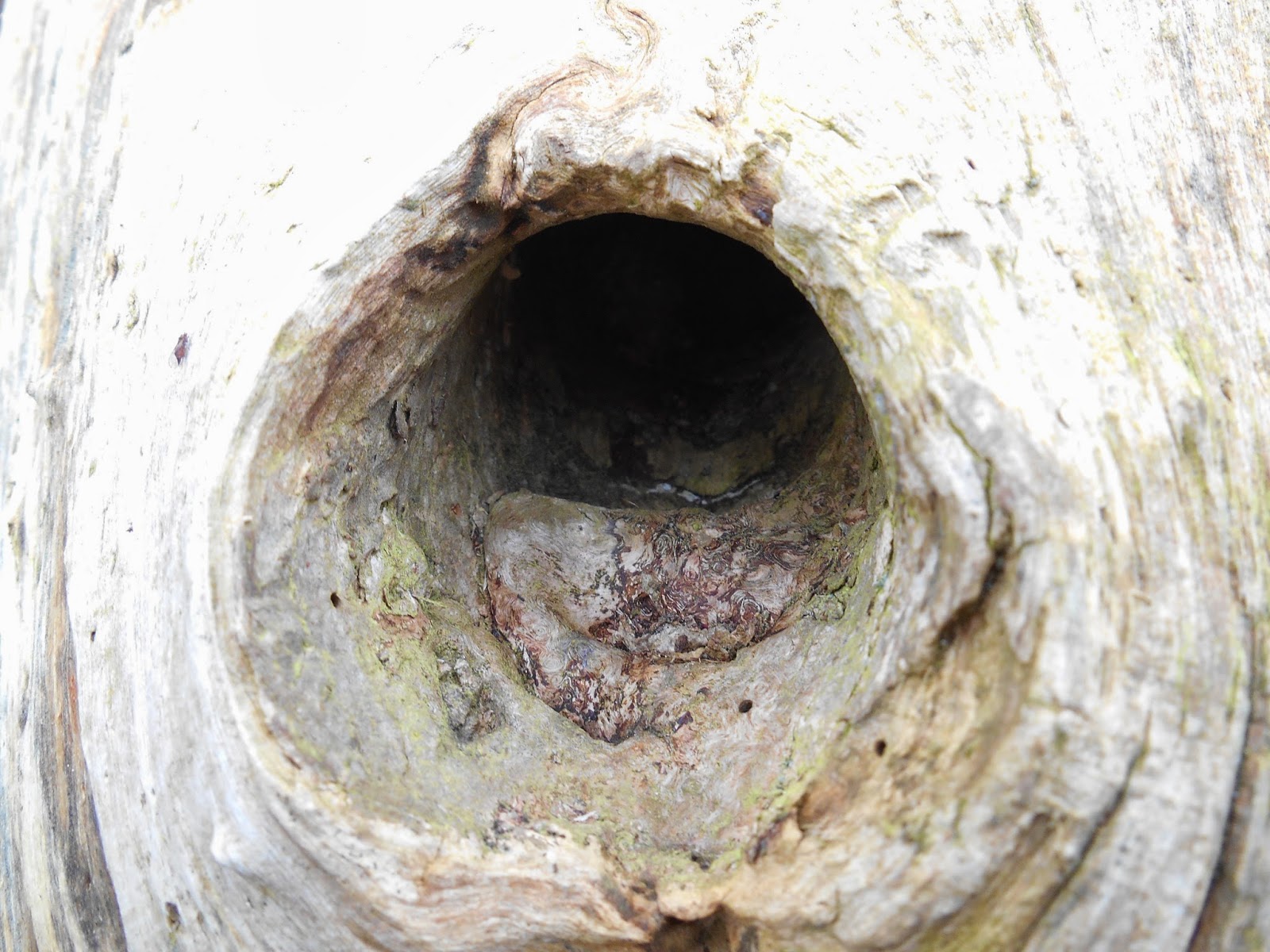
Woodpecker holes in Poplar.
Parsons Spinney. 19 March, 2014


Woodpeckers had been busy making large holes and, where trees had fallen, I was able to get a closer look at their work.


Close up of woodpecker hole
19 March, 2014


The edge of this hole has been worn smooth by adults making hundreds of visits to feed their young.


Daldinia concentrica on fallen Poplar. Parsons
Spinney, 19 March, 2014

In death these trees will still support a huge array of wildlife, particularly wood boring insects. Already fungi were at work with some fallen specimens bearing a rash of King Alfred's Cakes, Daldinia concentrica

High in the healthy trees a rather large rookery was very active, with dozens of birds wheeling around, the air loud with their excited calls.


Small Tortoiseshell  Aglais urticae at the edge of
Parsons Spinney  19 March, 2014


I left the dappled shade of the spinney and stepped out into bright sunshine. A Small Tortoiseshell butterfly was on a piece of plant stem, its wings spread as if to catch the warmth. It obligingly allowed me to get a photograph - unlike Brimstones over recent days which have take to the wing as I neared, no matter how stealthy my approach.


So, nothing dramatic today; just a pleasant walk to stretch the legs and get some fresh air. That'll do me.


Woodlice - for William

Woodlice are crustaceans, so they are close relatives of prawns and crabs. Most crustaceans live in the sea so they never dry out. Woodlice live on the land and have to be very careful not to get dry or they can quickly die. 


Armadillidium vulgare from beneath a stone.
Pit Lane, Byfield. 19 March, 2014


Some can roll up into a ball and this helps the delicate parts of their bodies to stay damp. The picture shows the common "Roly-poly" (it has lots of name) which I found under a stone, but this species will often come out in fairly bright sunshine.


They have no lungs, but if you turn a woodlouse upside down and look near its tail end you will see some white patches; these are little pads of tissue which can absorb oxygen and do the same job as lungs. These pads must stay damp because if they dry out they can't work, and the animal dies. This is why they stay under logs, stones or dead leaves.

The commonest woodlouse is Porcellio scaber or "scabby little pig". I wrote a bit more about this in my blog for 23 January, 2013 called "Roly-polies and Scabby little pigs".


I looked through my old photographs and found this picture of Porcellio scaber.  This species of woodlouse often gets into houses and I found this one in our kitchen! Oniscus asellus is similar but is bigger and rather shiny.


Sometimes, when you turn over a stone, you will find an ants' nest. Look carefully and you may find some strange little woodlice called Platyarthrus hoffmannseggi (sorry, this species doesn't have a common name). It is completely white and has no eyes. It lives all its life underground with the ants so it doesn't need eyes or body colour. It is common and even lives in my back garden.


Platyarthrus hoffamanseggi in my back garden.
17 March, 2014


It is rather small and I found it difficult to get a good photograph. In my garden it is living with black ants but it is more commonly found with yellow ants. 'Platyarthrus' comes from the Latin words for 'flat joint' (your Mum knows all about arthritis because she worked with patients who had joint problems).


Most woodlice are rather dull but if you are lucky you may find a lovely one called the Rosy Woodlouse. It is a bright pink species with a pair of yellow stripes down its back. It lives under damp leaves but for some reason I often find it under rather wet cardboard on waste ground. I haven't got a picture of it but there are plenty on the internet under its Latin name of Androniscus dentiger.

Keep looking, and good luck!


Monday, 17 March 2014

Buds are starting to break

The unfurling of buds is one of the most critical events on the wildlife year. Among the first to show its leaves is the elder, Sambucus nigra. 
Elder in early leaf. Byfield Pocket Park.
17 March, 2014


Despite the comments in my last blog (sorry about the dreadful pun) some elders are permitted to flourish and, indeed are welcome for their fruits, but their new leaves seem to attract no interest among browsers, miners or nibblers. This is hardly surprising as they are poisonous, containing some thoroughly unpleasant - and carcinogenic - glycosides. They thrive, uneaten, around rabbit burrows.


Hazel leaves start to unfurl in Byfield
Pocket Park  17 March, 2014

Hazel, Corylus avellana, also breaks into leaf quite early. It is generally part of the shrub layer in deciduous woodland and so perhaps needs to get on with the task of photosynthesis before the canopy of oak, etc, closes above it to drastically reduce the sunlight. John Clare made the point when he wrote:

     'Neath Oxeye Hazel bowers
     As near Hazels I have stood
     In the gloomy hanging wood,
     Whence the sunbeams filtering small
     Freckling through the branches fall.

                           Clare's Village Minstrel, 1821


Trees such as birch tend to occupy more open ground and therefore leaf-bud opening can be delayed. It is a beautiful tree but, as spring advances...

                                 ... the birchen bud doth spring
                                 That makes the schoolboy cry.

                                        Beaumont and Fletcher: "The Knight of the Burning Pestle"

As a schoolboy I frequently made painful contact with bamboo canes, wielded by practised hands, but not, as far as I can recall, with a birch stick!


Silver Birch in the burial ground adjacent
to the pocket park.
Byfield, 17 March, 2014
The Silver Birch, Betula pendula, is indeed, "a dainty lady"; it is one of two species of birch found in our county. The second one, the Downy Birch, Betula pubescens, is rather uncommon and confined to acidic soils; I have yet to find a specimen. 

The Silver Birch is the usual source for anyone wishing to make birch sap syrup. Holes are drilled into the bark and the sap is tapped off into a suitable container. Once home the sap is gently heated to drive off up to 80-90% of the water and the resultant syrup may be used on pancakes, etc. There is plenty of information on the internet including an article from The Guardian which first brought this interesting product to my attention.

It is an excellent tree for supporting wildlife, with over 300 species of insect making use of birches in the UK. Watch out for the Bronze Birch Borer, Agrilus anxius, a beetle which apparently also relishes the sap. It is a recent American invader, capable of causing great damage and is currently a matter of concern in Britain.


I will monitor the whole process (of bud-break, not syrup production) because, with tender leaves come hungry caterpillars and bugs. Bring them on! 


Saturday, 15 March 2014

More work in Byfield Pocket Park

Fine weather greeted four of us  - Emma and Dave Marsh, Chris and myself - as we gathered to work in the pocket park. We had only the one objective for the day: planting a couple of dozen trees and shrubs. The selection included birch, field maple, blackthorn, cherry and wild rose. I also put in a plant of Daphne laureola. All have been chosen to improve the park's range of insects, birds and so on.


Chris clears a suitable spot

The pocket park stands on the site of Byfield's long-gone railway station, which itself was situated in a cutting. The cutting was subsequently filled with rubble, and creating planting holes in this material can be, and is, hard work.


Dave seems to be making progress.


Rubble-filled or not,  brambles enjoy the conditions and the area is smothered with them; secateurs were frequently brought into play. We were always taught to respect our elders - but lots of these have been pulled out too. (Ouch!) Even a pickaxe was needed for the more difficult areas.


Emma takes a well-earned breather.


The pocket park probably has as many trees and shrubs as it requires, the bulk of which have been planted by Dave and Emma, but we must accept that a proportion will die, with some simply being smothered by brambles. In between the stones the soil is surprisingly fertile and we have removed a lot of plant material from the site in the hope of reducing this fertility. 


Making the soil poorer seems an odd objective but in rich soil plant thugs such as nettles and brambles will thrive, crowding out many more desirable species. The brambles and nettles will have to be tolerated in the short term but eventually they will - hopefully - be tamed.