Sunday, 21 April 2013

More work in the Pocket Park

The weather has not be conducive to much outdoor work so far this spring so today's fine weather was very welcome. A team of six: Emma and David Marsh, Lynda and Damien Moran, my wife Chris and I, gathered in the Pocket Park to continue the job of creating an area supporting native plants, putting in plugs of Cowslips, Devil's Bit Scabious, Ragged Robin and Chicory and a number of other species.


Hard at it! L to R: Dave, Emma, Chris and Lynda
Stigmatogaster subterranea at Byfield Pocket Park
21 April, 2013
The soil still contained roots of Stinging Nettles, Brambles and Rosebay Willow Herb and we removed these as we went along. Bits of root will have been missed so we'll need to be vigilant over forthcoming weeks. The stony ground is free-draining and was rather dry so, although I had been keeping an eye open for earthworms, only a few came to my attention. I did, however, find several specimens of the Western Yellow Centipede Stigmatogaster subterranea. This soil-dwelling species, with about 80 pairs of legs, is very common and I had already recorded from the Pocket Park. It feeds on small soil organisms and will apparently tackle caterpillars. It was a very lively specimen and a good photograph proved to be tricky. We normally put in a couple of hours work but we did overtime today, anxious to get all the plants in, but there was time for a well-earned break.
Coffee up!  L to R. Lynda, Damien, Chris (behind
Emma) and Dave. 20 April, 2013 


An Elm, of a strain believed to be resistant to Dutch Elm Disease, has also been planted nearby and we will be anxious to see how it fares. Emma has made a check of our Ash trees for signs of Chalara attack but so far they appear to be clear. So, for all sorts of reasons, the next few weeks should be very interesting.


Friday, 19 April 2013

The Primrose

I spotted a primrose in the Pocket Park today. It brings the total number of vascular plants recorded there to 123.

In a situation like a disused railway station - which is what the pocket park is - there is always a chance that a plant has escaped from cultivation, but it looks perfectly natural here.


Primrose Primula vulgaris Byfield Pocket Park
18 April, 2013 
In my childhood everyone was familiar with the primrose but, in an increasingly urbanised environment this seems no longer to be the case. Nevertheless the species is in no danger and its flowers should be enjoyed by generations to come.

Pretty though the flowers are - and lauded by so many poets (inevitably including John Clare) - it was once more valued for other reasons. In the early days of medicine it was widely used as a remedy for gout, "muscular rheumatism" and as a vermifuge, while the roots are said to be "a strong and safe emetic" (Clapham, Tutin and Warburg, 'Flora of the British Isles' 2nd edition, p.631). 

Linnaeus called it Primula acaulis. At first this may appear odd, for "acaulis" means "stemless", and yet it is correct, for the leaves are not borne on a stem but form a rosette at ground level. The flower is born on a scape or pedicel, and botanists are careful not to use the word stem in this situation. For reasons which I haven't investigated, Linnaeus' specific name is no longer used and today the Primrose is Primula vulgaris. 


Thursday, 18 April 2013

On a very windy day...


Today's weather, though quite sunny, has been dominated by a very blustery wind. Only a fool would attempt to catch flies in such conditions, so I gathered my sweep net and set out for the pocket park.

A couple of flies were taking shelter in the trumpets of daffodils. One was the very common muscid (i.e related to the House Fly) Eudasyphora cyanella; the other was a species of cluster fly, Pollenia angustigena. Cluster Flies are slightly larger than house flies and are recognised by golden hairs on the upper side of the thorax, often quite clear to the naked eye. The commonest species is generally Pollenia rudis but P. angustigena has proved to be at least as common hereabouts. The golden hairs tend to rub off after a time but my specimen had a liberal coating of them and so had probably only recently emerged from its pupa.

Almost inevitably a Common Dung Fly Scatophaga stercoraria was seen, sitting on a dandelion and minding its own business. 

Common Dung Fly Scatophaga stercoraria on Dandelion.
Byfield Pocket Park 17 April, 2013


In the adjacent graveyard a blowfly was basking in strong sunshine. Once again it was a very familiar species, Calliphora vicina. Showing no consideration for photographers it had chosen to pose on a quartz-rich granite even though more helpful surfaces were available.


The blowfly Calliphora vicina on a granite headstone
adjacent to Byfield Pocket Park. 17 April, 2013


Not a great haul, but the weather was quite exhilarating so I didn't regard the time as wasted. On arriving home I found a large bumble bee on a window ledge. It was tempting to believe that it had come into the house to shelter from the wind, but of course it had merely taken a wrong turning. It was probably a Buff-tailed Bumble Bee Bombus terrestris but this species is very difficult to distinguish from Bombus lucorum without putting it under a microscope - or at least using a good hand lens. This would probably lead to its death, so I opened the window and freed it.


Wednesday, 17 April 2013

The Green Shieldbug

Shieldbugs make excellent subjects for study: there are not too many species in Britain; all are easy - or fairly easy - to recognise and there are some very good guide books available. I generally make use of Roger Hawkins' excellent book, "The Shieldbugs of Surrey" which, despite its title, covers all species likely to found in Britain. This morning I saw a roadside specimen which could cause confusion among newcomers to the subject.


Green Shieldbug, Palomina prasina.
Byfield,, 16 April, 2013

The Green Shieldbug is, as you would, expect, bright green in colour. However, this species, which overwinters under dead leaves etc, assumes a cryptic coloration for this period of hibernation. In these brown colours it is presumably less conspicuous to hungry birds. For the summer months (when it feeds on unripe berries) it reverts to an equally cryptic leaf-green. Even if a bird were to find this potential meal it would be unlikely to eat the insect for on the side of the body, a little behind the head, it bears a pair of glands which secrete a foul-smelling fluid. Anyone who clumsily handles one of these bugs will soon become aware of the pong! 

Shieldbugs are true bugs, by which is meant insects with mouthparts modified to form a tube, used rather like a drinking straw.  Most bugs, such as aphids, consume plant juices but many, including the human bed bug Cimex lectularius, obtain their food by feeding on animal fluids. I have recorded the Green Shieldbug from Byfield Pocket Park along with 45 other bug species but this number could be at least doubled with diligent searching - yet another job for this summer.


Tuesday, 16 April 2013

Horse Blobs and Bee-flies

I was delighted to find, earlier today, that Horse Blobs are now in flower. Before there is too much confusion I should make it clear that I am referring to the Marsh Marigold, Caltha palustris. It has a host of common names: Kingcups, Water Blobs, Water Bubbles and - the name used by my grandmother - Molly Blobs.
Marsh Marigold, Caltha palustris. Byfield, 15 April, 2013
Marsh Marigold, Byfield.  15 April, 2013

It is frequent around Northamptonshire although, as a result of land drainage, has now been lost from many of its former locations. Certainly it was far more common in the time of John Clare and he makes a number of references to it. For example:

                       Here 'neath the shelving banks' retreat
                       The Horse Blob swells its golden ball.

                                                      Village Minstrel, 1821

No botanical knowledge is required to recognise that the Pilewort, or Lesser Celandine is closely related to the Marsh Marigold. I have written about the Pilewort in an earlier blog (29 January, 2013) but at that time the plant was not in flower; it now blazes from grassy banks all around the village. Both are members of the Buttercup Family, Ranunculaceae, but the Marsh Marigold is placed in a separate genus, partly because it has no petals; what appear to be petals are modified sepals, which have taken on the role of attracting insects.
Lesser Celandine, Ranunculus ficaria. Byfield, 15 April 2013


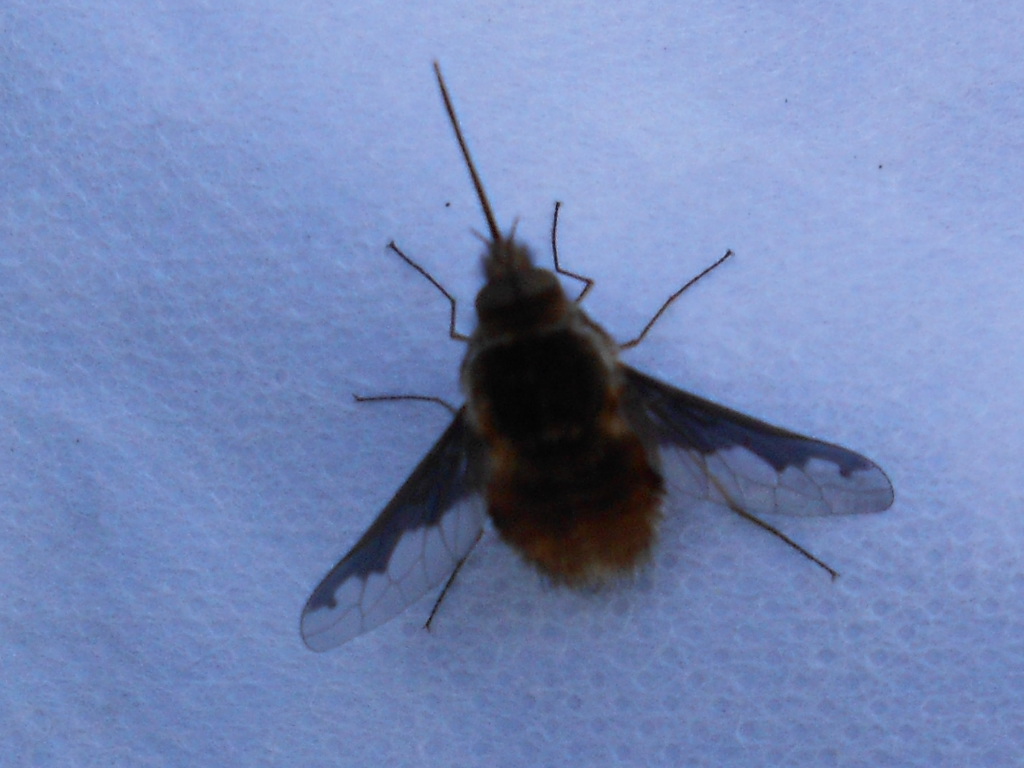
A little later on in the afternoon Chris drew my attention to an insect clinging to some washing on the line. It seemed to be in a torpid state and I was able to get a good look at it. It was a Dark-edged Bee-fly, Bombylius major. Despite being rather bee-like in appearance it is a true fly, having two wings (whereas bees have four) and belongs to a group of flies known as the Larger Brachycera. It is one of the harbingers of spring and is often to be found hovering in front of a flower and inserting its long proboscis (clearly seen in my photograph) into the bloom to obtain nectar. The grubs are parasites of certain bees. In my garden it frequently visits primulas such as Primula denticulata.


Primula denticulata in my garden, Byfield.
 16 April 2013
On checking an old tree stump a short 
distance away I found a second specimen, with a 7-spot Ladybird enjoying the same sheltered spot. 
7-spot Ladybird Coccinella 7-punctata in my garden.
Byfield 16 April, 2013
A second Dark-edged Bee-fly Bombylius major
16 April, 2013


Back to Earth

   After a few days in the French city of Avignon it was back to the reality of Byfield, with temperatures of around 27 degrees being replaced by distinctly chillier conditions! As this blog is intended to focus on the Byfield area I will only dwell briefly on our break in Provence. 

Barleya robertiana above Nimes


The flowers of the limestone hills above the Rhone valley were lovely, with the Giant Orchid, Barleya robertiana, being common in grassy placesThis is an early-flowering species and is generally over by the time most holidaymakers arrive in the area. It was sometimes accompanied by the more delicate Sombre Bee Orchid, Ophrys fusca. (Apologies for the poor photograph.)


Ophrys fusca near Avignon

                                            These orchids are almost impossible to grow and are best enjoyed in the wild. Not only is it difficult to recreate the conditions - thin, gritty, summer-baked soil - but the correct  mycorrhizal fungus generally needs to be present to support the root system (although it has to be said that recent research in Italy casts doubt on these previous assumptions).    


Also present, sometimes in large numbers, was the yellow-flowered Iris lutescens. This can flourish in cultivation if its rhizomes get a good summer baking.

                                                    Iris lutescens above Avignon                       

In some places, on the sun-warmed rocks, there were hundreds of specimens of the bug, Lygaeus saxatilis. As "saxatilis" means "of rocks" they were clearly in an ideal habitat. Many pairs were mating.
Lygaeus saxatilis above Villeneuve les Avignon. 

Viburnum tinus, Church Street, Byfield
14 April, 2013

      The familiar garden shrub Laurustinus, Viburnum tinus, is native to Provence and grows prolifically around Avignon, being seen every day on our rambles. It was somehow fitting therefore that, on a stroll around Byfield a day after returning, I should see this shrub flowering in Church Street; I had come full circle.  

(Ever since my youth - and for a century or so before that - Viburnum has been placed in the Honeysuckle Family, Caprifoliaceae. As a consequence of genetic research this genus, together with Elder and a few other shrubs, has been reassigned to the Adoxaceae Family. And I now find that Mistletoe, Viscum album - prolific in central France has been removed from the Loranthaceae Family and placed in the Sandalwood Family, Santalaceae. I'm getting too old to cope with all these changes!)


Monday, 1 April 2013

Work in Byfield Pocket Park

The idea of a pocket park in Byfield dates back to 1963, with work starting soon after. Over the years the park has evolved, with the planting of trees, the creation of footpaths and so on. But like any similar site there have been problems, and constant maintenance is necessary. For this reason a working group, led by Emma Marsh and aided and abetted by her husband David. has been formed.

Our main current task involves the clearing of invasive weeds, primarily nettles and brambles, from an area earmarked for the planting of native wildflowers. The weeds are being removed from the site to decompose elsewhere, with the object of reducing the soil fertility and so discouraging the growth of rank vegetation. It might be thought that rich, fertile soil would be desirable  but this would encourage tall, strong-growing plants to flourish, crowding out smaller, less robust species.
Emma and Dave clearing weeds

The weather has not been our friend but progress is being made and the second photograph shows the ground largely cleared - although the brambles and nettles, given a chance, will re-assert themselves.
We're almost there! Chris and Dave at work
30 March, 2013


Soil quality and fertility can, to some 
extent, be judged by the earthworms present. The value of earthworms is generally acknowledged but the species present are not often recorded. For this reason I kept an eye on any worms revealed. One of the commonest earthworms hereabouts is the Green Worm, Allobophora chlorotica, but none was revealed. However several specimens of Common Earthworm, Lumbricus terrestris, were turned up by our spades and trowels. I will continue to record earthworms from the site. The ground is very stony and there is little that can be done about this, but it does give a very free-draining soil and suits us very well.
Common Earthworm Lumbricus terrestris at Byfield
Pocket Park, 30 March, 2013