Tuesday, 12 February 2013

The Jurassic Way

Having been confined to the house by snow yesterday I felt the need for a good walk so, setting off from Charwelton, I walked a short section of the Jurassic Way. This long-distance footpath takes its name from the Jurassic rocks which form the backbone to the landscape in west Northamptonshire. In places the rocks are rich in fossils and many stone walls show remains of belemnites, brachiopods and so on.  Between Charwelton and Byfield these rocks were also worked for their iron ore until being replaced by richer ores from Sweden, Australia, etc.


On the Jurassic Way


I set off over gently undulating ground to cross the infant River Cherwell (usually pronounced "Charwell") as it begins its long journey to join the River Thames and head for London. The walking was less easy than I'd anticipated. Beneath about ten centimetres of snow the ground, far from being frozen, was wet and very sticky. A very slow thaw was underway and the snow itself was getting wet. 

Rooks were excitedly gathering around their nests, grouped in a clump of oaks; a Raven, twig in its mouth, steered clear of its smaller brethren, appearing rather aloof. A couple of Snipe, feeding in a wet field, took to the air with a zig-zagging flight and a whirr of wings as I approached.
Charwelton Church,
12 February, 2013


Charwelton church is rather isolated from the village (which is actually little more than a hamlet) but people still make the journey of a mile or so to attend services. There were once two villages here, Little (or Church) Charwelton and Great (or Town) Charwelton. For reasons which are unclear Little Charwelton began to lose inhabitants at an alarming rate leaving what is now simply Charwelton, on the A361. A few bullocks seemed disinclined to move but these "stirks" are inquisitive rather than aggressive and soon lost their nerve as I approached.


The church is an unfussy, four-square sort of building, now far too big for the usual handful of worshippers although the funeral of a local worthy can still fill the pews. A couple of fine sycamores flank the building and in a few weeks the churchyard will be ablaze with daffodils. I surveyed them last year for insects but, sadly, these highly-bred plants do not get many visitors. For the first half of my journey I was never much more than a stone's throw from the track of the old Great Central Railway. Remarkably Charwelton did have a station and a few traces of it remain. The bridges still appear to be in a good state of repair and, had the proposed HS2 used any of this old route, little work would have been needed on these structures.
One of the many bridges still spanning the
old track-bed of the Great Central


I plodded on, often having to tread warily as I approached farm gates, the ground being just a sea of mud; it would have been easy to lose one's footing. The last mile or so was relatively uninteresting and I was glad to see the buildings of Woodford Halse come into view. By now I had left the railway behind but sixty years ago I would probably have seen clouds of smoke and steam as I looked towards this small town. A huge railway shed was sited there (technically called a Motive Power Depot but always known to "gricers" as a shed). It was closed in June, 1965 bringing an end to an era. What modern planners would give for the Great Central to be still open today!

I approached the Woodford Halse to Byfield road and was glad to have firm tarmac beneath my feet for the last few hundred yards. A Treecreeper worked its way along a hawthorn hedge beside the road, looking somehow odd as it scaled "trunks" little more than a metre high. Above, at the other end of the size scale, a buzzard soared, mewing plaintively. No doubt it was hungry - and so was I. And shortly afterwards i was tucking into very welcome hot food and coffee!


Monday, 11 February 2013

Of Foxes and Spiders

Today's newspapers have been headlining the case of a fox in south London which entered a house and attacked a baby. The fox escaped.

Less fortunate than the fox was a tiny spider found scurrying across our kitchen floor earlier today. Unsurprisingly it turned out to be Lepthyphantes tenuis; I say unsurprisingly as this is surely Britain's commonest spider, though being so small it is generally overlooked by the non-specialist. Unlike better known species such as the Garden Cross Spider (the one whose beautifully constructed orb webs festoon every garden shrub in the late summer) L. tenuis is active in every month of the year. 

Lepthyphantes is only one of many spider genera whose name ends in "phantes" - Bolyphantes, Magniphantes, Stemonyphantes, Pityohyphantes and so on. The suffix is derived from the Greek word for 'spinner'. 

As it happens all those just mentioned are "money spiders", so-called since they were once believed to bring good luck. Hold a spider on the end of a strand of web and pass it three times around the head for fame and fortune - so the old belief went. I've tried it prior to filling in a Lottery Ticket; it doesn't work! 

For obvious reasons, the association of spiders with good fortune was particularly strong in the spinning and weaving trade. 

Sunday, 10 February 2013

Laurels, Laurels and Laurels

I noticed yesterday that Spotted Laurels were in fruit, and I reflected on the confusion caused by the word "laurel". The true Laurel, Laurus nobilis, otherwise known as Bay, is a well known shrub grown for ornament and culinary use and belongs to the Lauraceae Family. It is the plant once used to create laurel wreaths in Ancient Greece.

Then there is the completely unrelated Spotted Laurel, Aucuba japonica, a member of the Cornaceae Family. Its flowers are rarely noticed, being small, dull and often hidden by the foliage. The leaves are naturally dark green but the variety with yellow spots is the most commonly grown and it was this which caught my attention yesterday. It hails from Japan but, despite being tough, it rarely becomes naturalised in Britain.


Spotted Laurel in fruit, Northampton, 9 February, 2013


Cherry Laurel, Northampton, 9 February, 2013
Often confused with Spotted Laurel is Cherry Laurel. This is a member of the Rose Family (Rosaceae) and is grouped with the true cherries (Prunus species) as Prunus laurocerasus. It is this plant, with leaves laced with cyanide, which I generally used for "knocking out" insects; providing they are released within a short time the insects generally recover and resume their lives. It bears racemes of creamy-white flowers but they are hardly exciting. As the photographs show, the leaves of Cherry Laurel have perfectly smooth edges whereas those of Spotted Laurel are partially serrated.

Then there is the Spurge Laurel, about which I wrote on 18 December. This belongs to the  Thymeleaceae Family and is therefore unrelated to any of the other "laurels" mentioned in this blog! Around the world dozens of plants are known as laurels, generally because they bear similarly-shaped leaves. Small wonder that confusion can arise and, for anyone irritated by Latin names, laurels make their value clear.
                                                                    

Thursday, 7 February 2013

Lords and Ladies (2)

Despite being free of wind the conditions today were distinctly raw but I wrapped up well and set off on a constitutional. In a garden beside the village church the leaves of a cultivated Primula had been mined by the larva of an Agromyzid fly, Chromatomyia primulae. This is very common on primroses, cowslips and their kin, but the mine is usually quite narrow, whereas the one I saw was rather wide - but I think I'm correct in my identification.
The pale mines of Chromatomyia primulae, a little
to the left of the violet flowers on this cultivar.
 Byfield, 7 February, 2013


I pushed on, entering a railway cutting leading to the sad remains of Byfield station. There on the bank Lords and Ladies, Arum maculatum, were growing strongly. This plant always puts in an early appearance, but we'll have to wait for a few weeks for the remarkable  flowers. I first mentioned the species way back on 14 November but it deserves further consideration, being such an extraordinary plant. 


                            Come rain. frost, snow or drought 
                            it rarely fails,
                            the first green leaves of spring
                            and every year like a seasoned magician,
                            it shows off its amazing conjuring trick.
                            In April it points,
                            Half-sheathed in a green glove
                            A rude brown finger. In August
                            glove and finger have disappeared
                            and it offers, equally impertinently,
                            a fist of orange berries.

                                             Trevor Hold. "Cuckoo-pint" from Chasing the Moon

The early leaves of Lords and Ladies. Byfield, 7 February, 2013


These early leaves are not yet showing the purple spots which give the plant its specific epithet of "maculatum". The spots seem to appear as its remarkable flower develops. 


Wednesday, 6 February 2013

Lime Trees

A flurry of snow yesterday evening reminded us that Winter has not yet relinquished its grip. In medieval times these February days must have been desperate: food stocks running low; soil too wet for sowing or planting; thin bodies finding the cold increasingly numbing. A couple of lines in a poem (14th century?) leave me puzzled:

                        The boneless fish close quaking lies
                        And eats for cold his aching feet.

I've no idea what the "boneless fish" could be and yet the reader can feel the biting chill.

So, in these dark days, what can the wildlife enthusiast enthuse about?  

Some fairly large hybrid limes (Tilia x cordata) stand adjacent to our house and yesterday morning, in the bright sunshine, the twigs took on a pinkish glow. The buds are enclosed in cherry-red scales and, as the sap begins to rise, these buds are swelling; the twigs are also red and I suspect these were the cause of the glow. We have two native species of Lime, The Large-leaved and the Small-leaved; Tilia x cordata is the hybrid formed by these two. Our native limes are unusual as, along with the (unrelated) Maples, they are insect pollinated. 
Pink twigs and buds of Hybrid Lime, Byfield, 6 February, 2013

Oak, willow, birch, poplar and so on are wind pollinated. As this is such an inefficient system they need to produce vast quantities of pollen and in suitable conditions such as wet, acid soil, these pollen grains - which are very resistant to decay - will remain for thousands of years. The pollen of Limes is rarely found in these ancient deposits and for a long time palaeobotanists, analyzing these grains, believed it was a scarce tree in Britain's prehistoric woodlands. In fact the reason why Lime pollen is infrequently found is simply that these insect-pollinated trees only need to produce pollen in small quantities. We now know that the Small-leaved Lime (Tilia cordata) was extremely common some four thousand years ago, dominating quite large areas of woodland.

In terms of wildlife, Lime trees are of considerable importance, not least because their leaves are highly nutritious. Aphids abound on them, especially Eucallipterus tiliae, and it is the main pabulum of the Lime Hawk-moth. Common too are many galls, the one illustrated being that caused by the mite Eriophyes tiliae, but there are at least another dozen of these gall-forming organisms to be found on Lime


Galls of the mite Eriophyes tiliae, 
Byfield Pocket Park, Summer, 2012


One day someone will explain to be why Limes are so often planted as street trees, because I regard them as a really unfortunate choice: the leaves get covered in aphids, which drip sticky honeydew on to any cars parked beneath; the trunks constantly produce suckers and, in Northamptonshire alone, hundreds (thousands?) of hours must be spent annually removing them; the falling leaves decay at the roadside producing a particularly wet and slippery mush. As I say, a strange choice. Rant over!


A thicket of suckers on Hybrid Lime, Tilia x europaea
Byfield, 6 February, 2013


Monday, 4 February 2013

As the light lengthens...

Another deceptively sunny morning. The air temperature was probably well above freezing but a brisk north-westerly wind introduced an unwelcome chill factor.

                    As the light lengthens, so the cold strengthens.

This old saying recognises the cruel nature of these February days but, wrapping up well, I had an enjoyable walk.                   
The spire of the village church stood out against a       clear blue sky and Jackdaws circled the structure, calling excitedly. In the churchyard a much more stealthy Wood Pigeon quietly gorged itself on the now-ripe Ivy berries. Snowdrops, by this time fully open, studded the grass but were failing to attract any bees.
Snowdrops, Byfield churchyard, 4 February, 2013


My walk took me on to the Pocket Park (surprise, surprise!) where a few flies took to the wing as I approached. I caught one and, as suspected, it turned out to be a male Common Dung Fly. These furry yellow males are frequently seen but the duller, greenish females are more likely to be observed on fresh cow pats, upon which they lay their eggs*. The Blow-fly, Calliphora vicina, was also out in some numbers, favouring sun-bathed tree trunks. Without hope of reward I  swept my net through some dead grass stems and was pleased to find that I had secured a male Lonchoptera lutea. I have to admit that, to the non-dipterist, it is an excessively dull-looking fly, furthermore it is the most commonly taken species of Lonchoptera. But I was pleased because specimens are rarely taken so early in the year.

Naturalists take pleasure in odd things. In his book "The Lichen Hunters" by the late Oliver Gilbert, I came across this passage (page 29): "Who will forget the excitement as news spread of the discovery of Psilolechia leprosa..."  Well, I suspect it failed to make the front page of the Daily Mail but, for the interested few, it genuinely was exciting. And by monitoring the abundance and mapping the distribution of these insignificant organisms we may pick up clues to events and trends of real significance such as pollution levels, climate change and so on. I rest my case m'lud. 

*For more information on these fascinating flies I recommend Peter Skidmore's book, "Insects of the British Cow-Dung Community" - a copy of which should surely be in everyone's book case.

Saturday, 2 February 2013

Alder Trees

Although there are about 30 species of Alder only one, Alnus glutinosa, is native to Britain. The other species are all confined to temperate regions of the northern hemisphere except for one, Alnus acuminata, found in the Andes of South America. 

Our native Alder is a familiar tree, naturally occurring in wettish habitats such as carr (wet woodland), river sides and damp meadows, although it is quite often planted. More widely planted is the Grey Alder, Alnus incana, of which there are several specimens around Byfield's playing fields, and as I passed them earlier today I saw that they are flowering. The Grey Alder, a Central European species, has a rather smooth greyish trunk whereas that of the Common Alder is dark brown and quite fissured. The two species frequently hybridise.
Male catkins of Grey Alder, Byfield, 2 February, 2013


The previous season's female "cones" on Grey Alder. 
The male flowers are in the form of catkins, not unlike those of Birch or Hazel and, being wind pollinated, can afford to appear early in the year. However, the female flowers are quite a lot different. Technically they are catkins but are in the shape of a cone and, being quite woody, they persist long after the fall of their fruit, so those pictured are from last year. It is as well that pollinating insects are not required since today, despite a bright sun and blue sky, it is bitingly cold. 

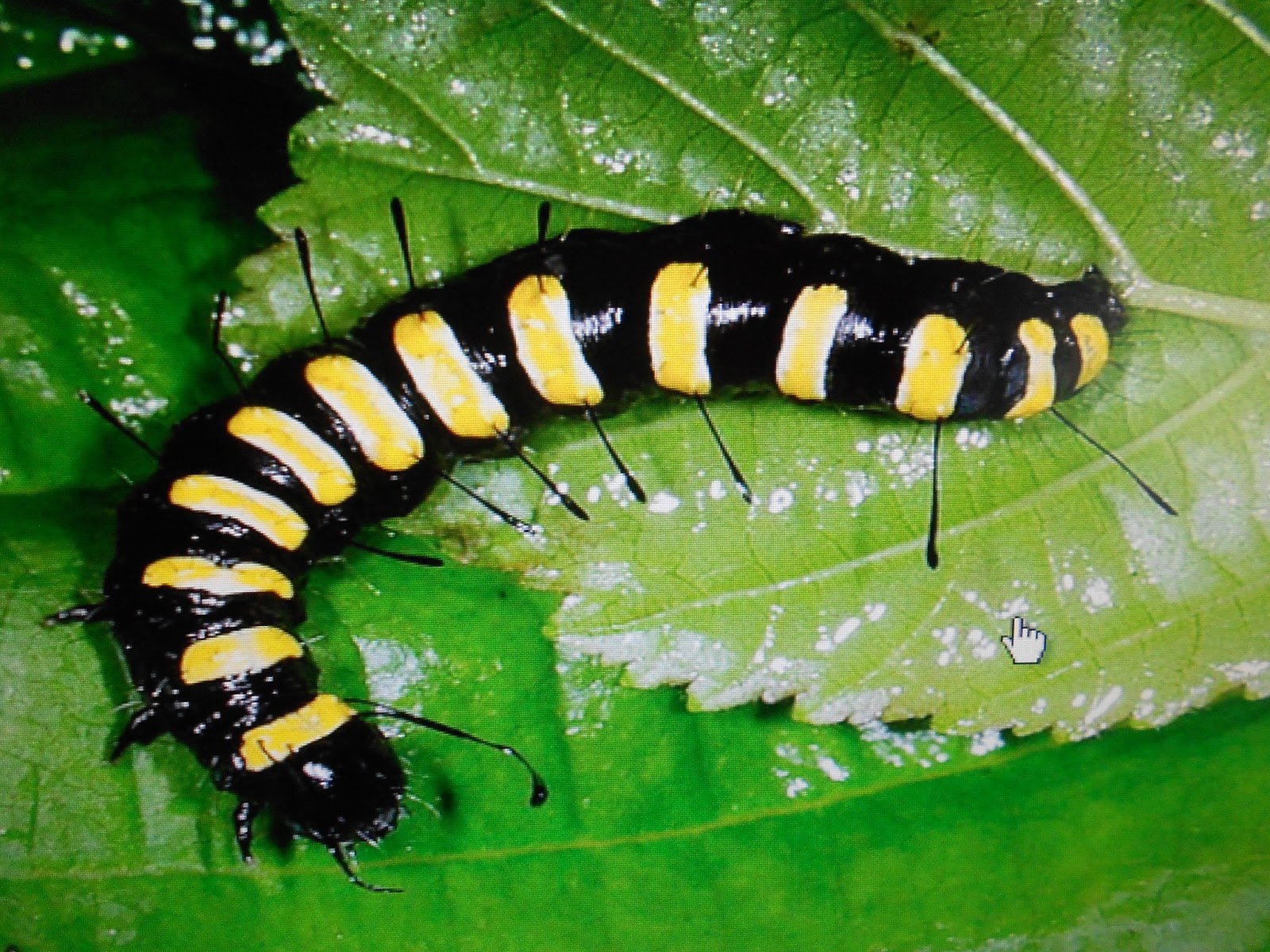
Caterpillar of the Alder Moth, Acronicta alni
Alders are important for wildlife. A dozen or so bugs - by which I mean true bugs - occur on the trees and in the Pocket park I have found the rather colourful Pantilus tunicatus on the foliage. Occasionally I also been lucky enough find the unmistakable caterpillar of the Alder Moth, though I have yet to find it in the Byfield area. I will keep looking...

Alder bark was once used in the leather industry as a tanning agent, so in our county it was a tree if some significance.