Monday, 21 January 2013

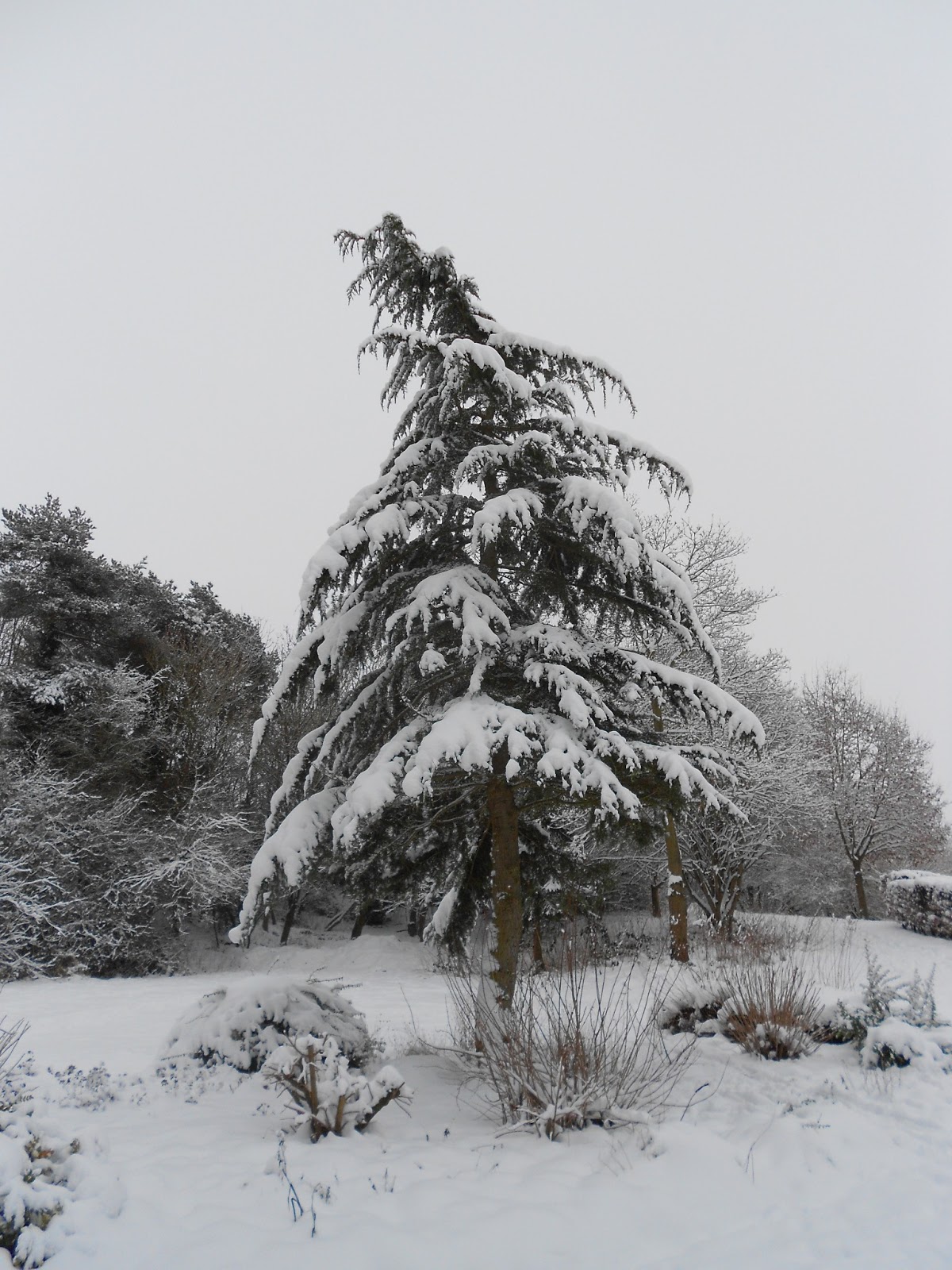
Cedar of Lebanon?

Cedar tree in Byfield Pocket Park
My friend Oliver Tynan and I often have long conversations about this and that, and if I mention that I have been to the Pocket Park he is wont to ask, "And how is my Cedar of Lebanon doing?" Oliver and his wife Carol did lots of planting soon after the park had been created and the tree to which he refers, here looking lovely in the snow, is a prominent feature.

It is certainly a cedar but whether it is really Cedar of Lebanon, Cedrus libani... The truth is that, until it produces cones, I can't be sure but at the moment it is looking far more like a Deodar, Cedrus deodara. It is a handsome tree and, as Shakespeare didn't say, "A cedar by any other name would smell as sweet". Sadly I have never found any insects associated with it - but I'm being picky.

The oak in my second picture is a different matter altogether. Oaks support an enormous number of insects, many of them causing galls. In my much-thumbed copy of Redfern and Shirley's "British Plant Galls", the keys to those found on oak cover 29 pages - far more than for any other plant.
Pedunculate Oak, Byfield Pocket Park
21 January, 2013

In Britain there are two native species of oak. Those found in Byfield's Pocket Park are all Pedunculate Oak, Quercus robur. (Our other British species is the Sessile Oak, Quercus petraea, largely - but not exclusively - found in northern and western Britain, growing on neutral to acid soils.)
Knopper Galls in Byfield Pocket Park

I have recorded many galls from oaks in this park including the Knopper Gall, caused by a tiny wasp-like insect Andricus quercuscalicis. The odd thing is that the wasp goes through a two-stage life-cycle, one stage involving the Pedunculate Oak and the other stage requiring Turkey Oak Quercus cerris, yet I am not aware of any Turkey Oaks in the vicinity. But I am on the lookout!

Sunday, 20 January 2013

Snowdrops (1)

These early weeks of 2013 can hardly be allowed to pass without mention of snowdrops. The genus consists of about twenty species, all more or less confined to the east Mediterranean region, especially Turkey. Our own Galanthus nivalis is the most widespread of the snowdrops. My old 1962 copy of Clapham, Tutin and Warburg's "Flora of the British Isles" states that it is "probably native" to Britain but since then opinion has shifted; it is now generally considered to be an introduction to these islands, perhaps arriving during the 16th century. As for our county, Druce, in his "Flora of Northamptonshire", published in 1930, is quite forthright on the matter stating: "Alien...with no pretensions to being indigenous in this county". Having said that, snowdrops are certainly very well established here, especially in orchards, old churchyards and so on. 

I have an equivocal view of them as they are abundant in my garden to the point of being a weed. Clive Stace's "New Flora of the British Isles" states of the species: "Rarely seeding" but my plants seed prolifically and I have to dead-head them in order to remove the seed capsules. I tolerate my snowdrops as the flowers are visited with enthusiasm by early bees, probably largely for the nectar but perhaps taking pollen too. Whether other insects visit the flowers is a moot point ; I have never noted any other species. At the moment they are snug beneath the snow but should begin blooming as soon as the thaw has set in.

The name Galanthus is derived from the Greek, meaning "milk flower"; as for nivalis, it simply means "of snow". Greater Snowdrop Galanthus elwesii, Caucasian Snowdrop G. caucasicus  and Pleated Snowdrop G. plicatus are all naturalised here and there, mostly in the southern counties of England.

Saturday, 19 January 2013

Snow comes to Byfield

Wall in Church Street, Byfield
Golden Privet in Westhorpe Lane
I am no photographer but, 10 to 15 cm of snow having fallen on Byfield, I couldn't resist going for a stroll and capturing a few images. A long wall is a feature of Church Street and the individual stones had been picked out by the snow. This wall is important historically and, I believe, is a listed building, but I like it for the array of plants which find a home in the mortar-filled crevices.

The Victorians can be admired for many of their innovations but it is difficult to forgive them for privet hedges. Dull, labour-intensive and pointless they still blight many a garden frontage. I will, however, make an exception of the Golden Privet Ligustrum ovalifolium 'Aureum'. It makes most attractive shrub when grown as an individual and even as a hedge, as here in Westhorpe Lane, where it is looking cheerful in the snow.
Westhorpe Pump
This hedge on the Boddington
Road consists entire
ly of Ash
The much renovated Westhorpe pump stood out as quite a striking feature and interestingly, despite the bitter weather, water was still flowing freely at the base. 

Turning into Boddington Road I was struck by the fact that virtually all the large trees along the roadside are Ash, as are the hedgerows. It is a reminder of how devastating the effects will be if Ash dieback is not halted. Several of the Ash trees bore large bracket fungi, showing that Ash Heart Rot, Inonotus hispidus has begun its deadly attack. This affliction will almost certainly lead to the death of the trees.
A bracket fungus Inonotus hispidus on Ash
The Silk Tassel Bush Garrya elliptica


On the last leg of my walk a lovely specimen of Garrya elliptica caught my attention. The catkins on this shrub can reach well over 10cm in length and, given the right setting, this makes a splendid plant.

Thursday, 17 January 2013

Black Winter Freezes to his Seat

Norway Spruce viewed from my
bedroom window. 17 January, 2013
There is understandable concern about the current spell of harsh weather and its effects upon our wildlife. I am old enough to recall, albeit patchily, the dreadful winter of 1947 and can remember train after train - steam engines of course, belching out vast quantities of smoke and steam - slogging through blizzard conditions to get desperately needed coal supplies to London. Milk bottles stood on the doorstep with their tops pushed off as the contents turned to ice and expanded. Many birds such as Kingfisher and Grey Heron, with virtually all lakes and rivers frozen solid, surely must have perished in great numbers - and yet they recovered.

These thoughts passed through my mind as I replenished the grain and nuts at my bird-feeding station. A dozen species have paid a visit during the past 24 hours and a flock of Long-tailed Tits numbering 10 or 12 or so has hung around all day, making visit after visit to this food source; if the bitter conditions continue this food could be the difference between survival and death.


In the case of insects, they'll have to fend for themselves. Insect bodies contain antifreeze proteins (AFP's). These are polypeptides which afford a considerable measure of protection but will those insects which have moved northward to colonise Britain in recent years, such as the Violet Carpenter Bee, have the required level of AFP's to survive? If this very cold spell persists then recording insects over the coming few months will be very interesting. 

Incidentally hundreds of viewers have contacted me about the title for this particular blog (Tony, don't tell lies!). It is from a sixteenth century poem called "Shine Out" by that prolific writer Anon, and forms the wonderful introduction to Benjamin Britten's Spring Symphony.

Tuesday, 15 January 2013

Midwinter Miscellany

Silver Birch in Byfield Pocket park
    I visited Byfield Pocket Park this morning, crunching my way through the snow and not feeling optimistic about seeing any notable wildlife on such a bleak day. The trees stood out against a brilliant blue sky, giving a false impression of the conditions. A Marsh Tit, Parus palustris caught my attention with its pitchu-pitchu call; a close relative, the Coal Tit Parus ater was also present but otherwise things were rather quiet. A Cotoneaster, which only a few days ago had borne many berries, has now been stripped clean, probably by various species of thrush.


Several of the tree trunks in the area are stained with what at first looks like an orange-coloured lichen, but in fact is an alga, Trentepohlia aurea. It seems to be getting commoner, as I cannot recall seeing it beyond about ten years back. Around here it is usually on the bark of Ash trees but it is often found elsewhere.

In these conditions hungry birds seem to get a little less cautious, taking risks they would normally avoid, and I nearly trod on a pheasant as it rummaged single-mindedly through the undergrowth. It blasted into the air and whirred away cackling frantically. I'm not sure which of us was the more startled!
The alga, Trentepohlia aurea, in Byfield Pocket Park

The North Wind Doth Blow

Cottages in Byfield 14 January, 2013
Well actually it is a west wind coming up against cold continental air over Britain, and it has brought snow - quite a lot of it!

Pretty though it is, the snow creates problems for many birds. Lots of gardens in the village have bird feeding stations of some sort and my garden is no exception. I was relieved to see a Great Tit, Parus major, pecking away at peanuts today because I haven't seen one for weeks. Great Tits seems to be particularly susceptible to Avian Pox, a virus which is currently a problem in Britain, but not only was one at my feeding station but another one was present in the Pocket Park, its see-saw call ringing clear.

I have given the Latin name for the Great Tit - as I am doing for many organisms - partly because quite a number of viewings of this site have been from the United States, where English vernacular names may mean little, but also to avoid more general confusion. For instance the name "Bluebell" may be perfectly clear to someone living in England but in Scotland the name is applied to the Harebell Campanula rotundifolia, a quite unrelated plant. In California the name refers to Phacelia campanularia - so bear with me if at times I seem pedantic.  I'll be considering English Bluebells, Hyacinthoides non-scriptus, in a later blog.


Sunday, 13 January 2013

Bufo bufo

My friend and fellow Byfield inhabitant Harry Ferminger (a curious surname, apparently meaning "cheese-maker", cf French 'fromage') has a lovely cottage - and a very large garden. When he approached Chris for a helping hand she and I were happy to oblige. One challenge was a gigantic compost heap which had accumulated over many years and he wanted it "dismantling". At first I had visions of barrow loads of compost for my allotment - but then I remembered that I'd given it up! Nevertheless we were happy to visit him earlier today and get to work with shovel and fork.


Common Toad Bufo bufo from Harry's garden 
In the process of dismantling the heap I disturbed a Common Toad Bufo bufo. It was unharmed and I moved it from the compost heap and placed it among dead leaves beneath a nearby bush of Laurustinus Viburnum tinus which was in full flower.

As a child I was once playing in our front garden when my ball rolled under the caravan at the side of the house. Crawling under the van to retrieve it I spotted a large toad squatting there and was horrified to see that the poor creature was covered in maggots. I now know that it was a victim of a fly called Lucilia bufonivora (the specific name means "toad-eater"). It is not a particularly rare fly but I have never taken a specimen of the adult; perhaps I should be glad that isn't very common.

Viburnum tinus in Harry Ferminger's garden.


Anyway, the toad in Harry's garden seemed in good health and, all being well, it will live to eat flies rather than being eaten by them. Incidentally this species is called Common
Toad to distinguish it from the much rarer Natterjack Toad, itself a specialist of dune slacks.

Lucilia is a genus of blowflies and includes many so-called bluebottles, the commonest of which is Lucilia caesar. Not only is this species abundant in our gardens but is only too common in our houses, where its unpleasant habits make it far from welcome.