Tuesday, 31 July 2018

Allotment notes

The recent heavy rains have relieved us of one chore: visiting our plot and applying copious amounts of water had become a daily event. I say our plot but in truth Chris is the official plot holder and she took it on very sensibly, suspecting that it would be of some help in her recovery from cancer (why do so many people either avoid that word or slightly lower their voices lest, it seems, some taboo is broken?). I understand that some, to my mind enlightened, doctors in the N.H.S. have also been encouraging patients to embark upon this form of therapy.


Anyway, it has been, for me at least, a doubly positive experience: obviously we have enjoyed the experience of growing - and eating - the fruits (literally) of our labours, but I have invariably found something of interest in terms of botany or mini-beasts. One lesson, not involving mini-beasts, is that gooseberries left uncovered will soon find themselves gorged upon by wood pigeons!
Not all the crops were 'the fruit of our labours'. The blackberries were
 wild - but very acceptable. 31 July, 2018

When Chris announced her intention of having an allotment I had visions of me spending hours digging the plot but I have got around that by advocating and applying a 'no-dig' policy. In truth, given the few years I have left, the soil structure will have had little time to recover before someone else takes over, perhaps without the same concern for pedological matters beyond that of short-term fertility. Eh bien!


Only their first year, but the raspberries are yielding well.
Our allotment at Drayton. 31 July, 2018
We have picked dozens of courgettes but the leaves are now covered with mildew and seem to have ceased functioning. Our squashes may go the same way, but they were only for ornament anyway. The Patty Pan examples seem to be doing reasonably well - so far.


Patty Pan squashes lurk under the leaves and this had avoided my search
for several days.
We grow some flowers and have been delighted by our cardoons, originating from the garden of our friend Lynda Moran. A camera does not do them justice but they are now a good eight feet high.

Our cardoons are attracting squadrons of bees.

I was about to leave today when I noticed an extremely tatty Comma butterfly on a runner bean leaf. Time-worn it may have been but after pausing for a photograph it flitted away smartly enough.

Hailstones? Certainly this comma has seen better days. Our allotment,
31 July, 2018
As far as I can recall this is the first Comma, Polygonia c-album, I've seen this year. Oh dear, what are we doing to our planet!




Sunday, 29 July 2018

Newnham Hill

Recent heavy rain has imbued the dry grasslands with a faint flush of green. A few more days and this scene will rapidly become verdant, grass having remarkable powers of recovery. As I stand on the hill beside the windmill I gaze across the sweeping landscape to the west. A temporary lull in traffic quite erroneously suggests that the scene hasn't changed much in centuries - then I notice the slash of a vapour trail across the sky; there must rarely be a time nowadays when such scars are absent.


Another 'ear worm' is harrying me today. It is the second of Edward German's three dances from Nell Gwyn. It is a haunting little tune but my brain is doing it to death. I ought to be whistling the third dance - one frequently mocked or parodied in comedy sketches: think Monty Python's fish-slapping dance.


A couple of rabbits scuttle into the undergrowth. I don't see many mammals on my walks, and only an occasional amphibian - a frog or two on the lower, damper ground. I've not seen a reptile at all and am unlikely to do so - unless Christopher Chope puts in an appearance. 


I'm feeling a bit down in the dumps today. An enquiry has concluded that democracy is being undermined by the harvesting and misuse of data in order to manipulate people. Was an enquiry necessary? After all it was only, to use the technical jargon, 'stating the bleeding obvious'. This has been going on for many years, when rich and powerful people such as Rupert Murdoch (whoops, I'm back to reptiles again) take over a huge proportion of the media and then employ carefully selected statistics to misinform their audience.  God help us!


Striding across damp fields I see that some Creeping Thistle has been sprayed. I confess to being a little disappointed but I do recognise that this is a working farm and not currently a candidate for re-wilding. In his book, Our Place, Mark Cocker laments that 'Britain (is becoming) a country of nature-rich islands amid an increasingly uniform ocean of chemically treated monocultures'. Here on Foxhill Farm Matt is doing his bit but unless he is prepared to get in a herd of goats or something similar the thistles will need removing by other means.


But there is no doubt in my own mind that walking in the countryside, herbicide-tainted though it may be, does help to lift depression. The in-word is 'mindfulness' - looking rather than just seeing - and this is surely key to enjoying the surroundings and returning home with spirits lifted.


Anyway, where was I?


I had entered the farm from the east, the windmill gradually appearing, the grasses hiding the ugly graffiti defacing the base. It occupies a superb position, able to make the most of westerly winds as they sweep up the scarp slope.

Newnham Windmill came into sight. 30 July, 2018
Restored, it would make a wonderful sight, and would offer a breathtaking view west into Warwickshire. My photograph, looking across the tree-clothed slopes, is taken from the base of the tower; imagine what it would be from the top!

Looking west from the base of the windmill  into Warwickshire.
30 July, 2018
The high winds were make it difficult to utilise my umbrella but it nevertheless proved effective in scooping up insects. An Oak Bush Cricket, Meconema thalassinum, was soon found, dropping into my umbrella from a sycamore tree.

The Oak Bush Cricket is superbly camouflaged.
Foxhill Farm. 30 July, 2018
The long, curved ovipositor showed it to be a female. It is quite a common species but its superb camouflage makes it easy to overlook.


It was soon followed by a Hawthorn Shieldbug, Acanthosoma haemorrhoidale, a species I have found very scarce this year. As I have said before, the specific name refers to the reddish underside of the rear end, fancifully suggesting to Linnaeus that the insect was suffering from piles. It is a rather handsome creature.

The hawthorn Shield bug is by no means confined to hawthorn.
Foxhill Farm, 30 July, 2018
On the whole I was disappointed with my haul but hopefully a surprise or two will be revealed once I get down to properly examining some of the smaller specimens


Reference


Cocker, Mark (2018) Our Place. Jonathan Cape


Tony White. E-mail: diaea@yahoo.co.uk

Friday, 27 July 2018

Of ladybirds and other things


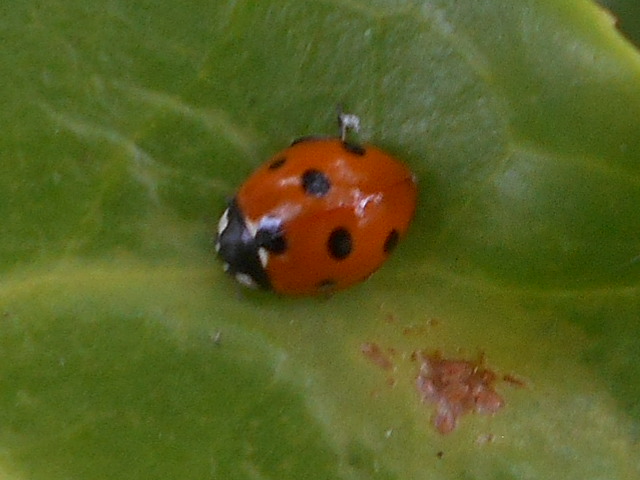
I recall an occasion, a couple of years back when, as I was talking to a friend in Byfield, a ladybird landed on her arm. Some where in the ensuing conversation I said something about ladybirds being useful beetles. She looked a little surprised and said, 'I didn't know they were beetles.' I suspect the ladybird was the Seven-spot, by far the commonest coccinellid. 
Seven-spot Ladybird, Coccinella septempunctata, on cherry laurel.
  Daventry. 30 July, 2018


This tiny incident came back to me yesterday when I was updating my spreadsheet for Foxhill Farm and realised that I had recorded seven ladybird species there this year. For the record they are: Eyed, Larch, 7-spot, Harlequin, Cream-spot, 16-spot and the 18-spot.
But not a 2-spot yet, even though this is normally a common species. All, when looked at, are fairly obviously ladybirds except, perhaps the Larch Ladybird, Aphidecta obliterata, which is rather small and all brown with no distinct markings.

I also caught (and released) this larva of an Eyed Ladybird. On pine,
Foxhill Farm, Badby. 26.vii.2018


Four of these ladybirds - the Pine, the Larch, the Eyed and the Cream-spot - all came from pine. This stand of trees is situated at the top of a precipitous slope and as I left them I found I had to zig-zig my way down in order to cope. Edging my way down I realised I was humming to myself one of the movements from Kodaly's lovely Peacock Variations. (I mention it because I find I am still humming it 24 hours later; it has become what the Germans apparently call an 'ear worm' - a little tune, sometimes trite, which keeps irritatingly going through your head). I was watching my footing carefully but half way down I realised that I was carrying a walking stick, used for giving branches a sharp tap in order to dislodge insects. 'I don't need a walking stick,' I muttered to myself, but soon found myself employing it on the more treacherous parts as I crabbed my way down.


A few dock plants, their upper parts crisped and brown, invited a tap with my stick, an open umbrella carefully positioned to catch any insects or spiders. It was then that I had a surprise: an odd, spindly insect, was among the meagre catch, but what was it? My first instinct told me that it was a bug and, given its general shape, it surely had to be one of the Stilt Bugs, Berytidae. Once home, I examined the creature under a microscope and tried to key it out, using Southwood and Leston (ref below). Nope, it just didn't match. It wasn't a Stilt Bug. After following the keys up a couple of blind alleys I realised that I was looking at an Assassin Bug of the Reduviidae family. To be more precise it was Empicoris vagabundus, a new species for me and certainly one of the strangest. Unsurprisingly my haul also included a Dock Bug, Coreus marginatus, surely one of the most familiar of all bugs to the general public.


This Dock Bug was on a dock plant but it also occurs on the related sorrel.
Foxhill Farm, 26.vii.2018 


By now my damp shirt was sticking to my body and salty sweat was making my eyes sting. Time to begin the slog back uphill, this time zag-zigging of course. I paused only to photograph an elder leaf, mined by the fly Liriomyza amoena.


Elder leaves are commonly mined by Liriomyza amoena. Little harm is done.
Foxhill farm, 26 July, 2018
 
And that was about it really. I had a millipede and a couple of spiders to check out when back home and despite baking conditions it had been quite a successful day. (Later, the millipede turned out  to be a 'Blunt-tailed Snake Millipede'; common, but new to the farm and pushing the total up to 322 species.)

Reference

Southwood, T.R.E. and Leston, D. (1959) Land and Water Bugs of the British Isles. Warne and Co.

Sunday, 22 July 2018

Three hundred up!

A visit to Foxhill Farm today resulted in the finding of several new species, pushing the site total for invertebrates beyond the 300 mark.


The actual 300th species was the sheet-web building spider. Agelena labyrinthica. The spider is large and so too is its web. Even through a veil of web the chevron-like markings can be seen on the abdomen; also the rather prominent spinners at the tip of the abdomen.
Agelena labyrinthica is a top  predator in the world of mini-beasts.
Foxhill Farm, Badby. 22 July, 2018
This is a powerful and fierce creature and woe betide any insect falling into the labyrinthine sheet web. The spider is lightning-fast and will seize the unfortunate victim and haul it down through a tunnel into its retreat, there to be consumed.

Rather less dramatic were several insects whose larvae produce characteristic features on leaves. One of these - widespread and occurring in Byfield Pocket Park - is the Hawthorn Button-top Gall, Dasineura crataegi. It causes the leaves at the shoot-tip to become distorted, often forming a rosette of misshapen, frequently reddish bunch.

A bunch of distorted leaves at the tip of a branch is the work of the
Hawthorn Button-top Gall. Foxhill Farm. 22 July, 2018
The Firethorn Leaf-miner, Phyllonorycter leucographella is, as the name suggests, a frequent pest of Firethorn but will attack other plants including, in this case, hawthorn. First found in Britain in 1989  this tiny moth has spread rapidly and the blister mine formed by the larve is very familiar to anyone who goes around scrutinising Firethorn leaves, i.e. about 90% of the population.

The distinctive mine of the Firethorn Leaf-miner. On hawthorn at
Foxhill Farm. 22 July, 2018
Many butterflies were on the wing including many Small Whites, Pieris rapae. I was pleased to find also one or two Large Whites. Pieris brassicae. The former is abundant - ask any allotment holder or market gardener - but the latter has apparently declined in recent years, though still common enough.


A Large White takes nectar from bramble flowers. Foxhill Farm.
22 July, 2018
Looking for other creatures I grovelled around in the grass tussocks, burned to a crisp in this relentless sun we are 'enjoying' but found far less that would be normal for late July.
The hedgerows were only a little better but I did find Hops, Humulus lupulus, weaving through hawthorn. Hops are dioecious, i.e. male and female flowers are on separate plants but I only found the male. Perhaps I'll find a female with its cone like fruiting heads if I make a further search.

A male plant of hops scrambles through a hedge at Foxhill Farm.
22 July, 2018
Hops belong to the Cannabis Family, Cannabaceae, although why I bother to mention this I have no idea.

To finish off, I mentioned a few days ago the wing-patterning of the Tephritidae - the Picture-winged Flies. This is Anomoia purmunda, swept from a hawthorn bush today. Not a very good picture I know but the insect is only 3mm long and hopefully shows the odd wing pattern on this particular species. It is sometimes called the Spectacled Berry Fly.
Anomoia purmunda. Swept from hawthorn at Foxhill Farm, Badby.
22 July, 2018


Saturday, 21 July 2018

More allotmenty things

This spring I put some young Hollyhock, Alcea rosea,  plants into the allotment, more in hope than expectation as Hollyhock Rust, Puccinea malvacearum, has seriously disfigured plants in recent years. In fact they have put in a very pleasing display and have been much appreciated by bees. Indeed, in the U.S.A. it is visited by humming birds seeking nectar.
Against a typical allotment background, our hollyhocks are looking good.
8 July, 2018
There have been an astonishing number of Groundsel plants springing up on the plot. Why not compost them? Fine in theory but the snag is that the flowers continue to develop on the compost heap to produce seeds for the following season! I have been pleased to see lots of the caterpillars of Cinnabar moths, Tyria jacobaeae, chomping away at the plants and where this is happening I've left them to it. A few days later I noticed that they had begun to attack our Cosmos plants. Not so good!
Cinnabar caterpillars attacking Cosmos on our allotment!
15 July, 2018
In some cases the leaves of groundsel have been mined by the tephritid fly, Trypeta zoe. These mines are usually, but not always, on the midrib. Again I have left these for the fly larvae to pupate and go on to great things. Tephritid flies are generally referred to as Picture-winged Flies. Their wings bear distinctive patterns, useful in identifying each species, but I like to also note the plant to which a specimen was associated plus details of the body such as colour, etc. before putting a name to a specimen.

Trypeta zoe makes a distinctive mine on groundsel leaves.
Drayton allotments, Daventry. 8 July, 2018
Chria and I are very fond of broad beans, but they almost invariably suffer from black aphid attacks. This particular species, Aphis fabae, alternates between spindle and broad beans and, although there is no obvious spindle near to our allotment, an infestation invariably occurs. Indeed, as Ken Thompson has pointed out, 'spindle...has a strongly southern distribution (but) from this southern base they go on the colonise the entire country every spring' (Thompson, 2014). Ladybirds move in to consume the aphids but they are usually too late to prevent the crop from being very disfigured. Having said that, the beans are not really affected and taste delicious.
The fruit of Spindle, Euonumus europaeus, have not yet ripened. Gibberd
Gardens, Harlow. 14 July, 2018


Ladybird larvae are soon present too and in 90% of the cases are those of Harlequin Ladybirds, Harmonia axyridis. When they emerge from their pupal cocoon the ladybirds are in a teneral state, pale and with the fore wings not fully hardened.


When in the teneral stage a ladybird has not assumed its pattern of spots.
Our allotment. 21, July, 2018
After a few hours the pattern of spots appears and the fully developed imago can go about its business.

One of the many forms of the Harlequin Ladybird. On broad beans at
Drayton allotments, Daventry. 21 July, 2017 (An empty pupal case
is just above it.)
Next year I intend to pinch out the young tips of our broad bean plants to discourage aphid attack.


Reference


Thompson, K. (2014) Where do Camels Belong? Profile Books


Friday, 20 July 2018

Thin on the ground

From time to time a working party is assembled to do some maintenance work in Byfield's Pocket Park. Today, as usual, Chris and I reported for duty only to find that, owing to a misunderstanding, only two other people were there. Lynda and Paul were the other attendees but, as I pointed out, what we lacked in quantity we made up for in quality.


It was blisteringly hot but the four of us managed to get some useful work done, shifting weeds and cutting back encroaching shrubs. One of the shrubs present was probably Tutsan, Hypericum androsaemum. It is rather like a small flowered H. 'Hidcote' but that popular garden cultivar is sterile, and this plant had clearly grown from seed. I must take a closer look at it shortly.


This plant, apparently of Tutsan, had clearly grown from seed. Byfield
Pocket Park. 20 July, 2018
Despite their rather neat pink panicles of flowers I am not fond of Spiraea salicifolia or its hybrids. They are dull for eleven months of the year, but butterflies clearly take a different view and this Gatekeeper, Pyronia tithonus, was content with what was on offer.


Gatekeeper at a spiraea.
On a far smaller scale, with a wingspan of about 16 mm, a purple and gold moth was also flitting about. Pyrausta aurata is one of the prettier of the micro moths. Known as the Small Purple and Gold it must be carefully distinguished from the Common Purple and Gold, P. purpuralis. Oddly enough, in my experience, the Common Purple and Gold is slightly less common than its congener.


Small Purple and Gold in Byfield's pocket park. 20 July, 2018
The larvae of P. aurata feed on, amongst other plants, Marjoram, of which there was plenty in the pocket park.

By this time a party of ravens had arrived, apparently mocking our efforts, laughing at us with deep croaking laughs. Perhaps they were amused by the fact that, despite our weeding, I was deliberately leaving 'weeds' of interest. One such plant was Yellow Toadflax, Linaria vulgaris, which as far as I could recall, was 'new' to the pocket park.

Yellow Toadflax. Note the long 'tails', which distinguish Linaria from
Antirrhinum. Byfield Pocket Park, 20 July, 2018
I have to say that our work resulted in the area looking far tidier that when we had arrived but, as Pom Boddington observed, we really need to draw up a plan: what are we trying to achieve and what is the most sensible or logical way of going about it? Simply 'tidying up' is hardly an aim in itself.


Thursday, 19 July 2018

Butterflies

I am not good with butterflies - or moths for that matter. I have always been intrigued by neglected groups of arthropods such as  spiders, woodlice, millipedes or centipedes. In consequence I need to take great care when putting a name to a lepidopteron. This lack of experience has been highlighted recently when I failed to recognise a female Purple Emperor butterfly. True, 95% of all illustrations show the splendid male, but that is the feeblest of excuses.


I set off for Foxhill Farm determined to be a little more cautious. Some of the meadows have only recently been mown and in this baking hot weather I was expecting to find everything sere. By and large it was but it is surprising how, even in these demanding conditions grass will flourish. Not all species of course but this plant of Cocksfoot Grass was finding moisture from somewhere.
Against the odds grass is putting on growth. Foxhill Farm, 19 July, 2018


Today my knowledge was put to the test when, at Foxhill Farm, hundreds of butterflies were on the wing. Some, such as Gatekeepers, Small Whites and Meadow Browns, are familiar and I feel confident with them but with others, such as skippers or blues, I need to exercise a little caution. This is particularly the case when an awkward cuss refuses to spread its wings.


The Common Blue, Polyommatus icarus, is not a problem as with the Holly Blue, Chalkhill Blue, and Silver-studded Blue even the underside of the wings seems to be quite distinctive.

Common Blue feeding on Creeping Thistle. Foxhill Farm, 19 July, 2018

Despite looking superficially quite different the Small Copper, Lycaena phlaeas, is closely related to the blues as all are members of the Lycaenidae. It apparently even shares the same tastes as the Common Blue!
Small Copper also on Creeping Thistle. Foxhill Farm. 19 July, 2018

Anyway, as I say, lepidoptera are not my main interest and today I was mainly on the lookout for bugs - true bugs, that is. True bugs include aphids, and when I turned over an oddly distorted Hawthorn leaf and found aphids on the under surface I assumed that they were responsible for this pale green gall.
Taphrina crataegi galls can take various forms.
Foxhill Farm, 19 July, 2018
I was wrong: closer examination showed that the culprit was the fungus, Taphrina crataegi. This organism can distort the leaf in various ways so a little caution is called for. But there were bugs a-plenty. Bugs are insects with the mouth parts modified to form a structure akin to a drinking straw, with the Common Bed Bug, Cimex lectarius, being a notorious example. A Forest Bug, Pentatoma rufipes, quickly found itself in my sweep net but was quickly released.
Also called the Red-legged Shieldbug, a Forest Bug awaits release.
Foxxhill Farm, 19 July, 2018
Most of the other bugs taken were below five millimetres long and in some cases less than half that. These will be a microscope job of course. Most will prove to be mirid bugs, i.e. belonging to the Miridae family and take the sap from plants. The study of bugs has become far more popular in recent years as access to reliable identification material has become available via the internet, plus an on-line journal, Hetnews.

Tony White. E-mail: diaea@yahoo.co.uk